 Add to Chrome
 Add to Firefox
 Add to Edge
AVOC: Enhancing Hour-Level Audio-Video Understanding in Omni-Modal LLMs via Retrieval-Inspired Token Compression
Jun 23, 2026
Multimodal Large Language Models have achieved remarkable progress in short-form audio-video understanding, yet long-form audio-video comprehension remains challenged by limited context windows and severe information redundancy. To address these bottlenecks, we propose AVOC, a framework for long-form audio-video understanding in Omni-modal Large Language Models. AVOC introduces a learnable token compression module between the modality encoders and the LLM backbone. We reframe multimodal token compression as a top-$K$ retrieval problem: given a fixed context budget, the module must retrieve a compact subset of tokens that best supports answering the user query. We draw inspiration from three classical Information Retrieval criteria for selecting informative units from a large candidate pool: relevance, importance, and diversity. AVOC instantiates each criterion as a tailored mechanism for audio-video understanding, and integrates them into a unified retrieval-style compression pipeline. Experiments show that AVOC achieves state-of-the-art performance on long-form audio-video benchmarks, surpassing the second-best model by 4.9 and 5.5 points in average accuracy on OmniVideoBench and LVOmniBench, respectively. Moreover, AVOC maintains robust performance on Audio-Video Needle-in-a-Haystack task at durations up to one hour.

GA-VLN: Geometry-Aware BEV Representation for Efficient Vision-Language Navigation
May 21, 2026Despite significant progress in Vision-Language Navigation (VLN), existing approaches still rely on dense RGB videos that produce excessive patch tokens and lack explicit spatial structure, resulting in substantial computational overhead and limited spatial reasoning. To address these issues, we introduce the Geometry-Aware BEV (GA-BEV) - a compact, 3D-grounded feature representation that integrates both explicit and implicit geometric cues into multimodal large language model (MLLM) - based navigation systems. We construct BEV spatial maps from RGB-D inputs by projecting visual features into 3D space and aggregating them into an agent-centric layout that preserves geometric consistency while reducing token redundancy. To further enrich geometric understanding, we incorporate features from a pretrained 3D foundation model into the BEV space, injecting structural priors learned from large-scale 3D reconstruction tasks. Together, these complementary cues - explicit depth-based projection and implicit learned priors - yield compact yet spatially expressive representations that substantially improve navigation efficiency and performance. Experiments show that our method achieves state-of-the-art results using only navigation data, without DAgger augmentation or mixed VQA training, demonstrating the robustness and data efficiency of the proposed GA-VLN framework.
ComPrivDet: Efficient Privacy Object Detection in Compressed Domains Through Inference Reuse
Apr 04, 2026As the Internet of Things (IoT) becomes deeply embedded in daily life, users are increasingly concerned about privacy leakage, especially from video data. Since frame-by-frame protection in large-scale video analytics (e.g., smart communities) introduces significant latency, a more efficient solution is to selectively protect frames containing privacy objects (e.g., faces). Existing object detectors require fully decoded videos or per-frame processing in compressed videos, leading to decoding overhead or reduced accuracy. Therefore, we propose ComPrivDet, an efficient method for detecting privacy objects in compressed video by reusing I-frame inference results. By identifying the presence of new objects through compressed-domain cues, ComPrivDet either skips P- and B-frame detections or efficiently refines them with a lightweight detector. ComPrivDet maintains 99.75% accuracy in private face detection and 96.83% in private license plate detection while skipping over 80% of inferences. It averages 9.84% higher accuracy with 75.95% lower latency than existing compressed-domain detection methods.
GLM-5: from Vibe Coding to Agentic Engineering
Feb 17, 2026We present GLM-5, a next-generation foundation model designed to transition the paradigm of vibe coding to agentic engineering. Building upon the agentic, reasoning, and coding (ARC) capabilities of its predecessor, GLM-5 adopts DSA to significantly reduce training and inference costs while maintaining long-context fidelity. To advance model alignment and autonomy, we implement a new asynchronous reinforcement learning infrastructure that drastically improves post-training efficiency by decoupling generation from training. Furthermore, we propose novel asynchronous agent RL algorithms that further improve RL quality, enabling the model to learn from complex, long-horizon interactions more effectively. Through these innovations, GLM-5 achieves state-of-the-art performance on major open benchmarks. Most critically, GLM-5 demonstrates unprecedented capability in real-world coding tasks, surpassing previous baselines in handling end-to-end software engineering challenges. Code, models, and more information are available at https://github.com/zai-org/GLM-5.
Exploring Recommender System Evaluation: A Multi-Modal User Agent Framework for A/B Testing
Jan 08, 2026In recommender systems, online A/B testing is a crucial method for evaluating the performance of different models. However, conducting online A/B testing often presents significant challenges, including substantial economic costs, user experience degradation, and considerable time requirements. With the Large Language Models' powerful capacity, LLM-based agent shows great potential to replace traditional online A/B testing. Nonetheless, current agents fail to simulate the perception process and interaction patterns, due to the lack of real environments and visual perception capability. To address these challenges, we introduce a multi-modal user agent for A/B testing (A/B Agent). Specifically, we construct a recommendation sandbox environment for A/B testing, enabling multimodal and multi-page interactions that align with real user behavior on online platforms. The designed agent leverages multimodal information perception, fine-grained user preferences, and integrates profiles, action memory retrieval, and a fatigue system to simulate complex human decision-making. We validated the potential of the agent as an alternative to traditional A/B testing from three perspectives: model, data, and features. Furthermore, we found that the data generated by A/B Agent can effectively enhance the capabilities of recommendation models. Our code is publicly available at https://github.com/Applied-Machine-Learning-Lab/ABAgent.
SentGraph: Hierarchical Sentence Graph for Multi-hop Retrieval-Augmented Question Answering
Jan 06, 2026Traditional Retrieval-Augmented Generation (RAG) effectively supports single-hop question answering with large language models but faces significant limitations in multi-hop question answering tasks, which require combining evidence from multiple documents. Existing chunk-based retrieval often provides irrelevant and logically incoherent context, leading to incomplete evidence chains and incorrect reasoning during answer generation. To address these challenges, we propose SentGraph, a sentence-level graph-based RAG framework that explicitly models fine-grained logical relationships between sentences for multi-hop question answering. Specifically, we construct a hierarchical sentence graph offline by first adapting Rhetorical Structure Theory to distinguish nucleus and satellite sentences, and then organizing them into topic-level subgraphs with cross-document entity bridges. During online retrieval, SentGraph performs graph-guided evidence selection and path expansion to retrieve fine-grained sentence-level evidence. Extensive experiments on four multi-hop question answering benchmarks demonstrate the effectiveness of SentGraph, validating the importance of explicitly modeling sentence-level logical dependencies for multi-hop reasoning.
Lumine: An Open Recipe for Building Generalist Agents in 3D Open Worlds
Nov 12, 2025
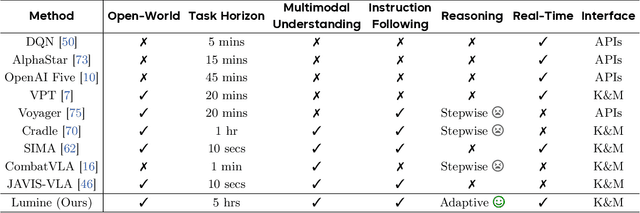
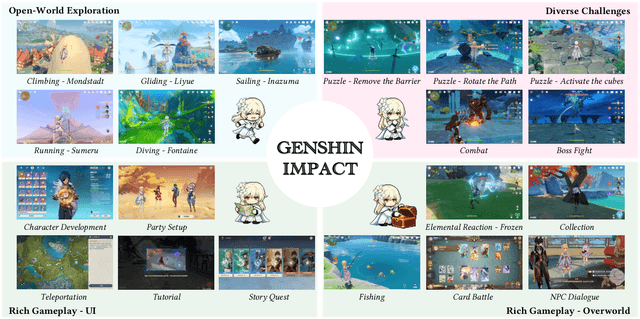
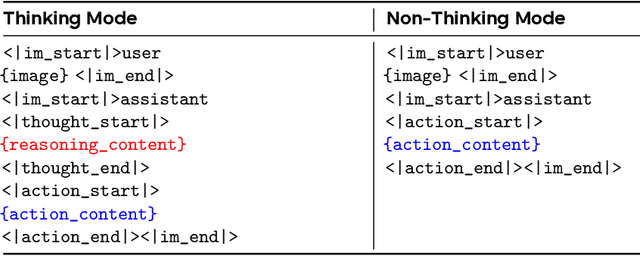
We introduce Lumine, the first open recipe for developing generalist agents capable of completing hours-long complex missions in real time within challenging 3D open-world environments. Lumine adopts a human-like interaction paradigm that unifies perception, reasoning, and action in an end-to-end manner, powered by a vision-language model. It processes raw pixels at 5 Hz to produce precise 30 Hz keyboard-mouse actions and adaptively invokes reasoning only when necessary. Trained in Genshin Impact, Lumine successfully completes the entire five-hour Mondstadt main storyline on par with human-level efficiency and follows natural language instructions to perform a broad spectrum of tasks in both 3D open-world exploration and 2D GUI manipulation across collection, combat, puzzle-solving, and NPC interaction. In addition to its in-domain performance, Lumine demonstrates strong zero-shot cross-game generalization. Without any fine-tuning, it accomplishes 100-minute missions in Wuthering Waves and the full five-hour first chapter of Honkai: Star Rail. These promising results highlight Lumine's effectiveness across distinct worlds and interaction dynamics, marking a concrete step toward generalist agents in open-ended environments.
Humanity's Last Code Exam: Can Advanced LLMs Conquer Human's Hardest Code Competition?
Jun 15, 2025Code generation is a core capability of large language models (LLMs), yet mainstream benchmarks (e.g., APPs and LiveCodeBench) contain questions with medium-level difficulty and pose no challenge to advanced LLMs. To better reflected the advanced reasoning and code generation ability, We introduce Humanity's Last Code Exam (HLCE), comprising 235 most challenging problems from the International Collegiate Programming Contest (ICPC World Finals) and the International Olympiad in Informatics (IOI) spanning 2010 - 2024. As part of HLCE, we design a harmonized online-offline sandbox that guarantees fully reproducible evaluation. Through our comprehensive evaluation, we observe that even the strongest reasoning LLMs: o4-mini(high) and Gemini-2.5 Pro, achieve pass@1 rates of only 15.9% and 11.4%, respectively. Meanwhile, we propose a novel "self-recognition" task to measure LLMs' awareness of their own capabilities. Results indicate that LLMs' self-recognition abilities are not proportionally correlated with their code generation performance. Finally, our empirical validation of test-time scaling laws reveals that current advanced LLMs have substantial room for improvement on complex programming tasks. We expect HLCE to become a milestone challenge for code generation and to catalyze advances in high-performance reasoning and human-AI collaborative programming. Our code and dataset are also public available(https://github.com/Humanity-s-Last-Code-Exam/HLCE).
CrossLinear: Plug-and-Play Cross-Correlation Embedding for Time Series Forecasting with Exogenous Variables
May 29, 2025Time series forecasting with exogenous variables is a critical emerging paradigm that presents unique challenges in modeling dependencies between variables. Traditional models often struggle to differentiate between endogenous and exogenous variables, leading to inefficiencies and overfitting. In this paper, we introduce CrossLinear, a novel Linear-based forecasting model that addresses these challenges by incorporating a plug-and-play cross-correlation embedding module. This lightweight module captures the dependencies between variables with minimal computational cost and seamlessly integrates into existing neural networks. Specifically, it captures time-invariant and direct variable dependencies while disregarding time-varying or indirect dependencies, thereby mitigating the risk of overfitting in dependency modeling and contributing to consistent performance improvements. Furthermore, CrossLinear employs patch-wise processing and a global linear head to effectively capture both short-term and long-term temporal dependencies, further improving its forecasting precision. Extensive experiments on 12 real-world datasets demonstrate that CrossLinear achieves superior performance in both short-term and long-term forecasting tasks. The ablation study underscores the effectiveness of the cross-correlation embedding module. Additionally, the generalizability of this module makes it a valuable plug-in for various forecasting tasks across different domains. Codes are available at https://github.com/mumiao2000/CrossLinear.
Process vs. Outcome Reward: Which is Better for Agentic RAG Reinforcement Learning
May 20, 2025Retrieval-augmented generation (RAG) enhances the text generation capabilities of large language models (LLMs) by integrating external knowledge and up-to-date information. However, traditional RAG systems are limited by static workflows and lack the adaptability required for multistep reasoning and complex task management. To address these limitations, agentic RAG systems (e.g., DeepResearch) have been proposed, enabling dynamic retrieval strategies, iterative context refinement, and adaptive workflows for handling complex search queries beyond the capabilities of conventional RAG. Recent advances, such as Search-R1, have demonstrated promising gains using outcome-based reinforcement learning, where the correctness of the final answer serves as the reward signal. Nevertheless, such outcome-supervised agentic RAG methods face challenges including low exploration efficiency, gradient conflict, and sparse reward signals. To overcome these challenges, we propose to utilize fine-grained, process-level rewards to improve training stability, reduce computational costs, and enhance efficiency. Specifically, we introduce a novel method ReasonRAG that automatically constructs RAG-ProGuide, a high-quality dataset providing process-level rewards for (i) query generation, (ii) evidence extraction, and (iii) answer generation, thereby enhancing model inherent capabilities via process-supervised reinforcement learning. With the process-level policy optimization, the proposed framework empowers LLMs to autonomously invoke search, generate queries, extract relevant evidence, and produce final answers. Compared to existing approaches such as Search-R1 and traditional RAG systems, ReasonRAG, leveraging RAG-ProGuide, achieves superior performance on five benchmark datasets using only 5k training instances, significantly fewer than the 90k training instances required by Search-R1.