 Add to Chrome
 Add to Firefox
 Add to Edge
HalluScope: Fine-grained Hallucination Diagnosis for Multimodal Large Language Models
Jul 23, 2026
Although Multimodal Large Language Models have achieved strong performance across a wide range of vision-language tasks, they still suffer from hallucinations, where model outputs become inconsistent with the visual content, textual context, or commonsense knowledge. Existing studies primarily address this problem through coarse-grained detection. However, these approaches often provide insufficient diagnostic information for understanding hallucination types and supporting downstream hallucination mitigation. To bridge this gap, we propose fine-grained hallucination diagnosis for MLLMs, a new unified task that jointly performs hallucination detection, classification, and interpretable explanation generation. We develop an automated data generation pipeline and construct HalluScope-30K, a large-scale diagnostic dataset covering eight sources and five task categories. Based on this dataset, we design a multi-granular joint reward function and train two diagnosis models, HalluScope-4B and HalluScope-8B, which achieve state-of-the-art performance on both the MHALO benchmark and our fine-grained hallucination classification benchmark. Notably, detection and classification are mutually beneficial under joint optimization. Furthermore, diagnosis-driven feedback experiments show that the fine-grained diagnostic explanations produced by our model effectively guide target models to correct their hallucinations, with full diagnosis substantially outperforming all baselines on both Qwen3-VL-8B-Instruct and LLaVA-1.5-7B.

StepFinder: A Temporal Semantic Framework for Failure Attribution in Multi-Agent Systems
Jun 02, 2026LLM-based multi-agent systems exhibit remarkable collaborative capabilities in complex multi-step tasks. However, these systems are highly sensitive to single-step execution errors that can propagate through agent interactions and lead to cascading failures. To understand the causes of failure and improve system reliability, failure attribution has been introduced as a task that aims to automatically identify the root cause step responsible for a failure. Existing failure attribution methods mainly rely on LLMs to reason over original execution trajectories, which not only incur high inference costs and latency, but also suffer from interference caused by redundant and noisy execution logs, causing LLMs to struggle in accurately identifying the true root cause step. To address this, we propose StepFinder, a lightweight failure attribution framework. We use LLMs solely during the feature construction phase to encode execution logs into temporal semantic sequences. Subsequently, a parameter-efficient combination of temporal modeling and attention modules is applied to capture the sequential evolution and cross-step dependencies of the trajectories. Finally, the step-level error score is refined through multi-scale differences and position bias, enabling precise root cause identification. Experimental results on the Who&When benchmark demonstrate that StepFinder outperforms LLM-based methods in step-level failure attribution while achieving substantially higher inference efficiency, reducing inference time by 79% compared with the fastest LLM-based method, with no text generation overhead. Our code is available at https://github.com/taiyu-zhu/StepFinder.
Quant.npu: Enabling Efficient Mobile NPU Inference for on-device LLMs via Fully Static Quantization
May 19, 2026Large language models (LLMs) are increasingly deployed on mobile devices, where Neural Processing Units (NPUs) necessitate fully static quantization for optimal inference efficiency. However, existing post-training quantization (PTQ) methods predominantly rely on dynamic activation quantization, rendering them incompatible with NPU hardware constraints. To bridge the gap between high-fidelity PTQ and NPU-constrained inference, we propose Quant.npu, a integer-only fully static quantization framework. It incorporates learnable quantization parameters and rotation matrices, enabling low-bit activation-weight quantization without runtime quantization parameters re-computation. Crucially, we identify that initialization and selective optimization of quantization parameters is pivotal for optimization stability, as improper initialization and naive joint optimization induce gradient instability that disrupts the optimization of rotation matrices. To address this, we propose a rotation-and-bit-width-aware initialization tailored to diverse activation profiles and a distribution-aware selective optimization (two-stage quantization pipeline) tailored to rotated and unrotated tensors. Furthermore, we introduce a sensitivity-guided adaptive mixed-precision scheme to balance accuracy with inference efficiency. Extensive experiments on real-world mobile NPUs demonstrate that Quant.npu achieves comparable accuracy to state-of-the-art methods, while reducing inference latency by up to 15.1%.
QCalEval: Benchmarking Vision-Language Models for Quantum Calibration Plot Understanding
Apr 28, 2026Quantum computing calibration depends on interpreting experimental data, and calibration plots provide the most universal human-readable representation for this task, yet no systematic evaluation exists of how well vision-language models (VLMs) interpret them. We introduce QCalEval, the first VLM benchmark for quantum calibration plots: 243 samples across 87 scenario types from 22 experiment families, spanning superconducting qubits and neutral atoms, evaluated on six question types in both zero-shot and in-context learning settings. The best general-purpose zero-shot model reaches a mean score of 72.3, and many open-weight models degrade under multi-image in-context learning, whereas frontier closed models improve substantially. A supervised fine-tuning ablation at the 9-billion-parameter scale shows that SFT improves zero-shot performance but cannot close the multimodal in-context learning gap. As a reference case study, we release NVIDIA Ising Calibration 1, an open-weight model based on Qwen3.5-35B-A3B that reaches 74.7 zero-shot average score.
Searth Transformer: A Transformer Architecture Incorporating Earth's Geospheric Physical Priors for Global Mid-Range Weather Forecasting
Jan 14, 2026Accurate global medium-range weather forecasting is fundamental to Earth system science. Most existing Transformer-based forecasting models adopt vision-centric architectures that neglect the Earth's spherical geometry and zonal periodicity. In addition, conventional autoregressive training is computationally expensive and limits forecast horizons due to error accumulation. To address these challenges, we propose the Shifted Earth Transformer (Searth Transformer), a physics-informed architecture that incorporates zonal periodicity and meridional boundaries into window-based self-attention for physically consistent global information exchange. We further introduce a Relay Autoregressive (RAR) fine-tuning strategy that enables learning long-range atmospheric evolution under constrained memory and computational budgets. Based on these methods, we develop YanTian, a global medium-range weather forecasting model. YanTian achieves higher accuracy than the high-resolution forecast of the European Centre for Medium-Range Weather Forecasts and performs competitively with state-of-the-art AI models at one-degree resolution, while requiring roughly 200 times lower computational cost than standard autoregressive fine-tuning. Furthermore, YanTian attains a longer skillful forecast lead time for Z500 (10.3 days) than HRES (9 days). Beyond weather forecasting, this work establishes a robust algorithmic foundation for predictive modeling of complex global-scale geophysical circulation systems, offering new pathways for Earth system science.
M3-BENCH: Process-Aware Evaluation of LLM Agents Social Behaviors in Mixed-Motive Games
Jan 13, 2026As the capabilities of large language model (LLM) agents continue to advance, their advanced social behaviors, such as cooperation, deception, and collusion, call for systematic evaluation. However, existing benchmarks often emphasize a single capability dimension or rely solely on behavioral outcomes, overlooking rich process information from agents' decision reasoning and communicative interactions. To address this gap, we propose M3-Bench, a multi-stage benchmark for mixed-motive games, together with a process-aware evaluation framework that conducts synergistic analysis across three modules: BTA (Behavioral Trajectory Analysis), RPA (Reasoning Process Analysis), and CCA (Communication Content Analysis). Furthermore, we integrate the Big Five personality model and Social Exchange Theory to aggregate multi-dimensional evidence into interpretable social behavior portraits, thereby characterizing agents' personality traits and capability profiles beyond simple task scores or outcome-based metrics. Experimental results show that M3-Bench can reliably distinguish diverse social behavior competencies across models, and it reveals that some models achieve seemingly reasonable behavioral outcomes while exhibiting pronounced inconsistencies in their reasoning and communication.
MDAgent2: Large Language Model for Code Generation and Knowledge Q&A in Molecular Dynamics
Jan 07, 2026Molecular dynamics (MD) simulations are essential for understanding atomic-scale behaviors in materials science, yet writing LAMMPS scripts remains highly specialized and time-consuming tasks. Although LLMs show promise in code generation and domain-specific question answering, their performance in MD scenarios is limited by scarce domain data, the high deployment cost of state-of-the-art LLMs, and low code executability. Building upon our prior MDAgent, we present MDAgent2, the first end-to-end framework capable of performing both knowledge Q&A and code generation within the MD domain. We construct a domain-specific data-construction pipeline that yields three high-quality datasets spanning MD knowledge, question answering, and code generation. Based on these datasets, we adopt a three stage post-training strategy--continued pre-training (CPT), supervised fine-tuning (SFT), and reinforcement learning (RL)--to train two domain-adapted models, MD-Instruct and MD-Code. Furthermore, we introduce MD-GRPO, a closed-loop RL method that leverages simulation outcomes as reward signals and recycles low-reward trajectories for continual refinement. We further build MDAgent2-RUNTIME, a deployable multi-agent system that integrates code generation, execution, evaluation, and self-correction. Together with MD-EvalBench proposed in this work, the first benchmark for LAMMPS code generation and question answering, our models and system achieve performance surpassing several strong baselines.This work systematically demonstrates the adaptability and generalization capability of large language models in industrial simulation tasks, laying a methodological foundation for automatic code generation in AI for Science and industrial-scale simulations. URL: https://github.com/FredericVAN/PKU_MDAgent2
IoDResearch: Deep Research on Private Heterogeneous Data via the Internet of Data
Oct 02, 2025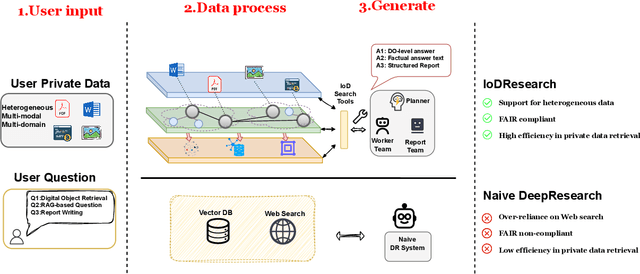
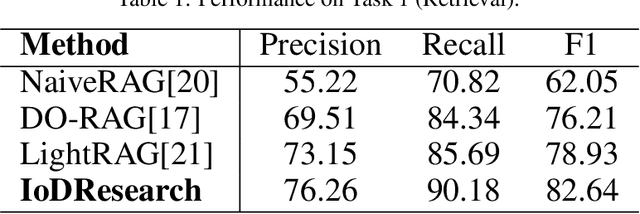
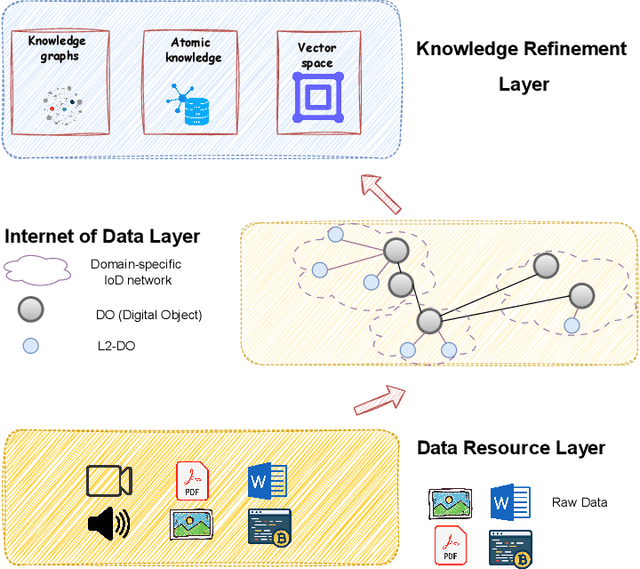
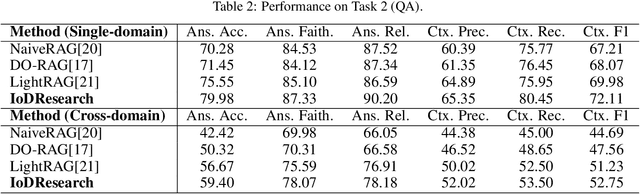
The rapid growth of multi-source, heterogeneous, and multimodal scientific data has increasingly exposed the limitations of traditional data management. Most existing DeepResearch (DR) efforts focus primarily on web search while overlooking local private data. Consequently, these frameworks exhibit low retrieval efficiency for private data and fail to comply with the FAIR principles, ultimately resulting in inefficiency and limited reusability. To this end, we propose IoDResearch (Internet of Data Research), a private data-centric Deep Research framework that operationalizes the Internet of Data paradigm. IoDResearch encapsulates heterogeneous resources as FAIR-compliant digital objects, and further refines them into atomic knowledge units and knowledge graphs, forming a heterogeneous graph index for multi-granularity retrieval. On top of this representation, a multi-agent system supports both reliable question answering and structured scientific report generation. Furthermore, we establish the IoD DeepResearch Benchmark to systematically evaluate both data representation and Deep Research capabilities in IoD scenarios. Experimental results on retrieval, QA, and report-writing tasks show that IoDResearch consistently surpasses representative RAG and Deep Research baselines. Overall, IoDResearch demonstrates the feasibility of private-data-centric Deep Research under the IoD paradigm, paving the way toward more trustworthy, reusable, and automated scientific discovery.
SplitGaussian: Reconstructing Dynamic Scenes via Visual Geometry Decomposition
Aug 06, 2025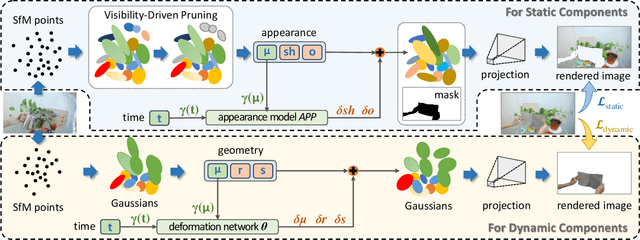
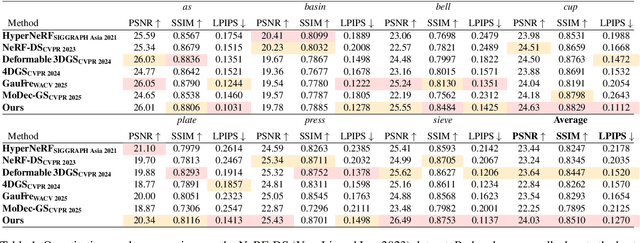
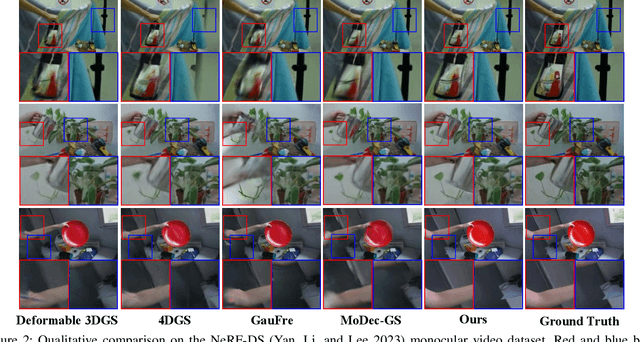
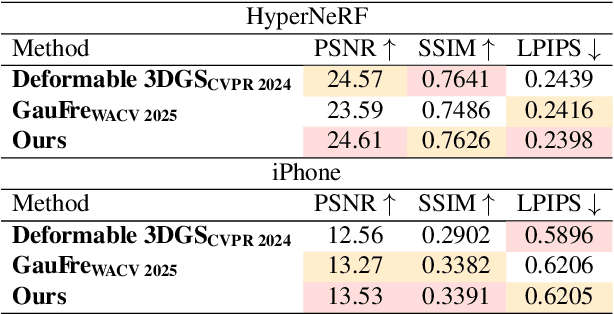
Reconstructing dynamic 3D scenes from monocular video remains fundamentally challenging due to the need to jointly infer motion, structure, and appearance from limited observations. Existing dynamic scene reconstruction methods based on Gaussian Splatting often entangle static and dynamic elements in a shared representation, leading to motion leakage, geometric distortions, and temporal flickering. We identify that the root cause lies in the coupled modeling of geometry and appearance across time, which hampers both stability and interpretability. To address this, we propose \textbf{SplitGaussian}, a novel framework that explicitly decomposes scene representations into static and dynamic components. By decoupling motion modeling from background geometry and allowing only the dynamic branch to deform over time, our method prevents motion artifacts in static regions while supporting view- and time-dependent appearance refinement. This disentangled design not only enhances temporal consistency and reconstruction fidelity but also accelerates convergence. Extensive experiments demonstrate that SplitGaussian outperforms prior state-of-the-art methods in rendering quality, geometric stability, and motion separation.
Doc-CoB: Enhancing Multi-Modal Document Understanding with Visual Chain-of-Boxes Reasoning
May 24, 2025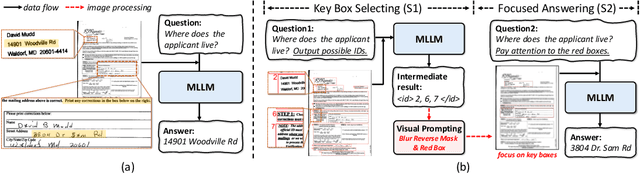
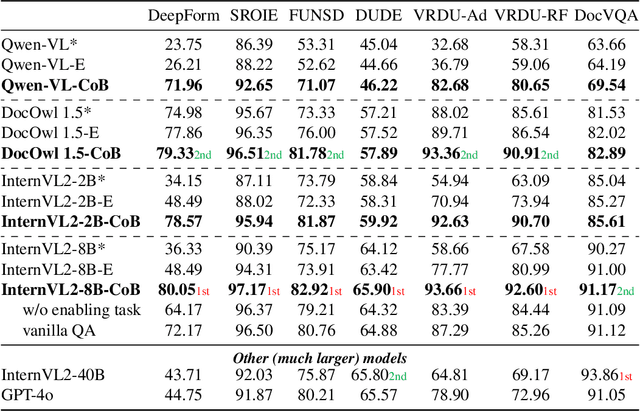
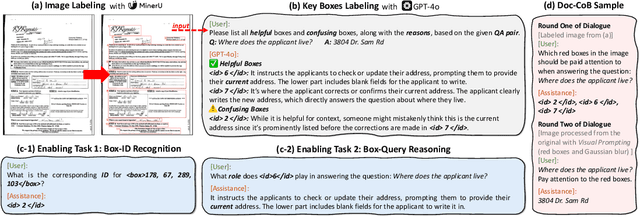

Multimodal large language models (MLLMs) have made significant progress in document understanding. However, the information-dense nature of document images still poses challenges, as most queries depend on only a few relevant regions, with the rest being redundant. Existing one-pass MLLMs process entire document images without considering query relevance, often failing to focus on critical regions and producing unfaithful responses. Inspired by the human coarse-to-fine reading pattern, we introduce Doc-CoB (Chain-of-Box), a simple-yet-effective mechanism that integrates human-style visual reasoning into MLLM without modifying its architecture. Our method allows the model to autonomously select the set of regions (boxes) most relevant to the query, and then focus attention on them for further understanding. We first design a fully automatic pipeline, integrating a commercial MLLM with a layout analyzer, to generate 249k training samples with intermediate visual reasoning supervision. Then we incorporate two enabling tasks that improve box identification and box-query reasoning, which together enhance document understanding. Extensive experiments on seven benchmarks with four popular models show that Doc-CoB significantly improves performance, demonstrating its effectiveness and wide applicability. All code, data, and models will be released publicly.