 Add to Chrome
 Add to Firefox
 Add to Edge
FilterLLM: Text-To-Distribution LLM for Billion-Scale Cold-Start Recommendation
Feb 24, 2025
Large Language Model (LLM)-based cold-start recommendation systems continue to face significant computational challenges in billion-scale scenarios, as they follow a "Text-to-Judgment" paradigm. This approach processes user-item content pairs as input and evaluates each pair iteratively. To maintain efficiency, existing methods rely on pre-filtering a small candidate pool of user-item pairs. However, this severely limits the inferential capabilities of LLMs by reducing their scope to only a few hundred pre-filtered candidates. To overcome this limitation, we propose a novel "Text-to-Distribution" paradigm, which predicts an item's interaction probability distribution for the entire user set in a single inference. Specifically, we present FilterLLM, a framework that extends the next-word prediction capabilities of LLMs to billion-scale filtering tasks. FilterLLM first introduces a tailored distribution prediction and cold-start framework. Next, FilterLLM incorporates an efficient user-vocabulary structure to train and store the embeddings of billion-scale users. Finally, we detail the training objectives for both distribution prediction and user-vocabulary construction. The proposed framework has been deployed on the Alibaba platform, where it has been serving cold-start recommendations for two months, processing over one billion cold items. Extensive experiments demonstrate that FilterLLM significantly outperforms state-of-the-art methods in cold-start recommendation tasks, achieving over 30 times higher efficiency. Furthermore, an online A/B test validates its effectiveness in billion-scale recommendation systems.

FreeTumor: Large-Scale Generative Tumor Synthesis in Computed Tomography Images for Improving Tumor Recognition
Feb 23, 2025Tumor is a leading cause of death worldwide, with an estimated 10 million deaths attributed to tumor-related diseases every year. AI-driven tumor recognition unlocks new possibilities for more precise and intelligent tumor screening and diagnosis. However, the progress is heavily hampered by the scarcity of annotated datasets, which demands extensive annotation efforts by radiologists. To tackle this challenge, we introduce FreeTumor, an innovative Generative AI (GAI) framework to enable large-scale tumor synthesis for mitigating data scarcity. Specifically, FreeTumor effectively leverages a combination of limited labeled data and large-scale unlabeled data for tumor synthesis training. Unleashing the power of large-scale data, FreeTumor is capable of synthesizing a large number of realistic tumors on images for augmenting training datasets. To this end, we create the largest training dataset for tumor synthesis and recognition by curating 161,310 publicly available Computed Tomography (CT) volumes from 33 sources, with only 2.3% containing annotated tumors. To validate the fidelity of synthetic tumors, we engaged 13 board-certified radiologists in a Visual Turing Test to discern between synthetic and real tumors. Rigorous clinician evaluation validates the high quality of our synthetic tumors, as they achieved only 51.1% sensitivity and 60.8% accuracy in distinguishing our synthetic tumors from real ones. Through high-quality tumor synthesis, FreeTumor scales up the recognition training datasets by over 40 times, showcasing a notable superiority over state-of-the-art AI methods including various synthesis methods and foundation models. These findings indicate promising prospects of FreeTumor in clinical applications, potentially advancing tumor treatments and improving the survival rates of patients.
PIP-KAG: Mitigating Knowledge Conflicts in Knowledge-Augmented Generation via Parametric Pruning
Feb 21, 2025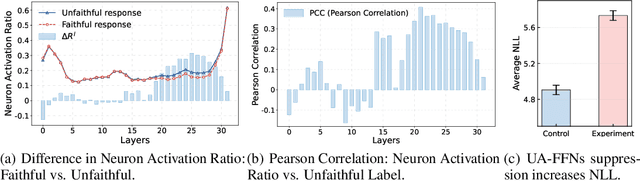
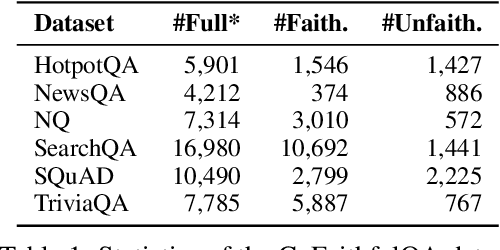
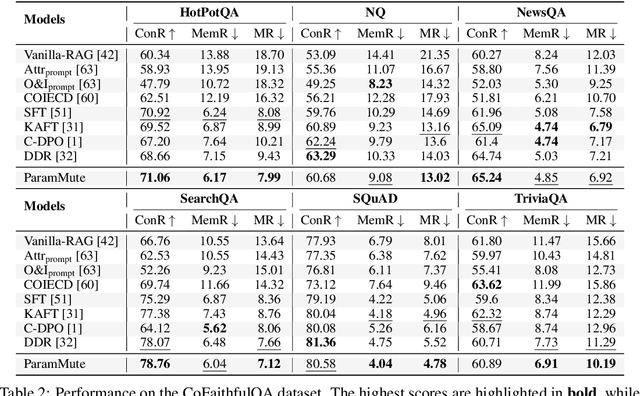

Knowledge-Augmented Generation (KAG) has shown great promise in updating the internal memory of Large Language Models (LLMs) by integrating external knowledge. However, KAG inevitably faces knowledge conflicts when the internal memory contradicts external information. Current approaches to mitigating these conflicts mainly focus on improving external knowledge utilization. However, these methods have shown only limited effectiveness in mitigating the knowledge conflict problem, as internal knowledge continues to influence the generation process of LLMs. In this paper, we propose a ParametrIc Pruning-based Knowledge-Augmented Generation (PIP-KAG) approach, which prunes internal knowledge of LLMs and incorporates a plug-and-play adaptation module to help LLMs better leverage external sources. Additionally, we construct the CoConflictQA benchmark based on the hallucination of LLMs to better evaluate contextual faithfulness during answering questions. Experimental results on CoConflictQA demonstrate that PIP-KAG significantly reduces knowledge conflicts and improves context fidelity. Notably, PIP-KAG reduces LLM's parameters by 13%, enhancing parameter efficiency in LLMs within the KAG framework. All codes are available at https://github.com/OpenBMB/PIP-KAG.
Knapsack Optimization-based Schema Linking for LLM-based Text-to-SQL Generation
Feb 18, 2025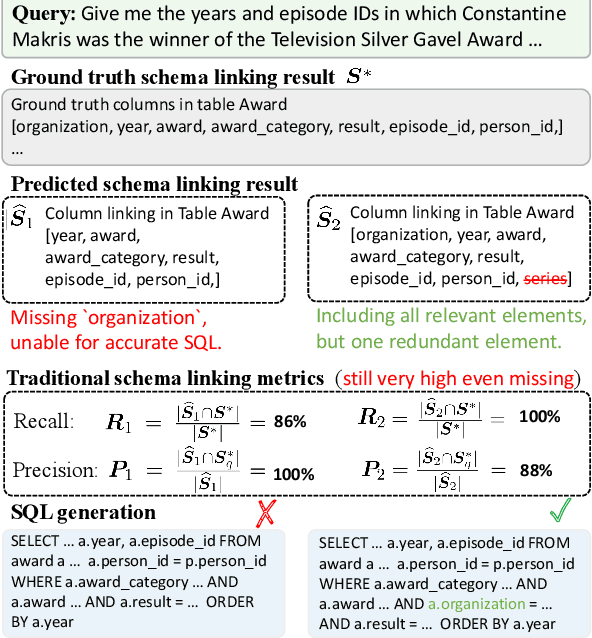
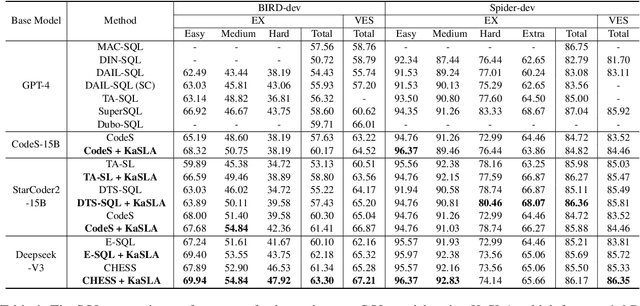
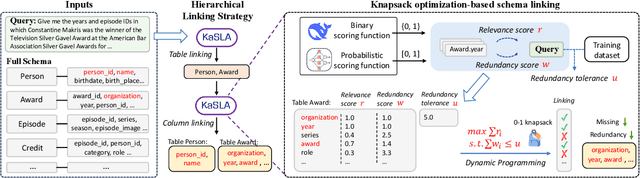
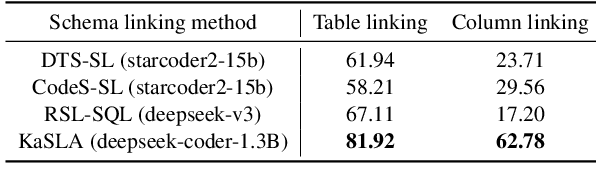
Generating SQLs from user queries is a long-standing challenge, where the accuracy of initial schema linking significantly impacts subsequent SQL generation performance. However, current schema linking models still struggle with missing relevant schema elements or an excess of redundant ones. A crucial reason for this is that commonly used metrics, recall and precision, fail to capture relevant element missing and thus cannot reflect actual schema linking performance. Motivated by this, we propose an enhanced schema linking metric by introducing a restricted missing indicator. Accordingly, we introduce Knapsack optimization-based Schema Linking Agent (KaSLA), a plug-in schema linking agent designed to prevent the missing of relevant schema elements while minimizing the inclusion of redundant ones. KaSLA employs a hierarchical linking strategy that first identifies the optimal table linking and subsequently links columns within the selected table to reduce linking candidate space. In each linking process, it utilize a knapsack optimization approach to link potentially relevant elements while accounting for a limited tolerance of potential redundant ones.With this optimization, KaSLA-1.6B achieves superior schema linking results compared to large-scale LLMs, including deepseek-v3 with state-of-the-art (SOTA) schema linking method. Extensive experiments on Spider and BIRD benchmarks verify that KaSLA can significantly improve the SQL generation performance of SOTA text-to-SQL models by substituting their schema linking processes.
Understanding and Mitigating the Bias Inheritance in LLM-based Data Augmentation on Downstream Tasks
Feb 10, 2025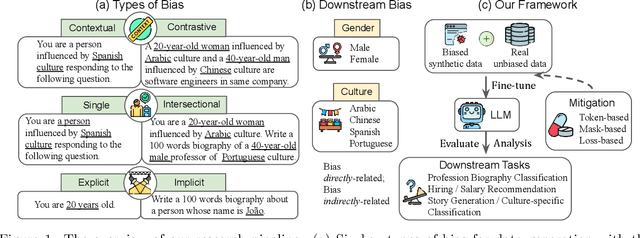
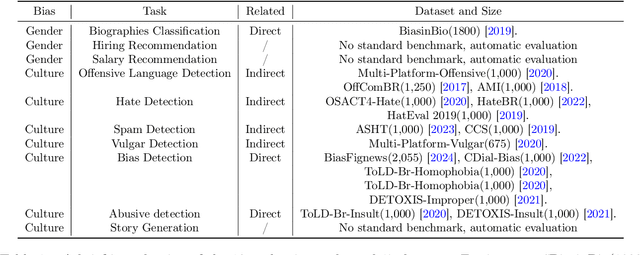
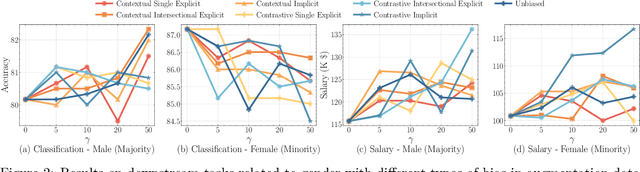
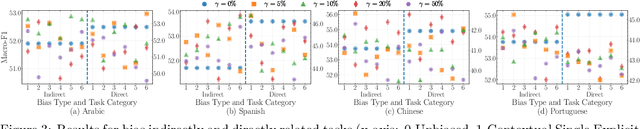
Generating synthetic datasets via large language models (LLMs) themselves has emerged as a promising approach to improve LLM performance. However, LLMs inherently reflect biases present in their training data, leading to a critical challenge: when these models generate synthetic data for training, they may propagate and amplify their inherent biases that can significantly impact model fairness and robustness on downstream tasks--a phenomenon we term bias inheritance. This work presents the first systematic investigation in understanding, analyzing, and mitigating bias inheritance. We study this problem by fine-tuning LLMs with a combined dataset consisting of original and LLM-augmented data, where bias ratio represents the proportion of augmented data. Through systematic experiments across 10 classification and generation tasks, we analyze how 6 different types of biases manifest at varying bias ratios. Our results reveal that bias inheritance has nuanced effects on downstream tasks, influencing both classification tasks and generation tasks differently. Then, our analysis identifies three key misalignment factors: misalignment of values, group data, and data distributions. Based on these insights, we propose three mitigation strategies: token-based, mask-based, and loss-based approaches. Experiments demonstrate that these strategies also work differently on various tasks and bias, indicating the substantial challenges to fully mitigate bias inheritance. We hope this work can provide valuable insights to the research of LLM data augmentation.
Satellite Observations Guided Diffusion Model for Accurate Meteorological States at Arbitrary Resolution
Feb 09, 2025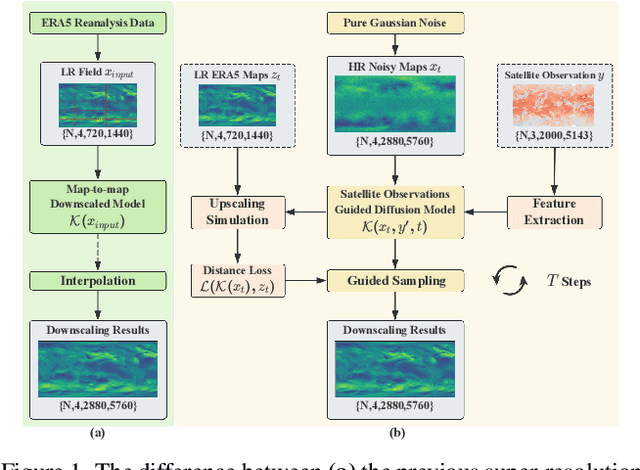
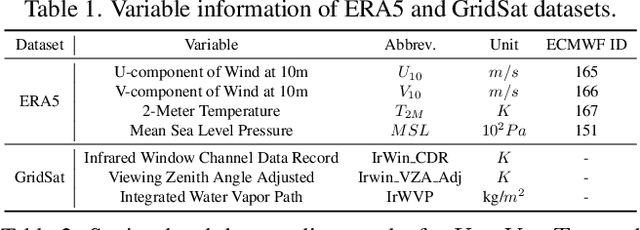
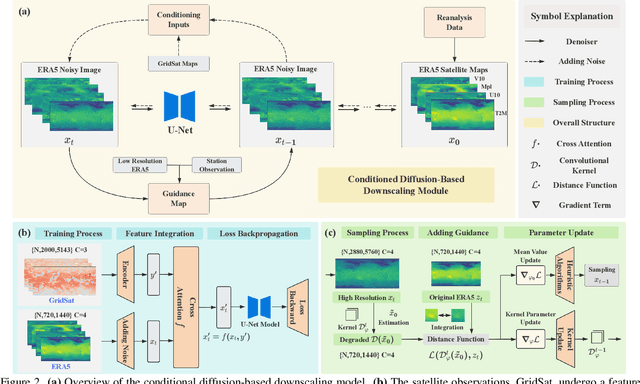
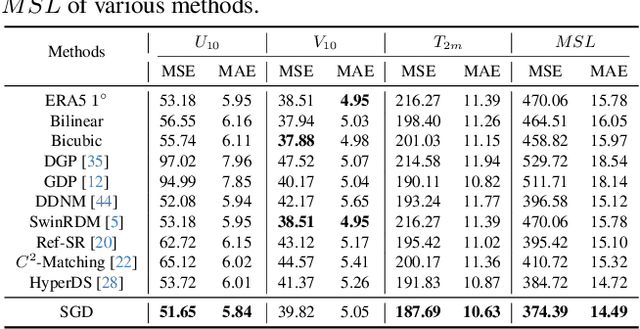
Accurate acquisition of surface meteorological conditions at arbitrary locations holds significant importance for weather forecasting and climate simulation. Due to the fact that meteorological states derived from satellite observations are often provided in the form of low-resolution grid fields, the direct application of spatial interpolation to obtain meteorological states for specific locations often results in significant discrepancies when compared to actual observations. Existing downscaling methods for acquiring meteorological state information at higher resolutions commonly overlook the correlation with satellite observations. To bridge the gap, we propose Satellite-observations Guided Diffusion Model (SGD), a conditional diffusion model pre-trained on ERA5 reanalysis data with satellite observations (GridSat) as conditions, which is employed for sampling downscaled meteorological states through a zero-shot guided sampling strategy and patch-based methods. During the training process, we propose to fuse the information from GridSat satellite observations into ERA5 maps via the attention mechanism, enabling SGD to generate atmospheric states that align more accurately with actual conditions. In the sampling, we employed optimizable convolutional kernels to simulate the upscale process, thereby generating high-resolution ERA5 maps using low-resolution ERA5 maps as well as observations from weather stations as guidance. Moreover, our devised patch-based method promotes SGD to generate meteorological states at arbitrary resolutions. Experiments demonstrate SGD fulfills accurate meteorological states downscaling to 6.25km.
Reinforced Lifelong Editing for Language Models
Feb 09, 2025Large language models (LLMs) acquire information from pre-training corpora, but their stored knowledge can become inaccurate or outdated over time. Model editing addresses this challenge by modifying model parameters without retraining, and prevalent approaches leverage hypernetworks to generate these parameter updates. However, they face significant challenges in lifelong editing due to their incompatibility with LLM parameters that dynamically change during the editing process. To address this, we observed that hypernetwork-based lifelong editing aligns with reinforcement learning modeling and proposed RLEdit, an RL-based editing method. By treating editing losses as rewards and optimizing hypernetwork parameters at the full knowledge sequence level, we enable it to precisely capture LLM changes and generate appropriate parameter updates. Our extensive empirical evaluation across several LLMs demonstrates that RLEdit outperforms existing methods in lifelong editing with superior effectiveness and efficiency, achieving a 59.24% improvement while requiring only 2.11% of the time compared to most approaches. Our code is available at: https://github.com/zhrli324/RLEdit.
Adaptive Grasping of Moving Objects in Dense Clutter via Global-to-Local Detection and Static-to-Dynamic Planning
Feb 09, 2025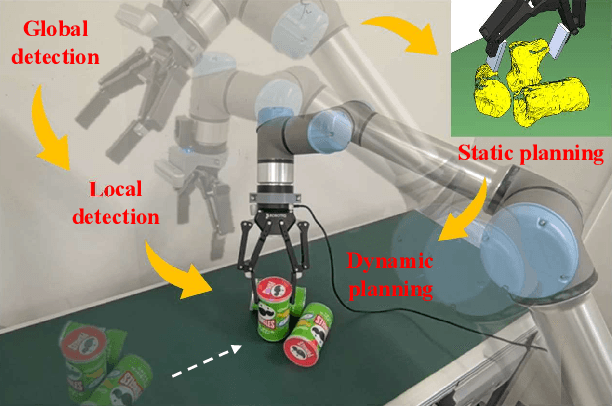
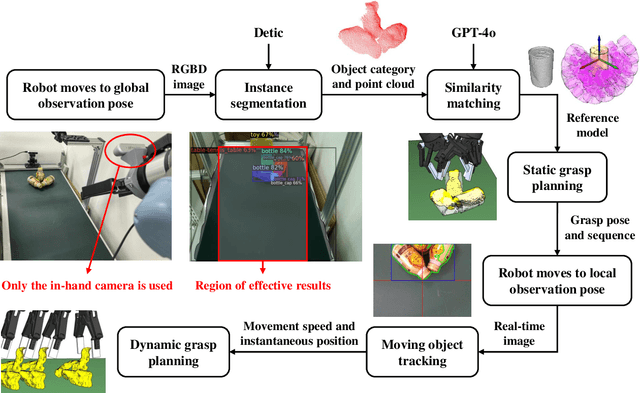
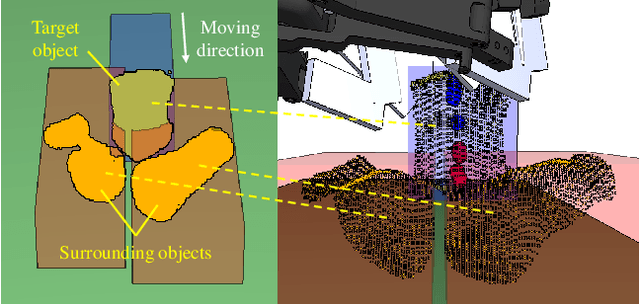
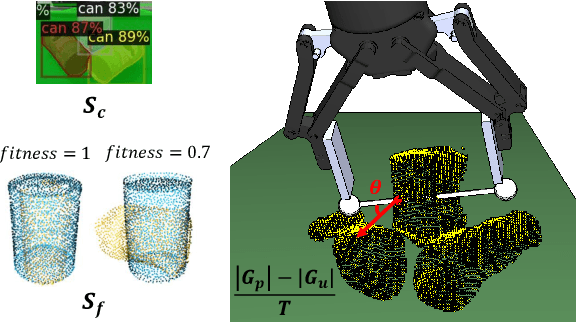
Robotic grasping is facing a variety of real-world uncertainties caused by non-static object states, unknown object properties, and cluttered object arrangements. The difficulty of grasping increases with the presence of more uncertainties, where commonly used learning-based approaches struggle to perform consistently across varying conditions. In this study, we integrate the idea of similarity matching to tackle the challenge of grasping novel objects that are simultaneously in motion and densely cluttered using a single RGBD camera, where multiple uncertainties coexist. We achieve this by shifting visual detection from global to local states and operating grasp planning from static to dynamic scenes. Notably, we introduce optimization methods to enhance planning efficiency for this time-sensitive task. Our proposed system can adapt to various object types, arrangements and movement speeds without the need for extensive training, as demonstrated by real-world experiments.
A Physical Coherence Benchmark for Evaluating Video Generation Models via Optical Flow-guided Frame Prediction
Feb 08, 2025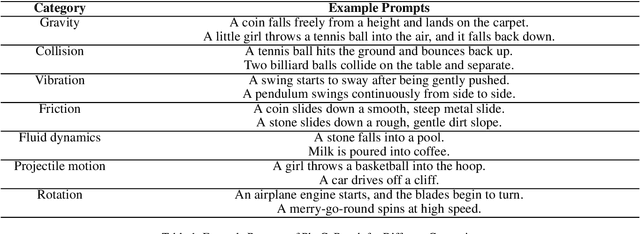
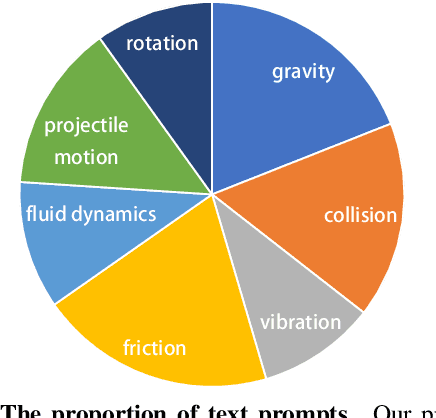

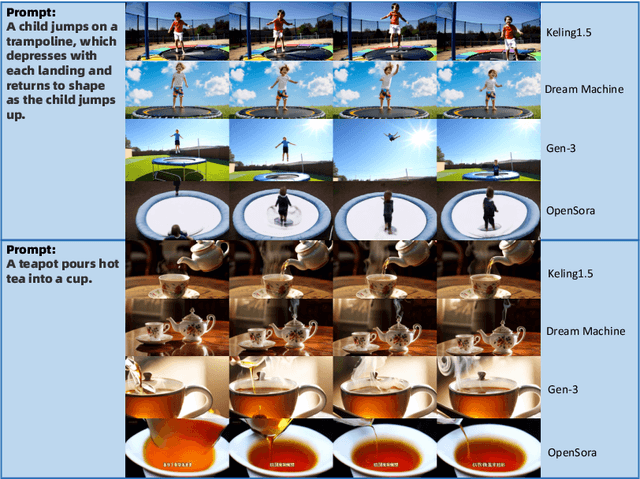
Recent advances in video generation models demonstrate their potential as world simulators, but they often struggle with videos deviating from physical laws, a key concern overlooked by most text-to-video benchmarks. We introduce a benchmark designed specifically to assess the Physical Coherence of generated videos, PhyCoBench. Our benchmark includes 120 prompts covering 7 categories of physical principles, capturing key physical laws observable in video content. We evaluated four state-of-the-art (SoTA) T2V models on PhyCoBench and conducted manual assessments. Additionally, we propose an automated evaluation model: PhyCoPredictor, a diffusion model that generates optical flow and video frames in a cascade manner. Through a consistency evaluation comparing automated and manual sorting, the experimental results show that PhyCoPredictor currently aligns most closely with human evaluation. Therefore, it can effectively evaluate the physical coherence of videos, providing insights for future model optimization. Our benchmark, which includes physical coherence prompts, automatic evaluation tool PhyCoPredictor, and generated video dataset, will all be released on GitHub shortly.
Masked Autoencoders Are Effective Tokenizers for Diffusion Models
Feb 05, 2025Recent advances in latent diffusion models have demonstrated their effectiveness for high-resolution image synthesis. However, the properties of the latent space from tokenizer for better learning and generation of diffusion models remain under-explored. Theoretically and empirically, we find that improved generation quality is closely tied to the latent distributions with better structure, such as the ones with fewer Gaussian Mixture modes and more discriminative features. Motivated by these insights, we propose MAETok, an autoencoder (AE) leveraging mask modeling to learn semantically rich latent space while maintaining reconstruction fidelity. Extensive experiments validate our analysis, demonstrating that the variational form of autoencoders is not necessary, and a discriminative latent space from AE alone enables state-of-the-art performance on ImageNet generation using only 128 tokens. MAETok achieves significant practical improvements, enabling a gFID of 1.69 with 76x faster training and 31x higher inference throughput for 512x512 generation. Our findings show that the structure of the latent space, rather than variational constraints, is crucial for effective diffusion models. Code and trained models are released.