 Add to Chrome
 Add to Firefox
 Add to Edge
Logics-Parsing-Omni Technical Report
Mar 12, 2026
Addressing the challenges of fragmented task definitions and the heterogeneity of unstructured data in multimodal parsing, this paper proposes the Omni Parsing framework. This framework establishes a Unified Taxonomy covering documents, images, and audio-visual streams, introducing a progressive parsing paradigm that bridges perception and cognition. Specifically, the framework integrates three hierarchical levels: 1) Holistic Detection, which achieves precise spatial-temporal grounding of objects or events to establish a geometric baseline for perception; 2) Fine-grained Recognition, which performs symbolization (e.g., OCR/ASR) and attribute extraction on localized objects to complete structured entity parsing; and 3) Multi-level Interpreting, which constructs a reasoning chain from local semantics to global logic. A pivotal advantage of this framework is its evidence anchoring mechanism, which enforces a strict alignment between high-level semantic descriptions and low-level facts. This enables ``evidence-based'' logical induction, transforming unstructured signals into standardized knowledge that is locatable, enumerable, and traceable. Building on this foundation, we constructed a standardized dataset and released the Logics-Parsing-Omni model, which successfully converts complex audio-visual signals into machine-readable structured knowledge. Experiments demonstrate that fine-grained perception and high-level cognition are synergistic, effectively enhancing model reliability. Furthermore, to quantitatively evaluate these capabilities, we introduce OmniParsingBench. Code, models and the benchmark are released at https://github.com/alibaba/Logics-Parsing/tree/master/Logics-Parsing-Omni.

A Physical Coherence Benchmark for Evaluating Video Generation Models via Optical Flow-guided Frame Prediction
Feb 08, 2025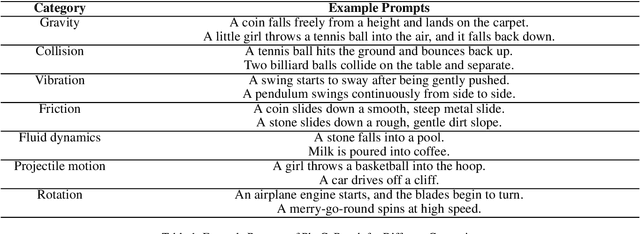
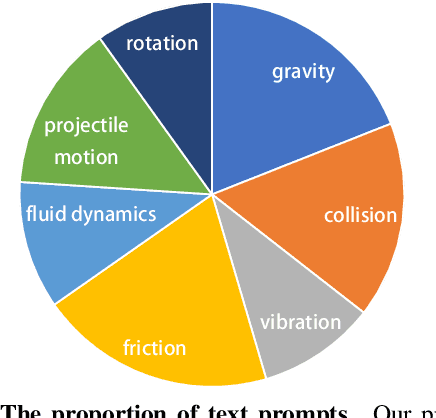

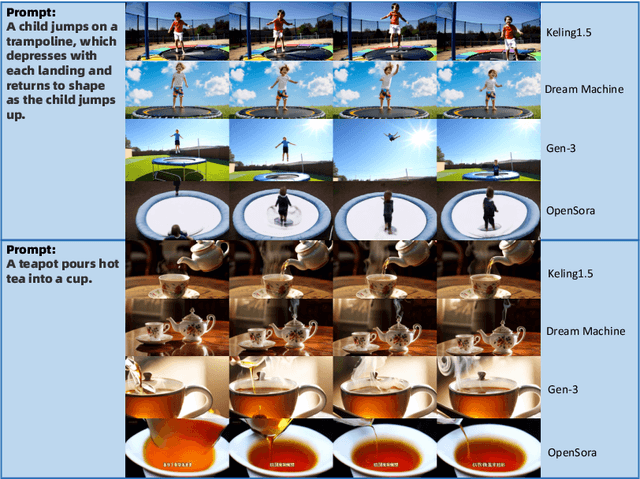
Recent advances in video generation models demonstrate their potential as world simulators, but they often struggle with videos deviating from physical laws, a key concern overlooked by most text-to-video benchmarks. We introduce a benchmark designed specifically to assess the Physical Coherence of generated videos, PhyCoBench. Our benchmark includes 120 prompts covering 7 categories of physical principles, capturing key physical laws observable in video content. We evaluated four state-of-the-art (SoTA) T2V models on PhyCoBench and conducted manual assessments. Additionally, we propose an automated evaluation model: PhyCoPredictor, a diffusion model that generates optical flow and video frames in a cascade manner. Through a consistency evaluation comparing automated and manual sorting, the experimental results show that PhyCoPredictor currently aligns most closely with human evaluation. Therefore, it can effectively evaluate the physical coherence of videos, providing insights for future model optimization. Our benchmark, which includes physical coherence prompts, automatic evaluation tool PhyCoPredictor, and generated video dataset, will all be released on GitHub shortly.
3D Human Reconstruction in the Wild with Synthetic Data Using Generative Models
Mar 17, 2024In this work, we show that synthetic data created by generative models is complementary to computer graphics (CG) rendered data for achieving remarkable generalization performance on diverse real-world scenes for 3D human pose and shape estimation (HPS). Specifically, we propose an effective approach based on recent diffusion models, termed HumanWild, which can effortlessly generate human images and corresponding 3D mesh annotations. We first collect a large-scale human-centric dataset with comprehensive annotations, e.g., text captions and surface normal images. Then, we train a customized ControlNet model upon this dataset to generate diverse human images and initial ground-truth labels. At the core of this step is that we can easily obtain numerous surface normal images from a 3D human parametric model, e.g., SMPL-X, by rendering the 3D mesh onto the image plane. As there exists inevitable noise in the initial labels, we then apply an off-the-shelf foundation segmentation model, i.e., SAM, to filter negative data samples. Our data generation pipeline is flexible and customizable to facilitate different real-world tasks, e.g., ego-centric scenes and perspective-distortion scenes. The generated dataset comprises 0.79M images with corresponding 3D annotations, covering versatile viewpoints, scenes, and human identities. We train various HPS regressors on top of the generated data and evaluate them on a wide range of benchmarks (3DPW, RICH, EgoBody, AGORA, SSP-3D) to verify the effectiveness of the generated data. By exclusively employing generative models, we generate large-scale in-the-wild human images and high-quality annotations, eliminating the need for real-world data collection.