 Add to Chrome
 Add to Firefox
 Add to Edge
StructRAG: Boosting Knowledge Intensive Reasoning of LLMs via Inference-time Hybrid Information Structurization
Oct 11, 2024

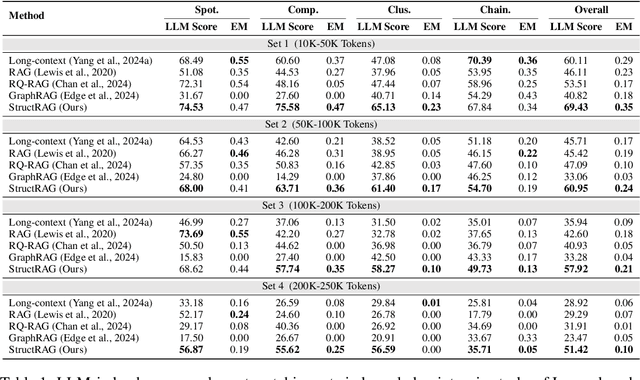


Retrieval-augmented generation (RAG) is a key means to effectively enhance large language models (LLMs) in many knowledge-based tasks. However, existing RAG methods struggle with knowledge-intensive reasoning tasks, because useful information required to these tasks are badly scattered. This characteristic makes it difficult for existing RAG methods to accurately identify key information and perform global reasoning with such noisy augmentation. In this paper, motivated by the cognitive theories that humans convert raw information into various structured knowledge when tackling knowledge-intensive reasoning, we proposes a new framework, StructRAG, which can identify the optimal structure type for the task at hand, reconstruct original documents into this structured format, and infer answers based on the resulting structure. Extensive experiments across various knowledge-intensive tasks show that StructRAG achieves state-of-the-art performance, particularly excelling in challenging scenarios, demonstrating its potential as an effective solution for enhancing LLMs in complex real-world applications.

Benchmarking Agentic Workflow Generation
Oct 10, 2024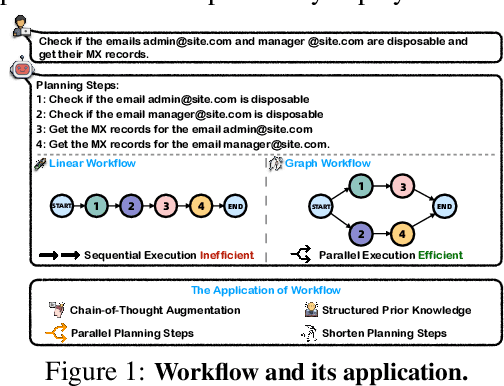

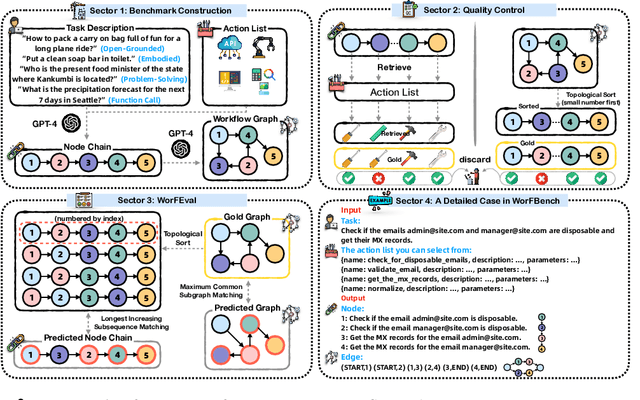

Large Language Models (LLMs), with their exceptional ability to handle a wide range of tasks, have driven significant advancements in tackling reasoning and planning tasks, wherein decomposing complex problems into executable workflows is a crucial step in this process. Existing workflow evaluation frameworks either focus solely on holistic performance or suffer from limitations such as restricted scenario coverage, simplistic workflow structures, and lax evaluation standards. To this end, we introduce WorFBench, a unified workflow generation benchmark with multi-faceted scenarios and intricate graph workflow structures. Additionally, we present WorFEval, a systemic evaluation protocol utilizing subsequence and subgraph matching algorithms to accurately quantify the LLM agent's workflow generation capabilities. Through comprehensive evaluations across different types of LLMs, we discover distinct gaps between the sequence planning capabilities and graph planning capabilities of LLM agents, with even GPT-4 exhibiting a gap of around 15%. We also train two open-source models and evaluate their generalization abilities on held-out tasks. Furthermore, we observe that the generated workflows can enhance downstream tasks, enabling them to achieve superior performance with less time during inference. Code and dataset will be available at https://github.com/zjunlp/WorFBench.
A Simple yet Effective Training-free Prompt-free Approach to Chinese Spelling Correction Based on Large Language Models
Oct 05, 2024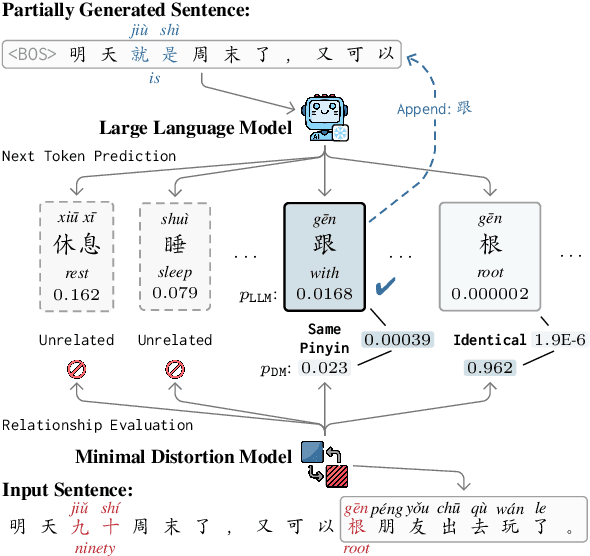

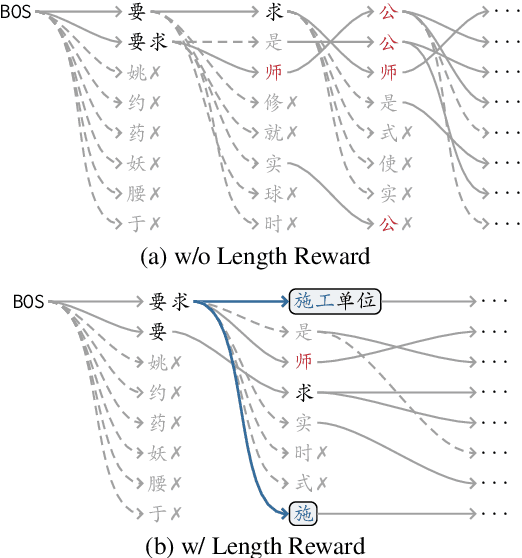

This work proposes a simple training-free prompt-free approach to leverage large language models (LLMs) for the Chinese spelling correction (CSC) task, which is totally different from all previous CSC approaches. The key idea is to use an LLM as a pure language model in a conventional manner. The LLM goes through the input sentence from the beginning, and at each inference step, produces a distribution over its vocabulary for deciding the next token, given a partial sentence. To ensure that the output sentence remains faithful to the input sentence, we design a minimal distortion model that utilizes pronunciation or shape similarities between the original and replaced characters. Furthermore, we propose two useful reward strategies to address practical challenges specific to the CSC task. Experiments on five public datasets demonstrate that our approach significantly improves LLM performance, enabling them to compete with state-of-the-art domain-general CSC models.
In-Context Transfer Learning: Demonstration Synthesis by Transferring Similar Tasks
Oct 02, 2024


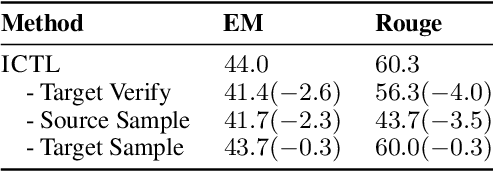
In-context learning (ICL) is an effective approach to help large language models (LLMs) adapt to various tasks by providing demonstrations of the target task. Considering the high cost of labeling demonstrations, many methods propose synthesizing demonstrations from scratch using LLMs. However, the quality of the demonstrations synthesized from scratch is limited by the capabilities and knowledge of LLMs. To address this, inspired by transfer learning, we propose In-Context Transfer Learning (ICTL), which synthesizes target task demonstrations by transferring labeled demonstrations from similar source tasks. ICTL consists of two steps: source sampling and target transfer. First, we define an optimization objective, which minimizes transfer error to sample source demonstrations similar to the target task. Then, we employ LLMs to transfer the sampled source demonstrations to the target task, matching the definition and format of the target task. Experiments on Super-NI show that ICTL outperforms synthesis from scratch by 2.0% on average, demonstrating the effectiveness of our method.
Codev-Bench: How Do LLMs Understand Developer-Centric Code Completion?
Oct 02, 2024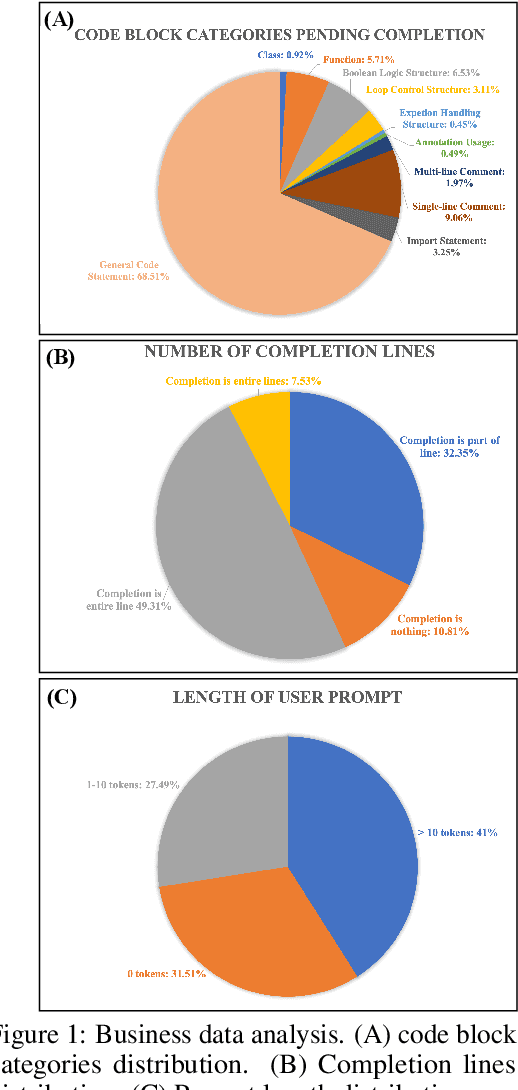


Code completion, a key downstream task in code generation, is one of the most frequent and impactful methods for enhancing developer productivity in software development. As intelligent completion tools evolve, we need a robust evaluation benchmark that enables meaningful comparisons between products and guides future advancements. However, existing benchmarks focus more on coarse-grained tasks without industrial analysis resembling general code generation rather than the real-world scenarios developers encounter. Moreover, these benchmarks often rely on costly and time-consuming human annotation, and the standalone test cases fail to leverage minimal tests for maximum repository-level understanding and code coverage. To address these limitations, we first analyze business data from an industrial code completion tool and redefine the evaluation criteria to better align with the developer's intent and desired completion behavior throughout the coding process. Based on these insights, we introduce Codev-Agent, an agent-based system that automates repository crawling, constructs execution environments, extracts dynamic calling chains from existing unit tests, and generates new test samples to avoid data leakage, ensuring fair and effective comparisons. Using Codev-Agent, we present the Code-Development Benchmark (Codev-Bench), a fine-grained, real-world, repository-level, and developer-centric evaluation framework. Codev-Bench assesses whether a code completion tool can capture a developer's immediate intent and suggest appropriate code across diverse contexts, providing a more realistic benchmark for code completion in modern software development.
The Imperative of Conversation Analysis in the Era of LLMs: A Survey of Tasks, Techniques, and Trends
Sep 21, 2024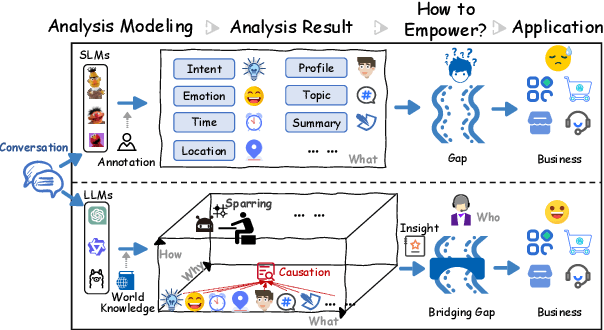
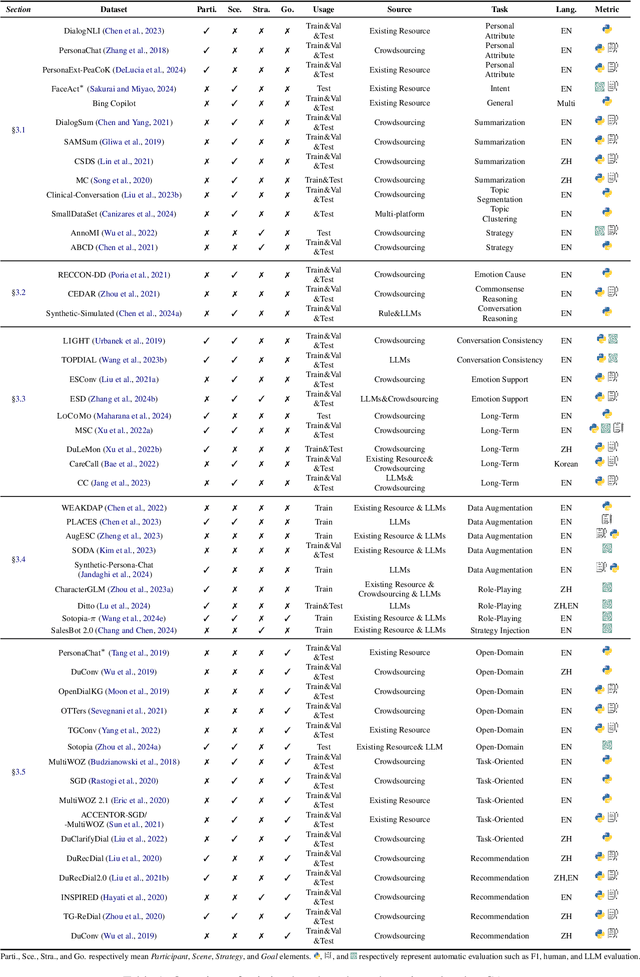


In the era of large language models (LLMs), a vast amount of conversation logs will be accumulated thanks to the rapid development trend of language UI. Conversation Analysis (CA) strives to uncover and analyze critical information from conversation data, streamlining manual processes and supporting business insights and decision-making. The need for CA to extract actionable insights and drive empowerment is becoming increasingly prominent and attracting widespread attention. However, the lack of a clear scope for CA leads to a dispersion of various techniques, making it difficult to form a systematic technical synergy to empower business applications. In this paper, we perform a thorough review and systematize CA task to summarize the existing related work. Specifically, we formally define CA task to confront the fragmented and chaotic landscape in this field, and derive four key steps of CA from conversation scene reconstruction, to in-depth attribution analysis, and then to performing targeted training, finally generating conversations based on the targeted training for achieving the specific goals. In addition, we showcase the relevant benchmarks, discuss potential challenges and point out future directions in both industry and academia. In view of current advancements, it is evident that the majority of efforts are still concentrated on the analysis of shallow conversation elements, which presents a considerable gap between the research and business, and with the assist of LLMs, recent work has shown a trend towards research on causality and strategic tasks which are sophisticated and high-level. The analyzed experiences and insights will inevitably have broader application value in business operations that target conversation logs.
Qwen2.5-Coder Technical Report
Sep 18, 2024


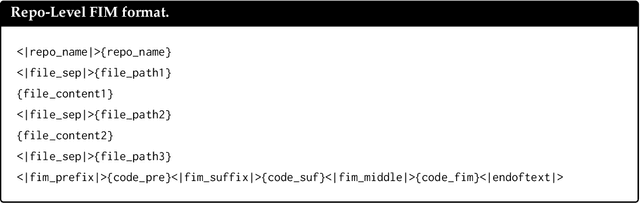
In this report, we introduce the Qwen2.5-Coder series, a significant upgrade from its predecessor, CodeQwen1.5. This series includes two models: Qwen2.5-Coder-1.5B and Qwen2.5-Coder-7B. As a code-specific model, Qwen2.5-Coder is built upon the Qwen2.5 architecture and continues pretrained on a vast corpus of over 5.5 trillion tokens. Through meticulous data cleaning, scalable synthetic data generation, and balanced data mixing, Qwen2.5-Coder demonstrates impressive code generation capabilities while retaining general versatility. The model has been evaluated on a wide range of code-related tasks, achieving state-of-the-art (SOTA) performance across more than 10 benchmarks, including code generation, completion, reasoning, and repair, consistently outperforming larger models of the same model size. We believe that the release of the Qwen2.5-Coder series will not only push the boundaries of research in code intelligence but also, through its permissive licensing, encourage broader adoption by developers in real-world applications.
MMEvol: Empowering Multimodal Large Language Models with Evol-Instruct
Sep 09, 2024

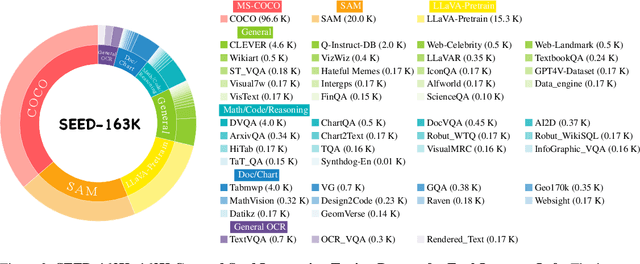

The development of Multimodal Large Language Models (MLLMs) has seen significant advancements. However, the quantity and quality of multimodal instruction data have emerged as significant bottlenecks in their progress. Manually creating multimodal instruction data is both time-consuming and inefficient, posing challenges in producing instructions of high complexity. Moreover, distilling instruction data from black-box commercial models (e.g., GPT-4o, GPT-4V) often results in simplistic instruction data, which constrains performance to that of these models. The challenge of curating diverse and complex instruction data remains substantial. We propose MMEvol, a novel multimodal instruction data evolution framework that combines fine-grained perception evolution, cognitive reasoning evolution, and interaction evolution. This iterative approach breaks through data quality bottlenecks to generate a complex and diverse image-text instruction dataset, thereby empowering MLLMs with enhanced capabilities. Beginning with an initial set of instructions, SEED-163K, we utilize MMEvol to systematically broadens the diversity of instruction types, integrates reasoning steps to enhance cognitive capabilities, and extracts detailed information from images to improve visual understanding and robustness. To comprehensively evaluate the effectiveness of our data, we train LLaVA-NeXT using the evolved data and conduct experiments across 13 vision-language tasks. Compared to the baseline trained with seed data, our approach achieves an average accuracy improvement of 3.1 points and reaches state-of-the-art (SOTA) performance on 9 of these tasks.
mPLUG-DocOwl2: High-resolution Compressing for OCR-free Multi-page Document Understanding
Sep 05, 2024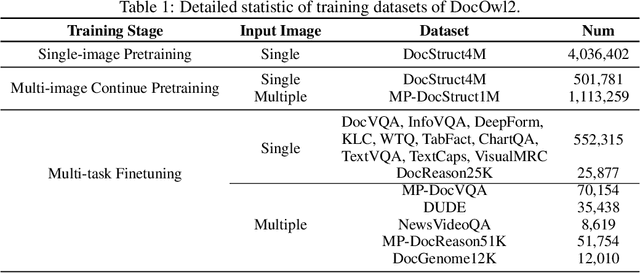
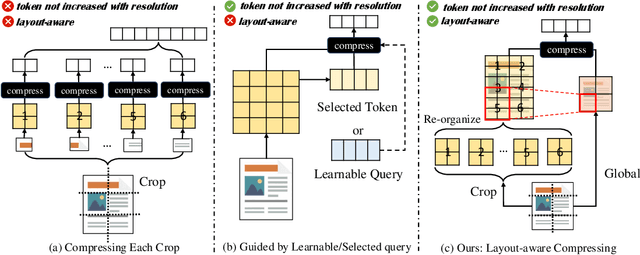


Multimodel Large Language Models(MLLMs) have achieved promising OCR-free Document Understanding performance by increasing the supported resolution of document images. However, this comes at the cost of generating thousands of visual tokens for a single document image, leading to excessive GPU memory and slower inference times, particularly in multi-page document comprehension. In this work, to address these challenges, we propose a High-resolution DocCompressor module to compress each high-resolution document image into 324 tokens, guided by low-resolution global visual features. With this compression module, to strengthen multi-page document comprehension ability and balance both token efficiency and question-answering performance, we develop the DocOwl2 under a three-stage training framework: Single-image Pretraining, Multi-image Continue-pretraining, and Multi-task Finetuning. DocOwl2 sets a new state-of-the-art across multi-page document understanding benchmarks and reduces first token latency by more than 50%, demonstrating advanced capabilities in multi-page questioning answering, explanation with evidence pages, and cross-page structure understanding. Additionally, compared to single-image MLLMs trained on similar data, our DocOwl2 achieves comparable single-page understanding performance with less than 20% of the visual tokens. Our codes, models, and data are publicly available at https://github.com/X-PLUG/mPLUG-DocOwl/tree/main/DocOwl2.
Platypus: A Generalized Specialist Model for Reading Text in Various Forms
Aug 27, 2024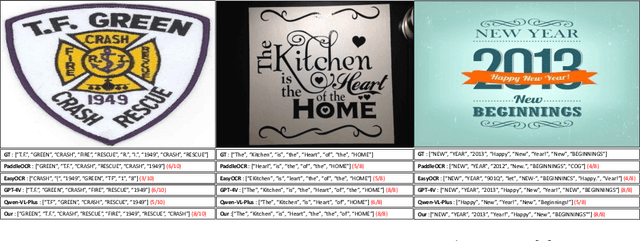
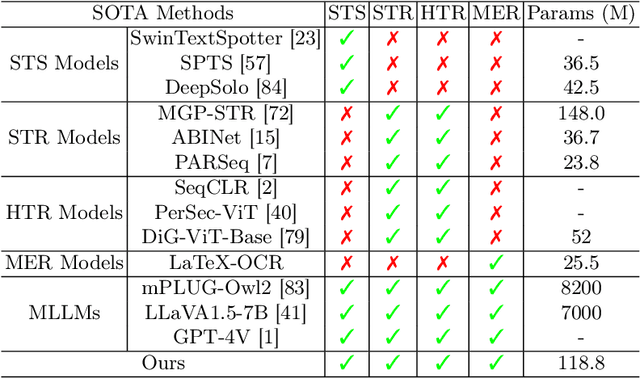
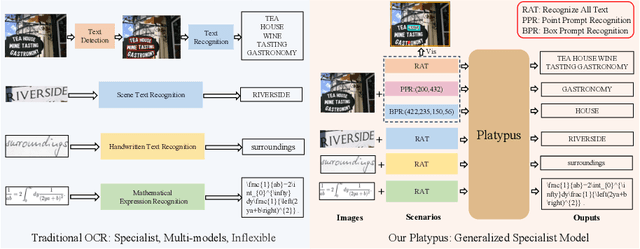
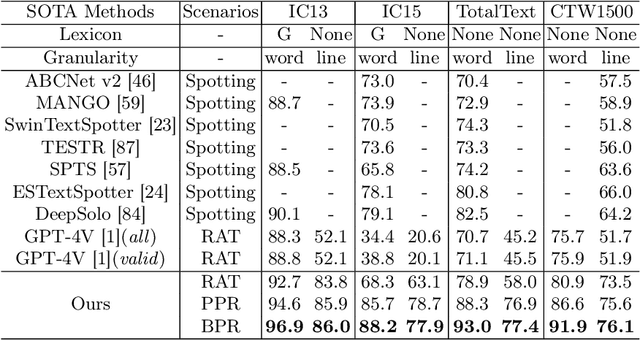
Reading text from images (either natural scenes or documents) has been a long-standing research topic for decades, due to the high technical challenge and wide application range. Previously, individual specialist models are developed to tackle the sub-tasks of text reading (e.g., scene text recognition, handwritten text recognition and mathematical expression recognition). However, such specialist models usually cannot effectively generalize across different sub-tasks. Recently, generalist models (such as GPT-4V), trained on tremendous data in a unified way, have shown enormous potential in reading text in various scenarios, but with the drawbacks of limited accuracy and low efficiency. In this work, we propose Platypus, a generalized specialist model for text reading. Specifically, Platypus combines the best of both worlds: being able to recognize text of various forms with a single unified architecture, while achieving excellent accuracy and high efficiency. To better exploit the advantage of Platypus, we also construct a text reading dataset (called Worms), the images of which are curated from previous datasets and partially re-labeled. Experiments on standard benchmarks demonstrate the effectiveness and superiority of the proposed Platypus model. Model and data will be made publicly available at https://github.com/AlibabaResearch/AdvancedLiterateMachinery/tree/main/OCR/Platypus.