 Add to Chrome
 Add to Firefox
 Add to Edge
Unsupervised Skill Discovery for Agentic Data Analysis
Jun 04, 2026
Inference-time skill augmentation provides a lightweight way to improve data-analytic agents by injecting reusable procedural knowledge without updating model parameters. However, discovering effective skills for data analysis remains challenging, as reliable supervision is expensive and success criteria vary across analytical formats. This raises the key question of how to discover reusable data-analysis skills from unlabeled exploration alone. We propose DataCOPE, an unsupervised verifier-guided skill discovery framework for data-analytic agents. DataCOPE derives verifier signals from the exploration trajectories and uses them to characterize relative quality or aggreement among trajectories. It iteratively coordinates a Data-Analytic Agent for trajectory generation, an Unsupervised Verifier for signal extraction, and a Skill Manager for contrastive skill distillation. For report-style analysis, we instantiate the verifier as an Adaptive Checklist Verifier that derives task-specific criteria, scores reports by verifiable coverage, and iteratively refines the checklist. For reasoning-style analysis, we instantiate it as an Answer Agreement Verifier that groups trajectories by answer agreement and uses self-consistency as an auxiliary signal. We evaluate DataCOPE on report-style analysis from Deep Data Research and reasoning-style analysis from DABStep. Across both settings, DataCOPE consistently improves held-out performance over baselines. Averaged across four model settings, DataCOPE improves the mean score by 9.71% and 32.30% on report-style and reasoning-style tasks respectively.

Rewarding the Scientific Process: Process-Level Reward Modeling for Agentic Data Analysis
Apr 27, 2026Process Reward Models (PRMs) have achieved remarkable success in augmenting the reasoning capabilities of Large Language Models (LLMs) within static domains such as mathematics. However, their potential in dynamic data analysis tasks remains underexplored. In this work, we first present a empirical study revealing that general-domain PRMs struggle to supervise data analysis agents. Specifically, they fail to detect silent errors, logical flaws that yield incorrect results without triggering interpreter exceptions, and erroneously penalize exploratory actions, mistaking necessary trial-and-error exploration for grounding failures. To bridge this gap, we introduce DataPRM, a novel environment-aware generative process reward model that (1) can serve as an active verifier, autonomously interacting with the environment to probe intermediate execution states and uncover silent errors, and (2) employs a reflection-aware ternary reward strategy that distinguishes between correctable grounding errors and irrecoverable mistakes. We design a scalable pipeline to construct over 8K high-quality training instances for DataPRM via diversity-driven trajectory generation and knowledge-augmented step-level annotation. Experimental results demonstrate that DataPRM improves downstream policy LLMs by 7.21% on ScienceAgentBench and 11.28% on DABStep using Best-of-N inference. Notably, with only 4B parameters, DataPRM outperforms strong baselines, and exhibits robust generalizability across diverse Test-Time Scaling strategies. Furthermore, integrating DataPRM into Reinforcement Learning yields substantial gains over outcome-reward baselines, achieving 78.73% on DABench and 64.84% on TableBench, validating the effectiveness of process reward supervision. Code is available at https://github.com/zjunlp/DataMind.
Agentic Knowledgeable Self-awareness
Apr 04, 2025Large Language Models (LLMs) have achieved considerable performance across various agentic planning tasks. However, traditional agent planning approaches adopt a "flood irrigation" methodology that indiscriminately injects gold trajectories, external feedback, and domain knowledge into agent models. This practice overlooks the fundamental human cognitive principle of situational self-awareness during decision-making-the ability to dynamically assess situational demands and strategically employ resources during decision-making. We propose agentic knowledgeable self-awareness to address this gap, a novel paradigm enabling LLM-based agents to autonomously regulate knowledge utilization. Specifically, we propose KnowSelf, a data-centric approach that applies agents with knowledgeable self-awareness like humans. Concretely, we devise a heuristic situation judgement criterion to mark special tokens on the agent's self-explored trajectories for collecting training data. Through a two-stage training process, the agent model can switch between different situations by generating specific special tokens, achieving optimal planning effects with minimal costs. Our experiments demonstrate that KnowSelf can outperform various strong baselines on different tasks and models with minimal use of external knowledge. Code is available at https://github.com/zjunlp/KnowSelf.
Benchmarking Agentic Workflow Generation
Oct 10, 2024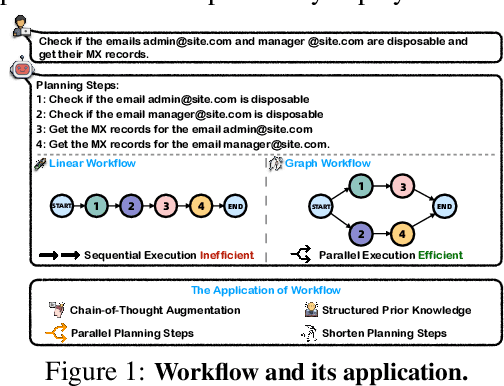

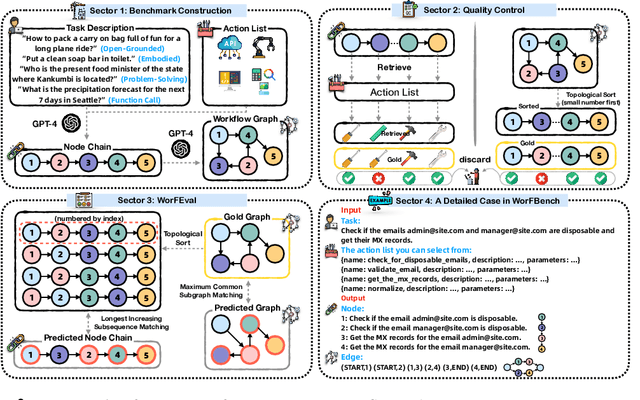

Large Language Models (LLMs), with their exceptional ability to handle a wide range of tasks, have driven significant advancements in tackling reasoning and planning tasks, wherein decomposing complex problems into executable workflows is a crucial step in this process. Existing workflow evaluation frameworks either focus solely on holistic performance or suffer from limitations such as restricted scenario coverage, simplistic workflow structures, and lax evaluation standards. To this end, we introduce WorFBench, a unified workflow generation benchmark with multi-faceted scenarios and intricate graph workflow structures. Additionally, we present WorFEval, a systemic evaluation protocol utilizing subsequence and subgraph matching algorithms to accurately quantify the LLM agent's workflow generation capabilities. Through comprehensive evaluations across different types of LLMs, we discover distinct gaps between the sequence planning capabilities and graph planning capabilities of LLM agents, with even GPT-4 exhibiting a gap of around 15%. We also train two open-source models and evaluate their generalization abilities on held-out tasks. Furthermore, we observe that the generated workflows can enhance downstream tasks, enabling them to achieve superior performance with less time during inference. Code and dataset will be available at https://github.com/zjunlp/WorFBench.