 Add to Chrome
 Add to Firefox
 Add to Edge
PatRe: A Full-Stage Office Action and Rebuttal Generation Benchmark for Patent Examination
May 05, 2026
Patent examination is a complex, multi-stage process requiring both technical expertise and legal reasoning, increasingly challenged by rising application volumes. Prior benchmarks predominantly view patent examination as discriminative classification or static extraction, failing to capture its inherently interactive and iterative nature, similar to the peer review and rebuttal process in academic publishing. In this paper, we introduce PatRe, the first benchmark that models the full patent examination lifecycle, including Office Action generation and applicant rebuttal. PatRe comprises 480 real-world cases and supports both oracle and retrieval-simulated evaluation settings. Our benchmark reframes patent examination as a dynamic, multi-turn process of justification and response. Extensive experiments across various LLMs reveal critical insights into model performance, including differences between proprietary and open-source models, as well as task asymmetries between examiner analysis and applicant-side rebuttal. These findings highlight both the potential and current limitations of LLMs in modeling complex, real-world legal reasoning and technical novelty judgment in patent examination. We release our code and dataset to facilitate future research on patent examination modeling.

DEFT: Distribution-guided Efficient Fine-Tuning for Human Alignment
Apr 02, 2026Reinforcement Learning from Human Feedback (RLHF), using algorithms like Proximal Policy Optimization (PPO), aligns Large Language Models (LLMs) with human values but is costly and unstable. Alternatives have been proposed to replace PPO or integrate Supervised Fine-Tuning (SFT) and contrastive learning for direct fine-tuning and value alignment. However, these methods still require voluminous data to learn preferences and may weaken the generalization ability of LLMs. To further enhance alignment efficiency and performance while mitigating the loss of generalization ability, this paper introduces Distribution-guided Efficient Fine-Tuning (DEFT), an efficient alignment framework incorporating data filtering and distributional guidance by calculating the differential distribution reward based on the output distribution of language model and the discrepancy distribution of preference data. A small yet high-quality subset is filtered from the raw data using a differential distribution reward, which is then incorporated into existing alignment methods to guide the model's output distribution. Experimental results demonstrate that the methods enhanced by DEFT outperform the original methods in both alignment capability and generalization ability, with significantly reduced training time.
FlowPIE: Test-Time Scientific Idea Evolution with Flow-Guided Literature Exploration
Mar 31, 2026Scientific idea generation (SIG) is critical to AI-driven autonomous research, yet existing approaches are often constrained by a static retrieval-then-generation paradigm, leading to homogeneous and insufficiently divergent ideas. In this work, we propose FlowPIE, a tightly coupled retrieval-generation framework that treats literature exploration and idea generation as a co-evolving process. FlowPIE expands literature trajectories via a flow-guided Monte Carlo Tree Search (MCTS) inspired by GFlowNets, using the quality of current ideas assessed by an LLM-based generative reward model (GRM) as a supervised signal to guide adaptive retrieval and construct a diverse, high-quality initial population. Based on this population, FlowPIE models idea generation as a test-time idea evolution process, applying selection, crossover, and mutation with the isolation island paradigm and GRM-based fitness computation to incorporate cross-domain knowledge. It effectively mitigates the information cocoons arising from over-reliance on parametric knowledge and static literature. Extensive evaluations demonstrate that FlowPIE consistently produces ideas with higher novelty, feasibility and diversity compared to strong LLM-based and agent-based frameworks, while enabling reward scaling during test time.
RuCL: Stratified Rubric-Based Curriculum Learning for Multimodal Large Language Model Reasoning
Feb 25, 2026Reinforcement Learning with Verifiable Rewards (RLVR) has emerged as a prevailing paradigm for enhancing reasoning in Multimodal Large Language Models (MLLMs). However, relying solely on outcome supervision risks reward hacking, where models learn spurious reasoning patterns to satisfy final answer checks. While recent rubric-based approaches offer fine-grained supervision signals, they suffer from high computational costs of instance-level generation and inefficient training dynamics caused by treating all rubrics as equally learnable. In this paper, we propose Stratified Rubric-based Curriculum Learning (RuCL), a novel framework that reformulates curriculum learning by shifting the focus from data selection to reward design. RuCL generates generalized rubrics for broad applicability and stratifies them based on the model's competence. By dynamically adjusting rubric weights during training, RuCL guides the model from mastering foundational perception to tackling advanced logical reasoning. Extensive experiments on various visual reasoning benchmarks show that RuCL yields a remarkable +7.83% average improvement over the Qwen2.5-VL-7B model, achieving a state-of-the-art accuracy of 60.06%.
Learning Ordinal Probabilistic Reward from Preferences
Feb 13, 2026Reward models are crucial for aligning large language models (LLMs) with human values and intentions. Existing approaches follow either Generative (GRMs) or Discriminative (DRMs) paradigms, yet both suffer from limitations: GRMs typically demand costly point-wise supervision, while DRMs produce uncalibrated relative scores that lack probabilistic interpretation. To address these challenges, we introduce a novel reward modeling paradigm: Probabilistic Reward Model (PRM). Instead of modeling reward as a deterministic scalar, our approach treats it as a random variable, learning a full probability distribution for the quality of each response. To make this paradigm practical, we present its closed-form, discrete realization: the Ordinal Probabilistic Reward Model (OPRM), which discretizes the quality score into a finite set of ordinal ratings. Building on OPRM, we propose a data-efficient training strategy called Region Flooding Tuning (RgFT). It enables rewards to better reflect absolute text quality by incorporating quality-level annotations, which guide the model to concentrate the probability mass within corresponding rating sub-regions. Experiments on various reward model benchmarks show that our method improves accuracy by $\textbf{2.9%}\sim\textbf{7.4%}$ compared to prior reward models, demonstrating strong performance and data efficiency. Analysis of the score distribution provides evidence that our method captures not only relative rankings but also absolute quality.
CLaSp: In-Context Layer Skip for Self-Speculative Decoding
May 30, 2025Speculative decoding (SD) is a promising method for accelerating the decoding process of Large Language Models (LLMs). The efficiency of SD primarily hinges on the consistency between the draft model and the verify model. However, existing drafting approaches typically require additional modules to be trained, which can be challenging to implement and ensure compatibility across various LLMs. In this paper, we propose CLaSp, an in-context layer-skipping strategy for self-speculative decoding. Unlike prior methods, CLaSp does not require additional drafting modules or extra training. Instead, it employs a plug-and-play mechanism by skipping intermediate layers of the verify model to construct a compressed draft model. Specifically, we develop a dynamic programming algorithm that optimizes the layer-skipping process by leveraging the complete hidden states from the last verification stage as an objective. This enables CLaSp to dynamically adjust its layer-skipping strategy after each verification stage, without relying on pre-optimized sets of skipped layers. Experimental results across diverse downstream tasks demonstrate that CLaSp achieves a speedup of 1.3x ~ 1.7x on LLaMA3 series models without altering the original distribution of the generated text.
EVADE: Multimodal Benchmark for Evasive Content Detection in E-Commerce Applications
May 23, 2025E-commerce platforms increasingly rely on Large Language Models (LLMs) and Vision-Language Models (VLMs) to detect illicit or misleading product content. However, these models remain vulnerable to evasive content: inputs (text or images) that superficially comply with platform policies while covertly conveying prohibited claims. Unlike traditional adversarial attacks that induce overt failures, evasive content exploits ambiguity and context, making it far harder to detect. Existing robustness benchmarks provide little guidance for this demanding, real-world challenge. We introduce EVADE, the first expert-curated, Chinese, multimodal benchmark specifically designed to evaluate foundation models on evasive content detection in e-commerce. The dataset contains 2,833 annotated text samples and 13,961 images spanning six demanding product categories, including body shaping, height growth, and health supplements. Two complementary tasks assess distinct capabilities: Single-Violation, which probes fine-grained reasoning under short prompts, and All-in-One, which tests long-context reasoning by merging overlapping policy rules into unified instructions. Notably, the All-in-One setting significantly narrows the performance gap between partial and full-match accuracy, suggesting that clearer rule definitions improve alignment between human and model judgment. We benchmark 26 mainstream LLMs and VLMs and observe substantial performance gaps: even state-of-the-art models frequently misclassify evasive samples. By releasing EVADE and strong baselines, we provide the first rigorous standard for evaluating evasive-content detection, expose fundamental limitations in current multimodal reasoning, and lay the groundwork for safer and more transparent content moderation systems in e-commerce. The dataset is publicly available at https://huggingface.co/datasets/koenshen/EVADE-Bench.
VCM: Vision Concept Modeling Based on Implicit Contrastive Learning with Vision-Language Instruction Fine-Tuning
Apr 28, 2025Large Vision-Language Models (LVLMs) are pivotal for real-world AI tasks like embodied intelligence due to their strong vision-language reasoning abilities. However, current LVLMs process entire images at the token level, which is inefficient compared to humans who analyze information and generate content at the conceptual level, extracting relevant visual concepts with minimal effort. This inefficiency, stemming from the lack of a visual concept model, limits LVLMs' usability in real-world applications. To address this, we propose VCM, an end-to-end self-supervised visual concept modeling framework. VCM leverages implicit contrastive learning across multiple sampled instances and vision-language fine-tuning to construct a visual concept model without requiring costly concept-level annotations. Our results show that VCM significantly reduces computational costs (e.g., 85\% fewer FLOPs for LLaVA-1.5-7B) while maintaining strong performance across diverse image understanding tasks. Moreover, VCM enhances visual encoders' capabilities in classic visual concept perception tasks. Extensive quantitative and qualitative experiments validate the effectiveness and efficiency of VCM.
IPBench: Benchmarking the Knowledge of Large Language Models in Intellectual Property
Apr 22, 2025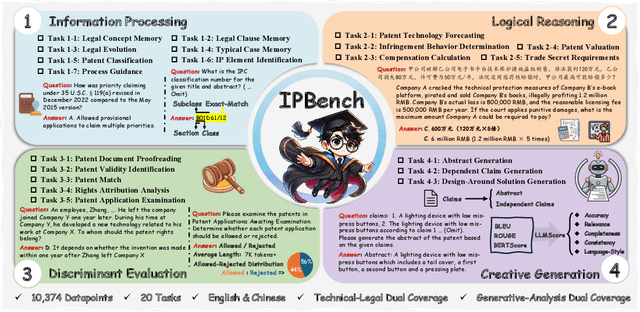
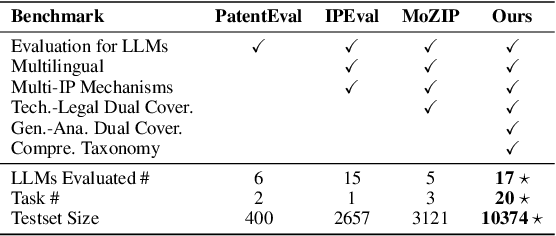
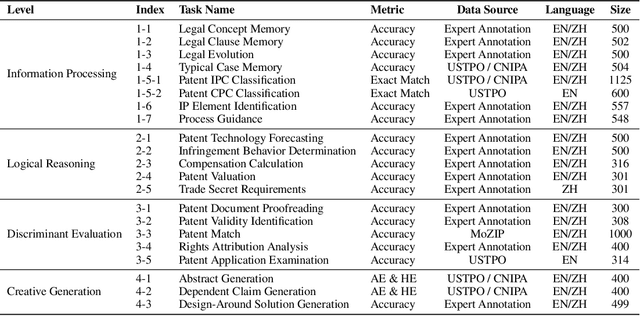
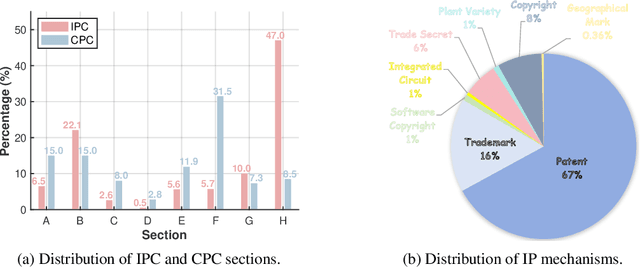
Intellectual Property (IP) is a unique domain that integrates technical and legal knowledge, making it inherently complex and knowledge-intensive. As large language models (LLMs) continue to advance, they show great potential for processing IP tasks, enabling more efficient analysis, understanding, and generation of IP-related content. However, existing datasets and benchmarks either focus narrowly on patents or cover limited aspects of the IP field, lacking alignment with real-world scenarios. To bridge this gap, we introduce the first comprehensive IP task taxonomy and a large, diverse bilingual benchmark, IPBench, covering 8 IP mechanisms and 20 tasks. This benchmark is designed to evaluate LLMs in real-world intellectual property applications, encompassing both understanding and generation. We benchmark 16 LLMs, ranging from general-purpose to domain-specific models, and find that even the best-performing model achieves only 75.8% accuracy, revealing substantial room for improvement. Notably, open-source IP and law-oriented models lag behind closed-source general-purpose models. We publicly release all data and code of IPBench and will continue to update it with additional IP-related tasks to better reflect real-world challenges in the intellectual property domain.
OpenOmni: Large Language Models Pivot Zero-shot Omnimodal Alignment across Language with Real-time Self-Aware Emotional Speech Synthesis
Jan 08, 2025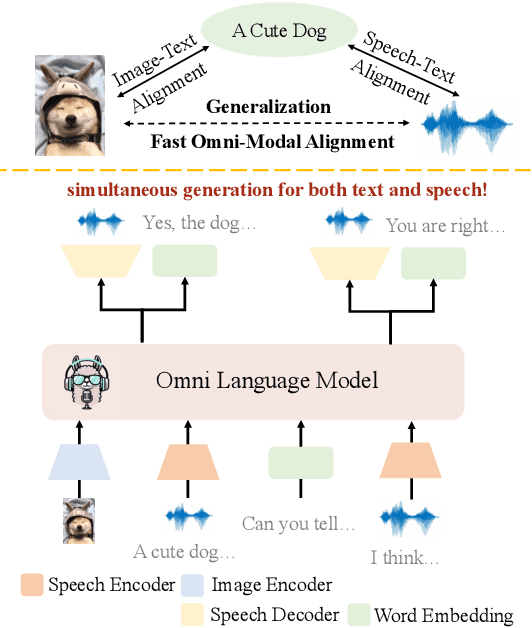
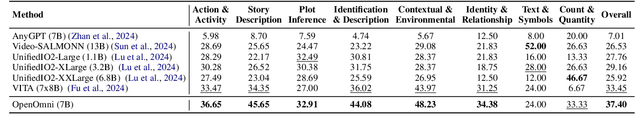
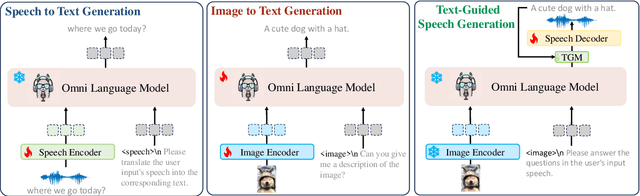

Recent advancements in omnimodal learning have been achieved in understanding and generation across images, text, and speech, though mainly within proprietary models. Limited omnimodal datasets and the inherent challenges associated with real-time emotional speech generation have hindered open-source progress. To address these issues, we propose openomni, a two-stage training method combining omnimodal alignment and speech generation to develop a state-of-the-art omnimodal large language model. In the alignment phase, a pre-trained speech model is further trained on text-image tasks to generalize from vision to speech in a (near) zero-shot manner, outperforming models trained on tri-modal datasets. In the speech generation phase, a lightweight decoder facilitates real-time emotional speech through training on speech tasks and preference learning. Experiments demonstrate that openomni consistently improves across omnimodal, vision-language, and speech-language evaluations, enabling natural, emotion-rich dialogues and real-time emotional speech generation.