 Add to Chrome
 Add to Firefox
 Add to Edge
S5: Scalable Semi-Supervised Semantic Segmentation in Remote Sensing
Aug 17, 2025
Semi-supervised semantic segmentation (S4) has advanced remote sensing (RS) analysis by leveraging unlabeled data through pseudo-labeling and consistency learning. However, existing S4 studies often rely on small-scale datasets and models, limiting their practical applicability. To address this, we propose S5, the first scalable framework for semi-supervised semantic segmentation in RS, which unlocks the potential of vast unlabeled Earth observation data typically underutilized due to costly pixel-level annotations. Built upon existing large-scale RS datasets, S5 introduces a data selection strategy that integrates entropy-based filtering and diversity expansion, resulting in the RS4P-1M dataset. Using this dataset, we systematically scales S4 methods by pre-training RS foundation models (RSFMs) of varying sizes on this extensive corpus, significantly boosting their performance on land cover segmentation and object detection tasks. Furthermore, during fine-tuning, we incorporate a Mixture-of-Experts (MoE)-based multi-dataset fine-tuning approach, which enables efficient adaptation to multiple RS benchmarks with fewer parameters. This approach improves the generalization and versatility of RSFMs across diverse RS benchmarks. The resulting RSFMs achieve state-of-the-art performance across all benchmarks, underscoring the viability of scaling semi-supervised learning for RS applications. All datasets, code, and models will be released at https://github.com/MiliLab/S5

SPEX: A Vision-Language Model for Land Cover Extraction on Spectral Remote Sensing Images
Aug 07, 2025Spectral information has long been recognized as a critical cue in remote sensing observations. Although numerous vision-language models have been developed for pixel-level interpretation, spectral information remains underutilized, resulting in suboptimal performance, particularly in multispectral scenarios. To address this limitation, we construct a vision-language instruction-following dataset named SPIE, which encodes spectral priors of land-cover objects into textual attributes recognizable by large language models (LLMs), based on classical spectral index computations. Leveraging this dataset, we propose SPEX, a multimodal LLM designed for instruction-driven land cover extraction. To this end, we introduce several carefully designed components and training strategies, including multiscale feature aggregation, token context condensation, and multispectral visual pre-training, to achieve precise and flexible pixel-level interpretation. To the best of our knowledge, SPEX is the first multimodal vision-language model dedicated to land cover extraction in spectral remote sensing imagery. Extensive experiments on five public multispectral datasets demonstrate that SPEX consistently outperforms existing state-of-the-art methods in extracting typical land cover categories such as vegetation, buildings, and water bodies. Moreover, SPEX is capable of generating textual explanations for its predictions, thereby enhancing interpretability and user-friendliness. Code will be released at: https://github.com/MiliLab/SPEX.
HunyuanWorld 1.0: Generating Immersive, Explorable, and Interactive 3D Worlds from Words or Pixels
Jul 29, 2025

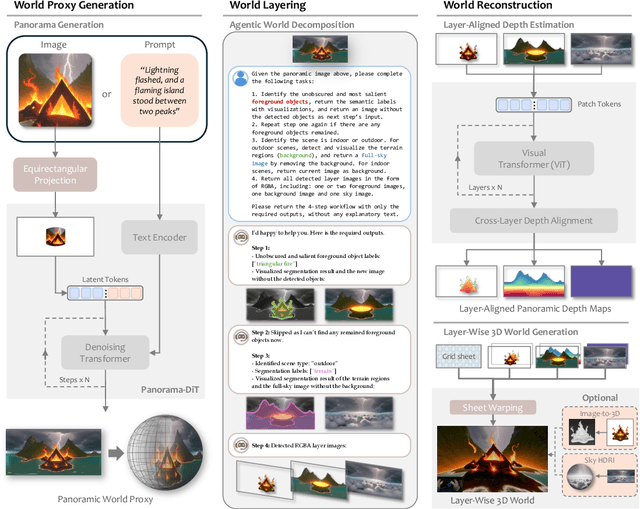
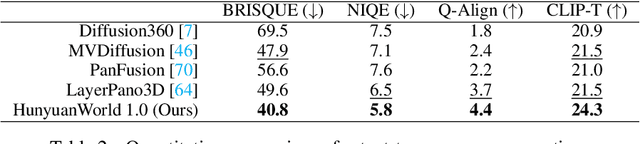
Creating immersive and playable 3D worlds from texts or images remains a fundamental challenge in computer vision and graphics. Existing world generation approaches typically fall into two categories: video-based methods that offer rich diversity but lack 3D consistency and rendering efficiency, and 3D-based methods that provide geometric consistency but struggle with limited training data and memory-inefficient representations. To address these limitations, we present HunyuanWorld 1.0, a novel framework that combines the best of both worlds for generating immersive, explorable, and interactive 3D scenes from text and image conditions. Our approach features three key advantages: 1) 360{\deg} immersive experiences via panoramic world proxies; 2) mesh export capabilities for seamless compatibility with existing computer graphics pipelines; 3) disentangled object representations for augmented interactivity. The core of our framework is a semantically layered 3D mesh representation that leverages panoramic images as 360{\deg} world proxies for semantic-aware world decomposition and reconstruction, enabling the generation of diverse 3D worlds. Extensive experiments demonstrate that our method achieves state-of-the-art performance in generating coherent, explorable, and interactive 3D worlds while enabling versatile applications in virtual reality, physical simulation, game development, and interactive content creation.
X-Omni: Reinforcement Learning Makes Discrete Autoregressive Image Generative Models Great Again
Jul 29, 2025Numerous efforts have been made to extend the ``next token prediction'' paradigm to visual contents, aiming to create a unified approach for both image generation and understanding. Nevertheless, attempts to generate images through autoregressive modeling with discrete tokens have been plagued by issues such as low visual fidelity, distorted outputs, and failure to adhere to complex instructions when rendering intricate details. These shortcomings are likely attributed to cumulative errors during autoregressive inference or information loss incurred during the discretization process. Probably due to this challenge, recent research has increasingly shifted toward jointly training image generation with diffusion objectives and language generation with autoregressive objectives, moving away from unified modeling approaches. In this work, we demonstrate that reinforcement learning can effectively mitigate artifacts and largely enhance the generation quality of a discrete autoregressive modeling method, thereby enabling seamless integration of image and language generation. Our framework comprises a semantic image tokenizer, a unified autoregressive model for both language and images, and an offline diffusion decoder for image generation, termed X-Omni. X-Omni achieves state-of-the-art performance in image generation tasks using a 7B language model, producing images with high aesthetic quality while exhibiting strong capabilities in following instructions and rendering long texts.
ARC-Hunyuan-Video-7B: Structured Video Comprehension of Real-World Shorts
Jul 28, 2025Real-world user-generated short videos, especially those distributed on platforms such as WeChat Channel and TikTok, dominate the mobile internet. However, current large multimodal models lack essential temporally-structured, detailed, and in-depth video comprehension capabilities, which are the cornerstone of effective video search and recommendation, as well as emerging video applications. Understanding real-world shorts is actually challenging due to their complex visual elements, high information density in both visuals and audio, and fast pacing that focuses on emotional expression and viewpoint delivery. This requires advanced reasoning to effectively integrate multimodal information, including visual, audio, and text. In this work, we introduce ARC-Hunyuan-Video, a multimodal model that processes visual, audio, and textual signals from raw video inputs end-to-end for structured comprehension. The model is capable of multi-granularity timestamped video captioning and summarization, open-ended video question answering, temporal video grounding, and video reasoning. Leveraging high-quality data from an automated annotation pipeline, our compact 7B-parameter model is trained through a comprehensive regimen: pre-training, instruction fine-tuning, cold start, reinforcement learning (RL) post-training, and final instruction fine-tuning. Quantitative evaluations on our introduced benchmark ShortVid-Bench and qualitative comparisons demonstrate its strong performance in real-world video comprehension, and it supports zero-shot or fine-tuning with a few samples for diverse downstream applications. The real-world production deployment of our model has yielded tangible and measurable improvements in user engagement and satisfaction, a success supported by its remarkable efficiency, with stress tests indicating an inference time of just 10 seconds for a one-minute video on H20 GPU.
Context Pooling: Query-specific Graph Pooling for Generic Inductive Link Prediction in Knowledge Graphs
Jul 10, 2025Recent investigations on the effectiveness of Graph Neural Network (GNN)-based models for link prediction in Knowledge Graphs (KGs) show that vanilla aggregation does not significantly impact the model performance. In this paper, we introduce a novel method, named Context Pooling, to enhance GNN-based models' efficacy for link predictions in KGs. To our best of knowledge, Context Pooling is the first methodology that applies graph pooling in KGs. Additionally, Context Pooling is first-of-its-kind to enable the generation of query-specific graphs for inductive settings, where testing entities are unseen during training. Specifically, we devise two metrics, namely neighborhood precision and neighborhood recall, to assess the neighbors' logical relevance regarding the given queries, thereby enabling the subsequent comprehensive identification of only the logically relevant neighbors for link prediction. Our method is generic and assessed by being applied to two state-of-the-art (SOTA) models on three public transductive and inductive datasets, achieving SOTA performance in 42 out of 48 settings.
CheXPO: Preference Optimization for Chest X-ray VLMs with Counterfactual Rationale
Jul 09, 2025Vision-language models (VLMs) are prone to hallucinations that critically compromise reliability in medical applications. While preference optimization can mitigate these hallucinations through clinical feedback, its implementation faces challenges such as clinically irrelevant training samples, imbalanced data distributions, and prohibitive expert annotation costs. To address these challenges, we introduce CheXPO, a Chest X-ray Preference Optimization strategy that combines confidence-similarity joint mining with counterfactual rationale. Our approach begins by synthesizing a unified, fine-grained multi-task chest X-ray visual instruction dataset across different question types for supervised fine-tuning (SFT). We then identify hard examples through token-level confidence analysis of SFT failures and use similarity-based retrieval to expand hard examples for balancing preference sample distributions, while synthetic counterfactual rationales provide fine-grained clinical preferences, eliminating the need for additional expert input. Experiments show that CheXPO achieves 8.93% relative performance gain using only 5% of SFT samples, reaching state-of-the-art performance across diverse clinical tasks and providing a scalable, interpretable solution for real-world radiology applications.
FlashDP: Private Training Large Language Models with Efficient DP-SGD
Jul 01, 2025As large language models (LLMs) increasingly underpin technological advancements, the privacy of their training data emerges as a critical concern. Differential Privacy (DP) serves as a rigorous mechanism to protect this data, yet its integration via Differentially Private Stochastic Gradient Descent (DP-SGD) introduces substantial challenges, primarily due to the complexities of per-sample gradient clipping. Current explicit methods, such as Opacus, necessitate extensive storage for per-sample gradients, significantly inflating memory requirements. Conversely, implicit methods like GhostClip reduce storage needs by recalculating gradients multiple times, which leads to inefficiencies due to redundant computations. This paper introduces FlashDP, an innovative cache-friendly per-layer DP-SGD that consolidates necessary operations into a single task, calculating gradients only once in a fused manner. This approach not only diminishes memory movement by up to \textbf{50\%} but also cuts down redundant computations by \textbf{20\%}, compared to previous methods. Consequently, FlashDP does not increase memory demands and achieves a \textbf{90\%} throughput compared to the Non-DP method on a four-A100 system during the pre-training of the Llama-13B model, while maintaining parity with standard per-layer clipped DP-SGD in terms of accuracy. These advancements establish FlashDP as a pivotal development for efficient and privacy-preserving training of LLMs. FlashDP's code has been open-sourced in https://github.com/kaustpradalab/flashdp.
Is Long-to-Short a Free Lunch? Investigating Inconsistency and Reasoning Efficiency in LRMs
Jun 24, 2025Large Reasoning Models (LRMs) have achieved remarkable performance on complex tasks by engaging in extended reasoning before producing final answers, yet this strength introduces the risk of overthinking, where excessive token generation occurs even for simple tasks. While recent work in efficient reasoning seeks to reduce reasoning length while preserving accuracy, it remains unclear whether such optimization is truly a free lunch. Drawing on the intuition that compressing reasoning may reduce the robustness of model responses and lead models to omit key reasoning steps, we investigate whether efficient reasoning strategies introduce behavioral inconsistencies. To systematically assess this, we introduce $ICBENCH$, a benchmark designed to measure inconsistency in LRMs across three dimensions: inconsistency across task settings (ITS), inconsistency between training objectives and learned behavior (TR-LB), and inconsistency between internal reasoning and self-explanations (IR-SE). Applying $ICBENCH$ to a range of open-source LRMs, we find that while larger models generally exhibit greater consistency than smaller ones, they all display widespread "scheming" behaviors, including self-disagreement, post-hoc rationalization, and the withholding of reasoning cues. Crucially, our results demonstrate that efficient reasoning strategies such as No-Thinking and Simple Token-Budget consistently increase all three defined types of inconsistency. These findings suggest that although efficient reasoning enhances token-level efficiency, further investigation is imperative to ascertain whether it concurrently introduces the risk of models evading effective supervision.
Hunyuan3D 2.1: From Images to High-Fidelity 3D Assets with Production-Ready PBR Material
Jun 18, 20253D AI-generated content (AIGC) is a passionate field that has significantly accelerated the creation of 3D models in gaming, film, and design. Despite the development of several groundbreaking models that have revolutionized 3D generation, the field remains largely accessible only to researchers, developers, and designers due to the complexities involved in collecting, processing, and training 3D models. To address these challenges, we introduce Hunyuan3D 2.1 as a case study in this tutorial. This tutorial offers a comprehensive, step-by-step guide on processing 3D data, training a 3D generative model, and evaluating its performance using Hunyuan3D 2.1, an advanced system for producing high-resolution, textured 3D assets. The system comprises two core components: the Hunyuan3D-DiT for shape generation and the Hunyuan3D-Paint for texture synthesis. We will explore the entire workflow, including data preparation, model architecture, training strategies, evaluation metrics, and deployment. By the conclusion of this tutorial, you will have the knowledge to finetune or develop a robust 3D generative model suitable for applications in gaming, virtual reality, and industrial design.