 Add to Chrome
 Add to Firefox
 Add to Edge
LAVA: Logic-Aware Validation and Augmentation Framework for Large-Scale Financial Document Auditing
Aug 17, 2026
Financial document validation in production, such as payroll auditing, tax compliance, and loan underwriting, demands exceptional accuracy, consistency, and reproducibility under strict enterprise constraints. In practice, documents arrive with heterogeneous layouts and formats, semantically rich and context-dependent content, and embedded business rules that current pipelines struggle to process reliably. We introduce LAVA (Logic-Aware Validation and Augmentation), a modular, backbone-agnostic pipeline built on multimodal large language models, that integrates a four-stage design: document-rule retrieval, layout-preserving information extraction, auxiliary metadata enrichment, and auditable symbolic/arithmetic verification. LAVA supports robust rule grounding, fine-grained error attribution, and consistent, traceable end-to-end execution, capabilities essential for high-stakes deployment. Evaluated on a large real-world benchmark with diverse financial documents and dozens of expert-curated validation rules, LAVA outperforms baselines in hallucination control and edge-case handling while maintaining efficient token usage, demonstrating practicality for high-volume, time-critical validation.

FRAMES: Guarded and Dual-Objective Skill Evolution for Agents in Policy-Governed Enterprise Workflows
Aug 03, 2026LLM agents increasingly run policy-bound enterprise workflows such as document auditing, where they must apply rules consistently, ground every value, and stay auditable. Improving these agents is hard: operational feedback is sparse and unlabeled, edits to one rule can regress unrelated cases, and accuracy must improve without inflating inference cost or losing auditability. We present FRAMES, a closed-loop framework that cold-starts deployable skills from existing assets and then evolves them through consensus-based mutation, Pareto selection over accuracy and cost, and an anti-regression guarantee, all while preserving auditability. Deployed on our internal production system, FRAMES attains the best accuracy-cost trade-off among baselines, with the same gains reproduced on tau-bench.
Parametric Skills
Jun 29, 2026Since intelligence fundamentally relies on efficient skill acquisition (Chollet, 2019), the ability to leverage skills is critical. For LLMs, skills, manually authored or extracted from task trajectories, are textual recipes encoding mature problem-solving experience and are critical to agentic capabilities. Despite widespread deployment, their utility is limited by the model's ability to comprehend and follow skill instructions, especially under complex and long-context scenarios, where key instructions are difficult to locate and adhere to. To address this limitation, we propose ParametricSkills, a framework that can convert free-form textual skills into parameters at test time, enabling context-free skill exploitation. Specifically, we first construct a large-scale, high-quality skill library, and synthesize single-turn and multi-turn skill exploitation trajectories built around these skills with OpenCode. Using these data, we then train a hypernetwork that parameterizes both the skill content and the test-time exploitation methodology by receiving textual skills and converting them into LoRA adapters. Experimental results on six complex software engineering (SWE) subtasks demonstrate that, the proposed ParametricSkills averagely outperforms in-context learning by 6.44 points as judged by DeepSeek-V4-Flash, while also achieving significantly higher BERT Score and F1 score, confirming its effectiveness. Beyond performance, we further find that parametric skills, being inherently accumulative, offer a preliminary yet promising avenue toward test-time continual learning.
CheXPO: Preference Optimization for Chest X-ray VLMs with Counterfactual Rationale
Jul 09, 2025Vision-language models (VLMs) are prone to hallucinations that critically compromise reliability in medical applications. While preference optimization can mitigate these hallucinations through clinical feedback, its implementation faces challenges such as clinically irrelevant training samples, imbalanced data distributions, and prohibitive expert annotation costs. To address these challenges, we introduce CheXPO, a Chest X-ray Preference Optimization strategy that combines confidence-similarity joint mining with counterfactual rationale. Our approach begins by synthesizing a unified, fine-grained multi-task chest X-ray visual instruction dataset across different question types for supervised fine-tuning (SFT). We then identify hard examples through token-level confidence analysis of SFT failures and use similarity-based retrieval to expand hard examples for balancing preference sample distributions, while synthetic counterfactual rationales provide fine-grained clinical preferences, eliminating the need for additional expert input. Experiments show that CheXPO achieves 8.93% relative performance gain using only 5% of SFT samples, reaching state-of-the-art performance across diverse clinical tasks and providing a scalable, interpretable solution for real-world radiology applications.
SHERL: Synthesizing High Accuracy and Efficient Memory for Resource-Limited Transfer Learning
Jul 10, 2024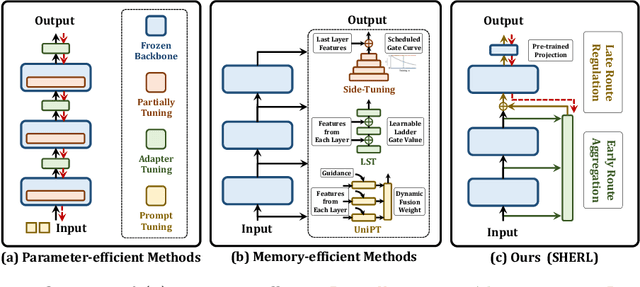
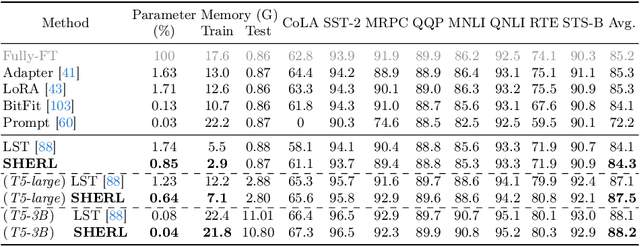
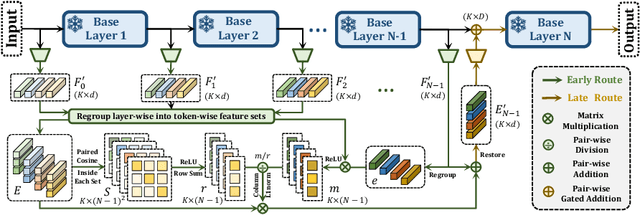
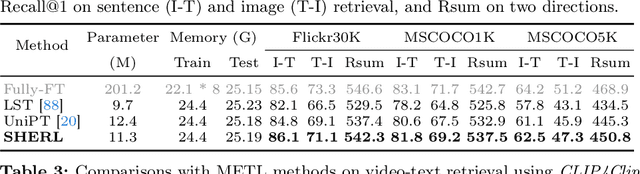
Parameter-efficient transfer learning (PETL) has emerged as a flourishing research field for adapting large pre-trained models to downstream tasks, greatly reducing trainable parameters while grappling with memory challenges during fine-tuning. To address it, memory-efficient series (METL) avoid backpropagating gradients through the large backbone. However, they compromise by exclusively relying on frozen intermediate outputs and limiting the exhaustive exploration of prior knowledge from pre-trained models. Moreover, the dependency and redundancy between cross-layer features are frequently overlooked, thereby submerging more discriminative representations and causing an inherent performance gap (vs. conventional PETL methods). Hence, we propose an innovative METL strategy called SHERL for resource-limited scenarios to decouple the entire adaptation into two successive and complementary processes. In the early route, intermediate outputs are consolidated via an anti-redundancy operation, enhancing their compatibility for subsequent interactions; thereby in the late route, utilizing minimal late pre-trained layers could alleviate the peak demand on memory overhead and regulate these fairly flexible features into more adaptive and powerful representations for new domains. Extensive ablations on vision-and-language and language-only tasks show that SHERL combines the strengths of both parameter and memory-efficient techniques, performing on-par or better across diverse architectures with lower memory during fine-tuning. Our code is publicly available at: https://github.com/Paranioar/SHERL.
LocCa: Visual Pretraining with Location-aware Captioners
Mar 28, 2024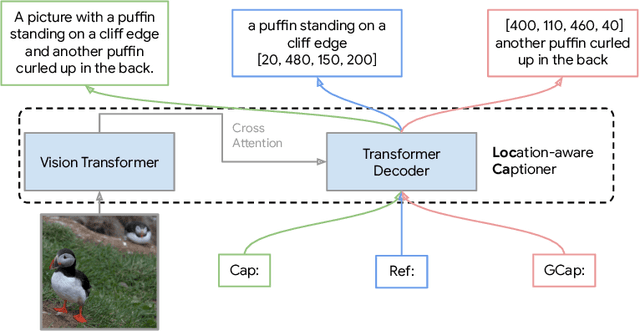


Image captioning has been shown as an effective pretraining method similar to contrastive pretraining. However, the incorporation of location-aware information into visual pretraining remains an area with limited research. In this paper, we propose a simple visual pretraining method with location-aware captioners (LocCa). LocCa uses a simple image captioner task interface, to teach a model to read out rich information, i.e. bounding box coordinates, and captions, conditioned on the image pixel input. Thanks to the multitask capabilities of an encoder-decoder architecture, we show that an image captioner can easily handle multiple tasks during pretraining. Our experiments demonstrate that LocCa outperforms standard captioners significantly on localization downstream tasks while maintaining comparable performance on holistic tasks.
Animate Your Motion: Turning Still Images into Dynamic Videos
Mar 15, 2024


In recent years, diffusion models have made remarkable strides in text-to-video generation, sparking a quest for enhanced control over video outputs to more accurately reflect user intentions. Traditional efforts predominantly focus on employing either semantic cues, like images or depth maps, or motion-based conditions, like moving sketches or object bounding boxes. Semantic inputs offer a rich scene context but lack detailed motion specificity; conversely, motion inputs provide precise trajectory information but miss the broader semantic narrative. For the first time, we integrate both semantic and motion cues within a diffusion model for video generation, as demonstrated in Fig 1. To this end, we introduce the Scene and Motion Conditional Diffusion (SMCD), a novel methodology for managing multimodal inputs. It incorporates a recognized motion conditioning module and investigates various approaches to integrate scene conditions, promoting synergy between different modalities. For model training, we separate the conditions for the two modalities, introducing a two-stage training pipeline. Experimental results demonstrate that our design significantly enhances video quality, motion precision, and semantic coherence.
Exploiting CLIP for Zero-shot HOI Detection Requires Knowledge Distillation at Multiple Levels
Sep 10, 2023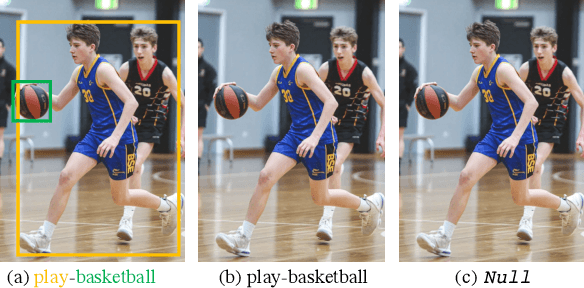
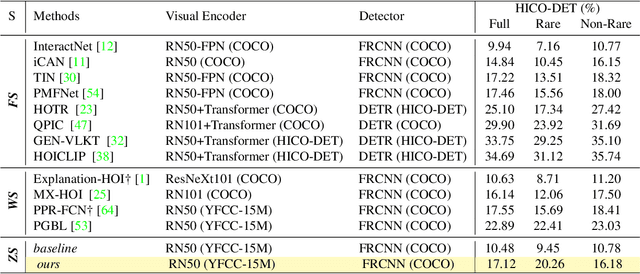
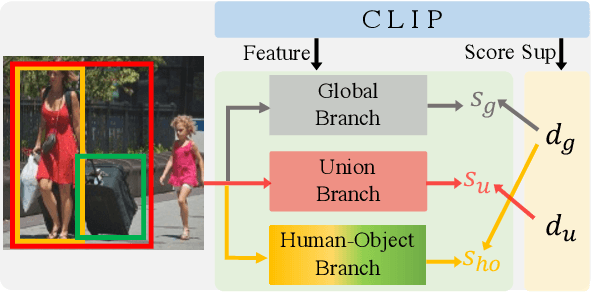
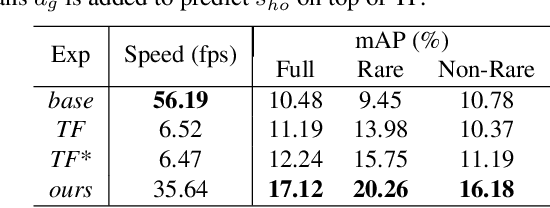
In this paper, we investigate the task of zero-shot human-object interaction (HOI) detection, a novel paradigm for identifying HOIs without the need for task-specific annotations. To address this challenging task, we employ CLIP, a large-scale pre-trained vision-language model (VLM), for knowledge distillation on multiple levels. Specifically, we design a multi-branch neural network that leverages CLIP for learning HOI representations at various levels, including global images, local union regions encompassing human-object pairs, and individual instances of humans or objects. To train our model, CLIP is utilized to generate HOI scores for both global images and local union regions that serve as supervision signals. The extensive experiments demonstrate the effectiveness of our novel multi-level CLIP knowledge integration strategy. Notably, the model achieves strong performance, which is even comparable with some fully-supervised and weakly-supervised methods on the public HICO-DET benchmark.
UniPT: Universal Parallel Tuning for Transfer Learning with Efficient Parameter and Memory
Aug 28, 2023

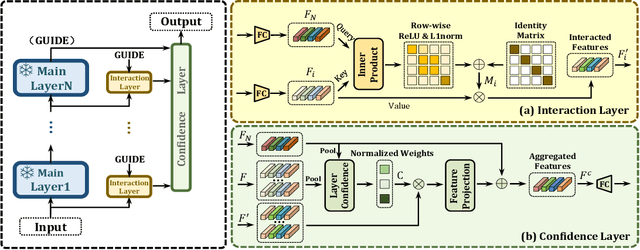
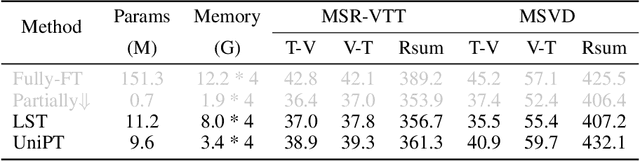
Fine-tuning pre-trained models has emerged as a powerful technique in numerous domains, owing to its ability to leverage enormous pre-existing knowledge and achieve remarkable performance on downstream tasks. However, updating the parameters of entire networks is computationally intensive. Although state-of-the-art parameter-efficient transfer learning (PETL) methods significantly reduce the trainable parameters and storage demand, almost all of them still need to back-propagate the gradients through large pre-trained networks. This memory-extensive characteristic extremely limits the applicability of PETL methods in real-world scenarios. To this end, we propose a new memory-efficient PETL strategy, dubbed Universal Parallel Tuning (UniPT). Specifically, we facilitate the transfer process via a lightweight learnable parallel network, which consists of two modules: 1) A parallel interaction module that decouples the inherently sequential connections and processes the intermediate activations detachedly of the pre-trained network. 2) A confidence aggregation module that learns optimal strategies adaptively for integrating cross-layer features. We evaluate UniPT with different backbones (e.g., VSE$\infty$, CLIP4Clip, Clip-ViL, and MDETR) on five challenging vision-and-language tasks (i.e., image-text retrieval, video-text retrieval, visual question answering, compositional question answering, and visual grounding). Extensive ablations on ten datasets have validated that our UniPT can not only dramatically reduce memory consumption and outperform the best memory-efficient competitor, but also achieve higher performance than existing PETL methods in a low-memory scenario on different architectures. Our code is publicly available at: https://github.com/Paranioar/UniPT.
A Study of Autoregressive Decoders for Multi-Tasking in Computer Vision
Mar 30, 2023


There has been a recent explosion of computer vision models which perform many tasks and are composed of an image encoder (usually a ViT) and an autoregressive decoder (usually a Transformer). However, most of this work simply presents one system and its results, leaving many questions regarding design decisions and trade-offs of such systems unanswered. In this work, we aim to provide such answers. We take a close look at autoregressive decoders for multi-task learning in multimodal computer vision, including classification, captioning, visual question answering, and optical character recognition. Through extensive systematic experiments, we study the effects of task and data mixture, training and regularization hyperparameters, conditioning type and specificity, modality combination, and more. Importantly, we compare these to well-tuned single-task baselines to highlight the cost incurred by multi-tasking. A key finding is that a small decoder learned on top of a frozen pretrained encoder works surprisingly well. We call this setup locked-image tuning with decoder (LiT-decoder). It can be seen as teaching a decoder to interact with a pretrained vision model via natural language.