 Add to Chrome
 Add to Firefox
 Add to Edge
UniT: Toward a Unified Physical Language for Human-to-Humanoid Policy Learning and World Modeling
Apr 21, 2026
Scaling humanoid foundation models is bottlenecked by the scarcity of robotic data. While massive egocentric human data offers a scalable alternative, bridging the cross-embodiment chasm remains a fundamental challenge due to kinematic mismatches. We introduce UniT (Unified Latent Action Tokenizer via Visual Anchoring), a framework that establishes a unified physical language for human-to-humanoid transfer. Grounded in the philosophy that heterogeneous kinematics share universal visual consequences, UniT employs a tri-branch cross-reconstruction mechanism: actions predict vision to anchor kinematics to physical outcomes, while vision reconstructs actions to filter out irrelevant visual confounders. Concurrently, a fusion branch synergies these purified modalities into a shared discrete latent space of embodiment-agnostic physical intents. We validate UniT across two paradigms: 1) Policy Learning (VLA-UniT): By predicting these unified tokens, it effectively leverages diverse human data to achieve state-of-the-art data efficiency and robust out-of-distribution (OOD) generalization on both humanoid simulation benchmark and real-world deployments, notably demonstrating zero-shot task transfer. 2) World Modeling (WM-UniT): By aligning cross-embodiment dynamics via unified tokens as conditions, it realizes direct human-to-humanoid action transfer. This alignment ensures that human data seamlessly translates into enhanced action controllability for humanoid video generation. Ultimately, by inducing a highly aligned cross-embodiment representation (empirically verified by t-SNE visualizations revealing the convergence of human and humanoid features into a shared manifold), UniT offers a scalable path to distill vast human knowledge into general-purpose humanoid capabilities.

DIAL: Decoupling Intent and Action via Latent World Modeling for End-to-End VLA
Mar 31, 2026The development of Vision-Language-Action (VLA) models has been significantly accelerated by pre-trained Vision-Language Models (VLMs). However, most existing end-to-end VLAs treat the VLM primarily as a multimodal encoder, directly mapping vision-language features to low-level actions. This paradigm underutilizes the VLM's potential in high-level decision making and introduces training instability, frequently degrading its rich semantic representations. To address these limitations, we introduce DIAL, a framework bridging high-level decision making and low-level motor execution through a differentiable latent intent bottleneck. Specifically, a VLM-based System-2 performs latent world modeling by synthesizing latent visual foresight within the VLM's native feature space; this foresight explicitly encodes intent and serves as the structural bottleneck. A lightweight System-1 policy then decodes this predicted intent together with the current observation into precise robot actions via latent inverse dynamics. To ensure optimization stability, we employ a two-stage training paradigm: a decoupled warmup phase where System-2 learns to predict latent futures while System-1 learns motor control under ground-truth future guidance within a unified feature space, followed by seamless end-to-end joint optimization. This enables action-aware gradients to refine the VLM backbone in a controlled manner, preserving pre-trained knowledge. Extensive experiments on the RoboCasa GR1 Tabletop benchmark show that DIAL establishes a new state-of-the-art, achieving superior performance with 10x fewer demonstrations than prior methods. Furthermore, by leveraging heterogeneous human demonstrations, DIAL learns physically grounded manipulation priors and exhibits robust zero-shot generalization to unseen objects and novel configurations during real-world deployment on a humanoid robot.
Learning to Reason in 4D: Dynamic Spatial Understanding for Vision Language Models
Dec 23, 2025Vision-language models (VLM) excel at general understanding yet remain weak at dynamic spatial reasoning (DSR), i.e., reasoning about the evolvement of object geometry and relationship in 3D space over time, largely due to the scarcity of scalable 4D-aware training resources. To bridge this gap across aspects of dataset, benchmark and model, we introduce DSR Suite. First, we propose an automated pipeline that generates multiple-choice question-answer pairs from in-the-wild videos for DSR. By leveraging modern vision foundation models, the pipeline extracts rich geometric and motion information, including camera poses, local point clouds, object masks, orientations, and 3D trajectories. These geometric cues enable the construction of DSR-Train for learning and further human-refined DSR-Bench for evaluation. Compared with previous works, our data emphasize (i) in-the-wild video sources, (ii) object- and scene-level 3D requirements, (iii) viewpoint transformations, (iv) multi-object interactions, and (v) fine-grained, procedural answers. Beyond data, we propose a lightweight Geometry Selection Module (GSM) to seamlessly integrate geometric priors into VLMs, which condenses question semantics and extracts question-relevant knowledge from pretrained 4D reconstruction priors into a compact set of geometry tokens. This targeted extraction avoids overwhelming the model with irrelevant knowledge. Experiments show that integrating DSR-Train and GSM into Qwen2.5-VL-7B significantly enhances its dynamic spatial reasoning capability, while maintaining accuracy on general video understanding benchmarks.
TimeLens: Rethinking Video Temporal Grounding with Multimodal LLMs
Dec 16, 2025This paper does not introduce a novel method but instead establishes a straightforward, incremental, yet essential baseline for video temporal grounding (VTG), a core capability in video understanding. While multimodal large language models (MLLMs) excel at various video understanding tasks, the recipes for optimizing them for VTG remain under-explored. In this paper, we present TimeLens, a systematic investigation into building MLLMs with strong VTG ability, along two primary dimensions: data quality and algorithmic design. We first expose critical quality issues in existing VTG benchmarks and introduce TimeLens-Bench, comprising meticulously re-annotated versions of three popular benchmarks with strict quality criteria. Our analysis reveals dramatic model re-rankings compared to legacy benchmarks, confirming the unreliability of prior evaluation standards. We also address noisy training data through an automated re-annotation pipeline, yielding TimeLens-100K, a large-scale, high-quality training dataset. Building on our data foundation, we conduct in-depth explorations of algorithmic design principles, yielding a series of meaningful insights and effective yet efficient practices. These include interleaved textual encoding for time representation, a thinking-free reinforcement learning with verifiable rewards (RLVR) approach as the training paradigm, and carefully designed recipes for RLVR training. These efforts culminate in TimeLens models, a family of MLLMs with state-of-the-art VTG performance among open-source models and even surpass proprietary models such as GPT-5 and Gemini-2.5-Flash. All codes, data, and models will be released to facilitate future research.
ARC-Chapter: Structuring Hour-Long Videos into Navigable Chapters and Hierarchical Summaries
Nov 18, 2025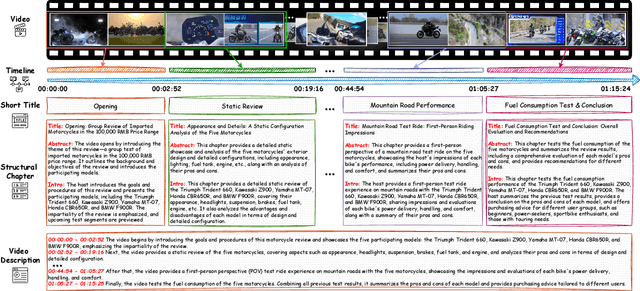
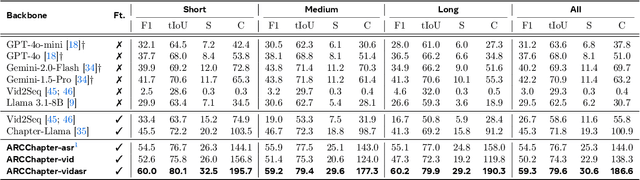
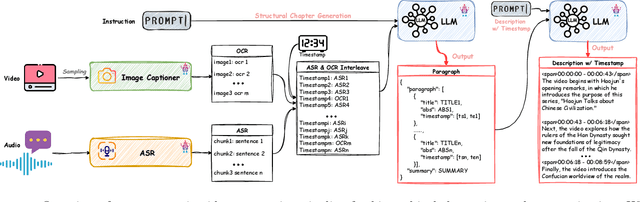
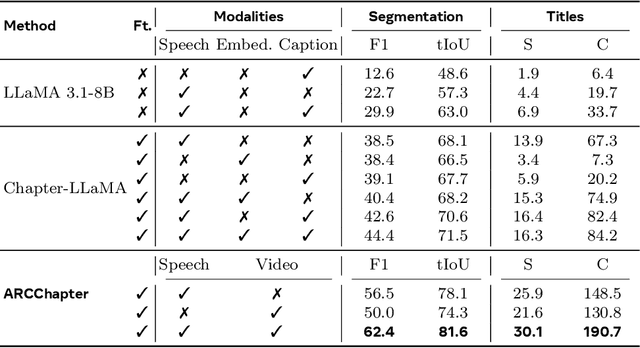
The proliferation of hour-long videos (e.g., lectures, podcasts, documentaries) has intensified demand for efficient content structuring. However, existing approaches are constrained by small-scale training with annotations that are typical short and coarse, restricting generalization to nuanced transitions in long videos. We introduce ARC-Chapter, the first large-scale video chaptering model trained on over million-level long video chapters, featuring bilingual, temporally grounded, and hierarchical chapter annotations. To achieve this goal, we curated a bilingual English-Chinese chapter dataset via a structured pipeline that unifies ASR transcripts, scene texts, visual captions into multi-level annotations, from short title to long summaries. We demonstrate clear performance improvements with data scaling, both in data volume and label intensity. Moreover, we design a new evaluation metric termed GRACE, which incorporates many-to-one segment overlaps and semantic similarity, better reflecting real-world chaptering flexibility. Extensive experiments demonstrate that ARC-Chapter establishes a new state-of-the-art by a significant margin, outperforming the previous best by 14.0% in F1 score and 11.3% in SODA score. Moreover, ARC-Chapter shows excellent transferability, improving the state-of-the-art on downstream tasks like dense video captioning on YouCook2.
AudioStory: Generating Long-Form Narrative Audio with Large Language Models
Aug 27, 2025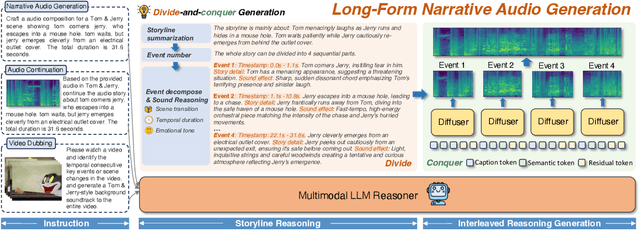
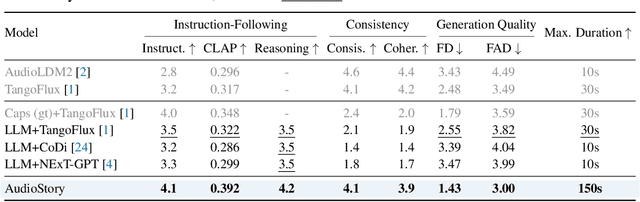
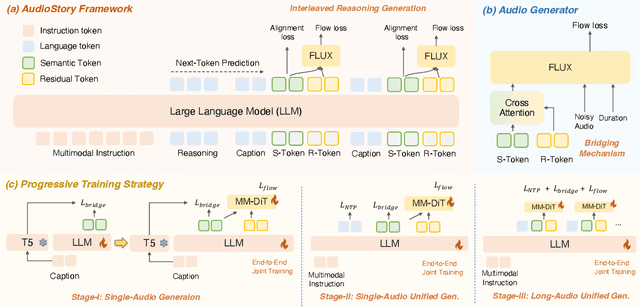
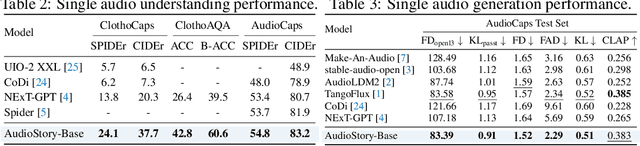
Recent advances in text-to-audio (TTA) generation excel at synthesizing short audio clips but struggle with long-form narrative audio, which requires temporal coherence and compositional reasoning. To address this gap, we propose AudioStory, a unified framework that integrates large language models (LLMs) with TTA systems to generate structured, long-form audio narratives. AudioStory possesses strong instruction-following reasoning generation capabilities. It employs LLMs to decompose complex narrative queries into temporally ordered sub-tasks with contextual cues, enabling coherent scene transitions and emotional tone consistency. AudioStory has two appealing features: (1) Decoupled bridging mechanism: AudioStory disentangles LLM-diffuser collaboration into two specialized components, i.e., a bridging query for intra-event semantic alignment and a residual query for cross-event coherence preservation. (2) End-to-end training: By unifying instruction comprehension and audio generation within a single end-to-end framework, AudioStory eliminates the need for modular training pipelines while enhancing synergy between components. Furthermore, we establish a benchmark AudioStory-10K, encompassing diverse domains such as animated soundscapes and natural sound narratives. Extensive experiments show the superiority of AudioStory on both single-audio generation and narrative audio generation, surpassing prior TTA baselines in both instruction-following ability and audio fidelity. Our code is available at https://github.com/TencentARC/AudioStory
ARC-Hunyuan-Video-7B: Structured Video Comprehension of Real-World Shorts
Jul 28, 2025Real-world user-generated short videos, especially those distributed on platforms such as WeChat Channel and TikTok, dominate the mobile internet. However, current large multimodal models lack essential temporally-structured, detailed, and in-depth video comprehension capabilities, which are the cornerstone of effective video search and recommendation, as well as emerging video applications. Understanding real-world shorts is actually challenging due to their complex visual elements, high information density in both visuals and audio, and fast pacing that focuses on emotional expression and viewpoint delivery. This requires advanced reasoning to effectively integrate multimodal information, including visual, audio, and text. In this work, we introduce ARC-Hunyuan-Video, a multimodal model that processes visual, audio, and textual signals from raw video inputs end-to-end for structured comprehension. The model is capable of multi-granularity timestamped video captioning and summarization, open-ended video question answering, temporal video grounding, and video reasoning. Leveraging high-quality data from an automated annotation pipeline, our compact 7B-parameter model is trained through a comprehensive regimen: pre-training, instruction fine-tuning, cold start, reinforcement learning (RL) post-training, and final instruction fine-tuning. Quantitative evaluations on our introduced benchmark ShortVid-Bench and qualitative comparisons demonstrate its strong performance in real-world video comprehension, and it supports zero-shot or fine-tuning with a few samples for diverse downstream applications. The real-world production deployment of our model has yielded tangible and measurable improvements in user engagement and satisfaction, a success supported by its remarkable efficiency, with stress tests indicating an inference time of just 10 seconds for a one-minute video on H20 GPU.
Aligning Latent Spaces with Flow Priors
Jun 05, 2025This paper presents a novel framework for aligning learnable latent spaces to arbitrary target distributions by leveraging flow-based generative models as priors. Our method first pretrains a flow model on the target features to capture the underlying distribution. This fixed flow model subsequently regularizes the latent space via an alignment loss, which reformulates the flow matching objective to treat the latents as optimization targets. We formally prove that minimizing this alignment loss establishes a computationally tractable surrogate objective for maximizing a variational lower bound on the log-likelihood of latents under the target distribution. Notably, the proposed method eliminates computationally expensive likelihood evaluations and avoids ODE solving during optimization. As a proof of concept, we demonstrate in a controlled setting that the alignment loss landscape closely approximates the negative log-likelihood of the target distribution. We further validate the effectiveness of our approach through large-scale image generation experiments on ImageNet with diverse target distributions, accompanied by detailed discussions and ablation studies. With both theoretical and empirical validation, our framework paves a new way for latent space alignment.
Video-Holmes: Can MLLM Think Like Holmes for Complex Video Reasoning?
May 27, 2025Recent advances in CoT reasoning and RL post-training have been reported to enhance video reasoning capabilities of MLLMs. This progress naturally raises a question: can these models perform complex video reasoning in a manner comparable to human experts? However, existing video benchmarks primarily evaluate visual perception and grounding abilities, with questions that can be answered based on explicit prompts or isolated visual cues. Such benchmarks do not fully capture the intricacies of real-world reasoning, where humans must actively search for, integrate, and analyze multiple clues before reaching a conclusion. To address this issue, we present Video-Holmes, a benchmark inspired by the reasoning process of Sherlock Holmes, designed to evaluate the complex video reasoning capabilities of MLLMs. Video-Holmes consists of 1,837 questions derived from 270 manually annotated suspense short films, which spans seven carefully designed tasks. Each task is constructed by first identifying key events and causal relationships within films, and then designing questions that require models to actively locate and connect multiple relevant visual clues scattered across different video segments. Our comprehensive evaluation of state-of-the-art MLLMs reveals that, while these models generally excel at visual perception, they encounter substantial difficulties with integrating information and often miss critical clues. For example, the best-performing model, Gemini-2.5-Pro, achieves an accuracy of only 45%, with most models scoring below 40%. We aim that Video-Holmes can serve as a "Holmes-test" for multimodal reasoning, motivating models to reason more like humans and emphasizing the ongoing challenges in this field. The benchmark is released in https://github.com/TencentARC/Video-Holmes.
TokLIP: Marry Visual Tokens to CLIP for Multimodal Comprehension and Generation
May 08, 2025Pioneering token-based works such as Chameleon and Emu3 have established a foundation for multimodal unification but face challenges of high training computational overhead and limited comprehension performance due to a lack of high-level semantics. In this paper, we introduce TokLIP, a visual tokenizer that enhances comprehension by semanticizing vector-quantized (VQ) tokens and incorporating CLIP-level semantics while enabling end-to-end multimodal autoregressive training with standard VQ tokens. TokLIP integrates a low-level discrete VQ tokenizer with a ViT-based token encoder to capture high-level continuous semantics. Unlike previous approaches (e.g., VILA-U) that discretize high-level features, TokLIP disentangles training objectives for comprehension and generation, allowing the direct application of advanced VQ tokenizers without the need for tailored quantization operations. Our empirical results demonstrate that TokLIP achieves exceptional data efficiency, empowering visual tokens with high-level semantic understanding while enhancing low-level generative capacity, making it well-suited for autoregressive Transformers in both comprehension and generation tasks. The code and models are available at https://github.com/TencentARC/TokLIP.