 Add to Chrome
 Add to Firefox
 Add to Edge
OmniCorpus: A Unified Multimodal Corpus of 10 Billion-Level Images Interleaved with Text
Jun 13, 2024
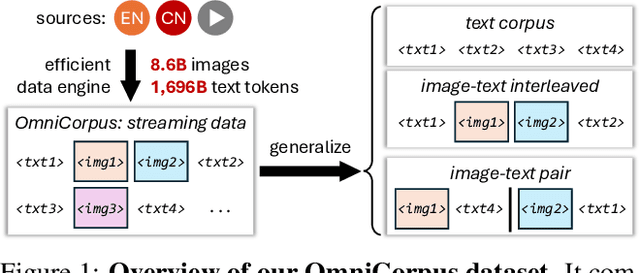


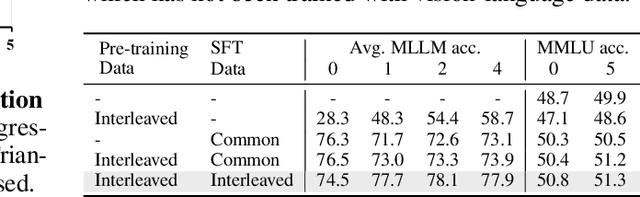
Image-text interleaved data, consisting of multiple images and texts arranged in a natural document format, aligns with the presentation paradigm of internet data and closely resembles human reading habits. Recent studies have shown that such data aids multimodal in-context learning and maintains the capabilities of large language models during multimodal fine-tuning. However, the limited scale and diversity of current image-text interleaved data restrict the development of multimodal large language models. In this paper, we introduce OmniCorpus, a 10 billion-scale image-text interleaved dataset. Using an efficient data engine, we filter and extract large-scale high-quality documents, which contain 8.6 billion images and 1,696 billion text tokens. Compared to counterparts (e.g., MMC4, OBELICS), our dataset 1) has 15 times larger scales while maintaining good data quality; 2) features more diverse sources, including both English and non-English websites as well as video-centric websites; 3) is more flexible, easily degradable from an image-text interleaved format to pure text corpus and image-text pairs. Through comprehensive analysis and experiments, we validate the quality, usability, and effectiveness of the proposed dataset. We hope this could provide a solid data foundation for future multimodal model research. Code and data are released at https://github.com/OpenGVLab/OmniCorpus.

OmniCorpus: An Unified Multimodal Corpus of 10 Billion-Level Images Interleaved with Text
Jun 12, 2024Image-text interleaved data, consisting of multiple images and texts arranged in a natural document format, aligns with the presentation paradigm of internet data and closely resembles human reading habits. Recent studies have shown that such data aids multimodal in-context learning and maintains the capabilities of large language models during multimodal fine-tuning. However, the limited scale and diversity of current image-text interleaved data restrict the development of multimodal large language models. In this paper, we introduce OmniCorpus, a 10 billion-scale image-text interleaved dataset. Using an efficient data engine, we filter and extract large-scale high-quality documents, which contain 8.6 billion images and 1,696 billion text tokens. Compared to counterparts (e.g., MMC4, OBELICS), our dataset 1) has 15 times larger scales while maintaining good data quality; 2) features more diverse sources, including both English and non-English websites as well as video-centric websites; 3) is more flexible, easily degradable from an image-text interleaved format to pure text corpus and image-text pairs. Through comprehensive analysis and experiments, we validate the quality, usability, and effectiveness of the proposed dataset. We hope this could provide a solid data foundation for future multimodal model research. Code and data are released at https://github.com/OpenGVLab/OmniCorpus.
Microsaccade-inspired Event Camera for Robotics
May 28, 2024Neuromorphic vision sensors or event cameras have made the visual perception of extremely low reaction time possible, opening new avenues for high-dynamic robotics applications. These event cameras' output is dependent on both motion and texture. However, the event camera fails to capture object edges that are parallel to the camera motion. This is a problem intrinsic to the sensor and therefore challenging to solve algorithmically. Human vision deals with perceptual fading using the active mechanism of small involuntary eye movements, the most prominent ones called microsaccades. By moving the eyes constantly and slightly during fixation, microsaccades can substantially maintain texture stability and persistence. Inspired by microsaccades, we designed an event-based perception system capable of simultaneously maintaining low reaction time and stable texture. In this design, a rotating wedge prism was mounted in front of the aperture of an event camera to redirect light and trigger events. The geometrical optics of the rotating wedge prism allows for algorithmic compensation of the additional rotational motion, resulting in a stable texture appearance and high informational output independent of external motion. The hardware device and software solution are integrated into a system, which we call Artificial MIcrosaccade-enhanced EVent camera (AMI-EV). Benchmark comparisons validate the superior data quality of AMI-EV recordings in scenarios where both standard cameras and event cameras fail to deliver. Various real-world experiments demonstrate the potential of the system to facilitate robotics perception both for low-level and high-level vision tasks.
U-DiTs: Downsample Tokens in U-Shaped Diffusion Transformers
May 04, 2024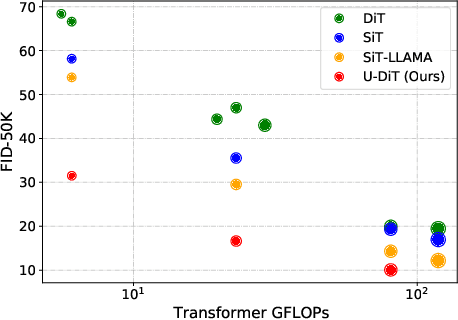
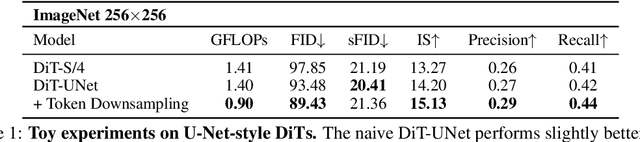
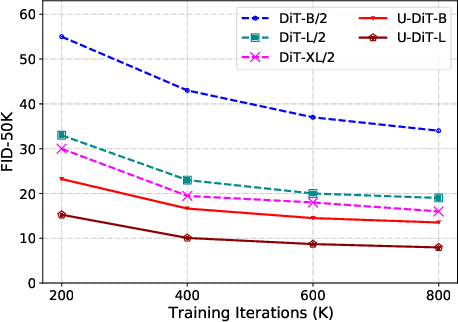
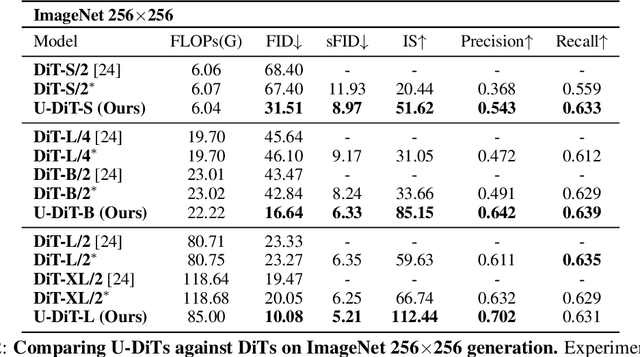
Diffusion Transformers (DiTs) introduce the transformer architecture to diffusion tasks for latent-space image generation. With an isotropic architecture that chains a series of transformer blocks, DiTs demonstrate competitive performance and good scalability; but meanwhile, the abandonment of U-Net by DiTs and their following improvements is worth rethinking. To this end, we conduct a simple toy experiment by comparing a U-Net architectured DiT with an isotropic one. It turns out that the U-Net architecture only gain a slight advantage amid the U-Net inductive bias, indicating potential redundancies within the U-Net-style DiT. Inspired by the discovery that U-Net backbone features are low-frequency-dominated, we perform token downsampling on the query-key-value tuple for self-attention and bring further improvements despite a considerable amount of reduction in computation. Based on self-attention with downsampled tokens, we propose a series of U-shaped DiTs (U-DiTs) in the paper and conduct extensive experiments to demonstrate the extraordinary performance of U-DiT models. The proposed U-DiT could outperform DiT-XL/2 with only 1/6 of its computation cost. Codes are available at https://github.com/YuchuanTian/U-DiT.
Implicit Swept Volume SDF: Enabling Continuous Collision-Free Trajectory Generation for Arbitrary Shapes
May 01, 2024
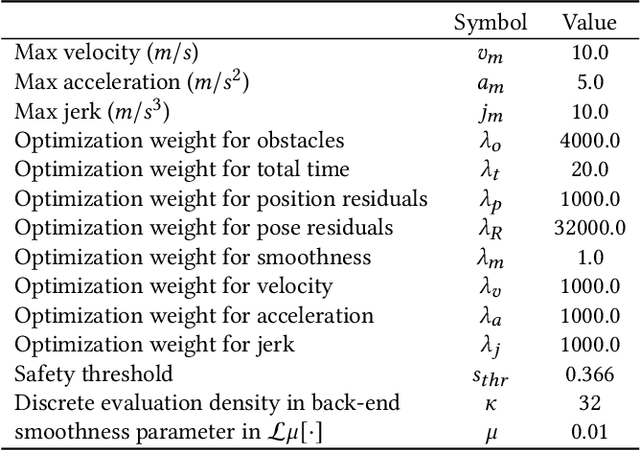

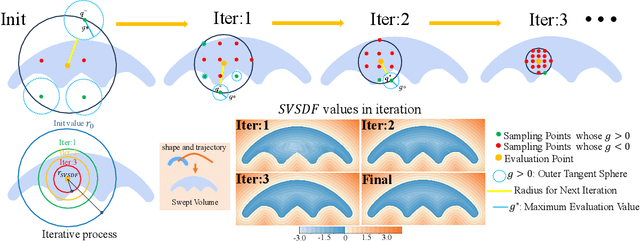
In the field of trajectory generation for objects, ensuring continuous collision-free motion remains a huge challenge, especially for non-convex geometries and complex environments. Previous methods either oversimplify object shapes, which results in a sacrifice of feasible space or rely on discrete sampling, which suffers from the "tunnel effect". To address these limitations, we propose a novel hierarchical trajectory generation pipeline, which utilizes the Swept Volume Signed Distance Field (SVSDF) to guide trajectory optimization for Continuous Collision Avoidance (CCA). Our interdisciplinary approach, blending techniques from graphics and robotics, exhibits outstanding effectiveness in solving this problem. We formulate the computation of the SVSDF as a Generalized Semi-Infinite Programming model, and we solve for the numerical solutions at query points implicitly, thereby eliminating the need for explicit reconstruction of the surface. Our algorithm has been validated in a variety of complex scenarios and applies to robots of various dynamics, including both rigid and deformable shapes. It demonstrates exceptional universality and superior CCA performance compared to typical algorithms. The code will be released at https://github.com/ZJU-FAST-Lab/Implicit-SVSDF-Planner for the benefit of the community.
How Far Are We to GPT-4V? Closing the Gap to Commercial Multimodal Models with Open-Source Suites
Apr 29, 2024
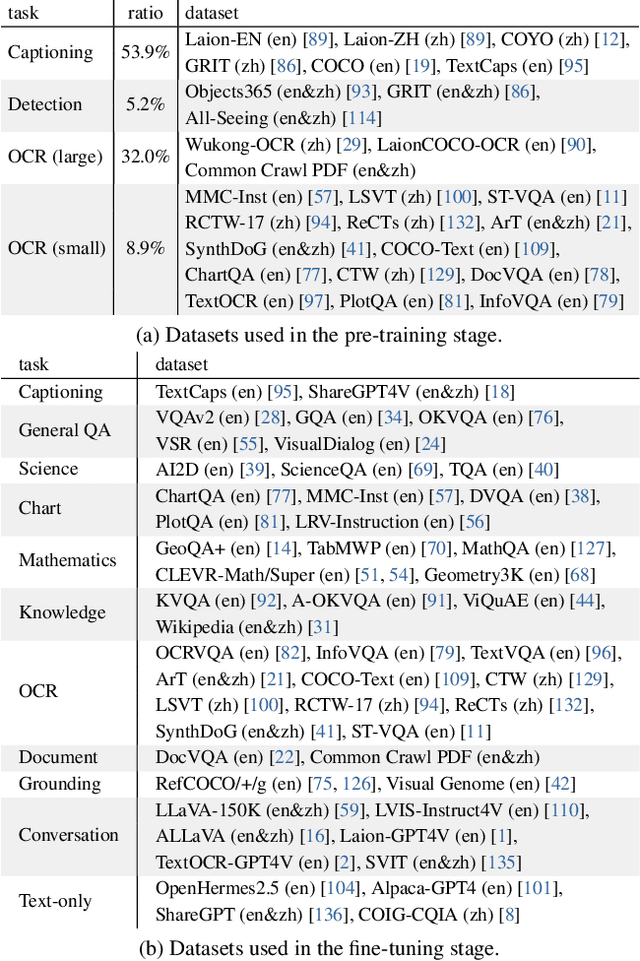
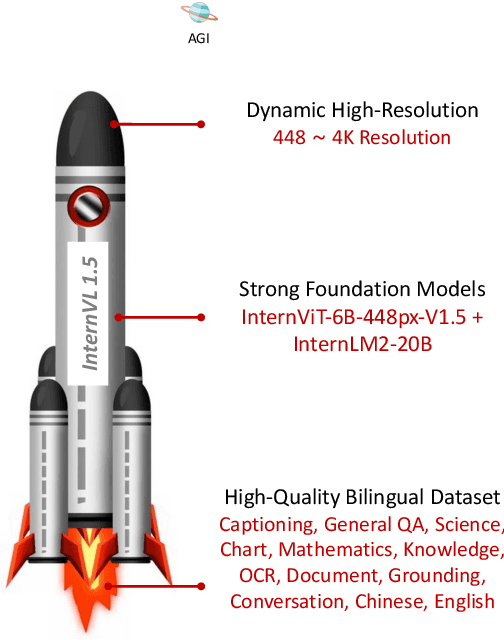
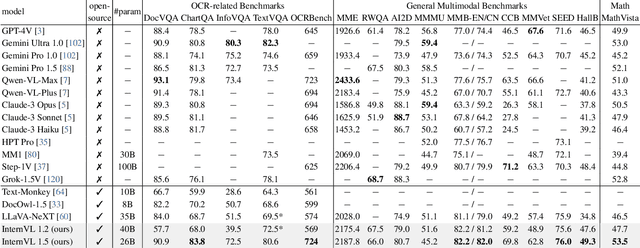
In this report, we introduce InternVL 1.5, an open-source multimodal large language model (MLLM) to bridge the capability gap between open-source and proprietary commercial models in multimodal understanding. We introduce three simple improvements: (1) Strong Vision Encoder: we explored a continuous learning strategy for the large-scale vision foundation model -- InternViT-6B, boosting its visual understanding capabilities, and making it can be transferred and reused in different LLMs. (2) Dynamic High-Resolution: we divide images into tiles ranging from 1 to 40 of 448$\times$448 pixels according to the aspect ratio and resolution of the input images, which supports up to 4K resolution input. (3) High-Quality Bilingual Dataset: we carefully collected a high-quality bilingual dataset that covers common scenes, document images, and annotated them with English and Chinese question-answer pairs, significantly enhancing performance in OCR- and Chinese-related tasks. We evaluate InternVL 1.5 through a series of benchmarks and comparative studies. Compared to both open-source and proprietary models, InternVL 1.5 shows competitive performance, achieving state-of-the-art results in 8 of 18 benchmarks. Code has been released at https://github.com/OpenGVLab/InternVL.
UniMERNet: A Universal Network for Real-World Mathematical Expression Recognition
Apr 23, 2024This paper presents the UniMER dataset to provide the first study on Mathematical Expression Recognition (MER) towards complex real-world scenarios. The UniMER dataset consists of a large-scale training set UniMER-1M offering an unprecedented scale and diversity with one million training instances and a meticulously designed test set UniMER-Test that reflects a diverse range of formula distributions prevalent in real-world scenarios. Therefore, the UniMER dataset enables the training of a robust and high-accuracy MER model and comprehensive evaluation of model performance. Moreover, we introduce the Universal Mathematical Expression Recognition Network (UniMERNet), an innovative framework designed to enhance MER in practical scenarios. UniMERNet incorporates a Length-Aware Module to process formulas of varied lengths efficiently, thereby enabling the model to handle complex mathematical expressions with greater accuracy. In addition, UniMERNet employs our UniMER-1M data and image augmentation techniques to improve the model's robustness under different noise conditions. Our extensive experiments demonstrate that UniMERNet outperforms existing MER models, setting a new benchmark in various scenarios and ensuring superior recognition quality in real-world applications. The dataset and model are available at https://github.com/opendatalab/UniMERNet.
PiRD: Physics-informed Residual Diffusion for Flow Field Reconstruction
Apr 12, 2024
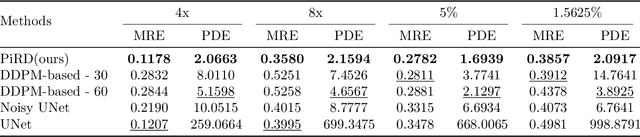

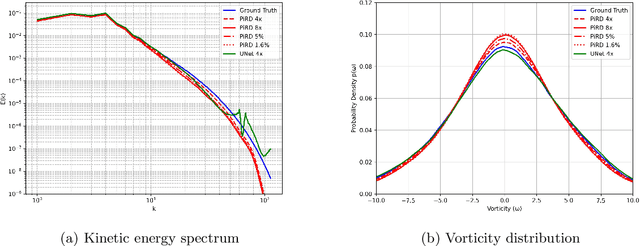
The use of machine learning in fluid dynamics is becoming more common to expedite the computation when solving forward and inverse problems of partial differential equations. Yet, a notable challenge with existing convolutional neural network (CNN)-based methods for data fidelity enhancement is their reliance on specific low-fidelity data patterns and distributions during the training phase. In addition, the CNN-based method essentially treats the flow reconstruction task as a computer vision task that prioritizes the element-wise precision which lacks a physical and mathematical explanation. This dependence can dramatically affect the models' effectiveness in real-world scenarios, especially when the low-fidelity input deviates from the training data or contains noise not accounted for during training. The introduction of diffusion models in this context shows promise for improving performance and generalizability. Unlike direct mapping from a specific low-fidelity to a high-fidelity distribution, diffusion models learn to transition from any low-fidelity distribution towards a high-fidelity one. Our proposed model - Physics-informed Residual Diffusion, demonstrates the capability to elevate the quality of data from both standard low-fidelity inputs, to low-fidelity inputs with injected Gaussian noise, and randomly collected samples. By integrating physics-based insights into the objective function, it further refines the accuracy and the fidelity of the inferred high-quality data. Experimental results have shown that our approach can effectively reconstruct high-quality outcomes for two-dimensional turbulent flows from a range of low-fidelity input conditions without requiring retraining.
TryOn-Adapter: Efficient Fine-Grained Clothing Identity Adaptation for High-Fidelity Virtual Try-On
Apr 01, 2024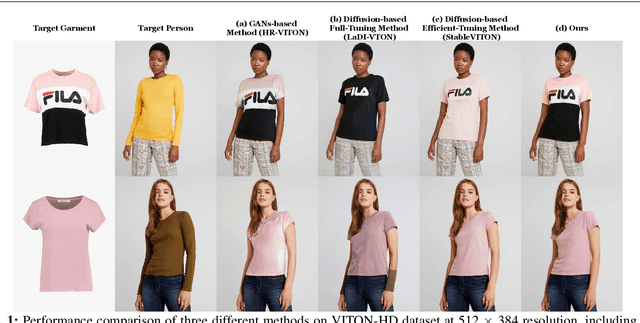


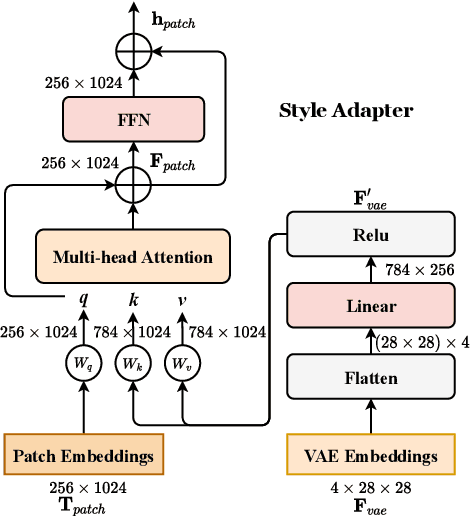
Virtual try-on focuses on adjusting the given clothes to fit a specific person seamlessly while avoiding any distortion of the patterns and textures of the garment. However, the clothing identity uncontrollability and training inefficiency of existing diffusion-based methods, which struggle to maintain the identity even with full parameter training, are significant limitations that hinder the widespread applications. In this work, we propose an effective and efficient framework, termed TryOn-Adapter. Specifically, we first decouple clothing identity into fine-grained factors: style for color and category information, texture for high-frequency details, and structure for smooth spatial adaptive transformation. Our approach utilizes a pre-trained exemplar-based diffusion model as the fundamental network, whose parameters are frozen except for the attention layers. We then customize three lightweight modules (Style Preserving, Texture Highlighting, and Structure Adapting) incorporated with fine-tuning techniques to enable precise and efficient identity control. Meanwhile, we introduce the training-free T-RePaint strategy to further enhance clothing identity preservation while maintaining the realistic try-on effect during the inference. Our experiments demonstrate that our approach achieves state-of-the-art performance on two widely-used benchmarks. Additionally, compared with recent full-tuning diffusion-based methods, we only use about half of their tunable parameters during training. The code will be made publicly available at https://github.com/jiazheng-xing/TryOn-Adapter.
Beyond Talking -- Generating Holistic 3D Human Dyadic Motion for Communication
Mar 28, 2024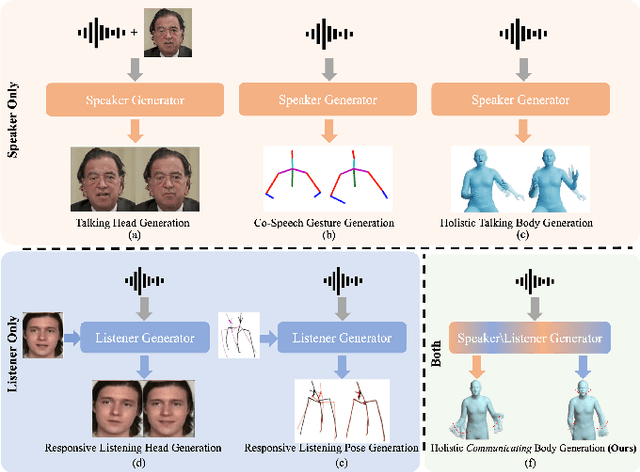
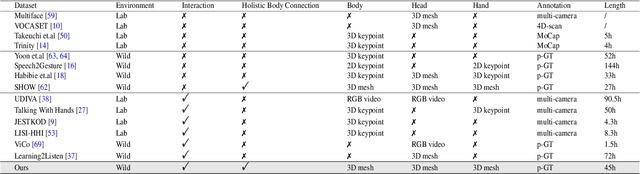
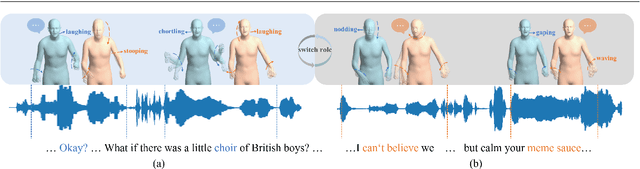
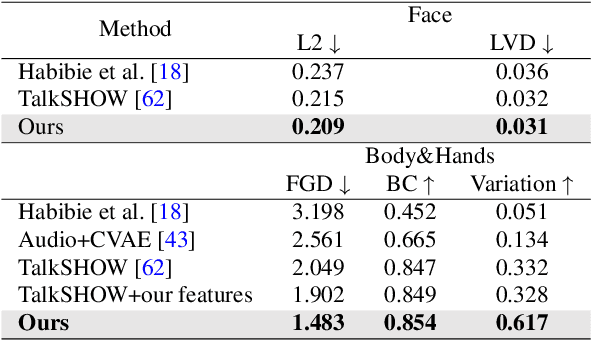
In this paper, we introduce an innovative task focused on human communication, aiming to generate 3D holistic human motions for both speakers and listeners. Central to our approach is the incorporation of factorization to decouple audio features and the combination of textual semantic information, thereby facilitating the creation of more realistic and coordinated movements. We separately train VQ-VAEs with respect to the holistic motions of both speaker and listener. We consider the real-time mutual influence between the speaker and the listener and propose a novel chain-like transformer-based auto-regressive model specifically designed to characterize real-world communication scenarios effectively which can generate the motions of both the speaker and the listener simultaneously. These designs ensure that the results we generate are both coordinated and diverse. Our approach demonstrates state-of-the-art performance on two benchmark datasets. Furthermore, we introduce the HoCo holistic communication dataset, which is a valuable resource for future research. Our HoCo dataset and code will be released for research purposes upon acceptance.