 Add to Chrome
 Add to Firefox
 Add to Edge
Evaluating Counterfactual Sensitivity to Patient Information in Medication-Safety Reasoning
Aug 04, 2026
Applying a valid medication-safety rule when its patient-specific conditions are not met can produce an incorrect decision. Existing medical evaluations largely use isolated and fixed scenarios. A model may therefore answer correctly by recalling a drug-risk association without showing that it used patient information to decide whether the rule applies. To address this gap, we introduce MedPIC-Bench, a benchmark of source-verifiable recommendations and expert-validated questions for patient-specific medication-safety reasoning. It combines guideline-following questions with paired counterfactual questions in which a controlled change in patient information changes whether a rule applies. The benchmark contains 467 questions annotated along six clinical and reasoning dimensions. Across 28 medical-specific, general, and proprietary LLMs, every model performs worse on counterfactual questions, with mean accuracy falling from 63.6\% to 45.1\%. Models perform well when an explicit patient attribute directly signals a familiar contraindication, but struggle when patient information must narrow or withdraw a safety warning. Model rationales often acknowledge the changed patient information, yet the final answers retain the previous safety judgment. This vulnerability persists among medical-specific LLMs, whose average CF performance trails that of general LLMs. MedPIC-Bench therefore makes conditional rule application measurable and highlights the limitations of static medication-safety accuracy for assessing patient-specific reliability.

DART: Decoded Attention over Recurrent States for Efficient Long-Context Sequence Modeling
Aug 03, 2026Modern language models are built primarily from Transformers, recurrent models, and their hybrid architectures. Transformers rely on token-level attention memories, while recurrent models such as state space models (SSMs) and linear attention maintain compact recurrent states. These architectures are typically instantiated separately or interleaved at the layer level, leaving open whether a shared memory representation can support both recurrent compression and attention-style retrieval. We study this question through the state space duality (SSD) view of Mamba-2, where the SSM state can be interpreted as a compressed associative key--value (KV) cache. We observe that Mamba-2 decodes token-conditioned values from this state but does not decode token-conditioned keys. Based on this observation, we propose DART (Decoded Attention over Recurrent sTates), which retains the chunk state contributions produced by the Mamba-2 chunked scan as chunk state memories, decodes token-conditioned keys and values from these memories, and performs state-memory attention (SMA) over the resulting KV pairs. The retrieved output is then combined with the native Mamba-2 output through a gated residual connection. DART supports practical training by reusing the Mamba-2 chunked scan and implementing SMA as a FlashAttention-style computation. Our analysis and experiments show that DART substantially reduces the length-dependent inference cache compared with a matched attention baseline (e.g., $75\%$ savings when the chunk size is $S=256$ and the state size is $N=128$). Compared with Mamba-2, DART substantially improves associative recall and retrieval while preserving general language-modeling quality.
PMC-InterCPT: Rethinking Biomedical Interleaved Data for Multimodal Continued Pretraining
May 31, 2026Large-scale biomedical image-text datasets extracted from scientific literature provide valuable resources for medical multimodal model training. These datasets are commonly organized as image-caption pairs; however, figure captions are often short, context-dependent, and only partially informative without the surrounding article text. At the same time, large-scale automatic extraction introduces structural noise such as missing captions, residual markup, duplicated context, and incoherent multi-paragraph figure descriptions. We revisit data construction for medical multimodal continued pretraining (CPT) and present PMC-InterCPT, a context-grounded biomedical interleaved corpus that incorporates figure-referencing body text in addition to captions. Our pipeline recovers missing captions, cleans caption and context text, reconstructs coherent interleaved image-text samples, and applies LLM-supervised medical relevance and quality classifiers to filter noisy records. We further reveal strong modality imbalance in the resulting corpus and introduce a four-bucket evidence taxonomy for modality-aware resampling. Through CPT followed by supervised fine-tuning (SFT) on Qwen3.5-4B-Base, PMC-InterCPT effectively improves medical and general multimodal performance while using fewer CPT tokens than the raw source pool. The experimental results also illustrate the complementarity between the data quality and modality for medical multimodal CPT.
Not All Disagreement Is Learnable: Token Teachability in On-Policy Distillation
May 26, 2026On-policy distillation (OPD) trains a student on its own rollouts with token-level teacher supervision. Recent selective OPD methods exploit the non-uniformity of OPD signals by prioritizing high-entropy or high-disagreement tokens. We revisit this principle and ask: which token-level teacher signals are actually learnable? Using a fixed-context diagnostic that measures same-context teacher-student KL reduction, we show that raw KL disagreement is a coarse proxy for learning value. It conflates learnable disagreement, where the teacher assigns corrective mass to the student's top-K candidates, with incompatible disagreement, where the teacher places mass mostly off the student's current support. We formalize this local compatibility as token teachability and show that it better predicts fixed-context improvement than raw KL alone. Motivated by this finding, we propose Teachability-Aware OPD (TA-OPD), a lightweight token-position selection method that applies OPD loss to high-teachability positions without reward models or verifiers. Across Qwen2.5 and Qwen 3 teacher-student settings, TA-OPD often surpasses full-token OPD with only 5% retained tokens and improves over entropy- and divergence-based baselines. Our results reframe selective OPD as selecting learnable teacher signals rather than merely salient tokens.
Discovering Physical Directions in Weight Space: Composing Neural PDE Experts
May 14, 2026Recent advances in neural operators have made partial differential equation (PDE) surrogate modeling increasingly scalable and transferable through large-scale pretraining and in-context adaptation. However, after a shared operator is fine-tuned to multiple regimes within a continuous physical family, it remains unclear whether the resulting weight-space updates merely form isolated regime experts or reveal reusable physical structure. Starting from a shared family anchor, we fine-tune low- and high-regime endpoint experts and show that their updates can be separated into a family-shared adaptation and a direction aligned with the underlying physical parameter. This separation reinterprets endpoint experts as finite-difference probes of a local physical direction in weight space, explaining why static averaging can interpolate between regimes but attenuates endpoint-specific physics. Building on this perspective, we propose Calibration-Conditioned Merge (CCM), a post-hoc coordinate readout method for composing neural PDE experts along this physical direction. Given physical metadata, a calibrated coordinate mapping, or a short observed rollout prefix, CCM infers the target composition coordinate and deploys a single merged checkpoint for the remaining rollout. We evaluate CCM on the reaction--diffusion system, viscosity-parameterized two-dimensional Navier--Stokes equations, and radial dam-break dynamics. Across these benchmarks, CCM achieves its strongest gains in extrapolative regimes, reducing out-of-distribution rollout error relative to the family anchor by 54.2%, 42.8%, and 13.8%, respectively. Further experiments across FNO scales, a DPOT-style backbone, and ablations confirm that endpoint fine-tuning is not arbitrary checkpoint drift, but reveals a calibratable physical direction for training-free transfer across PDE regimes.
FeatCal: Feature Calibration for Post-Merging Models
May 13, 2026Model merging combines task experts into one model and avoids joint training, retraining, or deploying many expert models, but the merged model often still underperforms task experts. We study this performance gap through feature drift, the difference between features produced by the merged model and by the expert on the same input. Our theory decomposes this drift into upstream propagation and local mismatch, tracks how it propagates and combines through later layers in forward order, and links final feature drift to output drift. This view motivates FeatCal, which uses a small calibration set to calibrate the merged model weights layer by layer in forward order, reducing feature drift while staying close to merged weights and preserving the benefits of model merging. FeatCal uses an efficient closed-form solution to update model weights, with no gradient descent, iterative optimization, or extra modules. On the main CLIP and GLUE benchmarks, FeatCal beats Surgery and ProbSurgery, the closest post-merging calibration baselines: 85.5% vs. 77.0%/78.8% on CLIP-ViT-B/32 Task Arithmetic (TA) and 85.2% vs. 83.7%/82.2% on FLAN-T5-base GLUE. On CLIP-ViT-B/32, 8 examples per task reach 82.9%, and 256 examples per task take 53 seconds, about 4x faster than both baselines, showing better sample efficiency and lower calibration cost.
Geometry Conflict: Explaining and Controlling Forgetting in LLM Continual Post-Training
May 10, 2026Continual post-training aims to extend large language models (LLMs) with new knowledge, skills, and behaviors, yet it remains unclear when sequential updates enable capability transfer and when they cause catastrophic forgetting. Existing methods mitigate forgetting through sequential fine-tuning, replay, regularization, or model merging, but offer limited criteria for determining when incorporating new updates is beneficial or harmful. In this work, we study LLM continual post-training through three questions: What drives forgetting? When do sequentially acquired capabilities transfer or interfere? How can compatibility be used to control update integration? We address these questions through task geometry: we represent each post-training task by its parameter update and study the covariance geometry induced by the update. Our central finding is that: forgetting can be considered as a state-relative update-integration failure, it arises when the covariance geometries induced by tasks misalign with the geometry of the evolving model state. Sequential updates transfer when they remain compatible with the model state shaped by previous updates, and interfere when state-relative geometry conflict becomes high. Motivated by this finding, we propose Geometry-Conflict Wasserstein Merging (GCWM), a data-free update-integration method that constructs a shared Wasserstein metric via Gaussian Wasserstein barycenters and uses geometry conflict to gate geometry-aware correction. Across Qwen3 0.6B--14B on domain-continual and capability-continual settings, GCWM consistently outperforms data-free baselines, improving retention and final performance without replay data. These results identify geometry conflict as both an explanatory signal for forgetting and a practical control signal for LLM continual post-training.
PiRD: Physics-informed Residual Diffusion for Flow Field Reconstruction
Apr 12, 2024
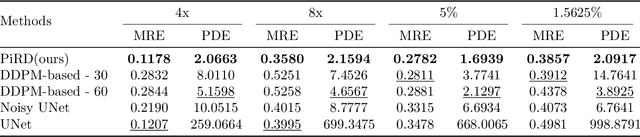

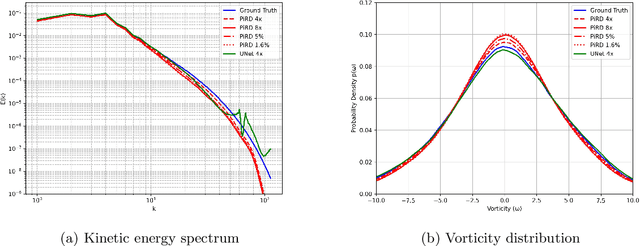
The use of machine learning in fluid dynamics is becoming more common to expedite the computation when solving forward and inverse problems of partial differential equations. Yet, a notable challenge with existing convolutional neural network (CNN)-based methods for data fidelity enhancement is their reliance on specific low-fidelity data patterns and distributions during the training phase. In addition, the CNN-based method essentially treats the flow reconstruction task as a computer vision task that prioritizes the element-wise precision which lacks a physical and mathematical explanation. This dependence can dramatically affect the models' effectiveness in real-world scenarios, especially when the low-fidelity input deviates from the training data or contains noise not accounted for during training. The introduction of diffusion models in this context shows promise for improving performance and generalizability. Unlike direct mapping from a specific low-fidelity to a high-fidelity distribution, diffusion models learn to transition from any low-fidelity distribution towards a high-fidelity one. Our proposed model - Physics-informed Residual Diffusion, demonstrates the capability to elevate the quality of data from both standard low-fidelity inputs, to low-fidelity inputs with injected Gaussian noise, and randomly collected samples. By integrating physics-based insights into the objective function, it further refines the accuracy and the fidelity of the inferred high-quality data. Experimental results have shown that our approach can effectively reconstruct high-quality outcomes for two-dimensional turbulent flows from a range of low-fidelity input conditions without requiring retraining.