 Add to Chrome
 Add to Firefox
 Add to Edge
Acoustic-driven millimetric helical robot: ultrasonic synergistic manipulation in confined fluidic environment
Aug 06, 2026
Acoustic field-driven manipulation provides a non-contact and non-invasive strategy for controlling microscale and nanoscale objects, yet its extension to millimeter-scale robots was limited by insufficient propulsion efficiency in confined biological environments. Here, a coordinated multi-acoustic-field approach is introduced, which harnesses the synergistic action of acoustic radiation forces and acoustic streaming flows to enable controlled locomotion of millimeter-scale helical robots and enhance propulsion. Multiphysics simulations captured the dynamics of millimeter-scale helical robots under combined acoustic fields, and experimental validation demonstrated their locomotion capabilities, including planar navigation, inclined climbing, and vertical motion. Semi-autonomous navigation experiments further confirmed that ultrasonic synergy substantially improved maneuverability. In vitro tests in porcine venous vessels demonstrated that coordinated acoustic fields supported both unidirectional and reciprocating motion under biologically relevant confinement. These findings provide mechanistic insight into scaling acoustic micromanipulation to the millimetre regime and support biomedical applications requiring versatile and controllable robotic mobility.

DART: Decoded Attention over Recurrent States for Efficient Long-Context Sequence Modeling
Aug 03, 2026Modern language models are built primarily from Transformers, recurrent models, and their hybrid architectures. Transformers rely on token-level attention memories, while recurrent models such as state space models (SSMs) and linear attention maintain compact recurrent states. These architectures are typically instantiated separately or interleaved at the layer level, leaving open whether a shared memory representation can support both recurrent compression and attention-style retrieval. We study this question through the state space duality (SSD) view of Mamba-2, where the SSM state can be interpreted as a compressed associative key--value (KV) cache. We observe that Mamba-2 decodes token-conditioned values from this state but does not decode token-conditioned keys. Based on this observation, we propose DART (Decoded Attention over Recurrent sTates), which retains the chunk state contributions produced by the Mamba-2 chunked scan as chunk state memories, decodes token-conditioned keys and values from these memories, and performs state-memory attention (SMA) over the resulting KV pairs. The retrieved output is then combined with the native Mamba-2 output through a gated residual connection. DART supports practical training by reusing the Mamba-2 chunked scan and implementing SMA as a FlashAttention-style computation. Our analysis and experiments show that DART substantially reduces the length-dependent inference cache compared with a matched attention baseline (e.g., $75\%$ savings when the chunk size is $S=256$ and the state size is $N=128$). Compared with Mamba-2, DART substantially improves associative recall and retrieval while preserving general language-modeling quality.
DSSMs: State Space Models with Explicit Memory via Delay Differential Equations
Jul 11, 2026State Space Models (SSMs) have emerged as a powerful paradigm for efficient long-sequence modeling, offering parallel training and fast linear-time recurrent inference. However, like other recurrent architectures, SSMs must compress an unbounded history into a fixed-size state, which limits context retention and makes precise retrieval over long-range context inherently difficult. To overcome this limitation, we propose Delay State Space Models (DSSMs), a delay differential equation (DDE)-inspired extension of diagonal SSMs that augments discrete SSM recurrences with explicit delayed-state feedback. Making explicit delayed feedback practical requires new stability parameterization, history management, and FFT-training tools. We address these challenges with a practical discretization and parameterization grounded in a simple delay-independent stability condition. To bypass direct time-domain kernel construction, we derive the DSSM transfer function and compute kernels in the frequency domain, using a kernel contour shift to suppress aliasing and recover accurate FFT training. Empirically, DSSMs substantially improve targeted delayed-retrieval tasks while outperforming S4D on most standard sequence metrics and remaining close on the others.
BadmintonGRF: A Multimodal Dataset and Benchmark for Markerless Ground Reaction Force Estimation in Badminton
May 03, 2026Multimodal resources for non-periodic court sports with laboratory-grade sensing remain scarce: few publicly pair instrumented ground reaction force (GRF) with high-frame-rate multi-view video, limiting markerless load estimation in realistic training settings. BadmintonGRF records eight synchronized RGB views at ~120 FPS, four Kistler force plates, and Vicon motion capture (C3D) without hardware genlock across modalities; alignment combines human-verified events, automated quality assurance, and per-camera time offsets with uncertainty metadata. Tier 1 distributes pose, time-aligned GRF, metadata, and splits under CC BY-NC 4.0, enabling the primary benchmark without raw RGB or C3D; we report a Tier 1 task that maps 2D pose to GRF. Tier 2 provides raw RGB and C3D under controlled access for studies that require appearance or full kinematics. The public release contains 17,425 impact-segment archives in the 10-subject benchmark tree (156 instrumented trials; raw multi-view RGB alone exceeds 1 TB); benchmark loader gates retain 12,867 view-specific instances and 1,732 unique impacts after multi-view deduplication. We are not aware of prior public badminton corpora that combine this sensing layout with audited video--GRF alignment for impact-centric GRF estimation. We distribute preprocessing code, leave-one-subject-out splits, ten reference baselines, and optional late fusion (one deterministic test-time pass per instance; no test-time augmentation), with a within-trial diagnostic in the supplementary material.
PiRD: Physics-informed Residual Diffusion for Flow Field Reconstruction
Apr 12, 2024
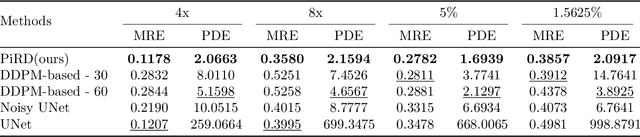

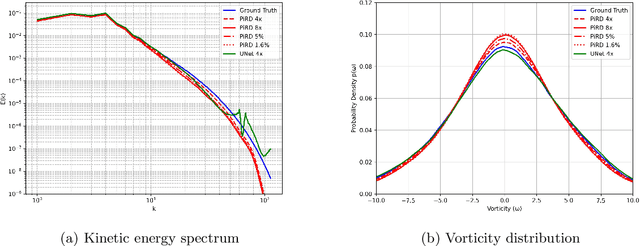
The use of machine learning in fluid dynamics is becoming more common to expedite the computation when solving forward and inverse problems of partial differential equations. Yet, a notable challenge with existing convolutional neural network (CNN)-based methods for data fidelity enhancement is their reliance on specific low-fidelity data patterns and distributions during the training phase. In addition, the CNN-based method essentially treats the flow reconstruction task as a computer vision task that prioritizes the element-wise precision which lacks a physical and mathematical explanation. This dependence can dramatically affect the models' effectiveness in real-world scenarios, especially when the low-fidelity input deviates from the training data or contains noise not accounted for during training. The introduction of diffusion models in this context shows promise for improving performance and generalizability. Unlike direct mapping from a specific low-fidelity to a high-fidelity distribution, diffusion models learn to transition from any low-fidelity distribution towards a high-fidelity one. Our proposed model - Physics-informed Residual Diffusion, demonstrates the capability to elevate the quality of data from both standard low-fidelity inputs, to low-fidelity inputs with injected Gaussian noise, and randomly collected samples. By integrating physics-based insights into the objective function, it further refines the accuracy and the fidelity of the inferred high-quality data. Experimental results have shown that our approach can effectively reconstruct high-quality outcomes for two-dimensional turbulent flows from a range of low-fidelity input conditions without requiring retraining.
Accelerated Distributed Aggregative Optimization
Apr 17, 2023In this paper, we investigate a distributed aggregative optimization problem in a network, where each agent has its own local cost function which depends not only on the local state variable but also on an aggregated function of state variables from all agents. To accelerate the optimization process, we combine heavy ball and Nesterov's accelerated methods with distributed aggregative gradient tracking, and propose two novel algorithms named DAGT-HB and DAGT-NES for solving the distributed aggregative optimization problem. We analyse that the DAGT-HB and DAGT-NES algorithms can converge to an optimal solution at a global $\mathbf{R}-$linear convergence rate when the objective function is smooth and strongly convex, and when the parameters (e.g., step size and momentum coefficients) are selected within certain ranges. A numerical experiment on the optimal placement problem is given to verify the effectiveness and superiority of our proposed algorithms.
The Novel Adaptive Fractional Order Gradient Decent Algorithms Design via Robust Control
Mar 08, 2023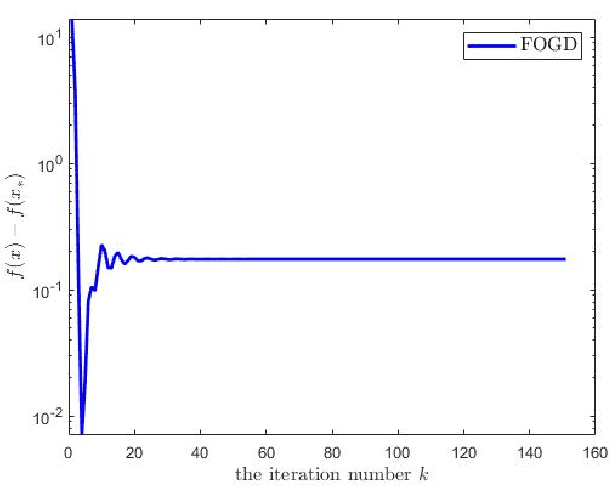
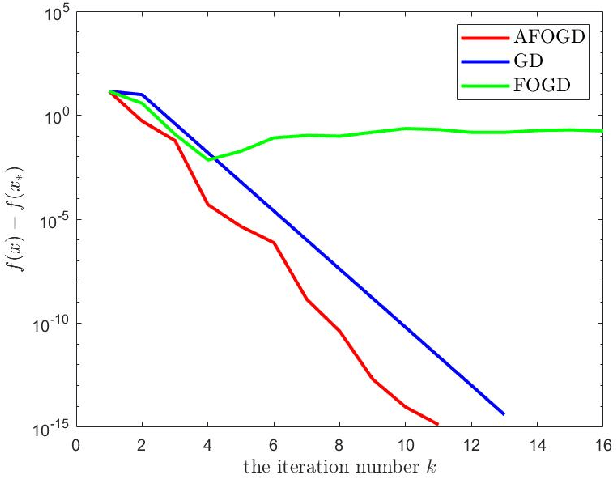
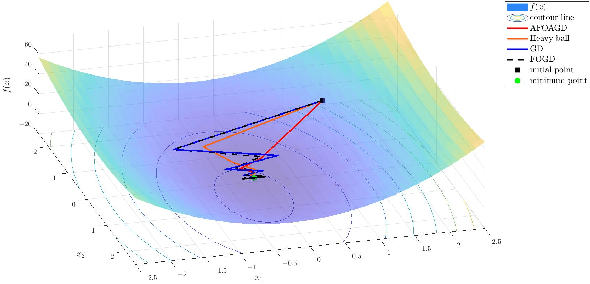

The vanilla fractional order gradient descent may oscillatively converge to a region around the global minimum instead of converging to the exact minimum point, or even diverge, in the case where the objective function is strongly convex. To address this problem, a novel adaptive fractional order gradient descent (AFOGD) method and a novel adaptive fractional order accelerated gradient descent (AFOAGD) method are proposed in this paper. Inspired by the quadratic constraints and Lyapunov stability analysis from robust control theory, we establish a linear matrix inequality to analyse the convergence of our proposed algorithms. We prove that the proposed algorithms can achieve R-linear convergence when the objective function is $\textbf{L-}$smooth and $\textbf{m-}$strongly-convex. Several numerical simulations are demonstrated to verify the effectiveness and superiority of our proposed algorithms.
GotFlow3D: Recurrent Graph Optimal Transport for Learning 3D Flow Motion in Particle Tracking
Oct 31, 2022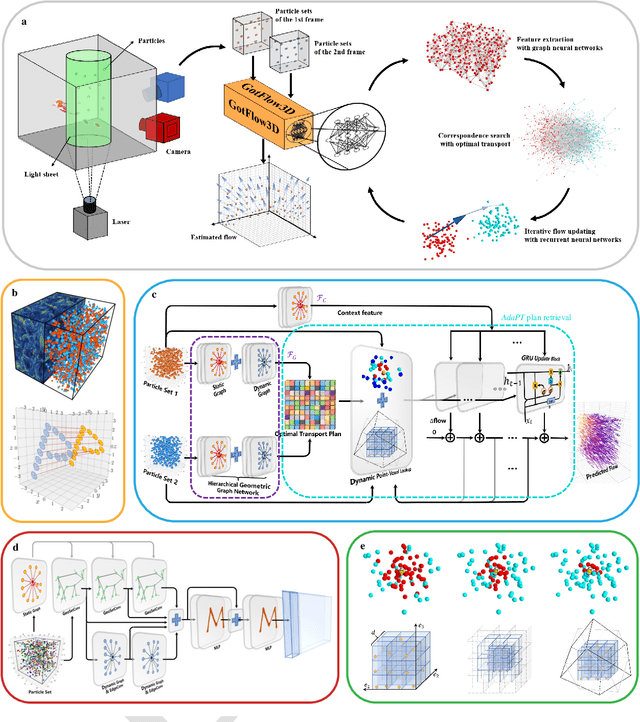
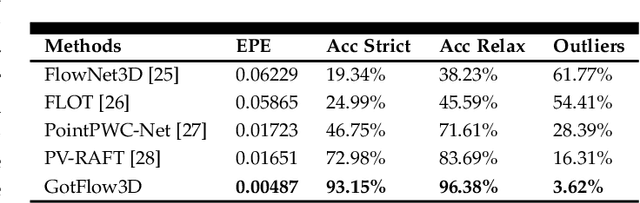
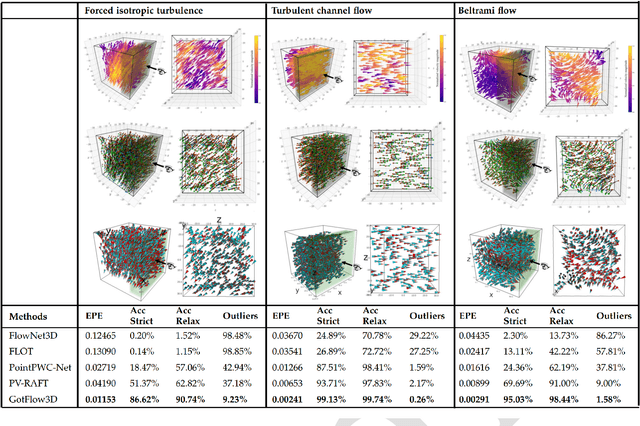

Flow visualization technologies such as particle tracking velocimetry (PTV) are broadly used in understanding the all-pervasiveness three-dimensional (3D) turbulent flow from nature and industrial processes. Despite the advances in 3D acquisition techniques, the developed motion estimation algorithms in particle tracking remain great challenges of large particle displacements, dense particle distributions and high computational cost. By introducing a novel deep neural network based on recurrent Graph Optimal Transport, called GotFlow3D, we present an end-to-end solution to learn the 3D fluid flow motion from double-frame particle sets. The proposed network constructs two graphs in the geometric and feature space and further enriches the original particle representations with the fused intrinsic and extrinsic features learnt from a graph neural network. The extracted deep features are subsequently utilized to make optimal transport plans indicating the correspondences of particle pairs, which are then iteratively and adaptively retrieved to guide the recurrent flow learning. Experimental evaluations, including assessments on numerical experiments and validations on real-world experiments, demonstrate that the proposed GotFlow3D achieves state-of-the-art performance against both recently-developed scene flow learners and particle tracking algorithms, with impressive accuracy, robustness and generalization ability, which can provide deeper insight into the complex dynamics of broad physical and biological systems.
AOSLO-net: A deep learning-based method for automatic segmentation of retinal microaneurysms from adaptive optics scanning laser ophthalmoscope images
Jun 25, 2021
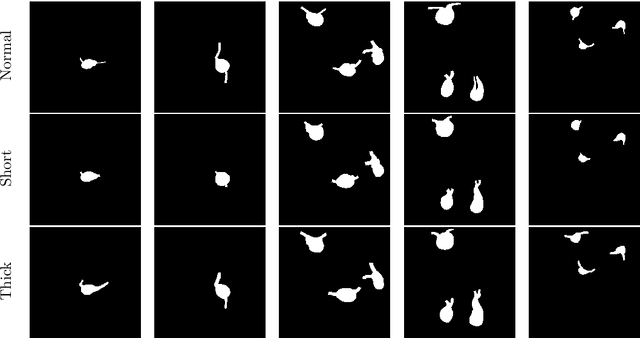
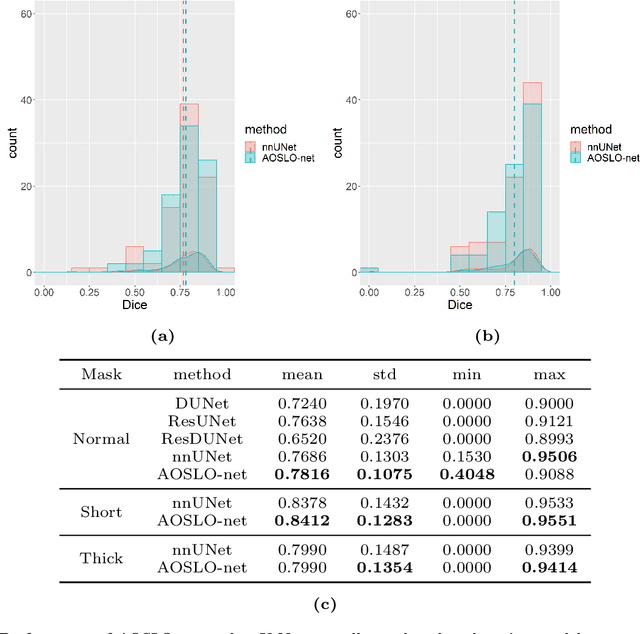
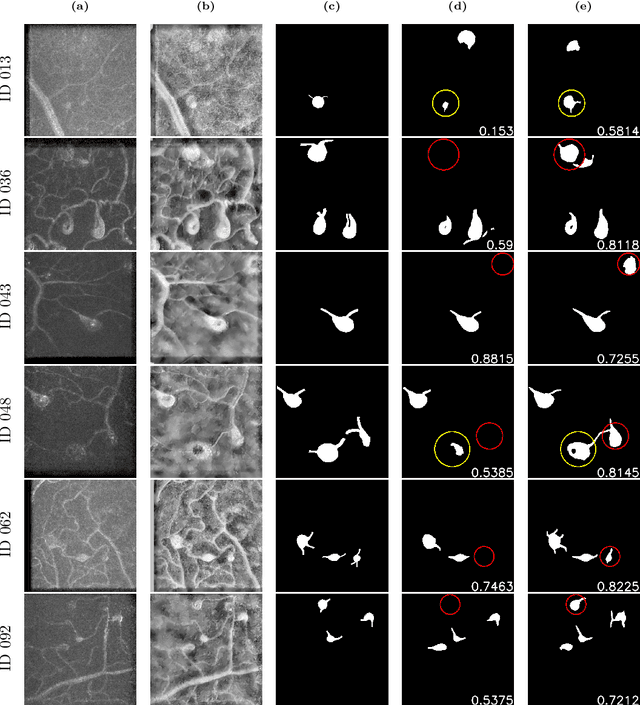
Microaneurysms (MAs) are one of the earliest signs of diabetic retinopathy (DR), a frequent complication of diabetes that can lead to visual impairment and blindness. Adaptive optics scanning laser ophthalmoscopy (AOSLO) provides real-time retinal images with resolution down to 2 $\mu m$ and thus allows detection of the morphologies of individual MAs, a potential marker that might dictate MA pathology and affect the progression of DR. In contrast to the numerous automatic models developed for assessing the number of MAs on fundus photographs, currently there is no high throughput image protocol available for automatic analysis of AOSLO photographs. To address this urgency, we introduce AOSLO-net, a deep neural network framework with customized training policies to automatically segment MAs from AOSLO images. We evaluate the performance of AOSLO-net using 87 DR AOSLO images and our results demonstrate that the proposed model outperforms the state-of-the-art segmentation model both in accuracy and cost and enables correct MA morphological classification.
Physics-informed neural networks (PINNs) for fluid mechanics: A review
May 20, 2021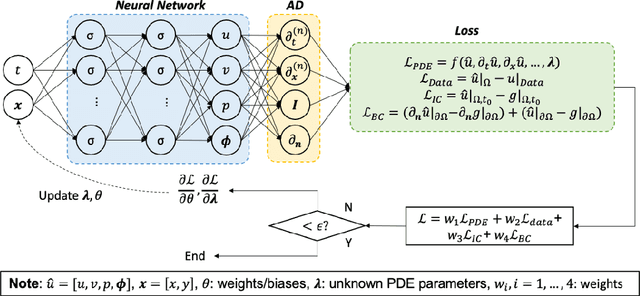
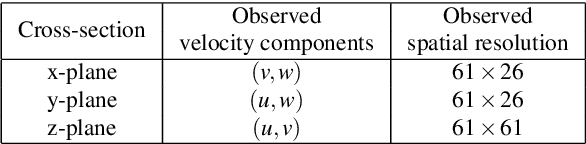
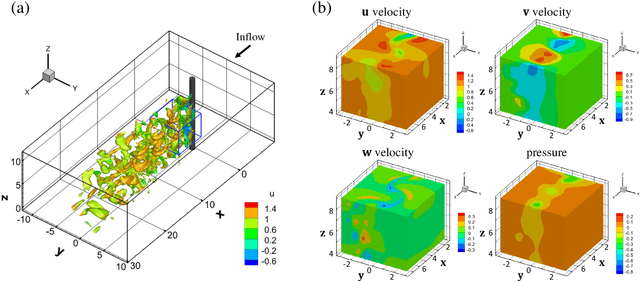
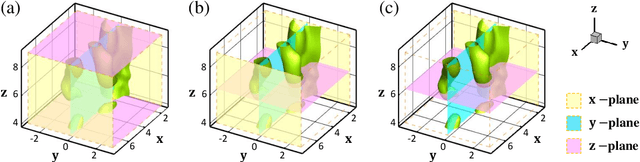
Despite the significant progress over the last 50 years in simulating flow problems using numerical discretization of the Navier-Stokes equations (NSE), we still cannot incorporate seamlessly noisy data into existing algorithms, mesh-generation is complex, and we cannot tackle high-dimensional problems governed by parametrized NSE. Moreover, solving inverse flow problems is often prohibitively expensive and requires complex and expensive formulations and new computer codes. Here, we review flow physics-informed learning, integrating seamlessly data and mathematical models, and implementing them using physics-informed neural networks (PINNs). We demonstrate the effectiveness of PINNs for inverse problems related to three-dimensional wake flows, supersonic flows, and biomedical flows.