 Add to Chrome
 Add to Firefox
 Add to Edge
Convolution for Large Language Models
Jul 20, 2026
Large language models (LLMs) largely rely on Transformers, where self-attention provides global token interaction but does not explicitly encode the locality of natural language. We study whether lightweight depthwise convolutions can supply this local inductive bias without materially increasing model size. Our macro-level ablation compares convolution at 17 locations in a Qwen3 Transformer block and finds the best results when convolution is applied to the projected queries, keys, and values before attention. A subsequent micro-level study favors a residual depthwise convolution with kernel size $k=3$, without additional normalization or activation. Across Qwen3 models and several pre-training data budgets, this design improves the average accuracy on seven downstream benchmarks while adding less than $0.01\%$ parameters. A representation-level case study further suggests that the convolution makes repeated token IDs more sensitive to their immediate context. These results support depthwise convolution as a lightweight complement to self-attention for modeling short-range token interactions.

Agentic Routing: The Harness-Native Data Flywheel
Jul 13, 2026Large language model agents are increasingly executed not by a single model call, but by an execution harness that manages observation, context, control, action, state, and verification. At the same time, frontier and open models are becoming structurally specialized: a model that is strong at code editing, long-context recovery, tool use, mathematical reasoning, or low-latency response may not dominate on the other axes. This makes model selection inside an agent a core systems problem rather than a per-query serving trick. Existing routing methods mostly optimize single-turn cost-quality trade-offs and therefore miss the execution state, intermediate failures, and feedback loops that make agents different from chat completion. We propose Harness-Native agentic routing, a step-level routing paradigm that selects either a single best-fit model for cost-effective execution or multiple complementary models for ensemble-style accuracy improvement, conditioned on the full harness state. The key insight is that every routing decision naturally produces a structured data record -- consisting of the query, harness state, model choice or model set, execution trace, outcome, and cost -- whose labels are supplied by the environment rather than by the router itself. These records form a harness-native data flywheel: execution traces train better routers and harness-native models, which improve cost-quality trade-offs and generate more traces under the same budget. We instantiate this idea in OpenSquilla with a four-layer routing stack, an open LightGBM cold-start ranker, and a staged router-model path that turns logged arena records into progressively stronger routing policies. The report studies singleton and multi-model routing on agentic benchmarks including DRACO and PinchBench, and argues that agentic routing is not merely cost control, but a data engine for agent-native training.
SafeClawBench: Separating Semantic, Audit-Evidence, and Sandbox Harm in Tool-Using LLM Agents
Jun 16, 2026Tool-using language-model agents introduce security failures that go beyond unsafe text: they can disclose protected objects, write persistent memory, send messages, modify databases, or trigger harmful code and tool effects. Existing evaluations often collapse these stages into a single attack success rate, making it difficult to tell whether a model merely agreed with an attacker or actually produced observable harm. We introduce SafeClawBench, a staged benchmark for tool-using agent security with 600 controlled adversarial tasks across six attack families: direct and indirect prompt injection, tool-return injection, memory poisoning, memory extraction, and ambiguity-driven unsafe inference. SafeClawBench reports three separate endpoints: semantic attack acceptance, audit-visible harm evidence, and sandbox-observed tool/state harm. Evaluating five agent endpoints under four prompt-level policies, we find that these endpoints capture different failure modes. Without additional prompt protection, semantic failure rates vary widely across models, from 9.0% to 44.2%. Audited harm evidence is narrower than semantic failure, and under a separate executable protocol some matched task identities produce sandbox harm despite passing the Semantic Core call: in a 12,000-row matched analysis, 291 of 347 observed sandbox harms occur in rows that pass the semantic check. Prompt policies change endpoint outcomes, but their effects depend on both model and protocol. SafeClawBench provides a reproducible framework for comparing agent models and prompt-policy conditions without conflating textual compliance, evidence-supported harm, and executable state changes. The open-source dataset is available at https://huggingface.co/datasets/sairights/safeclawbench.
Claw-SWE-Bench: A Benchmark for Evaluating OpenClaw-style Agent Harnesses on Coding Tasks
Jun 10, 2026General-purpose agents such as OpenClaw are increasingly used as autonomous tool users, but their coding ability is difficult to measure under SWE-bench: a generic agent does not by itself satisfy the clean Docker workspace, patch, and prediction contract required for scoring. We introduce Claw-SWE-Bench, a multilingual SWE-bench-style benchmark and adapter protocol that makes heterogeneous agent harnesses, or claws, comparable under fair settings including a fixed prompt, runtime budget, workspace contract, patch extraction procedure, and evaluator. The full benchmark contains 350 GitHub issue-resolution instances across 8 languages and 43 repositories, drawn from SWE-bench-Multilingual and SWE-bench-Verified-Mini after future-commit cleanup. We also release Claw-SWE-Bench Lite for faster validation, which is an 80-instance subset selected by a cost-aware, rank-aware procedure over 17 calibration columns. On the full benchmark, OpenClaw with a minimal direct-diff adapter scores only $19.1\%$ Pass@1, whereas the full adapter reaches $73.4\%$ with the same GLM 5.1 backbone, showing that adapter design is essential for enabling OpenClaw-style harnesses to perform coding tasks effectively. Across an OpenClaw $\times$ nine-model sweep and a five-claw $\times$ two-model sweep, model choice changes Pass@1 by $29.4$ pp and harness choice by $27.4$ pp under fixed models; systems with similar accuracy can differ substantially in total API cost. Claw-SWE-Bench therefore treats harness and cost accounting as first-class axes of SWE-style coding-agent evaluation, providing both a full benchmark and a low-cost reference set for reproducible comparison. The data is available at https://github.com/opensquilla/claw-swe-bench and https://huggingface.co/datasets/TokenRhythm/Claw-SWE-Bench.
DLLM Agent: See Farther, Run Faster
Feb 07, 2026Diffusion large language models (DLLMs) have emerged as an alternative to autoregressive (AR) decoding with appealing efficiency and modeling properties, yet their implications for agentic multi-step decision making remain underexplored. We ask a concrete question: when the generation paradigm is changed but the agent framework and supervision are held fixed, do diffusion backbones induce systematically different planning and tool-use behaviors, and do these differences translate into end-to-end efficiency gains? We study this in a controlled setting by instantiating DLLM and AR backbones within the same agent workflow (DeepDiver) and performing matched agent-oriented fine-tuning on the same trajectory data, yielding diffusion-backed DLLM Agents and directly comparable AR agents. Across benchmarks and case studies, we find that, at comparable accuracy, DLLM Agents are on average over 30% faster end to end than AR agents, with some cases exceeding 8x speedup. Conditioned on correct task completion, DLLM Agents also require fewer interaction rounds and tool invocations, consistent with higher planner hit rates that converge earlier to a correct action path with less backtracking. We further identify two practical considerations for deploying diffusion backbones in tool-using agents. First, naive DLLM policies are more prone to structured tool-call failures, necessitating stronger tool-call-specific training to emit valid schemas and arguments. Second, for multi-turn inputs interleaving context and action spans, diffusion-style span corruption requires aligned attention masking to avoid spurious context-action information flow; without such alignment, performance degrades. Finally, we analyze attention dynamics across workflow stages and observe paradigm-specific coordination patterns, suggesting stronger global planning signals in diffusion-backed agents.
Top 10 Open Challenges Steering the Future of Diffusion Language Model and Its Variants
Jan 20, 2026The paradigm of Large Language Models (LLMs) is currently defined by auto-regressive (AR) architectures, which generate text through a sequential ``brick-by-brick'' process. Despite their success, AR models are inherently constrained by a causal bottleneck that limits global structural foresight and iterative refinement. Diffusion Language Models (DLMs) offer a transformative alternative, conceptualizing text generation as a holistic, bidirectional denoising process akin to a sculptor refining a masterpiece. However, the potential of DLMs remains largely untapped as they are frequently confined within AR-legacy infrastructures and optimization frameworks. In this Perspective, we identify ten fundamental challenges ranging from architectural inertia and gradient sparsity to the limitations of linear reasoning that prevent DLMs from reaching their ``GPT-4 moment''. We propose a strategic roadmap organized into four pillars: foundational infrastructure, algorithmic optimization, cognitive reasoning, and unified multimodal intelligence. By shifting toward a diffusion-native ecosystem characterized by multi-scale tokenization, active remasking, and latent thinking, we can move beyond the constraints of the causal horizon. We argue that this transition is essential for developing next-generation AI capable of complex structural reasoning, dynamic self-correction, and seamless multimodal integration.
Deferred Commitment Decoding for Diffusion Language Models with Confidence-Aware Sliding Windows
Jan 05, 2026Diffusion language models (DLMs) have recently emerged as a strong alternative to autoregressive models by enabling parallel text generation. To improve inference efficiency and KV-cache compatibility, prior work commonly adopts block-based diffusion, decoding tokens block by block. However, this paradigm suffers from a structural limitation that we term Boundary-Induced Context Truncation (BICT): undecoded tokens near block boundaries are forced to commit without access to nearby future context, even when such context could substantially reduce uncertainty. This limitation degrades decoding confidence and generation quality, especially for tasks requiring precise reasoning, such as mathematical problem solving and code generation. We propose Deferred Commitment Decoding (DCD), a novel, training-free decoding strategy that mitigates this issue. DCD maintains a confidence-aware sliding window over masked tokens, resolving low-uncertainty tokens early while deferring high-uncertainty tokens until sufficient contextual evidence becomes available. This design enables effective bidirectional information flow within the decoding window without sacrificing efficiency. Extensive experiments across multiple diffusion language models, benchmarks, and caching configurations show that DCD improves generation accuracy by 1.39% with comparable time on average compared to fixed block-based diffusion methods, with the most significant improvement reaching 9.0%. These results demonstrate that deferring token commitment based on uncertainty is a simple yet effective principle for improving both the quality and efficiency of diffusion language model decoding.
Circle-RoPE: Cone-like Decoupled Rotary Positional Embedding for Large Vision-Language Models
May 22, 2025Rotary Position Embedding (RoPE) is a widely adopted technique for encoding relative positional information in large language models (LLMs). However, when extended to large vision-language models (LVLMs), its variants introduce unintended cross-modal positional biases. Specifically, they enforce relative positional dependencies between text token indices and image tokens, causing spurious alignments. This issue arises because image tokens representing the same content but located at different spatial positions are assigned distinct positional biases, leading to inconsistent cross-modal associations. To address this, we propose Per-Token Distance (PTD) - a simple yet effective metric for quantifying the independence of positional encodings across modalities. Informed by this analysis, we introduce Circle-RoPE, a novel encoding scheme that maps image token indices onto a circular trajectory orthogonal to the linear path of text token indices, forming a cone-like structure. This configuration ensures that each text token maintains an equal distance to all image tokens, reducing artificial cross-modal biases while preserving intra-image spatial information. To further enhance performance, we propose a staggered layer strategy that applies different RoPE variants across layers. This design leverages the complementary strengths of each RoPE variant, thereby enhancing the model's overall performance. Our experimental results demonstrate that our method effectively preserves spatial information from images while reducing relative positional bias, offering a more robust and flexible positional encoding framework for LVLMs. The code is available at [https://github.com/lose4578/CircleRoPE](https://github.com/lose4578/CircleRoPE).
Post-Training Quantization for Diffusion Transformer via Hierarchical Timestep Grouping
Mar 10, 2025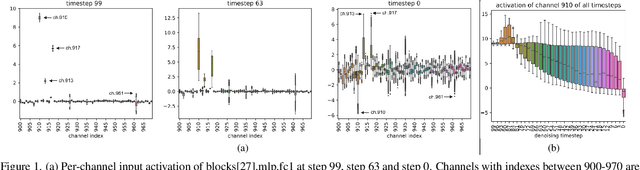
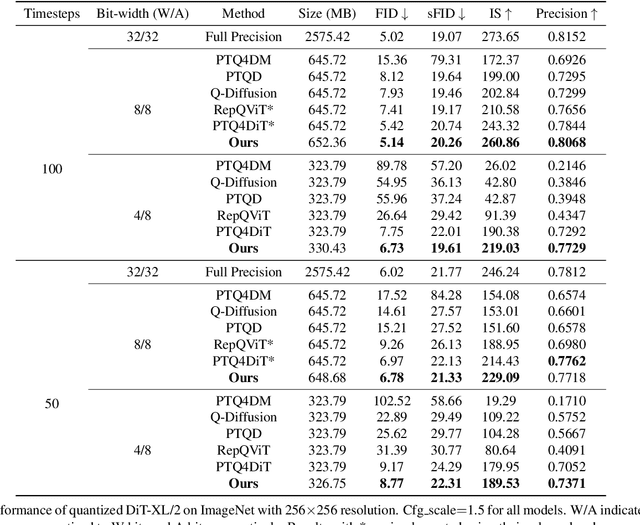
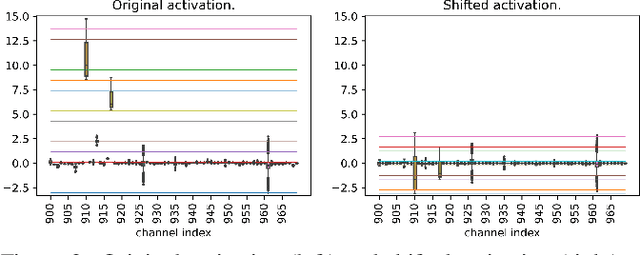
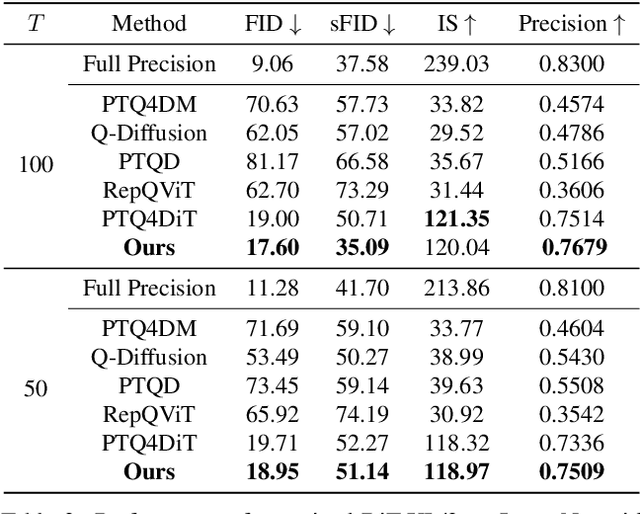
Diffusion Transformer (DiT) has now become the preferred choice for building image generation models due to its great generation capability. Unlike previous convolution-based UNet models, DiT is purely composed of a stack of transformer blocks, which renders DiT excellent in scalability like large language models. However, the growing model size and multi-step sampling paradigm bring about considerable pressure on deployment and inference. In this work, we propose a post-training quantization framework tailored for Diffusion Transforms to tackle these challenges. We firstly locate that the quantization difficulty of DiT mainly originates from the time-dependent channel-specific outliers. We propose a timestep-aware shift-and-scale strategy to smooth the activation distribution to reduce the quantization error. Secondly, based on the observation that activations of adjacent timesteps have similar distributions, we utilize a hierarchical clustering scheme to divide the denoising timesteps into multiple groups. We further design a re-parameterization scheme which absorbs the quantization parameters into nearby module to avoid redundant computations. Comprehensive experiments demonstrate that out PTQ method successfully quantize the Diffusion Transformer into 8-bit weight and 8-bit activation (W8A8) with state-of-the-art FiD score. And our method can further quantize DiT model into 4-bit weight and 8-bit activation (W4A8) without sacrificing generation quality.
DiC: Rethinking Conv3x3 Designs in Diffusion Models
Dec 31, 2024


Diffusion models have shown exceptional performance in visual generation tasks. Recently, these models have shifted from traditional U-Shaped CNN-Attention hybrid structures to fully transformer-based isotropic architectures. While these transformers exhibit strong scalability and performance, their reliance on complicated self-attention operation results in slow inference speeds. Contrary to these works, we rethink one of the simplest yet fastest module in deep learning, 3x3 Convolution, to construct a scaled-up purely convolutional diffusion model. We first discover that an Encoder-Decoder Hourglass design outperforms scalable isotropic architectures for Conv3x3, but still under-performing our expectation. Further improving the architecture, we introduce sparse skip connections to reduce redundancy and improve scalability. Based on the architecture, we introduce conditioning improvements including stage-specific embeddings, mid-block condition injection, and conditional gating. These improvements lead to our proposed Diffusion CNN (DiC), which serves as a swift yet competitive diffusion architecture baseline. Experiments on various scales and settings show that DiC surpasses existing diffusion transformers by considerable margins in terms of performance while keeping a good speed advantage. Project page: https://github.com/YuchuanTian/DiC