 Add to Chrome
 Add to Firefox
 Add to Edge
DART: Decoded Attention over Recurrent States for Efficient Long-Context Sequence Modeling
Aug 03, 2026
Modern language models are built primarily from Transformers, recurrent models, and their hybrid architectures. Transformers rely on token-level attention memories, while recurrent models such as state space models (SSMs) and linear attention maintain compact recurrent states. These architectures are typically instantiated separately or interleaved at the layer level, leaving open whether a shared memory representation can support both recurrent compression and attention-style retrieval. We study this question through the state space duality (SSD) view of Mamba-2, where the SSM state can be interpreted as a compressed associative key--value (KV) cache. We observe that Mamba-2 decodes token-conditioned values from this state but does not decode token-conditioned keys. Based on this observation, we propose DART (Decoded Attention over Recurrent sTates), which retains the chunk state contributions produced by the Mamba-2 chunked scan as chunk state memories, decodes token-conditioned keys and values from these memories, and performs state-memory attention (SMA) over the resulting KV pairs. The retrieved output is then combined with the native Mamba-2 output through a gated residual connection. DART supports practical training by reusing the Mamba-2 chunked scan and implementing SMA as a FlashAttention-style computation. Our analysis and experiments show that DART substantially reduces the length-dependent inference cache compared with a matched attention baseline (e.g., $75\%$ savings when the chunk size is $S=256$ and the state size is $N=128$). Compared with Mamba-2, DART substantially improves associative recall and retrieval while preserving general language-modeling quality.

DSSMs: State Space Models with Explicit Memory via Delay Differential Equations
Jul 11, 2026State Space Models (SSMs) have emerged as a powerful paradigm for efficient long-sequence modeling, offering parallel training and fast linear-time recurrent inference. However, like other recurrent architectures, SSMs must compress an unbounded history into a fixed-size state, which limits context retention and makes precise retrieval over long-range context inherently difficult. To overcome this limitation, we propose Delay State Space Models (DSSMs), a delay differential equation (DDE)-inspired extension of diagonal SSMs that augments discrete SSM recurrences with explicit delayed-state feedback. Making explicit delayed feedback practical requires new stability parameterization, history management, and FFT-training tools. We address these challenges with a practical discretization and parameterization grounded in a simple delay-independent stability condition. To bypass direct time-domain kernel construction, we derive the DSSM transfer function and compute kernels in the frequency domain, using a kernel contour shift to suppress aliasing and recover accurate FFT training. Empirically, DSSMs substantially improve targeted delayed-retrieval tasks while outperforming S4D on most standard sequence metrics and remaining close on the others.
Swarm-Inspired Generation of Collective Behaviors in Graph Dynamical Systems
Jun 23, 2026Collective behavior arises when locally interacting units produce coordinated global organization, from synchronization in dynamical systems to task-relevant information flow on graphs. The central challenge is not only to explain how collective behavior emerges, but to design local interaction rules that can produce desired global organization and generalize across graphs, dynamics and tasks.To address this challenge, we introduce the Swarm-Inspired Emergent Synchronizer (SIES), a graph-dynamical framework that learns generalizable local-interaction laws for controllable collective organization. Each node is an agent-like dynamical unit with a state and task cue, and signed source-target-conditioned attention acts as an adaptive coupling term inside an explicit evolution model. Therefore, SIES combines an explicit dynamical engine with local agent intelligence, similar to biological swarms. For synchronization control, SIES learns a generalizable coupling operator that produces prescribed synchronization patterns for CDSs across untrained network scales, target phase relations, and intrinsic node dynamics without retraining. The learned operator also reaches gait-related modes faster than three oscillator baselines and generalizes synchronization-driven locomotion to simulated multi-legged robots of different scales and a physical hexapod after leg disablement. For graph representation learning, SIES applies the same signed interaction principle to message passing and achieves the highest performance among the compared methods on heterophilous node-classification benchmarks. Together, these results position SIES as a generalizable and learnable graph-dynamical interaction framework with promise for synchronization control, adaptive robot coordination, and heterophilous graph representation learning.
VICX: Generalizable Robot Manipulation via Video Generation and In-Context Operator Network
Jun 10, 2026Generalizable robot manipulation requires not only task-level reasoning over unseen scenes, but also reliable grounding of visual plans into embodiment-specific execution. To bridge this gap, we propose VICX (Video generation and In-Context eXecution), a decoupled closed-loop manipulation framework. In VICX, a frozen video generation model produces vision-language-conditioned high-level visual plans, while a Video-to-Trajectory In-Context Operator Network (V2T-ICON) serves as the task-agnostic interface that grounds these plans into executable robot-state trajectories. To improve execution generalization, V2T-ICON operates on segmentation-extracted arm-only frame observations and uses retrieved image-state pairs as in-context prompts, allowing a robust and generalizable visual-to-state mapping at inference time without parameter updates. Experiments on Meta-World show that VICX supports cross-task generalization, closed-loop self-correction, and cross-embodiment transfer, demonstrating dual generalization across both task semantics and robot execution. The project webpage can be found here: https://scaling-group.github.io/vicx/.
DORA: Dynamic Online Reinforcement Agent for Token Merging in Vision Transformers
May 12, 2026Vision Transformers (ViTs) incur significant computational overhead due to the quadratic complexity of self-attention relative to the token sequence length. While existing token reduction methods mitigate this issue, they predominantly rely on fixed heuristic metrics, predefined ratios, or static offline masks, which lack the adaptability to capture input-dependent redundancy during inference. In this paper, we propose DORA (Dynamic Online Reinforcement Agent), the first reinforcement learning (RL)-driven online inference framework for dynamic token merging in ViTs. We formulate the merging process as a sequential Markov Decision Process (MDP), where a lightweight RL agent determines the merging strategy for each Transformer block based on the current feature state and layer-specific context. To balance computational efficiency and feature fidelity, the agent is optimized via a dense reward function incorporating a non-linear distillation-based penalty. We implement an asymmetric Actor-Critic architecture that utilizes a high-capacity Critic for stable offline training while retaining a minimal Actor head for low-computation online inference. Evaluations across multiple ViT scales (Tiny to Large) demonstrate that DORA improves the accuracy-efficiency Pareto front compared to current baselines. Under strict negligible accuracy-drop constraints (<= 0.05%), DORA achieves up to a 12.66% token merging rate, and delivers up to a 569.7% relative improvement over the most efficient baseline. On ImageNet-1K, under aligned accuracy constraints, DORA achieves up to a 76% relative improvement in computational savings compared to state-of-the-art methods. Furthermore, on out-of-distribution (OOD) benchmarks such as ImageNet-A and ImageNet-C, DORA attains a relative efficiency advantage of over 430%.
An FPGA Implementation of Displacement Vector Search for Intra Pattern Copy in JPEG XS
Mar 11, 2026Recently, progress has been made on the Intra Pattern Copy (IPC) tool for JPEG XS, an image compression standard designed for low-latency and low-complexity coding. IPC performs wavelet-domain intra compensation predictions to reduce spatial redundancy in screen content. A key module of IPC is the displacement vector (DV) search, which aims to solve the optimal prediction reference offset. However, the DV search process is computationally intensive, posing challenges for practical hardware deployment. In this paper, we propose an efficient pipelined FPGA architecture design for the DV search module to promote the practical deployment of IPC. Optimized memory organization, which leverages the IPC computational characteristics and data inherent reuse patterns, is further introduced to enhance the performance. Experimental results show that our proposed architecture achieves a throughput of 38.3 Mpixels/s with a power consumption of 277 mW, demonstrating its feasibility for practical hardware implementation in IPC and other predictive coding tools, and providing a promising foundation for ASIC deployment.
SecAgent: Efficient Mobile GUI Agent with Semantic Context
Mar 09, 2026Mobile Graphical User Interface (GUI) agents powered by multimodal large language models have demonstrated promising capabilities in automating complex smartphone tasks. However, existing approaches face two critical limitations: the scarcity of high-quality multilingual datasets, particularly for non-English ecosystems, and inefficient history representation methods. To address these challenges, we present SecAgent, an efficient mobile GUI agent at 3B scale. We first construct a human-verified Chinese mobile GUI dataset with 18k grounding samples and 121k navigation steps across 44 applications, along with a Chinese navigation benchmark featuring multi-choice action annotations. Building upon this dataset, we propose a semantic context mechanism that distills history screenshots and actions into concise, natural language summaries, significantly reducing computational costs while preserving task-relevant information. Through supervised and reinforcement fine-tuning, SecAgent outperforms similar-scale baselines and achieves performance comparable to 7B-8B models on our and public navigation benchmarks. We will open-source the training dataset, benchmark, model, and code to advance research in multilingual mobile GUI automation.
SASQ: Static Activation Scaling for Quantization-Aware Training in Large Language Models
Dec 16, 2025Large language models (LLMs) excel at natural language tasks but face deployment challenges due to their growing size outpacing GPU memory advancements. Model quantization mitigates this issue by lowering weight and activation precision, but existing solutions face fundamental trade-offs: dynamic quantization incurs high computational overhead and poses deployment challenges on edge devices, while static quantization sacrifices accuracy. Existing approaches of quantization-aware training (QAT) further suffer from weight training costs. We propose SASQ: a lightweight QAT framework specifically tailored for activation quantization factors. SASQ exclusively optimizes only the quantization factors (without changing pre-trained weights), enabling static inference with high accuracy while maintaining deployment efficiency. SASQ adaptively truncates some outliers, thereby reducing the difficulty of quantization while preserving the distributional characteristics of the activations. SASQ not only surpasses existing SOTA quantization schemes but also outperforms the corresponding FP16 models. On LLaMA2-7B, it achieves 5.2% lower perplexity than QuaRot and 4.7% lower perplexity than the FP16 model on WikiText2.
Ocean-OCR: Towards General OCR Application via a Vision-Language Model
Jan 26, 2025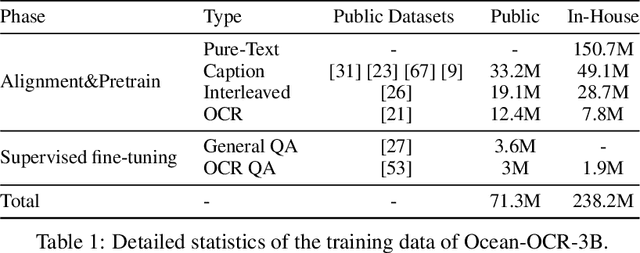
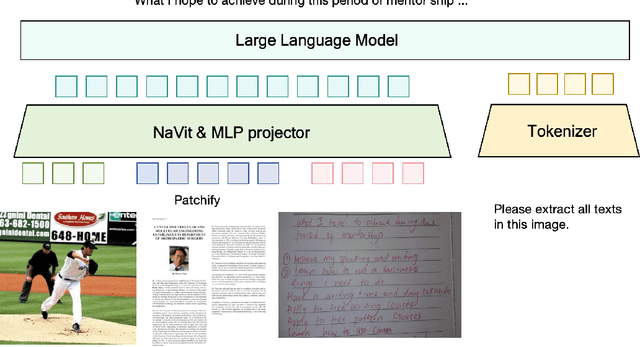
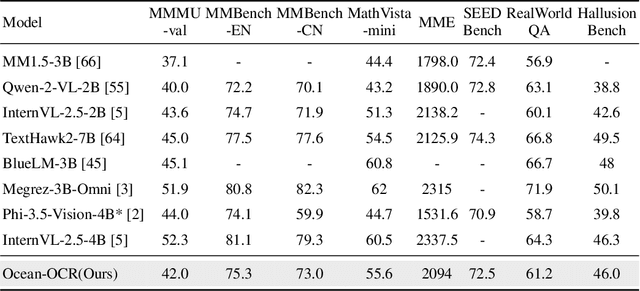

Multimodal large language models (MLLMs) have shown impressive capabilities across various domains, excelling in processing and understanding information from multiple modalities. Despite the rapid progress made previously, insufficient OCR ability hinders MLLMs from excelling in text-related tasks. In this paper, we present \textbf{Ocean-OCR}, a 3B MLLM with state-of-the-art performance on various OCR scenarios and comparable understanding ability on general tasks. We employ Native Resolution ViT to enable variable resolution input and utilize a substantial collection of high-quality OCR datasets to enhance the model performance. We demonstrate the superiority of Ocean-OCR through comprehensive experiments on open-source OCR benchmarks and across various OCR scenarios. These scenarios encompass document understanding, scene text recognition, and handwritten recognition, highlighting the robust OCR capabilities of Ocean-OCR. Note that Ocean-OCR is the first MLLM to outperform professional OCR models such as TextIn and PaddleOCR.
Baichuan-Omni-1.5 Technical Report
Jan 26, 2025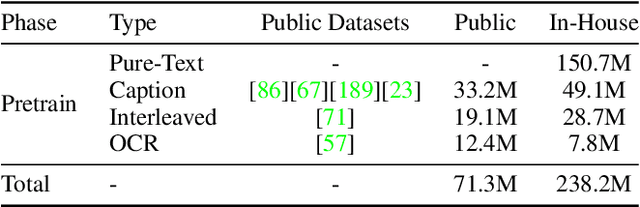
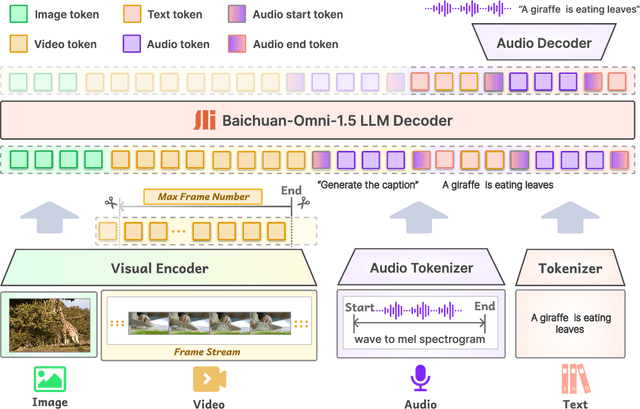
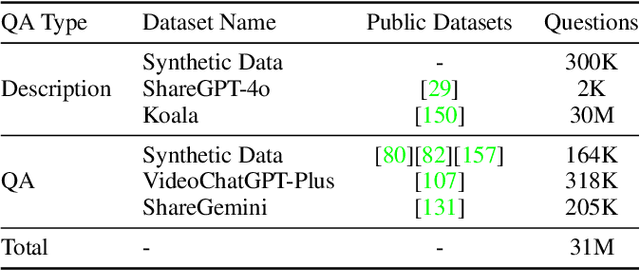
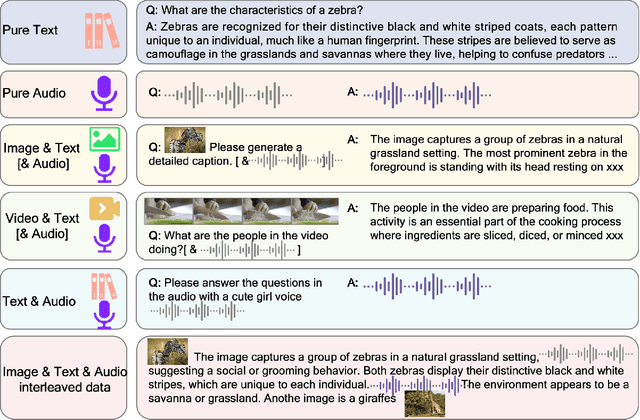
We introduce Baichuan-Omni-1.5, an omni-modal model that not only has omni-modal understanding capabilities but also provides end-to-end audio generation capabilities. To achieve fluent and high-quality interaction across modalities without compromising the capabilities of any modality, we prioritized optimizing three key aspects. First, we establish a comprehensive data cleaning and synthesis pipeline for multimodal data, obtaining about 500B high-quality data (text, audio, and vision). Second, an audio-tokenizer (Baichuan-Audio-Tokenizer) has been designed to capture both semantic and acoustic information from audio, enabling seamless integration and enhanced compatibility with MLLM. Lastly, we designed a multi-stage training strategy that progressively integrates multimodal alignment and multitask fine-tuning, ensuring effective synergy across all modalities. Baichuan-Omni-1.5 leads contemporary models (including GPT4o-mini and MiniCPM-o 2.6) in terms of comprehensive omni-modal capabilities. Notably, it achieves results comparable to leading models such as Qwen2-VL-72B across various multimodal medical benchmarks.