 Add to Chrome
 Add to Firefox
 Add to Edge
Dynamic Context Adapters: Efficiently Infusing History into Vision-and-Language Models
Aug 11, 2026
Historical context integration presents a fundamental challenge for Vision-Language Models (VLMs) in sequential decision-making tasks. Current VLMs process visual inputs independently, which creates critical limitations for downstream applications that require temporal understanding. Direct incorporation of historical frames into Transformer inputs produces quadratic attention complexity and excessive memory consumption. Existing approaches suffer from significant drawbacks: computational inflation or substantial information loss through temporal compression. To address these challenges, we introduce Dynamic Context Adapter (DCA), a novel context injection approach for pretrained VLMs. Our method employs fixed-size, dynamically compressed memory to preserve historical semantics without frame concatenation. DCA bridges static VLMs and recurrent policies and enables memory capabilities in pretrained models while maintaining computational efficiency. DCA achieves over $25\%$ reduction in attention FLOPs and $13\%$ memory savings while improving performance on long-horizon tasks.

Acoustic-driven millimetric helical robot: ultrasonic synergistic manipulation in confined fluidic environment
Aug 06, 2026Acoustic field-driven manipulation provides a non-contact and non-invasive strategy for controlling microscale and nanoscale objects, yet its extension to millimeter-scale robots was limited by insufficient propulsion efficiency in confined biological environments. Here, a coordinated multi-acoustic-field approach is introduced, which harnesses the synergistic action of acoustic radiation forces and acoustic streaming flows to enable controlled locomotion of millimeter-scale helical robots and enhance propulsion. Multiphysics simulations captured the dynamics of millimeter-scale helical robots under combined acoustic fields, and experimental validation demonstrated their locomotion capabilities, including planar navigation, inclined climbing, and vertical motion. Semi-autonomous navigation experiments further confirmed that ultrasonic synergy substantially improved maneuverability. In vitro tests in porcine venous vessels demonstrated that coordinated acoustic fields supported both unidirectional and reciprocating motion under biologically relevant confinement. These findings provide mechanistic insight into scaling acoustic micromanipulation to the millimetre regime and support biomedical applications requiring versatile and controllable robotic mobility.
DART: Decoded Attention over Recurrent States for Efficient Long-Context Sequence Modeling
Aug 03, 2026Modern language models are built primarily from Transformers, recurrent models, and their hybrid architectures. Transformers rely on token-level attention memories, while recurrent models such as state space models (SSMs) and linear attention maintain compact recurrent states. These architectures are typically instantiated separately or interleaved at the layer level, leaving open whether a shared memory representation can support both recurrent compression and attention-style retrieval. We study this question through the state space duality (SSD) view of Mamba-2, where the SSM state can be interpreted as a compressed associative key--value (KV) cache. We observe that Mamba-2 decodes token-conditioned values from this state but does not decode token-conditioned keys. Based on this observation, we propose DART (Decoded Attention over Recurrent sTates), which retains the chunk state contributions produced by the Mamba-2 chunked scan as chunk state memories, decodes token-conditioned keys and values from these memories, and performs state-memory attention (SMA) over the resulting KV pairs. The retrieved output is then combined with the native Mamba-2 output through a gated residual connection. DART supports practical training by reusing the Mamba-2 chunked scan and implementing SMA as a FlashAttention-style computation. Our analysis and experiments show that DART substantially reduces the length-dependent inference cache compared with a matched attention baseline (e.g., $75\%$ savings when the chunk size is $S=256$ and the state size is $N=128$). Compared with Mamba-2, DART substantially improves associative recall and retrieval while preserving general language-modeling quality.
Crossing the Margin Cliff: Toward Relearn-Robust LLM Unlearning via Margin Calibration
Jul 30, 2026Large language model unlearning is consistently fragile under relearn attacks. On TOFU, fine-tuning on twenty forget examples substantially recovers held-out forget-set ROUGE for every method we evaluate, and we trace this fragility to optimization geometry. The per-token answer margin of fourteen post-hoc methods spanning gradient, preference, and distillation families converges into a narrow band above the retain reference in 41 of 42 method--size cells, a regularity we call the margin cliff. We prove that this cliff follows whenever the retain coupling holds the diagnostic log-odds of forget content above a floor, a condition that token-saturating losses induce at stationarity and that we verify directly on 34 of 42 cells. Margin Calibration (\textsc{MC}) is a plug-in polish adding a non-saturating margin hinge anchored at the reference's per-token margin plus a KL probe on a disjoint instruction corpus, restoring forget-side pressure where the native loss saturates. Under a stated gradient-dominance condition, whose on-trajectory gradient signature we measure by instrumenting the polish, its stationary set lies on the cliff-crossing side, yielding an attack-budget upper bound on the relearn margin lift. Across TOFU (three Llama-3 sizes, three forget tiers), MUSE-News on Llama-2-7B-hf, and a Phi-3.5 panel, a single frozen configuration wins all 14 head-to-head forget aggregates and all populated relearn cells (panel-mean post-attack ROUGE-L $0.41$ to $0.18$) and lowers raw membership AUC on 13/14, with reduced retain-side utility as the main cost. A deployment variant matches these gains without a retain-trained reference.
DSSMs: State Space Models with Explicit Memory via Delay Differential Equations
Jul 11, 2026State Space Models (SSMs) have emerged as a powerful paradigm for efficient long-sequence modeling, offering parallel training and fast linear-time recurrent inference. However, like other recurrent architectures, SSMs must compress an unbounded history into a fixed-size state, which limits context retention and makes precise retrieval over long-range context inherently difficult. To overcome this limitation, we propose Delay State Space Models (DSSMs), a delay differential equation (DDE)-inspired extension of diagonal SSMs that augments discrete SSM recurrences with explicit delayed-state feedback. Making explicit delayed feedback practical requires new stability parameterization, history management, and FFT-training tools. We address these challenges with a practical discretization and parameterization grounded in a simple delay-independent stability condition. To bypass direct time-domain kernel construction, we derive the DSSM transfer function and compute kernels in the frequency domain, using a kernel contour shift to suppress aliasing and recover accurate FFT training. Empirically, DSSMs substantially improve targeted delayed-retrieval tasks while outperforming S4D on most standard sequence metrics and remaining close on the others.
READER: Robust Evidence-based Authorship Decoding via Extracted Representations
Jun 09, 2026As agentic applications increasingly route user tasks through official and third-party LLM APIs, provenance becomes an operational question: which model generated a given black-box response? We study Dynamic Black-Box LLM Provenance: identifying the source LLM from generations elicited by query-varying, non-predefined prompts rather than a fixed input set or benchmark suite. This setting is difficult because prompt semantics dominate the text, while model-specific authorship traces are weak and inconsistent at the surface level. We introduce READER (Robust Evidence-based Authorship Decoding via Extracted Representations), a lightweight provenance framework that treats a frozen proxy LLM as a reader of hidden authorship evidence. READER maps black-box outputs into proxy activation space, temporally filters token states within each response, and performs Bayesian Evidence Accumulation by summing single-response log-posterior evidence across independently sampled prompts. This avoids fragile mean-pooling of prompt-specific representations while preserving the query-wise evidence needed for calibrated confidence. On Agent500, a 50-target dataset built from agent-style prompts, READER reaches $31.0$-$42.4\%$ top-1 accuracy from a single response and $70.0$-$84.0\%$ from 50 responses, substantially outperforming sentence-encoder fingerprints. Scaling across nine proxy readers further shows that stronger LLMs expose more linearly decodable authorship structure, suggesting that authorship perception is already present in frozen LLM representations and can be converted into reliable multi-query attribution.
KD360-VoxelBEV: LiDAR and 360-degree Camera Cross Modality Knowledge Distillation for Bird's-Eye-View Segmentation
Dec 17, 2025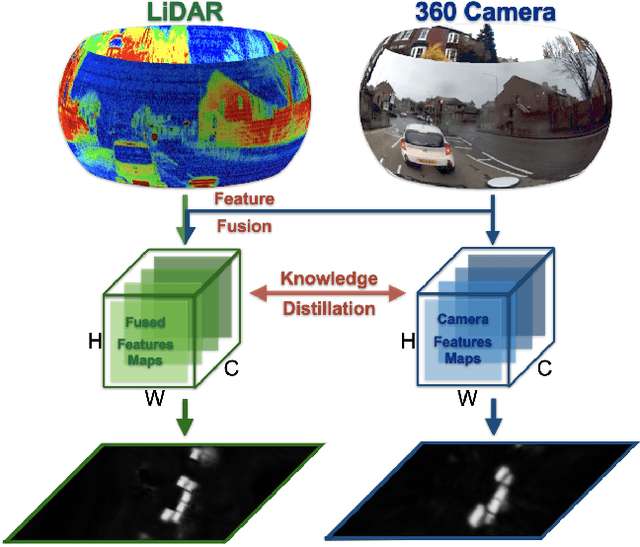
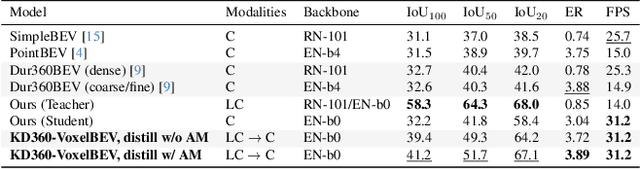
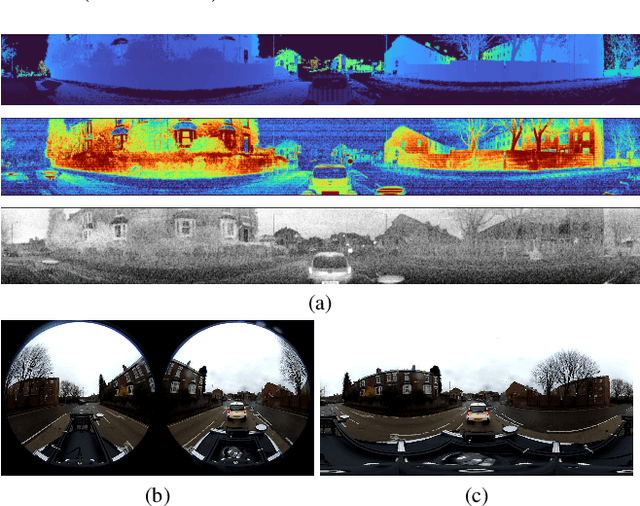

We present the first cross-modality distillation framework specifically tailored for single-panoramic-camera Bird's-Eye-View (BEV) segmentation. Our approach leverages a novel LiDAR image representation fused from range, intensity and ambient channels, together with a voxel-aligned view transformer that preserves spatial fidelity while enabling efficient BEV processing. During training, a high-capacity LiDAR and camera fusion Teacher network extracts both rich spatial and semantic features for cross-modality knowledge distillation into a lightweight Student network that relies solely on a single 360-degree panoramic camera image. Extensive experiments on the Dur360BEV dataset demonstrate that our teacher model significantly outperforms existing camera-based BEV segmentation methods, achieving a 25.6\% IoU improvement. Meanwhile, the distilled Student network attains competitive performance with an 8.5\% IoU gain and state-of-the-art inference speed of 31.2 FPS. Moreover, evaluations on KITTI-360 (two fisheye cameras) confirm that our distillation framework generalises to diverse camera setups, underscoring its feasibility and robustness. This approach reduces sensor complexity and deployment costs while providing a practical solution for efficient, low-cost BEV segmentation in real-world autonomous driving.
GatedFWA: Linear Flash Windowed Attention with Gated Associative Memory
Dec 08, 2025Modern autoregressive models rely on attention, yet the Softmax full attention in Transformers scales quadratically with sequence length. Sliding Window Attention (SWA) achieves linear-time encoding/decoding by constraining the attention pattern, but under an \textit{Associative Memory} interpretation, its difference-style update renders the training objective effectively \emph{unbounded}. In contrast, Softmax attention normalizes updates, leading to \emph{memory shrinkage and gradient vanishing}. We propose GatedFWA: a Memory-\underline{Gated} (\underline{F}lash) \underline{W}indowed \underline{A}ttention mechanism that preserves SWAs efficiency while stabilizing memory updates and making gradient flow controllable. In essence, GatedFWA accumulate a per-token/head gate into a decay bias added to the attention logits, acting as a learnable contraction in the memory recurrence. We implement a fused one-pass gate preprocessing and a FlashAttention-compatible kernel that injects the gate under a sliding mask, ensuring I/O efficiency and numerical stability. On language modelling benchmarks, GatedFWA delivers competitive throughput with negligible overhead and better use of global context, and it integrates cleanly with token compression/selection methods such as NSA and generalizes to various autoregressive domains.
TFDM: Time-Variant Frequency-Based Point Cloud Diffusion with Mamba
Mar 17, 2025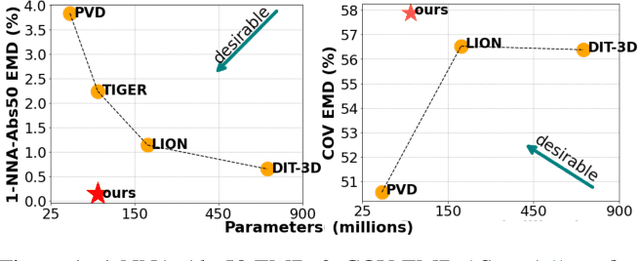
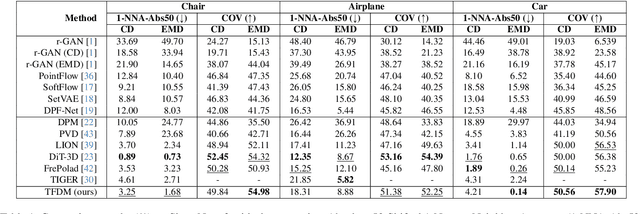
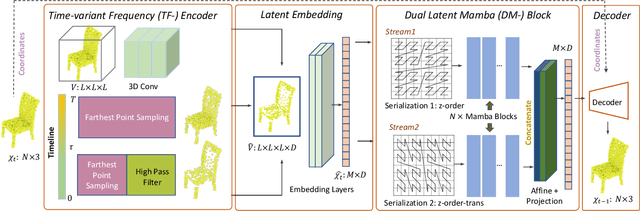
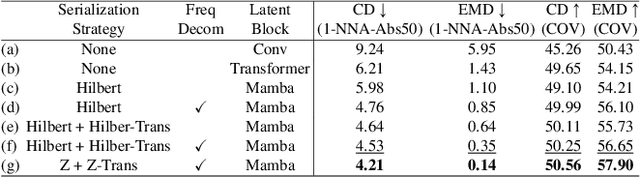
Diffusion models currently demonstrate impressive performance over various generative tasks. Recent work on image diffusion highlights the strong capabilities of Mamba (state space models) due to its efficient handling of long-range dependencies and sequential data modeling. Unfortunately, joint consideration of state space models with 3D point cloud generation remains limited. To harness the powerful capabilities of the Mamba model for 3D point cloud generation, we propose a novel diffusion framework containing dual latent Mamba block (DM-Block) and a time-variant frequency encoder (TF-Encoder). The DM-Block apply a space-filling curve to reorder points into sequences suitable for Mamba state-space modeling, while operating in a latent space to mitigate the computational overhead that arises from direct 3D data processing. Meanwhile, the TF-Encoder takes advantage of the ability of the diffusion model to refine fine details in later recovery stages by prioritizing key points within the U-Net architecture. This frequency-based mechanism ensures enhanced detail quality in the final stages of generation. Experimental results on the ShapeNet-v2 dataset demonstrate that our method achieves state-of-the-art performance (ShapeNet-v2: 0.14\% on 1-NNA-Abs50 EMD and 57.90\% on COV EMD) on certain metrics for specific categories while reducing computational parameters and inference time by up to 10$\times$ and 9$\times$, respectively. Source code is available in Supplementary Materials and will be released upon accpetance.
Integrating Object Detection Modality into Visual Language Model for Enhanced Autonomous Driving Agent
Nov 08, 2024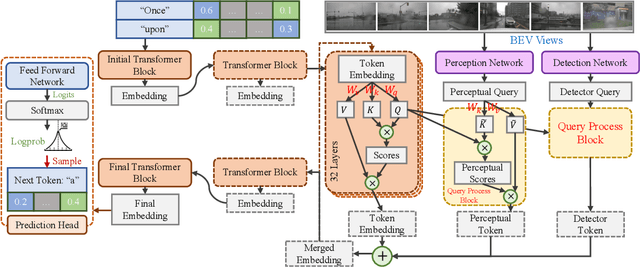

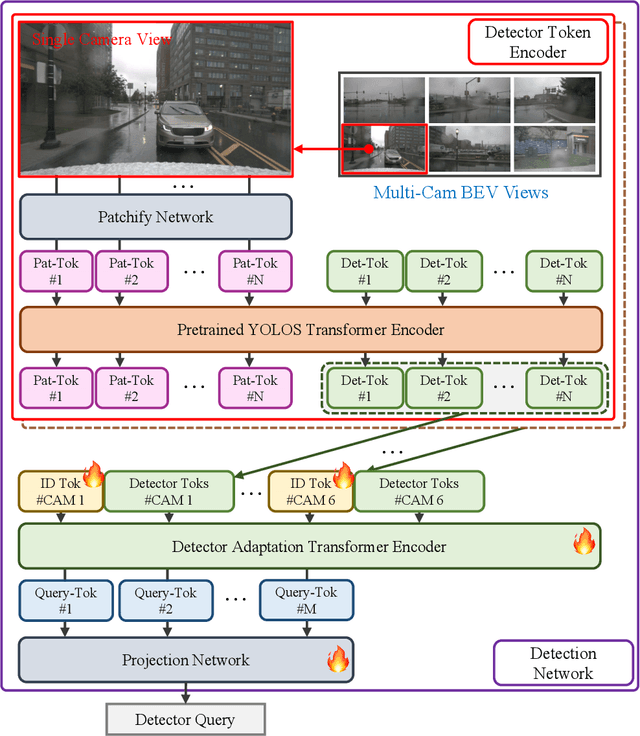

In this paper, we propose a novel framework for enhancing visual comprehension in autonomous driving systems by integrating visual language models (VLMs) with additional visual perception module specialised in object detection. We extend the Llama-Adapter architecture by incorporating a YOLOS-based detection network alongside the CLIP perception network, addressing limitations in object detection and localisation. Our approach introduces camera ID-separators to improve multi-view processing, crucial for comprehensive environmental awareness. Experiments on the DriveLM visual question answering challenge demonstrate significant improvements over baseline models, with enhanced performance in ChatGPT scores, BLEU scores, and CIDEr metrics, indicating closeness of model answer to ground truth. Our method represents a promising step towards more capable and interpretable autonomous driving systems. Possible safety enhancement enabled by detection modality is also discussed.