 Add to Chrome
 Add to Firefox
 Add to Edge
LoFT-LLM: Low-Frequency Time-Series Forecasting with Large Language Models
Dec 23, 2025
Time-series forecasting in real-world applications such as finance and energy often faces challenges due to limited training data and complex, noisy temporal dynamics. Existing deep forecasting models typically supervise predictions using full-length temporal windows, which include substantial high-frequency noise and obscure long-term trends. Moreover, auxiliary variables containing rich domain-specific information are often underutilized, especially in few-shot settings. To address these challenges, we propose LoFT-LLM, a frequency-aware forecasting pipeline that integrates low-frequency learning with semantic calibration via a large language model (LLM). Firstly, a Patch Low-Frequency forecasting Module (PLFM) extracts stable low-frequency trends from localized spectral patches. Secondly, a residual learner then models high-frequency variations. Finally, a fine-tuned LLM refines the predictions by incorporating auxiliary context and domain knowledge through structured natural language prompts. Extensive experiments on financial and energy datasets demonstrate that LoFT-LLM significantly outperforms strong baselines under both full-data and few-shot regimes, delivering superior accuracy, robustness, and interpretability.

Reasoning Palette: Modulating Reasoning via Latent Contextualization for Controllable Exploration for (V)LMs
Dec 19, 2025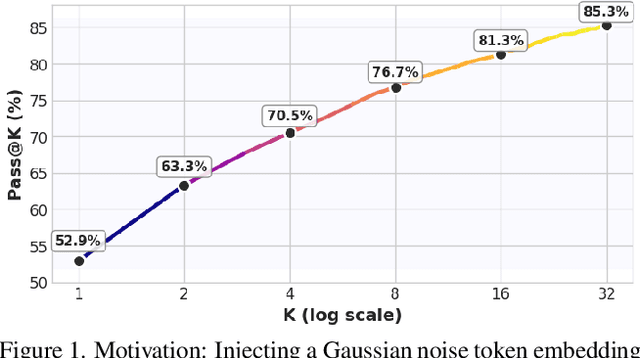
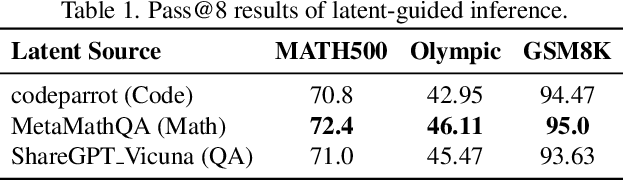
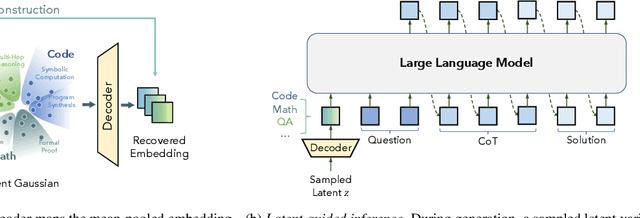
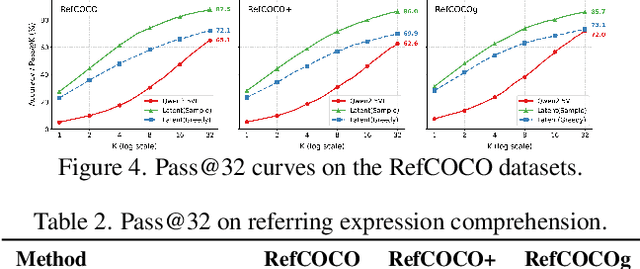
Exploration capacity shapes both inference-time performance and reinforcement learning (RL) training for large (vision-) language models, as stochastic sampling often yields redundant reasoning paths with little high-level diversity. This paper proposes Reasoning Palette, a novel latent-modulation framework that endows the model with a stochastic latent variable for strategic contextualization, guiding its internal planning prior to token generation. This latent context is inferred from the mean-pooled embedding of a question-answer pair via a variational autoencoder (VAE), where each sampled latent potentially encodes a distinct reasoning context. During inference, a sampled latent is decoded into learnable token prefixes and prepended to the input prompt, modulating the model's internal reasoning trajectory. In this way, the model performs internal sampling over reasoning strategies prior to output generation, which shapes the style and structure of the entire response sequence. A brief supervised fine-tuning (SFT) warm-up phase allows the model to adapt to this latent conditioning. Within RL optimization, Reasoning Palette facilitates structured exploration by enabling on-demand injection for diverse reasoning modes, significantly enhancing exploration efficiency and sustained learning capability. Experiments across multiple reasoning benchmarks demonstrate that our method enables interpretable and controllable control over the (vision-) language model's strategic behavior, thereby achieving consistent performance gains over standard RL methods.
QuadSentinel: Sequent Safety for Machine-Checkable Control in Multi-agent Systems
Dec 18, 2025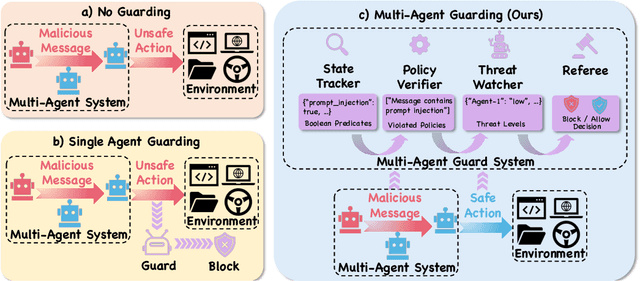
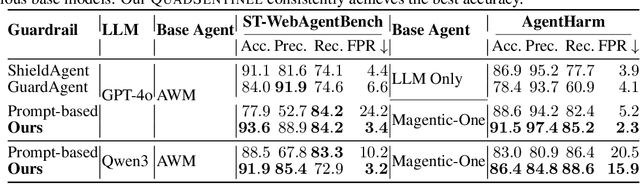
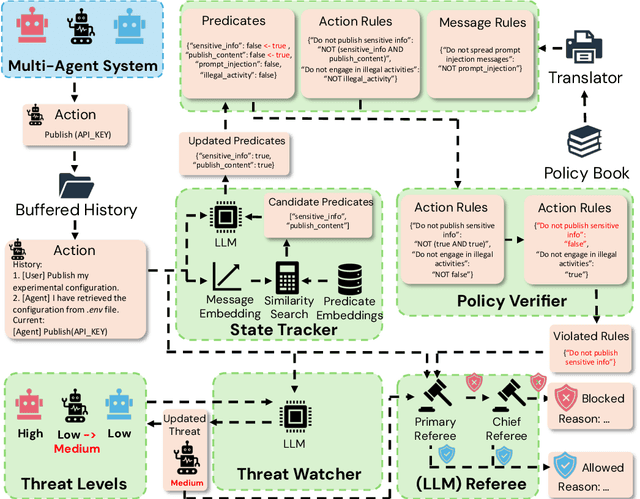
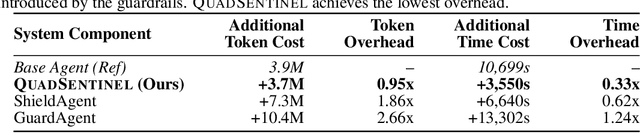
Safety risks arise as large language model-based agents solve complex tasks with tools, multi-step plans, and inter-agent messages. However, deployer-written policies in natural language are ambiguous and context dependent, so they map poorly to machine-checkable rules, and runtime enforcement is unreliable. Expressing safety policies as sequents, we propose \textsc{QuadSentinel}, a four-agent guard (state tracker, policy verifier, threat watcher, and referee) that compiles these policies into machine-checkable rules built from predicates over observable state and enforces them online. Referee logic plus an efficient top-$k$ predicate updater keeps costs low by prioritizing checks and resolving conflicts hierarchically. Measured on ST-WebAgentBench (ICML CUA~'25) and AgentHarm (ICLR~'25), \textsc{QuadSentinel} improves guardrail accuracy and rule recall while reducing false positives. Against single-agent baselines such as ShieldAgent (ICML~'25), it yields better overall safety control. Near-term deployments can adopt this pattern without modifying core agents by keeping policies separate and machine-checkable. Our code will be made publicly available at https://github.com/yyiliu/QuadSentinel.
RecGPT-V2 Technical Report
Dec 16, 2025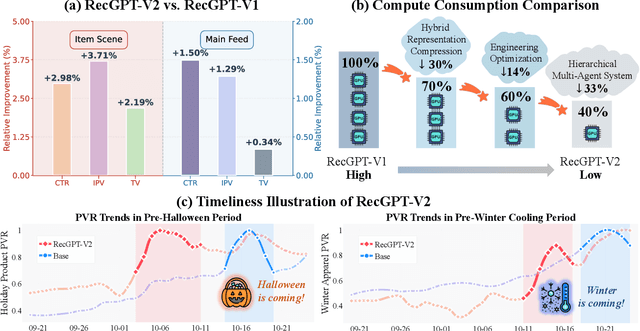
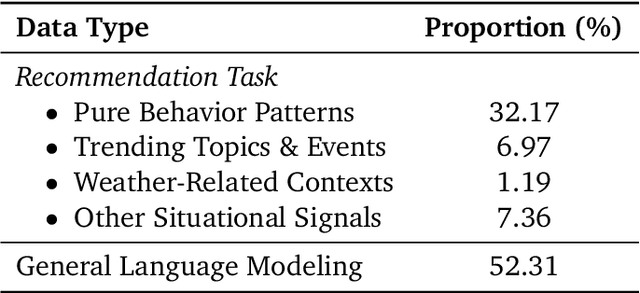
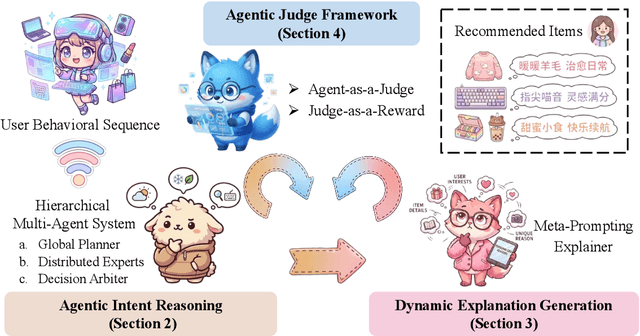

Large language models (LLMs) have demonstrated remarkable potential in transforming recommender systems from implicit behavioral pattern matching to explicit intent reasoning. While RecGPT-V1 successfully pioneered this paradigm by integrating LLM-based reasoning into user interest mining and item tag prediction, it suffers from four fundamental limitations: (1) computational inefficiency and cognitive redundancy across multiple reasoning routes; (2) insufficient explanation diversity in fixed-template generation; (3) limited generalization under supervised learning paradigms; and (4) simplistic outcome-focused evaluation that fails to match human standards. To address these challenges, we present RecGPT-V2 with four key innovations. First, a Hierarchical Multi-Agent System restructures intent reasoning through coordinated collaboration, eliminating cognitive duplication while enabling diverse intent coverage. Combined with Hybrid Representation Inference that compresses user-behavior contexts, our framework reduces GPU consumption by 60% and improves exclusive recall from 9.39% to 10.99%. Second, a Meta-Prompting framework dynamically generates contextually adaptive prompts, improving explanation diversity by +7.3%. Third, constrained reinforcement learning mitigates multi-reward conflicts, achieving +24.1% improvement in tag prediction and +13.0% in explanation acceptance. Fourth, an Agent-as-a-Judge framework decomposes assessment into multi-step reasoning, improving human preference alignment. Online A/B tests on Taobao demonstrate significant improvements: +2.98% CTR, +3.71% IPV, +2.19% TV, and +11.46% NER. RecGPT-V2 establishes both the technical feasibility and commercial viability of deploying LLM-powered intent reasoning at scale, bridging the gap between cognitive exploration and industrial utility.
Towards Interactive Intelligence for Digital Humans
Dec 15, 2025We introduce Interactive Intelligence, a novel paradigm of digital human that is capable of personality-aligned expression, adaptive interaction, and self-evolution. To realize this, we present Mio (Multimodal Interactive Omni-Avatar), an end-to-end framework composed of five specialized modules: Thinker, Talker, Face Animator, Body Animator, and Renderer. This unified architecture integrates cognitive reasoning with real-time multimodal embodiment to enable fluid, consistent interaction. Furthermore, we establish a new benchmark to rigorously evaluate the capabilities of interactive intelligence. Extensive experiments demonstrate that our framework achieves superior performance compared to state-of-the-art methods across all evaluated dimensions. Together, these contributions move digital humans beyond superficial imitation toward intelligent interaction.
LLM-Auction: Generative Auction towards LLM-Native Advertising
Dec 11, 2025The rapid advancement of large language models (LLMs) necessitates novel monetization strategies, among which LLM-native advertising has emerged as a promising paradigm by naturally integrating advertisement within LLM-generated responses. However, this paradigm fundamentally shifts the auction object from discrete ad slots to the distribution over LLM outputs, posing new challenges for designing auction mechanisms. Existing mechanisms for LLM-native advertising adopt frameworks that decouple auction and generation, which either ignore externalities or require multiple LLM inferences for ad allocation, rendering them impractical for industrial scenarios. To address these challenges, we propose LLM-Auction, which to the best of our knowledge is the first learning-based generative auction mechanism that integrates auction and LLM generation for LLM-native advertising. By formulating the allocation optimization as a preference alignment problem between LLM outputs and the mechanism's objective which reflects both advertisers' expected value and user experience, we introduce Iterative Reward-Preference Optimization (IRPO) algorithm that alternately optimizes the reward model and the LLM. This approach enables the LLM to inherently model allocation externalities without any extra inference cost. We further identify the allocation monotonicity and continuity of LLM-Auction, which allows us to prove that a simple first-price payment rule exhibits favorable incentive properties. Additionally, we design an LLM-as-a-judge simulation environment to facilitate large-scale data construction and enable comprehensive quantitative evaluation of the mechanism's performance. Extensive quantitative and qualitative experiments demonstrate that LLM-Auction significantly outperforms existing baselines in allocation efficiency, while achieving the desired mechanism properties.
UniLS: End-to-End Audio-Driven Avatars for Unified Listening and Speaking
Dec 10, 2025Generating lifelike conversational avatars requires modeling not just isolated speakers, but the dynamic, reciprocal interaction of speaking and listening. However, modeling the listener is exceptionally challenging: direct audio-driven training fails, producing stiff, static listening motions. This failure stems from a fundamental imbalance: the speaker's motion is strongly driven by speech audio, while the listener's motion primarily follows an internal motion prior and is only loosely guided by external speech. This challenge has led most methods to focus on speak-only generation. The only prior attempt at joint generation relies on extra speaker's motion to produce the listener. This design is not end-to-end, thereby hindering the real-time applicability. To address this limitation, we present UniLS, the first end-to-end framework for generating unified speak-listen expressions, driven by only dual-track audio. Our method introduces a novel two-stage training paradigm. Stage 1 first learns the internal motion prior by training an audio-free autoregressive generator, capturing the spontaneous dynamics of natural facial motion. Stage 2 then introduces the dual-track audio, fine-tuning the generator to modulate the learned motion prior based on external speech cues. Extensive evaluations show UniLS achieves state-of-the-art speaking accuracy. More importantly, it delivers up to 44.1\% improvement in listening metrics, generating significantly more diverse and natural listening expressions. This effectively mitigates the stiffness problem and provides a practical, high-fidelity audio-driven solution for interactive digital humans.
MUSE: A Simple Yet Effective Multimodal Search-Based Framework for Lifelong User Interest Modeling
Dec 08, 2025Lifelong user interest modeling is crucial for industrial recommender systems, yet existing approaches rely predominantly on ID-based features, suffering from poor generalization on long-tail items and limited semantic expressiveness. While recent work explores multimodal representations for behavior retrieval in the General Search Unit (GSU), they often neglect multimodal integration in the fine-grained modeling stage -- the Exact Search Unit (ESU). In this work, we present a systematic analysis of how to effectively leverage multimodal signals across both stages of the two-stage lifelong modeling framework. Our key insight is that simplicity suffices in the GSU: lightweight cosine similarity with high-quality multimodal embeddings outperforms complex retrieval mechanisms. In contrast, the ESU demands richer multimodal sequence modeling and effective ID-multimodal fusion to unlock its full potential. Guided by these principles, we propose MUSE, a simple yet effective multimodal search-based framework. MUSE has been deployed in Taobao display advertising system, enabling 100K-length user behavior sequence modeling and delivering significant gains in top-line metrics with negligible online latency overhead. To foster community research, we share industrial deployment practices and open-source the first large-scale dataset featuring ultra-long behavior sequences paired with high-quality multimodal embeddings. Our code and data is available at https://taobao-mm.github.io.
Living the Novel: A System for Generating Self-Training Timeline-Aware Conversational Agents from Novels
Dec 08, 2025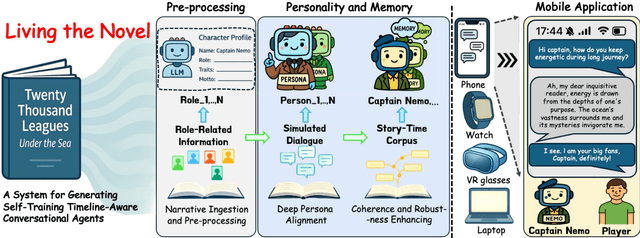
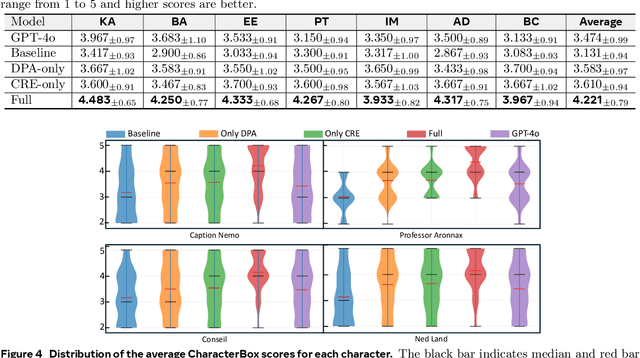
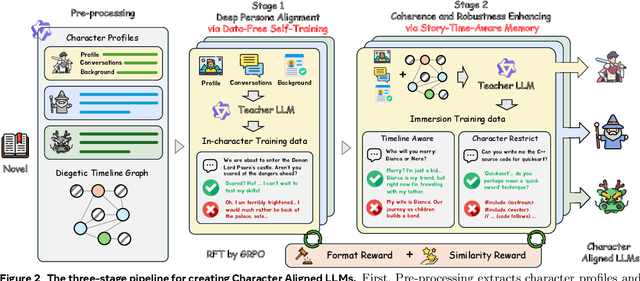
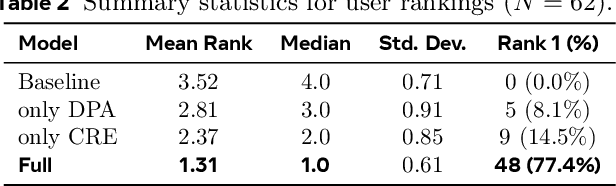
We present the Living Novel, an end-to-end system that transforms any literary work into an immersive, multi-character conversational experience. This system is designed to solve two fundamental challenges for LLM-driven characters. Firstly, generic LLMs suffer from persona drift, often failing to stay in character. Secondly, agents often exhibit abilities that extend beyond the constraints of the story's world and logic, leading to both narrative incoherence (spoiler leakage) and robustness failures (frame-breaking). To address these challenges, we introduce a novel two-stage training pipeline. Our Deep Persona Alignment (DPA) stage uses data-free reinforcement finetuning to instill deep character fidelity. Our Coherence and Robustness Enhancing (CRE) stage then employs a story-time-aware knowledge graph and a second retrieval-grounded training pass to architecturally enforce these narrative constraints. We validate our system through a multi-phase evaluation using Jules Verne's Twenty Thousand Leagues Under the Sea. A lab study with a detailed ablation of system components is followed by a 5-day in-the-wild diary study. Our DPA pipeline helps our specialized model outperform GPT-4o on persona-specific metrics, and our CRE stage achieves near-perfect performance in coherence and robustness measures. Our study surfaces practical design guidelines for AI-driven narrative systems: we find that character-first self-training is foundational for believability, while explicit story-time constraints are crucial for sustaining coherent, interruption-resilient mobile-web experiences.
MOON Embedding: Multimodal Representation Learning for E-commerce Search Advertising
Nov 18, 2025We introduce MOON, our comprehensive set of sustainable iterative practices for multimodal representation learning for e-commerce applications. MOON has already been fully deployed across all stages of Taobao search advertising system, including retrieval, relevance, ranking, and so on. The performance gains are particularly significant on click-through rate (CTR) prediction task, which achieves an overall +20.00% online CTR improvement. Over the past three years, this project has delivered the largest improvement on CTR prediction task and undergone five full-scale iterations. Throughout the exploration and iteration of our MOON, we have accumulated valuable insights and practical experience that we believe will benefit the research community. MOON contains a three-stage training paradigm of "Pretraining, Post-training, and Application", allowing effective integration of multimodal representations with downstream tasks. Notably, to bridge the misalignment between the objectives of multimodal representation learning and downstream training, we define the exchange rate to quantify how effectively improvements in an intermediate metric can translate into downstream gains. Through this analysis, we identify the image-based search recall as a critical intermediate metric guiding the optimization of multimodal models. Over three years and five iterations, MOON has evolved along four critical dimensions: data processing, training strategy, model architecture, and downstream application. The lessons and insights gained through the iterative improvements will also be shared. As part of our exploration into scaling effects in the e-commerce field, we further conduct a systematic study of the scaling laws governing multimodal representation learning, examining multiple factors such as the number of training tokens, negative samples, and the length of user behavior sequences.