 Add to Chrome
 Add to Firefox
 Add to Edge
HelloWorld: Enabling Socially Interactive Characters in Video World Models
Aug 05, 2026
Despite the remarkable recent progress of video world models, social interaction between users and the characters within these worlds remains unsupported. To fill this gap, we present HelloWorld, a video world model that enables social interaction with in-world characters. With a single button press, users can prompt the on-screen character to respond toward the camera, e.g., turning to the viewer, waving, nodding, or speaking a short greeting. To make these interactions natural, we propose a self-distillation pipeline that finetunes the video generation model on data synthesized by itself. Each synthesized clip contains both social interactions and camera motion, allowing the model to learn camera-pose conditioning without degrading interaction quality. At inference, we further introduce a training-free module that determines when the interaction occurs. Upon a button press, it modulates the cross-attention masks of the DiT so that the interaction-related text prompt attends only to the frames within the press window, temporally localizing the character's response. We further build HelloWorldBench, a 400-sample benchmark with three social interaction metrics alongside three conventional metrics, for evaluation. Experiments demonstrate that HelloWorld surpasses a variety of baselines in interaction quality, while maintaining state-of-the-art picture aesthetics and camera-pose following. Project page: https://github.com/AlayaLab/HelloWorld

AlayaWorld: Interactive Long-Horizon World Modeling -- Full Technical Report
Jul 20, 2026Unlike conventional video game development, which relies on labor-intensive pipelines for asset production, animation, physics, and programming, video world models generate interactive environments from user inputs instantly. It enable us to create customized, explorable, and continuously evolving virtual world from text, an image, or video. Realizing this vision requires four tightly coupled capabilities: interaction, persistent spatiotemporal consistency, stable long-horizon generation, and efficient response. We present AlayaWorld, an interactive long-horizon video world model that generates 24-fps video at 540p and 720p. Built on a 15B video diffusion transformer, AlayaWorld generates short latent chunks autoregressively under camera trajectories and switchable text prompts. Its bounded visual context combines a persistent sink frame, compressed temporal history, geometry-aligned spatial memory, and recent-frame conditioning. To reduce long-term drift, the model is trained with corrupted histories and prediction residuals collected from its own roll-outs. We further introduce a discrete autoregressive distillation formulation that combines distribution-matching distillation, self-forcing++, and consistency distillation, reducing inference from approximately 30 sampling steps to four steps per chunk. On iWorld-Bench, AlayaWorld achieves the best performance over long-horizon generation. Conceived as a full-stack, open-source, and long-term project, AlayaWorld is intended to provide an extensible foundation for future research on interactive video world models.
AlayaWorld: Long-Horizon and Playable Video World Generation
Jul 07, 2026Game worlds have traditionally been built through labor-intensive production pipelines, making them costly to develop, difficult to customization, and expensive to modify after deployment. Recent advances in video world models offer a fundamentally different paradigm. Rather than explicitly authoring every component of a virtual environment, these models autoregressively synthesize future observations conditioned on the current world state and user interactions, enabling playable worlds to be generated online. Trained on both gameplay recordings and real-world videos, they can capture diverse visual appearances and physical dynamics, opening new opportunities for interactive applications beyond gaming, including embodied intelligence. In this paper, we present \textbf{AlayaWorld}, a full-stack open-source framework for building interactive generative worlds. AlayaWorld enables open-ended real-time interaction, allowing users to freely navigate and perform diverse actions such as combat, spell casting, and monster summoning. The framework unifies the complete development-from data preparation model architecture, model training, inference acceleration, and deployment-within a modular and extensible architecture. Alongside the framework, we release reproducible pipelines, reference implementations, evaluation tools, and comprehensive documentation, establishing a practical foundation for future research and real-time applications of generative world models.
Perception or Prejudice: Can MLLMs Go Beyond First Impressions of Personality?
May 21, 2026Multimodal Large Language Models (MLLMs) are increasingly deployed in human-facing roles where personality perception is critical, yet existing benchmarks evaluate this capability solely on numerical Big Five score prediction, leaving open whether models truly perceive personality through behavioral understanding or merely prejudge through superficial pattern matching. We address this gap with three contributions. (i) A new task: we formalize Grounded Personality Reasoning (GPR), which requires MLLMs to anchor each Big Five rating in observable evidence through a chain of rating, reasoning, and grounding. (ii) A new dataset: we release MM-OCEAN (1,104 videos, 5,320 MCQs), produced by a multi-agent pipeline with human verification, with timestamped behavioral observations, evidence-grounded trait analyses, and seven categories of cue-grounding MCQs. (iii) Benchmark and analysis: we design a three-tier evaluation (rating, reasoning, grounding) plus four sample-level failure-mode metrics: Prejudice Rate (PR), Confabulation Rate (CR), Integration-failure Rate (IR), and Holistic-grounding Rate (HR), and benchmark 27 MLLMs (13 closed, 14 open). The analysis uncovers a striking Prejudice Gap: across the field, 51% of correct ratings are not grounded in retrieved cues, and the Holistic-Grounding Rate spans only 0-33.5%. These findings expose a disconnect between getting the right score and reasoning for the right reason, charting a roadmap for grounded social cognition in MLLMs.
SocialDirector: Training-Free Social Interaction Control for Multi-Person Video Generation
May 11, 2026Video generation has advanced rapidly, producing photorealistic videos from text or image prompts. Meanwhile, film production and social robotics increasingly demand multi-person videos with rich social interactions, including conversations, gestures, and coordinated actions. However, existing models offer no explicit control over interactions, such as who performs which action, when it occurs, and toward whom it is directed. This often results in wrong person performing unintended actions (actor-action mismatch), disordered social dynamics, and wrong action targets. To address these challenges, we present SocialDirector, a training-free interaction controller that enhances the generation model by modulating cross-attention maps. SocialDirector contains two modules: Social Actor Masking and Directional Reweighting. Social Actor Masking constrains each person's visual tokens to attend only to their own textual descriptions via a spatiotemporal mask, avoiding actor-action mismatch and disordered social dynamics. Directional Reweighting amplifies attention to directional words (e.g., "leftward", "right"), leading each action towards its intended target. To evaluate generated social interactions, we annotate existing datasets with interaction descriptions and build a fully automated evaluation pipeline powered by open-source VLMs. Experiments on different video generation models show that SocialDirector significantly improves interaction fidelity and approaches the upper bound set by real videos.
DyaDiT: A Multi-Modal Diffusion Transformer for Socially Favorable Dyadic Gesture Generation
Feb 26, 2026Generating realistic conversational gestures are essential for achieving natural, socially engaging interactions with digital humans. However, existing methods typically map a single audio stream to a single speaker's motion, without considering social context or modeling the mutual dynamics between two people engaging in conversation. We present DyaDiT, a multi-modal diffusion transformer that generates contextually appropriate human motion from dyadic audio signals. Trained on Seamless Interaction Dataset, DyaDiT takes dyadic audio with optional social-context tokens to produce context-appropriate motion. It fuses information from both speakers to capture interaction dynamics, uses a motion dictionary to encode motion priors, and can optionally utilize the conversational partner's gestures to produce more responsive motion. We evaluate DyaDiT on standard motion generation metrics and conduct quantitative user studies, demonstrating that it not only surpasses existing methods on objective metrics but is also strongly preferred by users, highlighting its robustness and socially favorable motion generation. Code and models will be released upon acceptance.
Towards Interactive Intelligence for Digital Humans
Dec 15, 2025We introduce Interactive Intelligence, a novel paradigm of digital human that is capable of personality-aligned expression, adaptive interaction, and self-evolution. To realize this, we present Mio (Multimodal Interactive Omni-Avatar), an end-to-end framework composed of five specialized modules: Thinker, Talker, Face Animator, Body Animator, and Renderer. This unified architecture integrates cognitive reasoning with real-time multimodal embodiment to enable fluid, consistent interaction. Furthermore, we establish a new benchmark to rigorously evaluate the capabilities of interactive intelligence. Extensive experiments demonstrate that our framework achieves superior performance compared to state-of-the-art methods across all evaluated dimensions. Together, these contributions move digital humans beyond superficial imitation toward intelligent interaction.
UniLS: End-to-End Audio-Driven Avatars for Unified Listening and Speaking
Dec 10, 2025Generating lifelike conversational avatars requires modeling not just isolated speakers, but the dynamic, reciprocal interaction of speaking and listening. However, modeling the listener is exceptionally challenging: direct audio-driven training fails, producing stiff, static listening motions. This failure stems from a fundamental imbalance: the speaker's motion is strongly driven by speech audio, while the listener's motion primarily follows an internal motion prior and is only loosely guided by external speech. This challenge has led most methods to focus on speak-only generation. The only prior attempt at joint generation relies on extra speaker's motion to produce the listener. This design is not end-to-end, thereby hindering the real-time applicability. To address this limitation, we present UniLS, the first end-to-end framework for generating unified speak-listen expressions, driven by only dual-track audio. Our method introduces a novel two-stage training paradigm. Stage 1 first learns the internal motion prior by training an audio-free autoregressive generator, capturing the spontaneous dynamics of natural facial motion. Stage 2 then introduces the dual-track audio, fine-tuning the generator to modulate the learned motion prior based on external speech cues. Extensive evaluations show UniLS achieves state-of-the-art speaking accuracy. More importantly, it delivers up to 44.1\% improvement in listening metrics, generating significantly more diverse and natural listening expressions. This effectively mitigates the stiffness problem and provides a practical, high-fidelity audio-driven solution for interactive digital humans.
Living the Novel: A System for Generating Self-Training Timeline-Aware Conversational Agents from Novels
Dec 08, 2025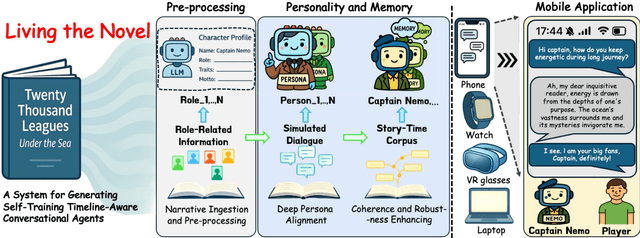
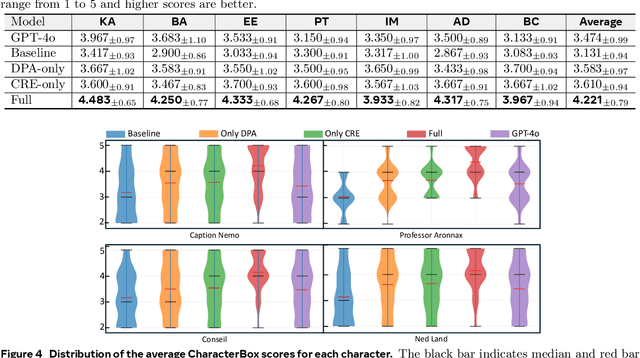
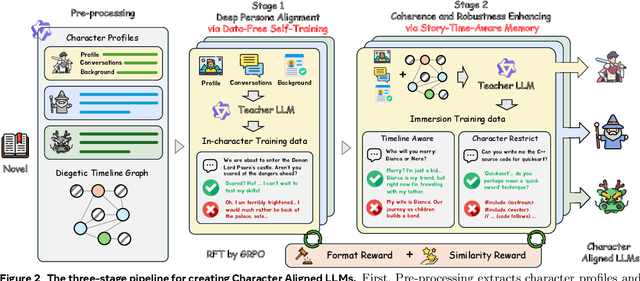
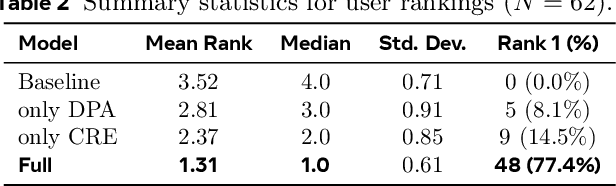
We present the Living Novel, an end-to-end system that transforms any literary work into an immersive, multi-character conversational experience. This system is designed to solve two fundamental challenges for LLM-driven characters. Firstly, generic LLMs suffer from persona drift, often failing to stay in character. Secondly, agents often exhibit abilities that extend beyond the constraints of the story's world and logic, leading to both narrative incoherence (spoiler leakage) and robustness failures (frame-breaking). To address these challenges, we introduce a novel two-stage training pipeline. Our Deep Persona Alignment (DPA) stage uses data-free reinforcement finetuning to instill deep character fidelity. Our Coherence and Robustness Enhancing (CRE) stage then employs a story-time-aware knowledge graph and a second retrieval-grounded training pass to architecturally enforce these narrative constraints. We validate our system through a multi-phase evaluation using Jules Verne's Twenty Thousand Leagues Under the Sea. A lab study with a detailed ablation of system components is followed by a 5-day in-the-wild diary study. Our DPA pipeline helps our specialized model outperform GPT-4o on persona-specific metrics, and our CRE stage achieves near-perfect performance in coherence and robustness measures. Our study surfaces practical design guidelines for AI-driven narrative systems: we find that character-first self-training is foundational for believability, while explicit story-time constraints are crucial for sustaining coherent, interruption-resilient mobile-web experiences.
Egocentric Action-aware Inertial Localization in Point Clouds
May 20, 2025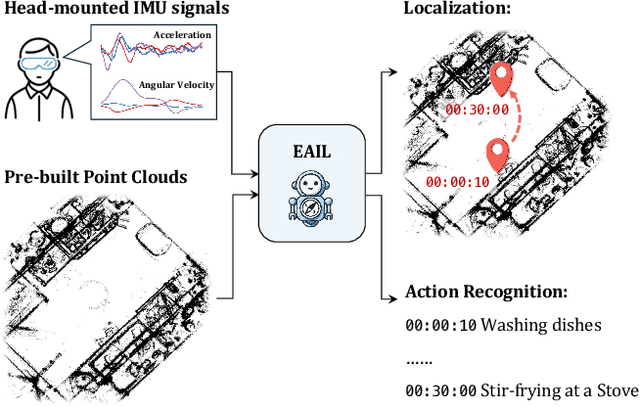
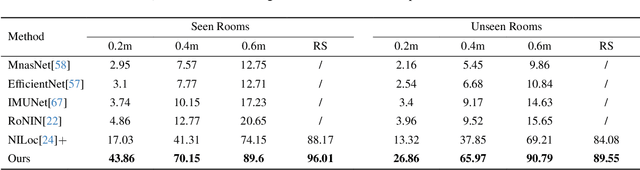
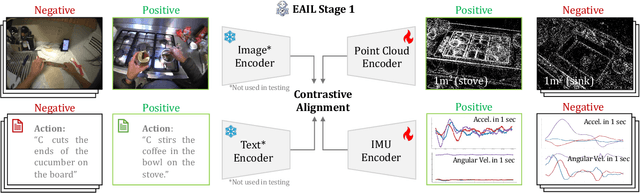
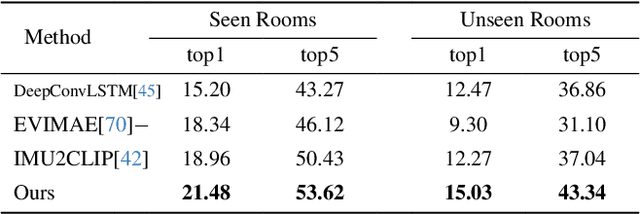
This paper presents a novel inertial localization framework named Egocentric Action-aware Inertial Localization (EAIL), which leverages egocentric action cues from head-mounted IMU signals to localize the target individual within a 3D point cloud. Human inertial localization is challenging due to IMU sensor noise that causes trajectory drift over time. The diversity of human actions further complicates IMU signal processing by introducing various motion patterns. Nevertheless, we observe that some actions observed through the head-mounted IMU correlate with spatial environmental structures (e.g., bending down to look inside an oven, washing dishes next to a sink), thereby serving as spatial anchors to compensate for the localization drift. The proposed EAIL framework learns such correlations via hierarchical multi-modal alignment. By assuming that the 3D point cloud of the environment is available, it contrastively learns modality encoders that align short-term egocentric action cues in IMU signals with local environmental features in the point cloud. These encoders are then used in reasoning the IMU data and the point cloud over time and space to perform inertial localization. Interestingly, these encoders can further be utilized to recognize the corresponding sequence of actions as a by-product. Extensive experiments demonstrate the effectiveness of the proposed framework over state-of-the-art inertial localization and inertial action recognition baselines.