 Add to Chrome
 Add to Firefox
 Add to Edge
PersonaGesture: Single-Reference Co-Speech Gesture Personalization for Unseen Speakers
May 07, 2026
We propose PersonaGesture, a diffusion-based pipeline for single-reference co-speech gesture personalization of unseen speakers. Given target speech and one motion clip from a new speaker, the model must synthesize gestures that follow the new utterance while retaining speaker-specific pose choices, without per-speaker optimization. This setting is useful for avatars and virtual agents, but it is hard because the reference mixes stable speaker habits with utterance-specific trajectories. PersonaGesture consists of two key components, Adaptive Style Infusion (ASI) and Implicit Distribution Rectification (IDR), to separate temporal identity evidence from residual statistic correction. A Style Perceiver first encodes the variable-length reference into compact speaker-memory tokens. ASI injects these tokens into denoising through zero-initialized residual cross-attention, enabling style evidence to affect motion formation without replacing the pretrained speech-to-motion prior. Building on this, IDR applies a length-aware diagonal affine map in latent space to correct residual channel-wise moments estimated from the same reference. Across BEAT2 and ZeroEGGS, we evaluate quantitative metrics, reference-identity controls, same-audio diagnostics, qualitative comparisons, and human preference. Experiments show that separating denoising-time speaker memory from conservative post-generation moment correction improves unseen-speaker personalization over collapsed style codes, full-reference attention, and one-clip finetuning. Project: https://xiangyue-zhang.github.io/PersonaGesture.

Towards Interactive Intelligence for Digital Humans
Dec 15, 2025We introduce Interactive Intelligence, a novel paradigm of digital human that is capable of personality-aligned expression, adaptive interaction, and self-evolution. To realize this, we present Mio (Multimodal Interactive Omni-Avatar), an end-to-end framework composed of five specialized modules: Thinker, Talker, Face Animator, Body Animator, and Renderer. This unified architecture integrates cognitive reasoning with real-time multimodal embodiment to enable fluid, consistent interaction. Furthermore, we establish a new benchmark to rigorously evaluate the capabilities of interactive intelligence. Extensive experiments demonstrate that our framework achieves superior performance compared to state-of-the-art methods across all evaluated dimensions. Together, these contributions move digital humans beyond superficial imitation toward intelligent interaction.
Motion Generation from Fine-grained Textual Descriptions
Mar 26, 2024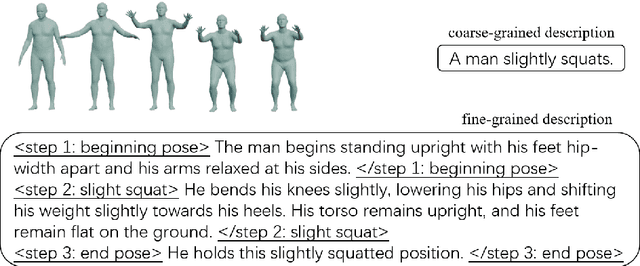

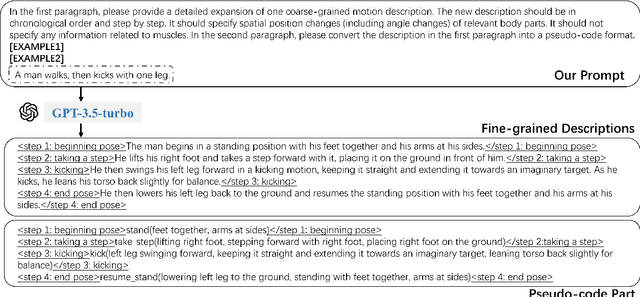
The task of text2motion is to generate human motion sequences from given textual descriptions, where the model explores diverse mappings from natural language instructions to human body movements. While most existing works are confined to coarse-grained motion descriptions, e.g., "A man squats.", fine-grained descriptions specifying movements of relevant body parts are barely explored. Models trained with coarse-grained texts may not be able to learn mappings from fine-grained motion-related words to motion primitives, resulting in the failure to generate motions from unseen descriptions. In this paper, we build a large-scale language-motion dataset specializing in fine-grained textual descriptions, FineHumanML3D, by feeding GPT-3.5-turbo with step-by-step instructions with pseudo-code compulsory checks. Accordingly, we design a new text2motion model, FineMotionDiffuse, making full use of fine-grained textual information. Our quantitative evaluation shows that FineMotionDiffuse trained on FineHumanML3D improves FID by a large margin of 0.38, compared with competitive baselines. According to the qualitative evaluation and case study, our model outperforms MotionDiffuse in generating spatially or chronologically composite motions, by learning the implicit mappings from fine-grained descriptions to the corresponding basic motions. We release our data at https://github.com/KunhangL/finemotiondiffuse.