 Add to Chrome
 Add to Firefox
 Add to Edge
SplitAvatar: One-shot Head Avatar with Autoregressive Gaussian Splitting
May 25, 2026
3D Gaussian Splatting (3DGS) provides an efficient method for high-quality scene reconstruction using anisotropic Gaussians. Recently, 3DGS-based methods have significantly improved the rendering quality of human avatars while enabling real-time performance. However, existing methods suffer from a magnitude mismatch in the number of Gaussians generated by image-based and 3DMM-based approaches. This discrepancy results in reconstructed expressions that lack fine-grained detail. In this paper, we introduce a novel method for reconstructing an animatable head avatar from a single image. We propose a Graph splitting network to progressively generate Gaussians from coarse to fine using an autoregressive architecture. To address the graph inconsistency caused by split Gaussians, we employ a mesh topology extension method to align the GNN's connectivity with the increased Gaussian count. Furthermore, we introduce a novel density control method that includes a gating mechanism that generates soft masks for Gaussians, preventing over-densification after the splitting operation. This allows for dynamic control over Gaussian density across different facial regions. For smooth and rapid training, we employ a delayed filtering strategy to avoid re-computing the graph topology during training. Experimental results demonstrate that our autoregressive structure effectively improves expression representation ability by progressively splitting Gaussians. This process, enabled by the GNN-guided splitting, synthesizes more precise facial details and achieves higher reconstruction quality.

PersonaGesture: Single-Reference Co-Speech Gesture Personalization for Unseen Speakers
May 07, 2026We propose PersonaGesture, a diffusion-based pipeline for single-reference co-speech gesture personalization of unseen speakers. Given target speech and one motion clip from a new speaker, the model must synthesize gestures that follow the new utterance while retaining speaker-specific pose choices, without per-speaker optimization. This setting is useful for avatars and virtual agents, but it is hard because the reference mixes stable speaker habits with utterance-specific trajectories. PersonaGesture consists of two key components, Adaptive Style Infusion (ASI) and Implicit Distribution Rectification (IDR), to separate temporal identity evidence from residual statistic correction. A Style Perceiver first encodes the variable-length reference into compact speaker-memory tokens. ASI injects these tokens into denoising through zero-initialized residual cross-attention, enabling style evidence to affect motion formation without replacing the pretrained speech-to-motion prior. Building on this, IDR applies a length-aware diagonal affine map in latent space to correct residual channel-wise moments estimated from the same reference. Across BEAT2 and ZeroEGGS, we evaluate quantitative metrics, reference-identity controls, same-audio diagnostics, qualitative comparisons, and human preference. Experiments show that separating denoising-time speaker memory from conservative post-generation moment correction improves unseen-speaker personalization over collapsed style codes, full-reference attention, and one-clip finetuning. Project: https://xiangyue-zhang.github.io/PersonaGesture.
FSMC-Pose: Frequency and Spatial Fusion with Multiscale Self-calibration for Cattle Mounting Pose Estimation
Mar 17, 2026Mounting posture is an important visual indicator of estrus in dairy cattle. However, achieving reliable mounting pose estimation in real-world environments remains challenging due to cluttered backgrounds and frequent inter-animal occlusion. We present FSMC-Pose, a top-down framework that integrates a lightweight frequency-spatial fusion backbone, CattleMountNet, and a multiscale self-calibration head, SC2Head. Specifically, we design two algorithmic components for CattleMountNet: the Spatial Frequency Enhancement Block (SFEBlock) and the Receptive Aggregation Block (RABlock). SFEBlock separates cattle from cluttered backgrounds, while RABlock captures multiscale contextual information. The Spatial-Channel Self-Calibration Head (SC2Head) attends to spatial and channel dependencies and introduces a self-calibration branch to mitigate structural misalignment under inter-animal overlap. We construct a mounting dataset, MOUNT-Cattle, covering 1176 mounting instances, which follows the COCO format and supports drop-in training across pose estimation models. Using a comprehensive dataset that combines MOUNT-Cattle with the public NWAFU-Cattle dataset, FSMC-Pose achieves higher accuracy than strong baselines, with markedly lower computational and parameter costs, while maintaining real-time inference on commodity GPUs. Extensive experiments and qualitative analyses show that FSMC-Pose effectively captures and estimates cattle mounting pose in complex and cluttered environments. Dataset and code are available at https://github.com/elianafang/FSMC-Pose.
TDMM-LM: Bridging Facial Understanding and Animation via Language Models
Mar 14, 2026Text-guided human body animation has advanced rapidly, yet facial animation lags due to the scarcity of well-annotated, text-paired facial corpora. To close this gap, we leverage foundation generative models to synthesize a large, balanced corpus of facial behavior. We design prompts suite covering emotions and head motions, generate about 80 hours of facial videos with multiple generators, and fit per-frame 3D facial parameters, yielding large-scale (prompt and parameter) pairs for training. Building on this dataset, we probe language models for bidirectional competence over facial motion via two complementary tasks: (1) Motion2Language: given a sequence of 3D facial parameters, the model produces natural-language descriptions capturing content, style, and dynamics; and (2) Language2Motion: given a prompt, the model synthesizes the corresponding sequence of 3D facial parameters via quantized motion tokens for downstream animation. Extensive experiments show that in this setting language models can both interpret and synthesize facial motion with strong generalization. To best of our knowledge, this is the first work to cast facial-parameter modeling as a language problem, establishing a unified path for text-conditioned facial animation and motion understanding.
DyaDiT: A Multi-Modal Diffusion Transformer for Socially Favorable Dyadic Gesture Generation
Feb 26, 2026Generating realistic conversational gestures are essential for achieving natural, socially engaging interactions with digital humans. However, existing methods typically map a single audio stream to a single speaker's motion, without considering social context or modeling the mutual dynamics between two people engaging in conversation. We present DyaDiT, a multi-modal diffusion transformer that generates contextually appropriate human motion from dyadic audio signals. Trained on Seamless Interaction Dataset, DyaDiT takes dyadic audio with optional social-context tokens to produce context-appropriate motion. It fuses information from both speakers to capture interaction dynamics, uses a motion dictionary to encode motion priors, and can optionally utilize the conversational partner's gestures to produce more responsive motion. We evaluate DyaDiT on standard motion generation metrics and conduct quantitative user studies, demonstrating that it not only surpasses existing methods on objective metrics but is also strongly preferred by users, highlighting its robustness and socially favorable motion generation. Code and models will be released upon acceptance.
DyStream: Streaming Dyadic Talking Heads Generation via Flow Matching-based Autoregressive Model
Dec 30, 2025Generating realistic, dyadic talking head video requires ultra-low latency. Existing chunk-based methods require full non-causal context windows, introducing significant delays. This high latency critically prevents the immediate, non-verbal feedback required for a realistic listener. To address this, we present DyStream, a flow matching-based autoregressive model that could generate video in real-time from both speaker and listener audio. Our method contains two key designs: (1) we adopt a stream-friendly autoregressive framework with flow-matching heads for probabilistic modeling, and (2) We propose a causal encoder enhanced by a lookahead module to incorporate short future context (e.g., 60 ms) to improve quality while maintaining low latency. Our analysis shows this simple-and-effective method significantly surpass alternative causal strategies, including distillation and generative encoder. Extensive experiments show that DyStream could generate video within 34 ms per frame, guaranteeing the entire system latency remains under 100 ms. Besides, it achieves state-of-the-art lip-sync quality, with offline and online LipSync Confidence scores of 8.13 and 7.61 on HDTF, respectively. The model, weights and codes are available.
Towards Interactive Intelligence for Digital Humans
Dec 15, 2025We introduce Interactive Intelligence, a novel paradigm of digital human that is capable of personality-aligned expression, adaptive interaction, and self-evolution. To realize this, we present Mio (Multimodal Interactive Omni-Avatar), an end-to-end framework composed of five specialized modules: Thinker, Talker, Face Animator, Body Animator, and Renderer. This unified architecture integrates cognitive reasoning with real-time multimodal embodiment to enable fluid, consistent interaction. Furthermore, we establish a new benchmark to rigorously evaluate the capabilities of interactive intelligence. Extensive experiments demonstrate that our framework achieves superior performance compared to state-of-the-art methods across all evaluated dimensions. Together, these contributions move digital humans beyond superficial imitation toward intelligent interaction.
Intentional Gesture: Deliver Your Intentions with Gestures for Speech
May 21, 2025When humans speak, gestures help convey communicative intentions, such as adding emphasis or describing concepts. However, current co-speech gesture generation methods rely solely on superficial linguistic cues (\textit{e.g.} speech audio or text transcripts), neglecting to understand and leverage the communicative intention that underpins human gestures. This results in outputs that are rhythmically synchronized with speech but are semantically shallow. To address this gap, we introduce \textbf{Intentional-Gesture}, a novel framework that casts gesture generation as an intention-reasoning task grounded in high-level communicative functions. % First, we curate the \textbf{InG} dataset by augmenting BEAT-2 with gesture-intention annotations (\textit{i.e.}, text sentences summarizing intentions), which are automatically annotated using large vision-language models. Next, we introduce the \textbf{Intentional Gesture Motion Tokenizer} to leverage these intention annotations. It injects high-level communicative functions (\textit{e.g.}, intentions) into tokenized motion representations to enable intention-aware gesture synthesis that are both temporally aligned and semantically meaningful, achieving new state-of-the-art performance on the BEAT-2 benchmark. Our framework offers a modular foundation for expressive gesture generation in digital humans and embodied AI. Project Page: https://andypinxinliu.github.io/Intentional-Gesture
Video Motion Graphs
Mar 26, 2025We present Video Motion Graphs, a system designed to generate realistic human motion videos. Using a reference video and conditional signals such as music or motion tags, the system synthesizes new videos by first retrieving video clips with gestures matching the conditions and then generating interpolation frames to seamlessly connect clip boundaries. The core of our approach is HMInterp, a robust Video Frame Interpolation (VFI) model that enables seamless interpolation of discontinuous frames, even for complex motion scenarios like dancing. HMInterp i) employs a dual-branch interpolation approach, combining a Motion Diffusion Model for human skeleton motion interpolation with a diffusion-based video frame interpolation model for final frame generation. ii) adopts condition progressive training to effectively leverage identity strong and weak conditions, such as images and pose. These designs ensure both high video texture quality and accurate motion trajectory. Results show that our Video Motion Graphs outperforms existing generative- and retrieval-based methods for multi-modal conditioned human motion video generation. Project page can be found at https://h-liu1997.github.io/Video-Motion-Graphs/
Free-viewpoint Human Animation with Pose-correlated Reference Selection
Dec 23, 2024
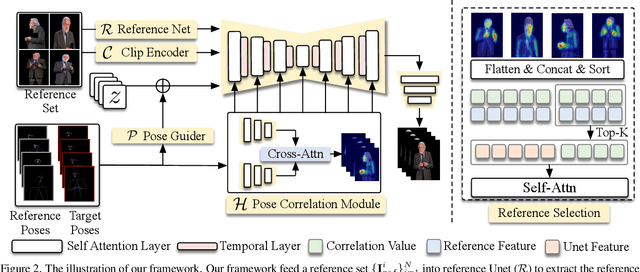
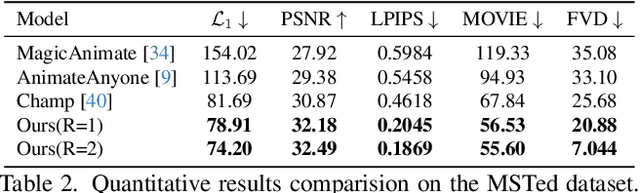
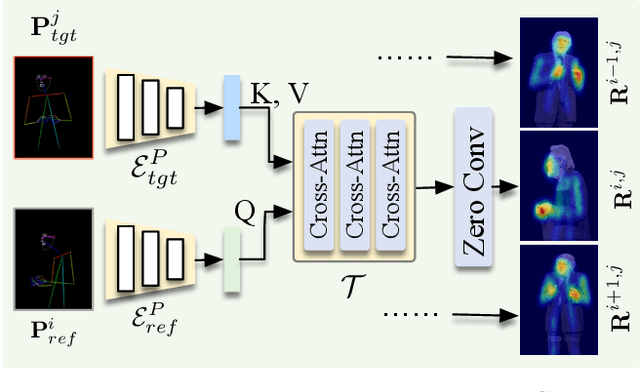
Diffusion-based human animation aims to animate a human character based on a source human image as well as driving signals such as a sequence of poses. Leveraging the generative capacity of diffusion model, existing approaches are able to generate high-fidelity poses, but struggle with significant viewpoint changes, especially in zoom-in/zoom-out scenarios where camera-character distance varies. This limits the applications such as cinematic shot type plan or camera control. We propose a pose-correlated reference selection diffusion network, supporting substantial viewpoint variations in human animation. Our key idea is to enable the network to utilize multiple reference images as input, since significant viewpoint changes often lead to missing appearance details on the human body. To eliminate the computational cost, we first introduce a novel pose correlation module to compute similarities between non-aligned target and source poses, and then propose an adaptive reference selection strategy, utilizing the attention map to identify key regions for animation generation. To train our model, we curated a large dataset from public TED talks featuring varied shots of the same character, helping the model learn synthesis for different perspectives. Our experimental results show that with the same number of reference images, our model performs favorably compared to the current SOTA methods under large viewpoint change. We further show that the adaptive reference selection is able to choose the most relevant reference regions to generate humans under free viewpoints.