 Add to Chrome
 Add to Firefox
 Add to Edge
Towards Interactive Intelligence for Digital Humans
Dec 15, 2025
We introduce Interactive Intelligence, a novel paradigm of digital human that is capable of personality-aligned expression, adaptive interaction, and self-evolution. To realize this, we present Mio (Multimodal Interactive Omni-Avatar), an end-to-end framework composed of five specialized modules: Thinker, Talker, Face Animator, Body Animator, and Renderer. This unified architecture integrates cognitive reasoning with real-time multimodal embodiment to enable fluid, consistent interaction. Furthermore, we establish a new benchmark to rigorously evaluate the capabilities of interactive intelligence. Extensive experiments demonstrate that our framework achieves superior performance compared to state-of-the-art methods across all evaluated dimensions. Together, these contributions move digital humans beyond superficial imitation toward intelligent interaction.

Living the Novel: A System for Generating Self-Training Timeline-Aware Conversational Agents from Novels
Dec 08, 2025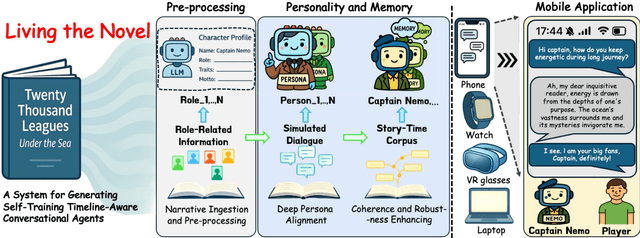
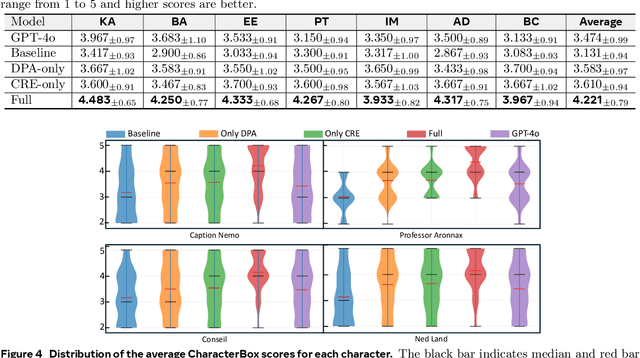
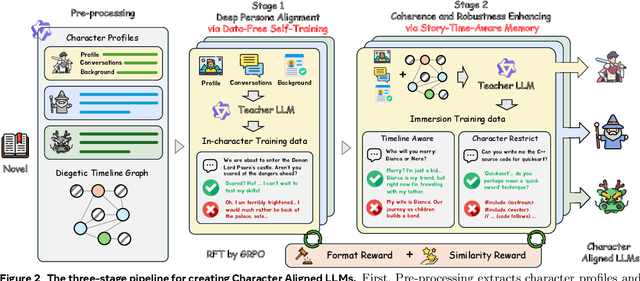
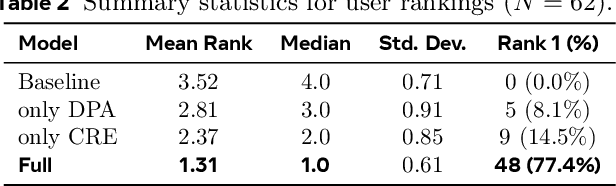
We present the Living Novel, an end-to-end system that transforms any literary work into an immersive, multi-character conversational experience. This system is designed to solve two fundamental challenges for LLM-driven characters. Firstly, generic LLMs suffer from persona drift, often failing to stay in character. Secondly, agents often exhibit abilities that extend beyond the constraints of the story's world and logic, leading to both narrative incoherence (spoiler leakage) and robustness failures (frame-breaking). To address these challenges, we introduce a novel two-stage training pipeline. Our Deep Persona Alignment (DPA) stage uses data-free reinforcement finetuning to instill deep character fidelity. Our Coherence and Robustness Enhancing (CRE) stage then employs a story-time-aware knowledge graph and a second retrieval-grounded training pass to architecturally enforce these narrative constraints. We validate our system through a multi-phase evaluation using Jules Verne's Twenty Thousand Leagues Under the Sea. A lab study with a detailed ablation of system components is followed by a 5-day in-the-wild diary study. Our DPA pipeline helps our specialized model outperform GPT-4o on persona-specific metrics, and our CRE stage achieves near-perfect performance in coherence and robustness measures. Our study surfaces practical design guidelines for AI-driven narrative systems: we find that character-first self-training is foundational for believability, while explicit story-time constraints are crucial for sustaining coherent, interruption-resilient mobile-web experiences.