 Add to Chrome
 Add to Firefox
 Add to Edge
MUSE: A Simple Yet Effective Multimodal Search-Based Framework for Lifelong User Interest Modeling
Dec 08, 2025
Lifelong user interest modeling is crucial for industrial recommender systems, yet existing approaches rely predominantly on ID-based features, suffering from poor generalization on long-tail items and limited semantic expressiveness. While recent work explores multimodal representations for behavior retrieval in the General Search Unit (GSU), they often neglect multimodal integration in the fine-grained modeling stage -- the Exact Search Unit (ESU). In this work, we present a systematic analysis of how to effectively leverage multimodal signals across both stages of the two-stage lifelong modeling framework. Our key insight is that simplicity suffices in the GSU: lightweight cosine similarity with high-quality multimodal embeddings outperforms complex retrieval mechanisms. In contrast, the ESU demands richer multimodal sequence modeling and effective ID-multimodal fusion to unlock its full potential. Guided by these principles, we propose MUSE, a simple yet effective multimodal search-based framework. MUSE has been deployed in Taobao display advertising system, enabling 100K-length user behavior sequence modeling and delivering significant gains in top-line metrics with negligible online latency overhead. To foster community research, we share industrial deployment practices and open-source the first large-scale dataset featuring ultra-long behavior sequences paired with high-quality multimodal embeddings. Our code and data is available at https://taobao-mm.github.io.

Migrant Resettlement by Evolutionary Multi-objective Optimization
Oct 26, 2023Migration has been a universal phenomenon, which brings opportunities as well as challenges for global development. As the number of migrants (e.g., refugees) increases rapidly in recent years, a key challenge faced by each country is the problem of migrant resettlement. This problem has attracted scientific research attention, from the perspective of maximizing the employment rate. Previous works mainly formulated migrant resettlement as an approximately submodular optimization problem subject to multiple matroid constraints and employed the greedy algorithm, whose performance, however, may be limited due to its greedy nature. In this paper, we propose a new framework MR-EMO based on Evolutionary Multi-objective Optimization, which reformulates Migrant Resettlement as a bi-objective optimization problem that maximizes the expected number of employed migrants and minimizes the number of dispatched migrants simultaneously, and employs a Multi-Objective Evolutionary Algorithm (MOEA) to solve the bi-objective problem. We implement MR-EMO using three MOEAs, the popular NSGA-II, MOEA/D as well as the theoretically grounded GSEMO. To further improve the performance of MR-EMO, we propose a specific MOEA, called GSEMO-SR, using matrix-swap mutation and repair mechanism, which has a better ability to search for feasible solutions. We prove that MR-EMO using either GSEMO or GSEMO-SR can achieve better theoretical guarantees than the previous greedy algorithm. Experimental results under the interview and coordination migration models clearly show the superiority of MR-EMO (with either NSGA-II, MOEA/D, GSEMO or GSEMO-SR) over previous algorithms, and that using GSEMO-SR leads to the best performance of MR-EMO.
Submodular Maximization under the Intersection of Matroid and Knapsack Constraints
Jul 18, 2023
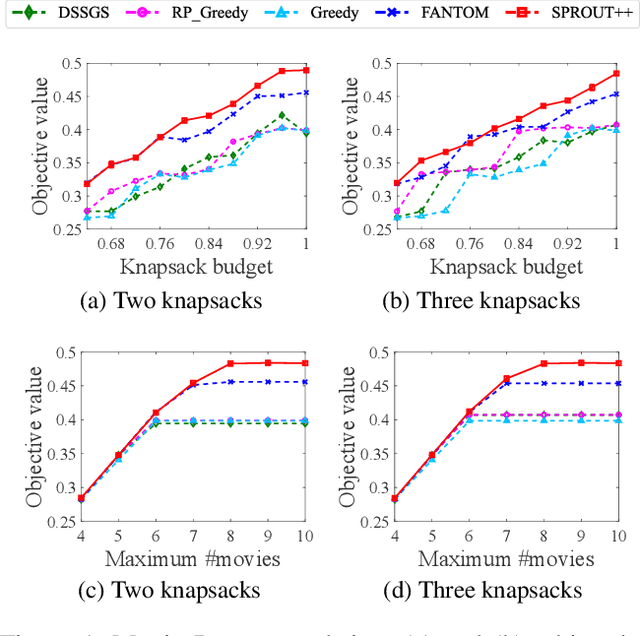
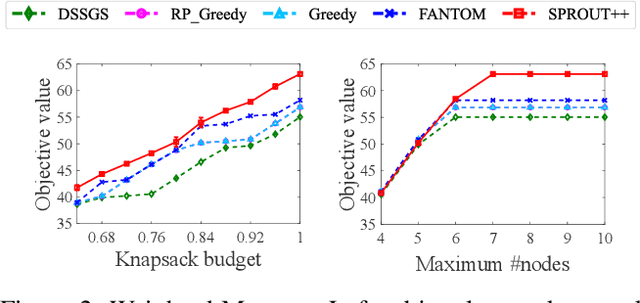
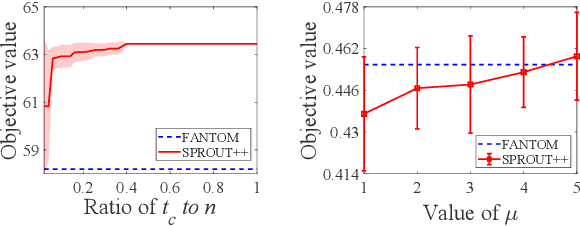
Submodular maximization arises in many applications, and has attracted a lot of research attentions from various areas such as artificial intelligence, finance and operations research. Previous studies mainly consider only one kind of constraint, while many real-world problems often involve several constraints. In this paper, we consider the problem of submodular maximization under the intersection of two commonly used constraints, i.e., $k$-matroid constraint and $m$-knapsack constraint, and propose a new algorithm SPROUT by incorporating partial enumeration into the simultaneous greedy framework. We prove that SPROUT can achieve a polynomial-time approximation guarantee better than the state-of-the-art algorithms. Then, we introduce the random enumeration and smooth techniques into SPROUT to improve its efficiency, resulting in the SPROUT++ algorithm, which can keep a similar approximation guarantee. Experiments on the applications of movie recommendation and weighted max-cut demonstrate the superiority of SPROUT++ in practice.