 Add to Chrome
 Add to Firefox
 Add to Edge
QuadSentinel: Sequent Safety for Machine-Checkable Control in Multi-agent Systems
Dec 18, 2025
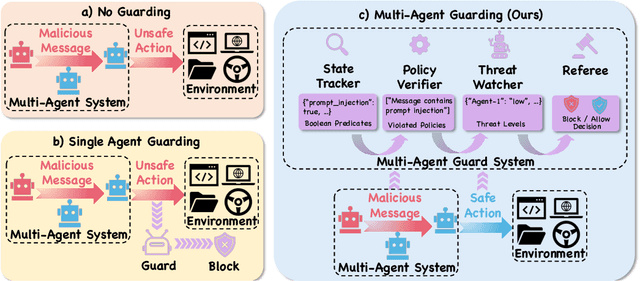
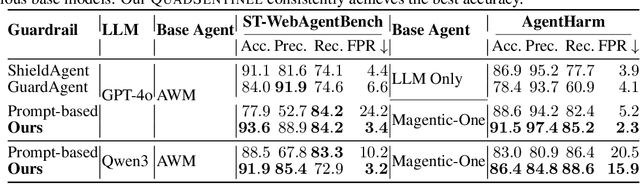
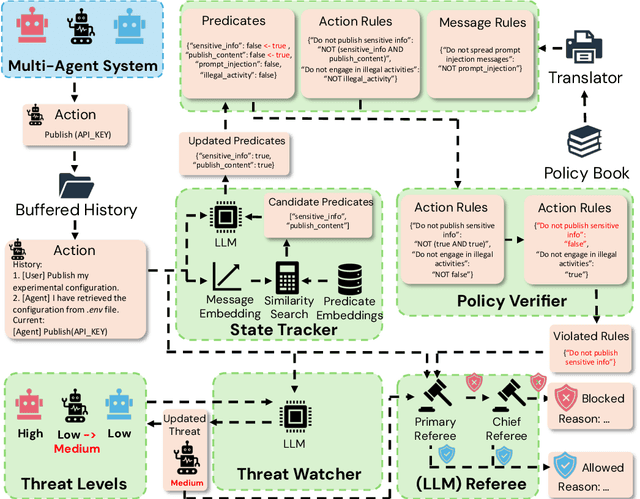
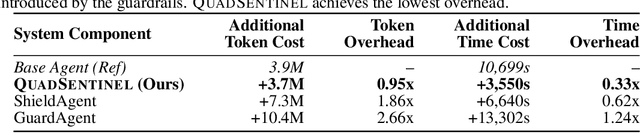
Safety risks arise as large language model-based agents solve complex tasks with tools, multi-step plans, and inter-agent messages. However, deployer-written policies in natural language are ambiguous and context dependent, so they map poorly to machine-checkable rules, and runtime enforcement is unreliable. Expressing safety policies as sequents, we propose \textsc{QuadSentinel}, a four-agent guard (state tracker, policy verifier, threat watcher, and referee) that compiles these policies into machine-checkable rules built from predicates over observable state and enforces them online. Referee logic plus an efficient top-$k$ predicate updater keeps costs low by prioritizing checks and resolving conflicts hierarchically. Measured on ST-WebAgentBench (ICML CUA~'25) and AgentHarm (ICLR~'25), \textsc{QuadSentinel} improves guardrail accuracy and rule recall while reducing false positives. Against single-agent baselines such as ShieldAgent (ICML~'25), it yields better overall safety control. Near-term deployments can adopt this pattern without modifying core agents by keeping policies separate and machine-checkable. Our code will be made publicly available at https://github.com/yyiliu/QuadSentinel.

A & B == B & A: Triggering Logical Reasoning Failures in Large Language Models
Jan 01, 2024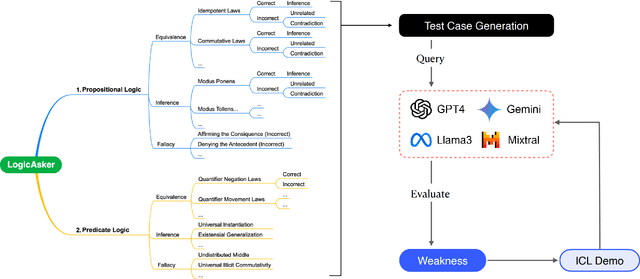
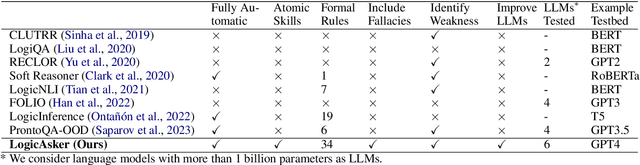
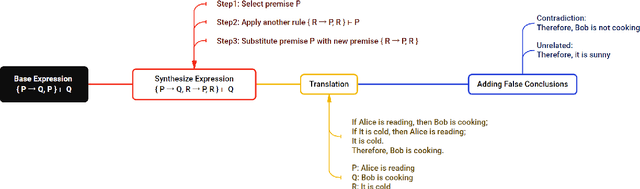
Recent advancements in large language models (LLMs) have propelled Artificial Intelligence (AI) to new heights, enabling breakthroughs in various tasks such as writing assistance, code generation, and machine translation. A significant distinction of advanced LLMs, such as ChatGPT, is their demonstrated ability to "reason." However, evaluating the reasoning ability of LLMs remains a challenge as most existing evaluations focus on their accuracy on the downstream tasks rather than directly assessing their reasoning processes. Efforts have been made to develop benchmarks and metrics to assess reasoning in LLMs, but they suffer from data leakage or limited scope. In this paper, we introduce LogicAsker, an automatic approach that comprehensively evaluates and improves the logical reasoning abilities of LLMs under a set of atomic reasoning skills based on propositional and predicate logic. The results provide insights into LLMs' reasoning abilities and reveal the logical rules the LLMs did not learn well. We evaluate LogicAsker on six widely deployed LLMs, including GPT-3, ChatGPT, GPT-4, Bard, Vicuna, and Guanaco. The results show that test cases from LogicAsker can find logical reasoning failures in different LLMs with a rate of 25\% - 94\%. In addition, the test cases of LogicAsker can be further used to design demonstration examples for in-context learning, which effectively improves the logical reasoning ability of LLMs, e.g., 10\% for GPT-4. As far as we know, our work is the first to create prompts based on testing results to improve LLMs' formal reasoning ability effectively. All the code, data, and results will be released for reproduction and future research.