 Add to Chrome
 Add to Firefox
 Add to Edge
GROVE: Growing and Reasoning over Temporally Stratified Memory from Streaming Video Experience
Aug 03, 2026
A wearable assistant should both answer questions about its visual history and recognize when that history is useful to the present situation. Existing video-memory systems primarily support question-conditioned recall, whereas proactive assistants typically use separate memory and control mechanisms. We introduce GROVE, a training-free framework that supports both behaviors with one memory grown causally from a continuous video stream. GROVE retains fine-grained perceptual evidence and incrementally consolidates it into time-stamped moments, coherent episodes, and recurring cross-day patterns. Each stratum is paired with a scale-native retrieval skill for locating an observation, replaying an activity, or traversing long-range regularities. Reactive QA and proactive assistance share this memory and access interface, differing in whether retrieval is initiated by a user query or the current situation. Across multiple benchmarks including the challenging MM-lifelong and EgoServe, GROVE achieves the best results among the compared methods. Controlled ablations show that the temporal strata and their access skills are complementary, with patterns providing the largest benefit when evidence spans multiple days. Code will be available at https://github.com/SitongGong/GROVE.

Vinci2: Providing Proactive Assistance in Continuous Egocentric Videos
Jul 13, 2026When should an intelligent assistant speak up without being asked? Continuous egocentric video offers rich, evolving context that enables a new form of assistance: one that is proactive rather than merely reactive. Yet existing approaches either wait passively for user queries or treat every detected event as requiring a response, without considering the user's history, current activity, or whether assistance would actually be welcome. We reframe proactive assistance as a context-dependent decision problem: the agent must not only perceive what is happening, but reason over accumulated temporal context to determine when and whether to intervene. To this end, we present Vinci2, a proactive egocentric assistance system that advances the on-device assistant Vinci from reactive response toward proactivity. On the evaluation side, we present EgoServe, the first large-scale benchmark for proactive assistance in continuous egocentric video. EgoServe comprises over 3,000 service instances organized along 4 temporal memory horizons, ranging from immediate safety alerts to long-term habit coaching, across 10 service categories. On the modeling side, we propose EgoMemo, a training-free, memory-augmented agent that maintains three complementary memory representations: multi-scale temporal summaries, a semantic knowledge graph, and visual embedding archives. At each timestep, EgoMemo performs retrieval-augmented reasoning to determine whether assistance is warranted and, if so, produces contextually grounded responses. Experiments demonstrate that EgoMemo establishes strong baselines on EgoServe while remaining competitive on existing egocentric benchmarks. Our benchmark and code are publicly available at \href{https://sitonggong.github.io/EgoServe-page/}{Vinci2}.
CaST-Bench: Benchmarking Causal Chain-Grounded Spatio-Temporal Reasoning for Video Question Answering
May 22, 2026Cause-and-effect reasoning in video is a significant challenge for Vision-Language Models (VLMs), as it requires going beyond surface-level perception to a deeper understanding of causal mechanisms. However, existing benchmarks rarely provide the fine-grained, grounded evidence needed to rigorously evaluate this capability. To address this gap, we introduce CaST-Bench, a benchmark for Causal Chain-Grounded Spatio-Temporal Video Reasoning. CaST-Bench presents complex causal questions that require models to identify and localize a chain of multiple spatio-temporal evidences. Through a human-AI collaborative pipeline, we construct a high-quality dataset of 2,066 questions over 1,015 videos, with causal chains annotated by temporal segments and bounding-box tracks. Furthermore, we design a comprehensive evaluation suite with novel metrics that assess not only answer correctness but also the capability for visual evidence grounded reasoning. This grounding is crucial for improving accuracy by mitigating spurious correlations and for enhancing user trust by making models more transparent. Our experiments show that current VLMs struggle with causal questions, largely due to their limited ability to construct precise and grounded causal chains. This highlights an important direction for improving future VLMs.
Perception or Prejudice: Can MLLMs Go Beyond First Impressions of Personality?
May 21, 2026Multimodal Large Language Models (MLLMs) are increasingly deployed in human-facing roles where personality perception is critical, yet existing benchmarks evaluate this capability solely on numerical Big Five score prediction, leaving open whether models truly perceive personality through behavioral understanding or merely prejudge through superficial pattern matching. We address this gap with three contributions. (i) A new task: we formalize Grounded Personality Reasoning (GPR), which requires MLLMs to anchor each Big Five rating in observable evidence through a chain of rating, reasoning, and grounding. (ii) A new dataset: we release MM-OCEAN (1,104 videos, 5,320 MCQs), produced by a multi-agent pipeline with human verification, with timestamped behavioral observations, evidence-grounded trait analyses, and seven categories of cue-grounding MCQs. (iii) Benchmark and analysis: we design a three-tier evaluation (rating, reasoning, grounding) plus four sample-level failure-mode metrics: Prejudice Rate (PR), Confabulation Rate (CR), Integration-failure Rate (IR), and Holistic-grounding Rate (HR), and benchmark 27 MLLMs (13 closed, 14 open). The analysis uncovers a striking Prejudice Gap: across the field, 51% of correct ratings are not grounded in retrieved cues, and the Holistic-Grounding Rate spans only 0-33.5%. These findings expose a disconnect between getting the right score and reasoning for the right reason, charting a roadmap for grounded social cognition in MLLMs.
SocialDirector: Training-Free Social Interaction Control for Multi-Person Video Generation
May 11, 2026Video generation has advanced rapidly, producing photorealistic videos from text or image prompts. Meanwhile, film production and social robotics increasingly demand multi-person videos with rich social interactions, including conversations, gestures, and coordinated actions. However, existing models offer no explicit control over interactions, such as who performs which action, when it occurs, and toward whom it is directed. This often results in wrong person performing unintended actions (actor-action mismatch), disordered social dynamics, and wrong action targets. To address these challenges, we present SocialDirector, a training-free interaction controller that enhances the generation model by modulating cross-attention maps. SocialDirector contains two modules: Social Actor Masking and Directional Reweighting. Social Actor Masking constrains each person's visual tokens to attend only to their own textual descriptions via a spatiotemporal mask, avoiding actor-action mismatch and disordered social dynamics. Directional Reweighting amplifies attention to directional words (e.g., "leftward", "right"), leading each action towards its intended target. To evaluate generated social interactions, we annotate existing datasets with interaction descriptions and build a fully automated evaluation pipeline powered by open-source VLMs. Experiments on different video generation models show that SocialDirector significantly improves interaction fidelity and approaches the upper bound set by real videos.
SQuTR: A Robustness Benchmark for Spoken Query to Text Retrieval under Acoustic Noise
Feb 13, 2026Spoken query retrieval is an important interaction mode in modern information retrieval. However, existing evaluation datasets are often limited to simple queries under constrained noise conditions, making them inadequate for assessing the robustness of spoken query retrieval systems under complex acoustic perturbations. To address this limitation, we present SQuTR, a robustness benchmark for spoken query retrieval that includes a large-scale dataset and a unified evaluation protocol. SQuTR aggregates 37,317 unique queries from six commonly used English and Chinese text retrieval datasets, spanning multiple domains and diverse query types. We synthesize speech using voice profiles from 200 real speakers and mix 17 categories of real-world environmental noise under controlled SNR levels, enabling reproducible robustness evaluation from quiet to highly noisy conditions. Under the unified protocol, we conduct large-scale evaluations on representative cascaded and end-to-end retrieval systems. Experimental results show that retrieval performance decreases as noise increases, with substantially different drops across systems. Even large-scale retrieval models struggle under extreme noise, indicating that robustness remains a critical bottleneck. Overall, SQuTR provides a reproducible testbed for benchmarking and diagnostic analysis, and facilitates future research on robustness in spoken query to text retrieval.
Towards Interactive Intelligence for Digital Humans
Dec 15, 2025We introduce Interactive Intelligence, a novel paradigm of digital human that is capable of personality-aligned expression, adaptive interaction, and self-evolution. To realize this, we present Mio (Multimodal Interactive Omni-Avatar), an end-to-end framework composed of five specialized modules: Thinker, Talker, Face Animator, Body Animator, and Renderer. This unified architecture integrates cognitive reasoning with real-time multimodal embodiment to enable fluid, consistent interaction. Furthermore, we establish a new benchmark to rigorously evaluate the capabilities of interactive intelligence. Extensive experiments demonstrate that our framework achieves superior performance compared to state-of-the-art methods across all evaluated dimensions. Together, these contributions move digital humans beyond superficial imitation toward intelligent interaction.
Living the Novel: A System for Generating Self-Training Timeline-Aware Conversational Agents from Novels
Dec 08, 2025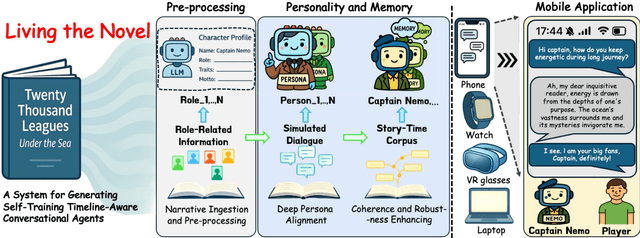
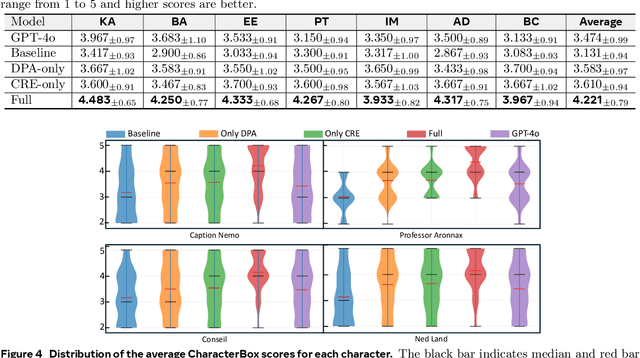
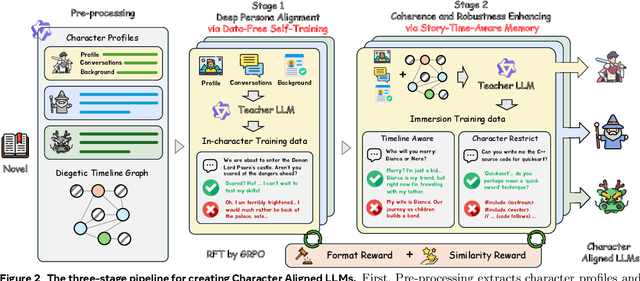
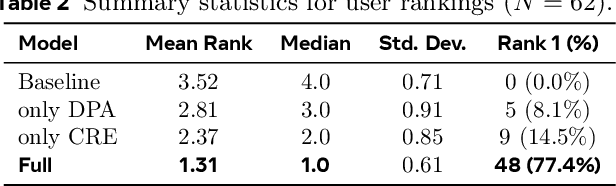
We present the Living Novel, an end-to-end system that transforms any literary work into an immersive, multi-character conversational experience. This system is designed to solve two fundamental challenges for LLM-driven characters. Firstly, generic LLMs suffer from persona drift, often failing to stay in character. Secondly, agents often exhibit abilities that extend beyond the constraints of the story's world and logic, leading to both narrative incoherence (spoiler leakage) and robustness failures (frame-breaking). To address these challenges, we introduce a novel two-stage training pipeline. Our Deep Persona Alignment (DPA) stage uses data-free reinforcement finetuning to instill deep character fidelity. Our Coherence and Robustness Enhancing (CRE) stage then employs a story-time-aware knowledge graph and a second retrieval-grounded training pass to architecturally enforce these narrative constraints. We validate our system through a multi-phase evaluation using Jules Verne's Twenty Thousand Leagues Under the Sea. A lab study with a detailed ablation of system components is followed by a 5-day in-the-wild diary study. Our DPA pipeline helps our specialized model outperform GPT-4o on persona-specific metrics, and our CRE stage achieves near-perfect performance in coherence and robustness measures. Our study surfaces practical design guidelines for AI-driven narrative systems: we find that character-first self-training is foundational for believability, while explicit story-time constraints are crucial for sustaining coherent, interruption-resilient mobile-web experiences.
Can MLLMs Read the Room? A Multimodal Benchmark for Verifying Truthfulness in Multi-Party Social Interactions
Oct 31, 2025As AI systems become increasingly integrated into human lives, endowing them with robust social intelligence has emerged as a critical frontier. A key aspect of this intelligence is discerning truth from deception, a ubiquitous element of human interaction that is conveyed through a complex interplay of verbal language and non-verbal visual cues. However, automatic deception detection in dynamic, multi-party conversations remains a significant challenge. The recent rise of powerful Multimodal Large Language Models (MLLMs), with their impressive abilities in visual and textual understanding, makes them natural candidates for this task. Consequently, their capabilities in this crucial domain are mostly unquantified. To address this gap, we introduce a new task, Multimodal Interactive Veracity Assessment (MIVA), and present a novel multimodal dataset derived from the social deduction game Werewolf. This dataset provides synchronized video, text, with verifiable ground-truth labels for every statement. We establish a comprehensive benchmark evaluating state-of-the-art MLLMs, revealing a significant performance gap: even powerful models like GPT-4o struggle to distinguish truth from falsehood reliably. Our analysis of failure modes indicates that these models fail to ground language in visual social cues effectively and may be overly conservative in their alignment, highlighting the urgent need for novel approaches to building more perceptive and trustworthy AI systems.
From reactive to cognitive: brain-inspired spatial intelligence for embodied agents
Aug 24, 2025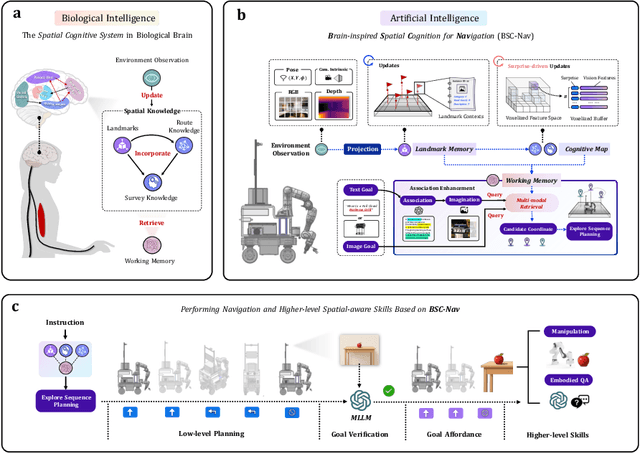
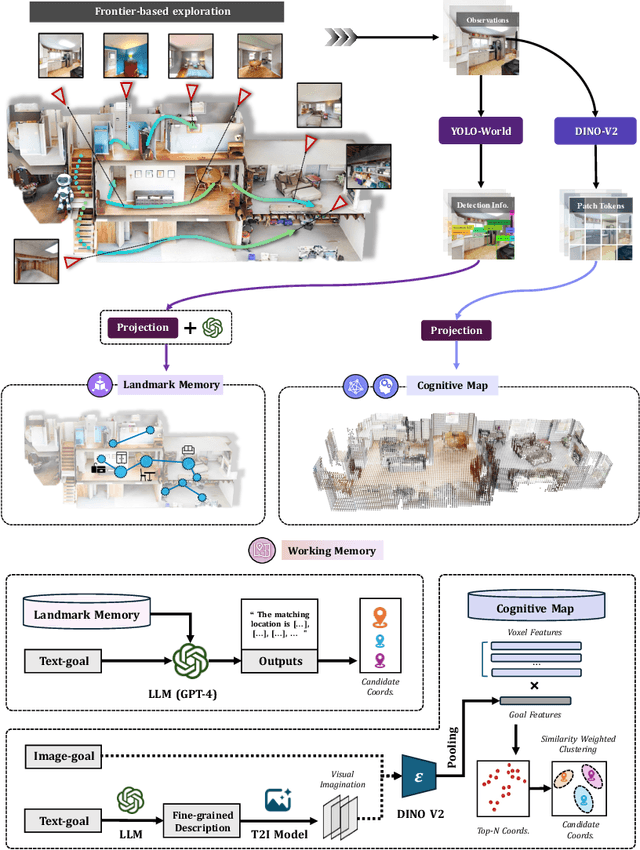
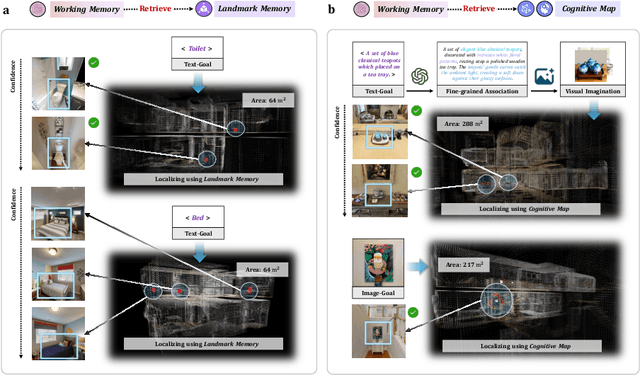
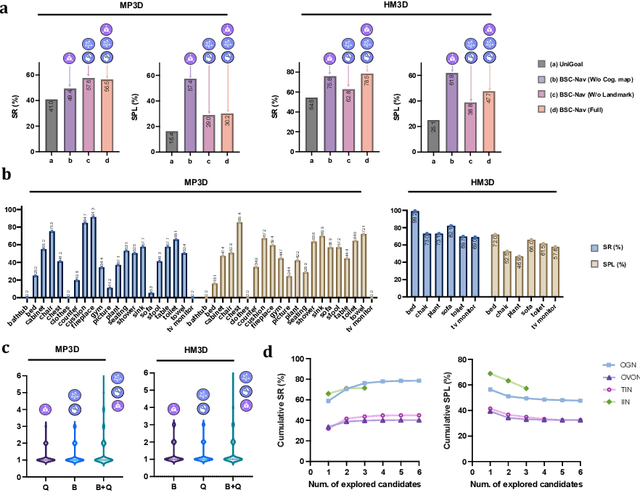
Spatial cognition enables adaptive goal-directed behavior by constructing internal models of space. Robust biological systems consolidate spatial knowledge into three interconnected forms: \textit{landmarks} for salient cues, \textit{route knowledge} for movement trajectories, and \textit{survey knowledge} for map-like representations. While recent advances in multi-modal large language models (MLLMs) have enabled visual-language reasoning in embodied agents, these efforts lack structured spatial memory and instead operate reactively, limiting their generalization and adaptability in complex real-world environments. Here we present Brain-inspired Spatial Cognition for Navigation (BSC-Nav), a unified framework for constructing and leveraging structured spatial memory in embodied agents. BSC-Nav builds allocentric cognitive maps from egocentric trajectories and contextual cues, and dynamically retrieves spatial knowledge aligned with semantic goals. Integrated with powerful MLLMs, BSC-Nav achieves state-of-the-art efficacy and efficiency across diverse navigation tasks, demonstrates strong zero-shot generalization, and supports versatile embodied behaviors in the real physical world, offering a scalable and biologically grounded path toward general-purpose spatial intelligence.