 Add to Chrome
 Add to Firefox
 Add to Edge
CityDreamer4D: Compositional Generative Model of Unbounded 4D Cities
Jan 15, 2025


3D scene generation has garnered growing attention in recent years and has made significant progress. Generating 4D cities is more challenging than 3D scenes due to the presence of structurally complex, visually diverse objects like buildings and vehicles, and heightened human sensitivity to distortions in urban environments. To tackle these issues, we propose CityDreamer4D, a compositional generative model specifically tailored for generating unbounded 4D cities. Our main insights are 1) 4D city generation should separate dynamic objects (e.g., vehicles) from static scenes (e.g., buildings and roads), and 2) all objects in the 4D scene should be composed of different types of neural fields for buildings, vehicles, and background stuff. Specifically, we propose Traffic Scenario Generator and Unbounded Layout Generator to produce dynamic traffic scenarios and static city layouts using a highly compact BEV representation. Objects in 4D cities are generated by combining stuff-oriented and instance-oriented neural fields for background stuff, buildings, and vehicles. To suit the distinct characteristics of background stuff and instances, the neural fields employ customized generative hash grids and periodic positional embeddings as scene parameterizations. Furthermore, we offer a comprehensive suite of datasets for city generation, including OSM, GoogleEarth, and CityTopia. The OSM dataset provides a variety of real-world city layouts, while the Google Earth and CityTopia datasets deliver large-scale, high-quality city imagery complete with 3D instance annotations. Leveraging its compositional design, CityDreamer4D supports a range of downstream applications, such as instance editing, city stylization, and urban simulation, while delivering state-of-the-art performance in generating realistic 4D cities.

Vchitect-2.0: Parallel Transformer for Scaling Up Video Diffusion Models
Jan 14, 2025


We present Vchitect-2.0, a parallel transformer architecture designed to scale up video diffusion models for large-scale text-to-video generation. The overall Vchitect-2.0 system has several key designs. (1) By introducing a novel Multimodal Diffusion Block, our approach achieves consistent alignment between text descriptions and generated video frames, while maintaining temporal coherence across sequences. (2) To overcome memory and computational bottlenecks, we propose a Memory-efficient Training framework that incorporates hybrid parallelism and other memory reduction techniques, enabling efficient training of long video sequences on distributed systems. (3) Additionally, our enhanced data processing pipeline ensures the creation of Vchitect T2V DataVerse, a high-quality million-scale training dataset through rigorous annotation and aesthetic evaluation. Extensive benchmarking demonstrates that Vchitect-2.0 outperforms existing methods in video quality, training efficiency, and scalability, serving as a suitable base for high-fidelity video generation.
Diffusion as Shader: 3D-aware Video Diffusion for Versatile Video Generation Control
Jan 07, 2025

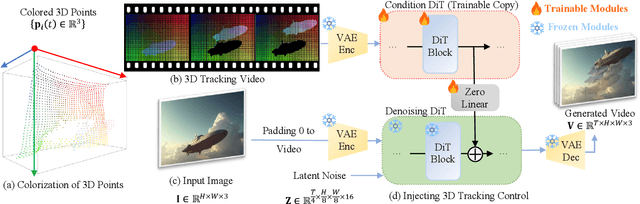

Diffusion models have demonstrated impressive performance in generating high-quality videos from text prompts or images. However, precise control over the video generation process, such as camera manipulation or content editing, remains a significant challenge. Existing methods for controlled video generation are typically limited to a single control type, lacking the flexibility to handle diverse control demands. In this paper, we introduce Diffusion as Shader (DaS), a novel approach that supports multiple video control tasks within a unified architecture. Our key insight is that achieving versatile video control necessitates leveraging 3D control signals, as videos are fundamentally 2D renderings of dynamic 3D content. Unlike prior methods limited to 2D control signals, DaS leverages 3D tracking videos as control inputs, making the video diffusion process inherently 3D-aware. This innovation allows DaS to achieve a wide range of video controls by simply manipulating the 3D tracking videos. A further advantage of using 3D tracking videos is their ability to effectively link frames, significantly enhancing the temporal consistency of the generated videos. With just 3 days of fine-tuning on 8 H800 GPUs using less than 10k videos, DaS demonstrates strong control capabilities across diverse tasks, including mesh-to-video generation, camera control, motion transfer, and object manipulation.
LiMoE: Mixture of LiDAR Representation Learners from Automotive Scenes
Jan 07, 2025LiDAR data pretraining offers a promising approach to leveraging large-scale, readily available datasets for enhanced data utilization. However, existing methods predominantly focus on sparse voxel representation, overlooking the complementary attributes provided by other LiDAR representations. In this work, we propose LiMoE, a framework that integrates the Mixture of Experts (MoE) paradigm into LiDAR data representation learning to synergistically combine multiple representations, such as range images, sparse voxels, and raw points. Our approach consists of three stages: i) Image-to-LiDAR Pretraining, which transfers prior knowledge from images to point clouds across different representations; ii) Contrastive Mixture Learning (CML), which uses MoE to adaptively activate relevant attributes from each representation and distills these mixed features into a unified 3D network; iii) Semantic Mixture Supervision (SMS), which combines semantic logits from multiple representations to boost downstream segmentation performance. Extensive experiments across 11 large-scale LiDAR datasets demonstrate our effectiveness and superiority. The code and model checkpoints have been made publicly accessible.
Are VLMs Ready for Autonomous Driving? An Empirical Study from the Reliability, Data, and Metric Perspectives
Jan 07, 2025

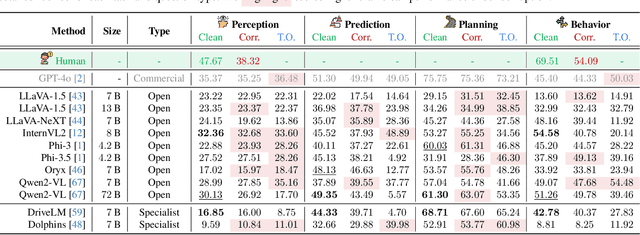

Recent advancements in Vision-Language Models (VLMs) have sparked interest in their use for autonomous driving, particularly in generating interpretable driving decisions through natural language. However, the assumption that VLMs inherently provide visually grounded, reliable, and interpretable explanations for driving remains largely unexamined. To address this gap, we introduce DriveBench, a benchmark dataset designed to evaluate VLM reliability across 17 settings (clean, corrupted, and text-only inputs), encompassing 19,200 frames, 20,498 question-answer pairs, three question types, four mainstream driving tasks, and a total of 12 popular VLMs. Our findings reveal that VLMs often generate plausible responses derived from general knowledge or textual cues rather than true visual grounding, especially under degraded or missing visual inputs. This behavior, concealed by dataset imbalances and insufficient evaluation metrics, poses significant risks in safety-critical scenarios like autonomous driving. We further observe that VLMs struggle with multi-modal reasoning and display heightened sensitivity to input corruptions, leading to inconsistencies in performance. To address these challenges, we propose refined evaluation metrics that prioritize robust visual grounding and multi-modal understanding. Additionally, we highlight the potential of leveraging VLMs' awareness of corruptions to enhance their reliability, offering a roadmap for developing more trustworthy and interpretable decision-making systems in real-world autonomous driving contexts. The benchmark toolkit is publicly accessible.
LargeAD: Large-Scale Cross-Sensor Data Pretraining for Autonomous Driving
Jan 07, 2025Recent advancements in vision foundation models (VFMs) have revolutionized visual perception in 2D, yet their potential for 3D scene understanding, particularly in autonomous driving applications, remains underexplored. In this paper, we introduce LargeAD, a versatile and scalable framework designed for large-scale 3D pretraining across diverse real-world driving datasets. Our framework leverages VFMs to extract semantically rich superpixels from 2D images, which are aligned with LiDAR point clouds to generate high-quality contrastive samples. This alignment facilitates cross-modal representation learning, enhancing the semantic consistency between 2D and 3D data. We introduce several key innovations: i) VFM-driven superpixel generation for detailed semantic representation, ii) a VFM-assisted contrastive learning strategy to align multimodal features, iii) superpoint temporal consistency to maintain stable representations across time, and iv) multi-source data pretraining to generalize across various LiDAR configurations. Our approach delivers significant performance improvements over state-of-the-art methods in both linear probing and fine-tuning tasks for both LiDAR-based segmentation and object detection. Extensive experiments on eleven large-scale multi-modal datasets highlight our superior performance, demonstrating the adaptability, efficiency, and robustness in real-world autonomous driving scenarios.
InterDance:Reactive 3D Dance Generation with Realistic Duet Interactions
Dec 22, 2024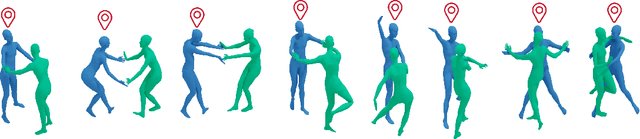



Humans perform a variety of interactive motions, among which duet dance is one of the most challenging interactions. However, in terms of human motion generative models, existing works are still unable to generate high-quality interactive motions, especially in the field of duet dance. On the one hand, it is due to the lack of large-scale high-quality datasets. On the other hand, it arises from the incomplete representation of interactive motion and the lack of fine-grained optimization of interactions. To address these challenges, we propose, InterDance, a large-scale duet dance dataset that significantly enhances motion quality, data scale, and the variety of dance genres. Built upon this dataset, we propose a new motion representation that can accurately and comprehensively describe interactive motion. We further introduce a diffusion-based framework with an interaction refinement guidance strategy to optimize the realism of interactions progressively. Extensive experiments demonstrate the effectiveness of our dataset and algorithm.
Neural LightRig: Unlocking Accurate Object Normal and Material Estimation with Multi-Light Diffusion
Dec 12, 2024


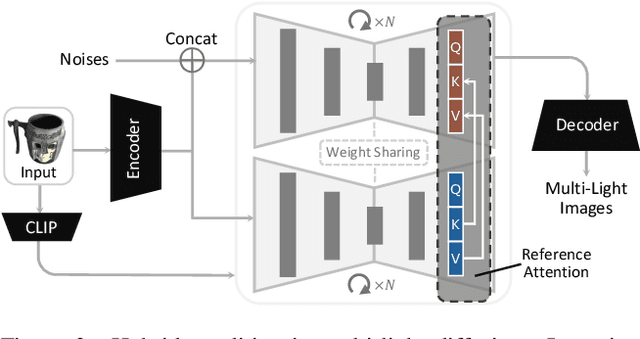
Recovering the geometry and materials of objects from a single image is challenging due to its under-constrained nature. In this paper, we present Neural LightRig, a novel framework that boosts intrinsic estimation by leveraging auxiliary multi-lighting conditions from 2D diffusion priors. Specifically, 1) we first leverage illumination priors from large-scale diffusion models to build our multi-light diffusion model on a synthetic relighting dataset with dedicated designs. This diffusion model generates multiple consistent images, each illuminated by point light sources in different directions. 2) By using these varied lighting images to reduce estimation uncertainty, we train a large G-buffer model with a U-Net backbone to accurately predict surface normals and materials. Extensive experiments validate that our approach significantly outperforms state-of-the-art methods, enabling accurate surface normal and PBR material estimation with vivid relighting effects. Code and dataset are available on our project page at https://projects.zxhezexin.com/neural-lightrig.
FreeScale: Unleashing the Resolution of Diffusion Models via Tuning-Free Scale Fusion
Dec 12, 2024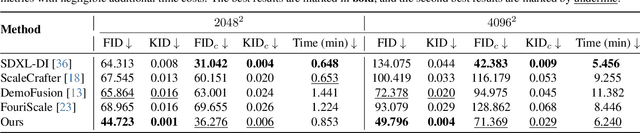
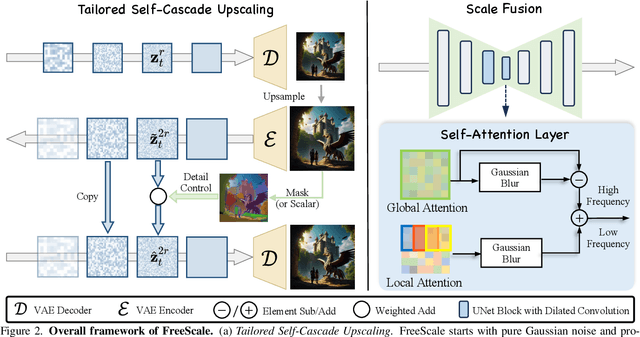

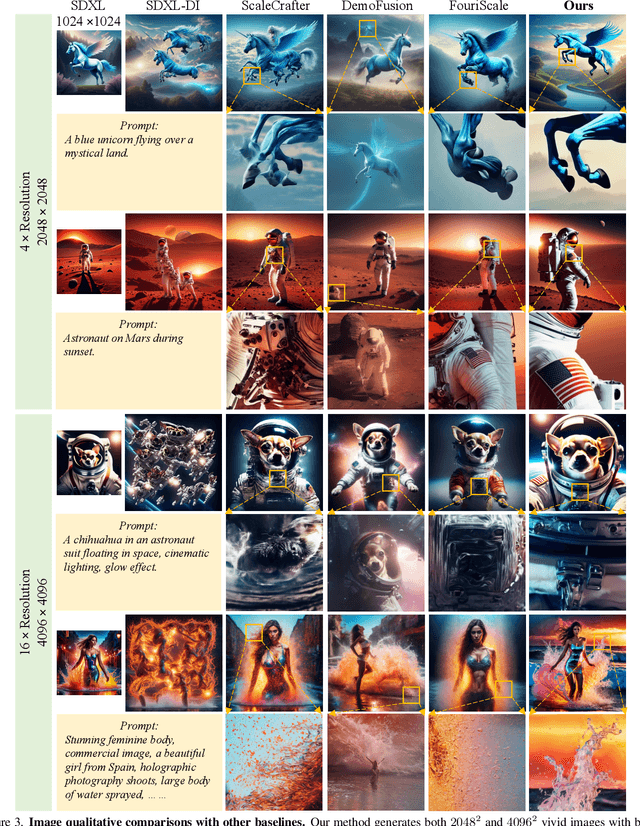
Visual diffusion models achieve remarkable progress, yet they are typically trained at limited resolutions due to the lack of high-resolution data and constrained computation resources, hampering their ability to generate high-fidelity images or videos at higher resolutions. Recent efforts have explored tuning-free strategies to exhibit the untapped potential higher-resolution visual generation of pre-trained models. However, these methods are still prone to producing low-quality visual content with repetitive patterns. The key obstacle lies in the inevitable increase in high-frequency information when the model generates visual content exceeding its training resolution, leading to undesirable repetitive patterns deriving from the accumulated errors. To tackle this challenge, we propose FreeScale, a tuning-free inference paradigm to enable higher-resolution visual generation via scale fusion. Specifically, FreeScale processes information from different receptive scales and then fuses it by extracting desired frequency components. Extensive experiments validate the superiority of our paradigm in extending the capabilities of higher-resolution visual generation for both image and video models. Notably, compared with the previous best-performing method, FreeScale unlocks the generation of 8k-resolution images for the first time.
Evaluation Agent: Efficient and Promptable Evaluation Framework for Visual Generative Models
Dec 10, 2024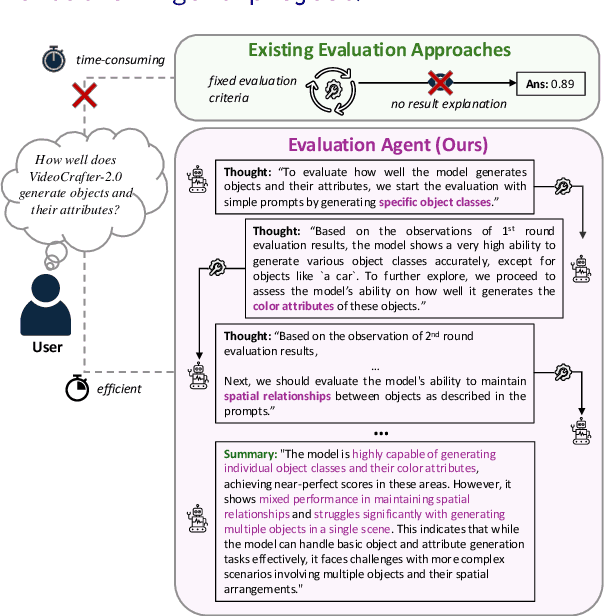

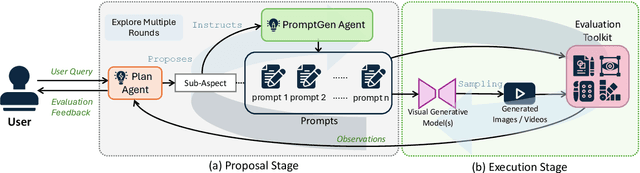
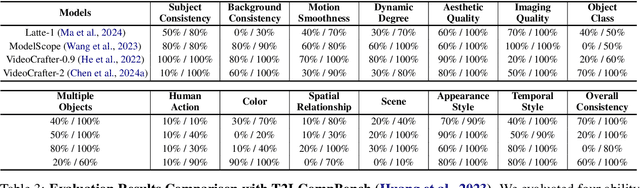
Recent advancements in visual generative models have enabled high-quality image and video generation, opening diverse applications. However, evaluating these models often demands sampling hundreds or thousands of images or videos, making the process computationally expensive, especially for diffusion-based models with inherently slow sampling. Moreover, existing evaluation methods rely on rigid pipelines that overlook specific user needs and provide numerical results without clear explanations. In contrast, humans can quickly form impressions of a model's capabilities by observing only a few samples. To mimic this, we propose the Evaluation Agent framework, which employs human-like strategies for efficient, dynamic, multi-round evaluations using only a few samples per round, while offering detailed, user-tailored analyses. It offers four key advantages: 1) efficiency, 2) promptable evaluation tailored to diverse user needs, 3) explainability beyond single numerical scores, and 4) scalability across various models and tools. Experiments show that Evaluation Agent reduces evaluation time to 10% of traditional methods while delivering comparable results. The Evaluation Agent framework is fully open-sourced to advance research in visual generative models and their efficient evaluation.