 Add to Chrome
 Add to Firefox
 Add to Edge
Not All Points Are Equal: Uncertainty-Aware 4D LiDAR Scene Synthesis
Jun 01, 2026
Constructing faithful 4D worlds from LiDAR-acquired sequences is crucial for embodied AI, yet current generative frameworks apply uniform modeling capacity across all spatial regions. This ignores that perceptual difficulty varies dramatically within a single scan: distant surfaces, occluded boundaries, and small-scale objects carry far higher uncertainty than well-observed structures. We present U4D, a new framework that explicitly leverages spatial uncertainty to guide LiDAR scene generation in a "hard-to-easy" schedule. U4D derives per-point uncertainty maps via Shannon Entropy from a pretrained segmentor, then applies an unconditional diffusion stage to synthesize high-entropy areas with precise geometry, followed by a conditional completion stage that fills in the remaining regions using these structures as priors. A MoST (Mixture of Spatio-Temporal) block further maintains cross-frame coherence by dynamically balancing spatial detail and temporal continuity. Extensive experiments on nuScenes and SemanticKITTI demonstrate state-of-the-art scene fidelity, temporal consistency, and downstream performance.

Distill to Think, Foresee to Act: Cognitive-Physical Reinforcement Learning for Autonomous Driving
May 20, 2026Current end-to-end autonomous driving models are fundamentally constrained by the behavioral cloning ceiling of imitation learning. While reinforcement learning offers a path to smarter autonomy, it demands two missing pieces of infrastructure: (1) a cognitive foundation that understands traffic semantics and driving intent, and (2) a foresighted physical environment that can anticipate the consequences of candidate actions. To this end, we propose CoPhy, a CognitivePhysical reinforcement learning framework for autonomous driving. To distill to think, we distill VLM knowledge into the BEV encoder and then discard the VLM entirely, retaining cognitive ability at zero inference cost while releasing the cognitive channel as a pluggable interface for optional human language commands. To foresee to act, we build an auto-regressive BEV world model that explicitly predicts future semantic maps conditioned on candidate actions, serving as an interpretable physical sandbox from which safety metrics are directly derived. Built upon this dual infrastructure, we optimize the driving policy via GRPO with a novel dual-reward mechanism: a physical reward derived from BEV rollouts enforces hard safety constraints, while a cognitive reward from a language-aligned scorer ensures intent compliance. Extensive experiments demonstrate that CoPhy not only achieves state-of-the-art results on NAVSIM v1 and v2 benchmarks, but also enables safer driving via cognitively informed scene compliance and flexible intent control through user-defined language instructions.
OmniLiDAR: A Unified Diffusion Framework for Multi-Domain 3D LiDAR Generation
May 13, 2026LiDAR scene generation is increasingly important for scalable simulation and synthetic data creation, especially under diverse sensing conditions that are costly to capture at scale. Typically, diffusion-based LiDAR generators are developed under single-domain settings, requiring separate models for different datasets or sensing conditions and hindering unified, controllable synthesis under heterogeneous distribution shifts. To this end, we present OmniLiDAR, a unified text-conditioned diffusion framework that generates LiDAR scans in a shared range-image representation across eight representative domains spanning three shift types: adverse weather, sensor-configuration changes (e.g., reduced beams), and cross-platform acquisition (vehicle, drone, and quadruped). To enable training a single model over heterogeneous domains without isolating optimization by domain, we introduce a Cross-Domain Training Strategy (CDTS) that mixes domains within each mini-batch and leverages conditioning to steer generation. We further propose Cross-Domain Feature Modeling (CDFM), which captures directional dependencies along azimuth and elevation axes to reflect the anisotropic scanning structure of range images, and Domain-Adaptive Feature Scaling (DAFS) as a lightweight modulation to account for structured domain-dependent feature shifts during denoising. In the absence of a public consolidated benchmark, we construct an 8-domain dataset by combining real-world scans with physically based weather simulation and systematic beam reduction while following official splits. Extensive experiments demonstrate strong generation fidelity and consistent gains in downstream use cases, including generative data augmentation for LiDAR semantic segmentation and 3D object detection, as well as robustness evaluation under corruptions, with consistent benefits in limited-label regimes.
Is Your Driving World Model an All-Around Player?
May 11, 2026Today's driving world models can generate remarkably realistic dash-cam videos, yet no single model excels universally. Some generate photorealistic textures but violate basic physics; others maintain geometric consistency but fail when subjected to closed-loop planning. This disconnect exposes a critical gap: the field evaluates how real generated worlds appear, but rarely whether they behave realistically. We introduce WorldLens, a unified benchmark that measures world-model fidelity across the full spectrum, from pixel quality and 4D geometry to closed-loop driving and human perceptual alignment, through five complementary aspects and 24 standardized dimensions. Our evaluation of six representative models reveals that no existing approach dominates across all axes: texture-rich models violate geometry, geometry-aware models lack behavioral fidelity, and even the strongest performers achieve only 2-3 out of 10 on human realism ratings. To bridge algorithmic metrics with human perception, we further contribute WorldLens-26K, a 26,808-entry human-annotated preference dataset pairing numerical scores with textual rationales, and WorldLens-Agent, a vision-language evaluator distilled from these judgments that enables scalable, explainable auto-assessment. Together, the benchmark, dataset, and agent form a unified ecosystem for assessing generated worlds not merely by visual appeal, but by physical and behavioral fidelity.
WorldLens: Full-Spectrum Evaluations of Driving World Models in Real World
Dec 11, 2025Generative world models are reshaping embodied AI, enabling agents to synthesize realistic 4D driving environments that look convincing but often fail physically or behaviorally. Despite rapid progress, the field still lacks a unified way to assess whether generated worlds preserve geometry, obey physics, or support reliable control. We introduce WorldLens, a full-spectrum benchmark evaluating how well a model builds, understands, and behaves within its generated world. It spans five aspects -- Generation, Reconstruction, Action-Following, Downstream Task, and Human Preference -- jointly covering visual realism, geometric consistency, physical plausibility, and functional reliability. Across these dimensions, no existing world model excels universally: those with strong textures often violate physics, while geometry-stable ones lack behavioral fidelity. To align objective metrics with human judgment, we further construct WorldLens-26K, a large-scale dataset of human-annotated videos with numerical scores and textual rationales, and develop WorldLens-Agent, an evaluation model distilled from these annotations to enable scalable, explainable scoring. Together, the benchmark, dataset, and agent form a unified ecosystem for measuring world fidelity -- standardizing how future models are judged not only by how real they look, but by how real they behave.
Perspective-Invariant 3D Object Detection
Jul 23, 2025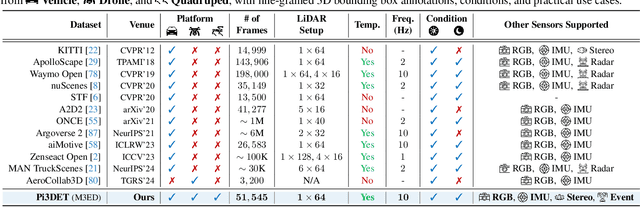
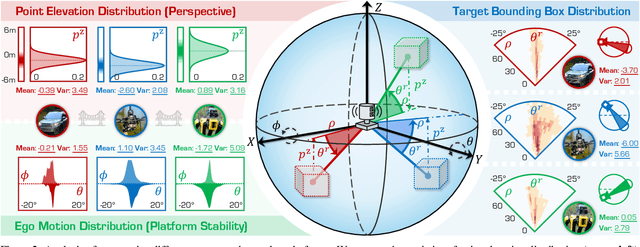
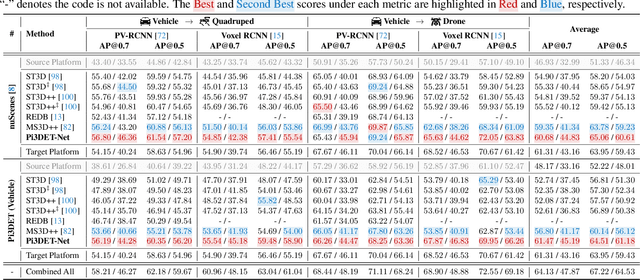
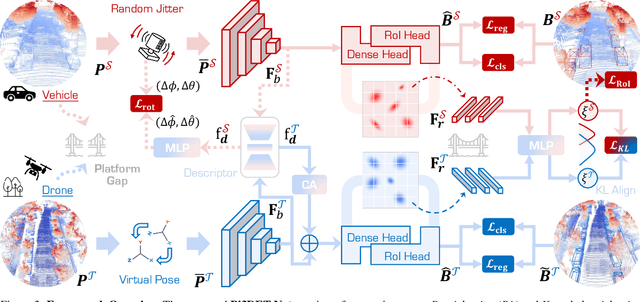
With the rise of robotics, LiDAR-based 3D object detection has garnered significant attention in both academia and industry. However, existing datasets and methods predominantly focus on vehicle-mounted platforms, leaving other autonomous platforms underexplored. To bridge this gap, we introduce Pi3DET, the first benchmark featuring LiDAR data and 3D bounding box annotations collected from multiple platforms: vehicle, quadruped, and drone, thereby facilitating research in 3D object detection for non-vehicle platforms as well as cross-platform 3D detection. Based on Pi3DET, we propose a novel cross-platform adaptation framework that transfers knowledge from the well-studied vehicle platform to other platforms. This framework achieves perspective-invariant 3D detection through robust alignment at both geometric and feature levels. Additionally, we establish a benchmark to evaluate the resilience and robustness of current 3D detectors in cross-platform scenarios, providing valuable insights for developing adaptive 3D perception systems. Extensive experiments validate the effectiveness of our approach on challenging cross-platform tasks, demonstrating substantial gains over existing adaptation methods. We hope this work paves the way for generalizable and unified 3D perception systems across diverse and complex environments. Our Pi3DET dataset, cross-platform benchmark suite, and annotation toolkit have been made publicly available.
SPIRAL: Semantic-Aware Progressive LiDAR Scene Generation
May 28, 2025Leveraging recent diffusion models, LiDAR-based large-scale 3D scene generation has achieved great success. While recent voxel-based approaches can generate both geometric structures and semantic labels, existing range-view methods are limited to producing unlabeled LiDAR scenes. Relying on pretrained segmentation models to predict the semantic maps often results in suboptimal cross-modal consistency. To address this limitation while preserving the advantages of range-view representations, such as computational efficiency and simplified network design, we propose Spiral, a novel range-view LiDAR diffusion model that simultaneously generates depth, reflectance images, and semantic maps. Furthermore, we introduce novel semantic-aware metrics to evaluate the quality of the generated labeled range-view data. Experiments on the SemanticKITTI and nuScenes datasets demonstrate that Spiral achieves state-of-the-art performance with the smallest parameter size, outperforming two-step methods that combine the generative and segmentation models. Additionally, we validate that range images generated by Spiral can be effectively used for synthetic data augmentation in the downstream segmentation training, significantly reducing the labeling effort on LiDAR data.
LargeAD: Large-Scale Cross-Sensor Data Pretraining for Autonomous Driving
Jan 07, 2025Recent advancements in vision foundation models (VFMs) have revolutionized visual perception in 2D, yet their potential for 3D scene understanding, particularly in autonomous driving applications, remains underexplored. In this paper, we introduce LargeAD, a versatile and scalable framework designed for large-scale 3D pretraining across diverse real-world driving datasets. Our framework leverages VFMs to extract semantically rich superpixels from 2D images, which are aligned with LiDAR point clouds to generate high-quality contrastive samples. This alignment facilitates cross-modal representation learning, enhancing the semantic consistency between 2D and 3D data. We introduce several key innovations: i) VFM-driven superpixel generation for detailed semantic representation, ii) a VFM-assisted contrastive learning strategy to align multimodal features, iii) superpoint temporal consistency to maintain stable representations across time, and iv) multi-source data pretraining to generalize across various LiDAR configurations. Our approach delivers significant performance improvements over state-of-the-art methods in both linear probing and fine-tuning tasks for both LiDAR-based segmentation and object detection. Extensive experiments on eleven large-scale multi-modal datasets highlight our superior performance, demonstrating the adaptability, efficiency, and robustness in real-world autonomous driving scenarios.
OVGaussian: Generalizable 3D Gaussian Segmentation with Open Vocabularies
Dec 31, 2024Open-vocabulary scene understanding using 3D Gaussian (3DGS) representations has garnered considerable attention. However, existing methods mostly lift knowledge from large 2D vision models into 3DGS on a scene-by-scene basis, restricting the capabilities of open-vocabulary querying within their training scenes so that lacking the generalizability to novel scenes. In this work, we propose \textbf{OVGaussian}, a generalizable \textbf{O}pen-\textbf{V}ocabulary 3D semantic segmentation framework based on the 3D \textbf{Gaussian} representation. We first construct a large-scale 3D scene dataset based on 3DGS, dubbed \textbf{SegGaussian}, which provides detailed semantic and instance annotations for both Gaussian points and multi-view images. To promote semantic generalization across scenes, we introduce Generalizable Semantic Rasterization (GSR), which leverages a 3D neural network to learn and predict the semantic property for each 3D Gaussian point, where the semantic property can be rendered as multi-view consistent 2D semantic maps. In the next, we propose a Cross-modal Consistency Learning (CCL) framework that utilizes open-vocabulary annotations of 2D images and 3D Gaussians within SegGaussian to train the 3D neural network capable of open-vocabulary semantic segmentation across Gaussian-based 3D scenes. Experimental results demonstrate that OVGaussian significantly outperforms baseline methods, exhibiting robust cross-scene, cross-domain, and novel-view generalization capabilities. Code and the SegGaussian dataset will be released. (https://github.com/runnanchen/OVGaussian).
An Empirical Study of Training State-of-the-Art LiDAR Segmentation Models
May 23, 2024In the rapidly evolving field of autonomous driving, precise segmentation of LiDAR data is crucial for understanding complex 3D environments. Traditional approaches often rely on disparate, standalone codebases, hindering unified advancements and fair benchmarking across models. To address these challenges, we introduce MMDetection3D-lidarseg, a comprehensive toolbox designed for the efficient training and evaluation of state-of-the-art LiDAR segmentation models. We support a wide range of segmentation models and integrate advanced data augmentation techniques to enhance robustness and generalization. Additionally, the toolbox provides support for multiple leading sparse convolution backends, optimizing computational efficiency and performance. By fostering a unified framework, MMDetection3D-lidarseg streamlines development and benchmarking, setting new standards for research and application. Our extensive benchmark experiments on widely-used datasets demonstrate the effectiveness of the toolbox. The codebase and trained models have been publicly available, promoting further research and innovation in the field of LiDAR segmentation for autonomous driving.