 Add to Chrome
 Add to Firefox
 Add to Edge
ACE-Data-0: Human-Centric Ambient Capture as Embodied Data Engine
Jul 30, 2026
Embodied intelligence faces a fundamental data bottleneck. Models must capture how first-person perception, whole-body motion, dexterous manipulation, object state, sound, and touch evolve together as humans pursue goals over time. Existing datasets fragment this experience across viewpoints, modalities, or spatial scales, leaving the full perception-action loop only partially observed. We introduce the Ambient Capture Engine (ACE), a human-centric data engine that transforms real home environments into spatially calibrated, temporally synchronized recording studios. ACE operates at two complementary scales: a table-scale configuration resolves hand-object manipulation, while a room-scale configuration captures whole-body motion, locomotion, and interactions across a furnished home. ACE records egocentric and multi-view exocentric video, full-body and articulated hand motion, object geometry and 6-DoF trajectories, audio, and tactile signals as a unified multisensory stream. Using ACE, we build ACE-Data-0, comprising 150 hours and 17M video frames across 200 task categories, performed by 50 participants in 2 environments, for a total of 75,000 interaction episodes. The dataset spans atomic manipulation, long-horizon chains of household activities, and human-scene interaction, while preserving natural behavioral variation through goal-level rather than step-by-step instructions. We further introduce a hierarchical benchmark that progresses from signals to scene components and then to interactions. Evaluations of state-of-the-art methods expose substantial gaps under contact, occlusion, egomotion, and long temporal horizons. ACE-Data-0 provides synchronized human demonstrations with aligned perceptual, kinematic, and contact supervision, offering a scalable foundation for imitation learning, world models, vision-language-action systems, and embodied AI.

Is Your Driving World Model an All-Around Player?
May 11, 2026Today's driving world models can generate remarkably realistic dash-cam videos, yet no single model excels universally. Some generate photorealistic textures but violate basic physics; others maintain geometric consistency but fail when subjected to closed-loop planning. This disconnect exposes a critical gap: the field evaluates how real generated worlds appear, but rarely whether they behave realistically. We introduce WorldLens, a unified benchmark that measures world-model fidelity across the full spectrum, from pixel quality and 4D geometry to closed-loop driving and human perceptual alignment, through five complementary aspects and 24 standardized dimensions. Our evaluation of six representative models reveals that no existing approach dominates across all axes: texture-rich models violate geometry, geometry-aware models lack behavioral fidelity, and even the strongest performers achieve only 2-3 out of 10 on human realism ratings. To bridge algorithmic metrics with human perception, we further contribute WorldLens-26K, a 26,808-entry human-annotated preference dataset pairing numerical scores with textual rationales, and WorldLens-Agent, a vision-language evaluator distilled from these judgments that enables scalable, explainable auto-assessment. Together, the benchmark, dataset, and agent form a unified ecosystem for assessing generated worlds not merely by visual appeal, but by physical and behavioral fidelity.
HSImul3R: Physics-in-the-Loop Reconstruction of Simulation-Ready Human-Scene Interactions
Mar 16, 2026We present HSImul3R, a unified framework for simulation-ready 3D reconstruction of human-scene interactions (HSI) from casual captures, including sparse-view images and monocular videos. Existing methods suffer from a perception-simulation gap: visually plausible reconstructions often violate physical constraints, leading to instability in physics engines and failure in embodied AI applications. To bridge this gap, we introduce a physically-grounded bi-directional optimization pipeline that treats the physics simulator as an active supervisor to jointly refine human dynamics and scene geometry. In the forward direction, we employ Scene-targeted Reinforcement Learning to optimize human motion under dual supervision of motion fidelity and contact stability. In the reverse direction, we propose Direct Simulation Reward Optimization, which leverages simulation feedback on gravitational stability and interaction success to refine scene geometry. We further present HSIBench, a new benchmark with diverse objects and interaction scenarios. Extensive experiments demonstrate that HSImul3R produces the first stable, simulation-ready HSI reconstructions and can be directly deployed to real-world humanoid robots.
WorldLens: Full-Spectrum Evaluations of Driving World Models in Real World
Dec 11, 2025Generative world models are reshaping embodied AI, enabling agents to synthesize realistic 4D driving environments that look convincing but often fail physically or behaviorally. Despite rapid progress, the field still lacks a unified way to assess whether generated worlds preserve geometry, obey physics, or support reliable control. We introduce WorldLens, a full-spectrum benchmark evaluating how well a model builds, understands, and behaves within its generated world. It spans five aspects -- Generation, Reconstruction, Action-Following, Downstream Task, and Human Preference -- jointly covering visual realism, geometric consistency, physical plausibility, and functional reliability. Across these dimensions, no existing world model excels universally: those with strong textures often violate physics, while geometry-stable ones lack behavioral fidelity. To align objective metrics with human judgment, we further construct WorldLens-26K, a large-scale dataset of human-annotated videos with numerical scores and textual rationales, and develop WorldLens-Agent, an evaluation model distilled from these annotations to enable scalable, explainable scoring. Together, the benchmark, dataset, and agent form a unified ecosystem for measuring world fidelity -- standardizing how future models are judged not only by how real they look, but by how real they behave.
4DNeX: Feed-Forward 4D Generative Modeling Made Easy
Aug 18, 2025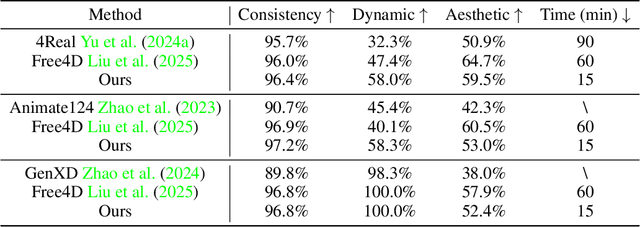
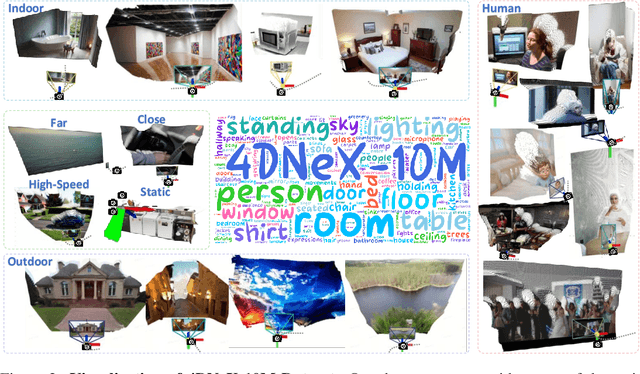

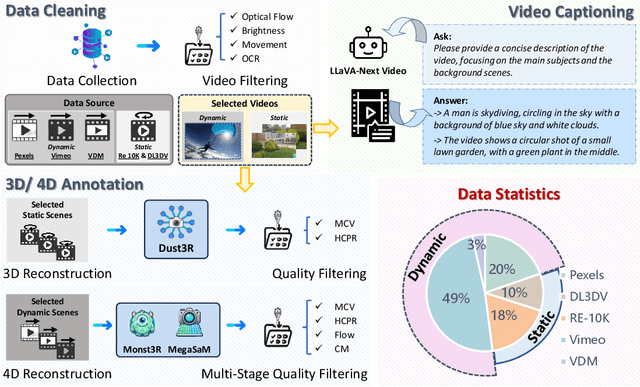
We present 4DNeX, the first feed-forward framework for generating 4D (i.e., dynamic 3D) scene representations from a single image. In contrast to existing methods that rely on computationally intensive optimization or require multi-frame video inputs, 4DNeX enables efficient, end-to-end image-to-4D generation by fine-tuning a pretrained video diffusion model. Specifically, 1) to alleviate the scarcity of 4D data, we construct 4DNeX-10M, a large-scale dataset with high-quality 4D annotations generated using advanced reconstruction approaches. 2) we introduce a unified 6D video representation that jointly models RGB and XYZ sequences, facilitating structured learning of both appearance and geometry. 3) we propose a set of simple yet effective adaptation strategies to repurpose pretrained video diffusion models for 4D modeling. 4DNeX produces high-quality dynamic point clouds that enable novel-view video synthesis. Extensive experiments demonstrate that 4DNeX outperforms existing 4D generation methods in efficiency and generalizability, offering a scalable solution for image-to-4D modeling and laying the foundation for generative 4D world models that simulate dynamic scene evolution.
Hi3DEval: Advancing 3D Generation Evaluation with Hierarchical Validity
Aug 07, 2025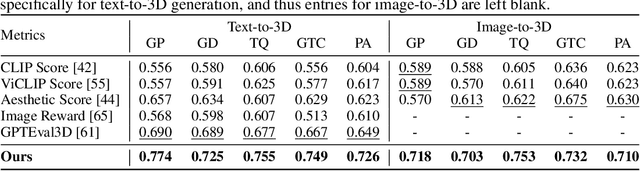
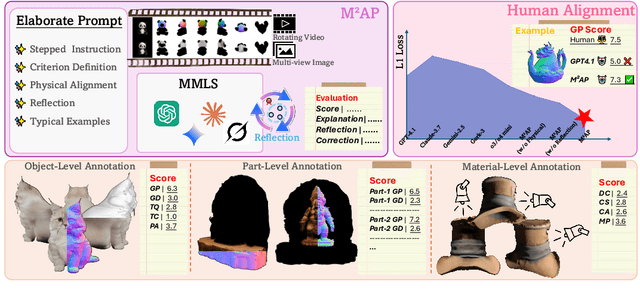
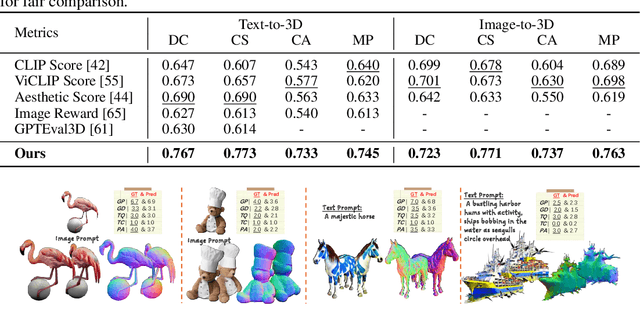
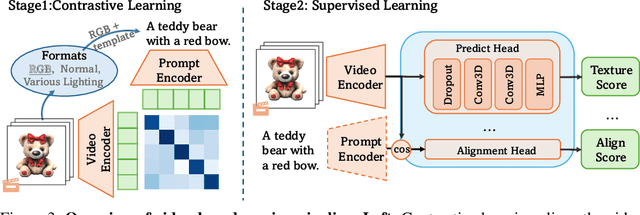
Despite rapid advances in 3D content generation, quality assessment for the generated 3D assets remains challenging. Existing methods mainly rely on image-based metrics and operate solely at the object level, limiting their ability to capture spatial coherence, material authenticity, and high-fidelity local details. 1) To address these challenges, we introduce Hi3DEval, a hierarchical evaluation framework tailored for 3D generative content. It combines both object-level and part-level evaluation, enabling holistic assessments across multiple dimensions as well as fine-grained quality analysis. Additionally, we extend texture evaluation beyond aesthetic appearance by explicitly assessing material realism, focusing on attributes such as albedo, saturation, and metallicness. 2) To support this framework, we construct Hi3DBench, a large-scale dataset comprising diverse 3D assets and high-quality annotations, accompanied by a reliable multi-agent annotation pipeline. We further propose a 3D-aware automated scoring system based on hybrid 3D representations. Specifically, we leverage video-based representations for object-level and material-subject evaluations to enhance modeling of spatio-temporal consistency and employ pretrained 3D features for part-level perception. Extensive experiments demonstrate that our approach outperforms existing image-based metrics in modeling 3D characteristics and achieves superior alignment with human preference, providing a scalable alternative to manual evaluations. The project page is available at https://zyh482.github.io/Hi3DEval/.
Vchitect-2.0: Parallel Transformer for Scaling Up Video Diffusion Models
Jan 14, 2025


We present Vchitect-2.0, a parallel transformer architecture designed to scale up video diffusion models for large-scale text-to-video generation. The overall Vchitect-2.0 system has several key designs. (1) By introducing a novel Multimodal Diffusion Block, our approach achieves consistent alignment between text descriptions and generated video frames, while maintaining temporal coherence across sequences. (2) To overcome memory and computational bottlenecks, we propose a Memory-efficient Training framework that incorporates hybrid parallelism and other memory reduction techniques, enabling efficient training of long video sequences on distributed systems. (3) Additionally, our enhanced data processing pipeline ensures the creation of Vchitect T2V DataVerse, a high-quality million-scale training dataset through rigorous annotation and aesthetic evaluation. Extensive benchmarking demonstrates that Vchitect-2.0 outperforms existing methods in video quality, training efficiency, and scalability, serving as a suitable base for high-fidelity video generation.
Evading Detection Actively: Toward Anti-Forensics against Forgery Localization
Oct 16, 2023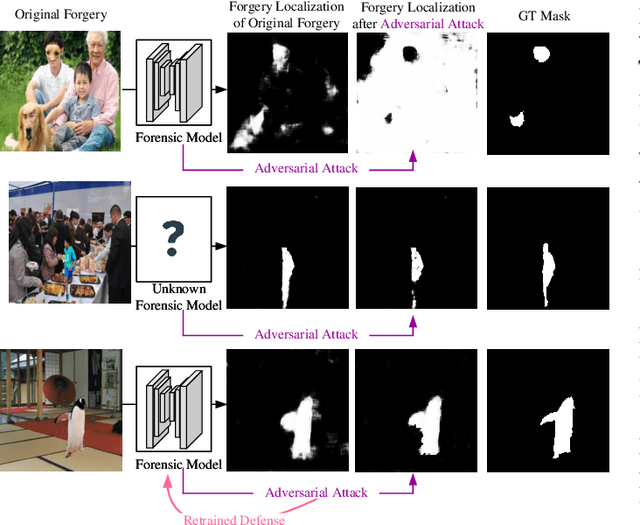
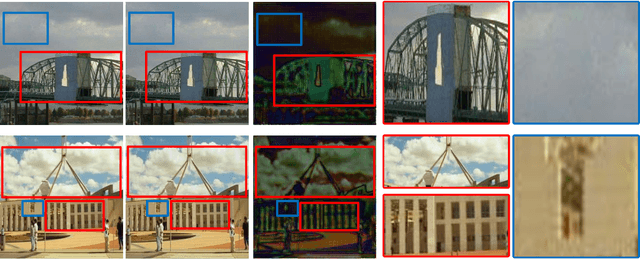
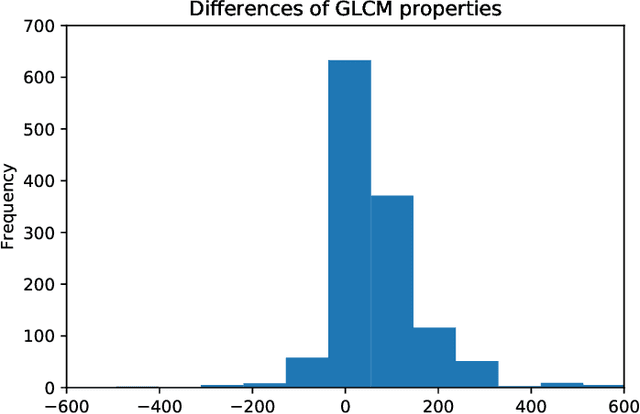
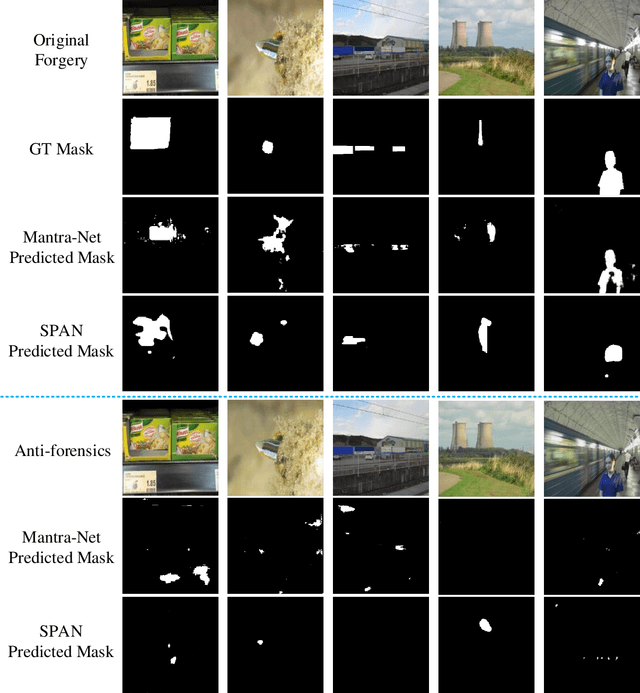
Anti-forensics seeks to eliminate or conceal traces of tampering artifacts. Typically, anti-forensic methods are designed to deceive binary detectors and persuade them to misjudge the authenticity of an image. However, to the best of our knowledge, no attempts have been made to deceive forgery detectors at the pixel level and mis-locate forged regions. Traditional adversarial attack methods cannot be directly used against forgery localization due to the following defects: 1) they tend to just naively induce the target forensic models to flip their pixel-level pristine or forged decisions; 2) their anti-forensics performance tends to be severely degraded when faced with the unseen forensic models; 3) they lose validity once the target forensic models are retrained with the anti-forensics images generated by them. To tackle the three defects, we propose SEAR (Self-supErvised Anti-foRensics), a novel self-supervised and adversarial training algorithm that effectively trains deep-learning anti-forensic models against forgery localization. SEAR sets a pretext task to reconstruct perturbation for self-supervised learning. In adversarial training, SEAR employs a forgery localization model as a supervisor to explore tampering features and constructs a deep-learning concealer to erase corresponding traces. We have conducted largescale experiments across diverse datasets. The experimental results demonstrate that, through the combination of self-supervised learning and adversarial learning, SEAR successfully deceives the state-of-the-art forgery localization methods, as well as tackle the three defects regarding traditional adversarial attack methods mentioned above.
RenderMe-360: A Large Digital Asset Library and Benchmarks Towards High-fidelity Head Avatars
May 22, 2023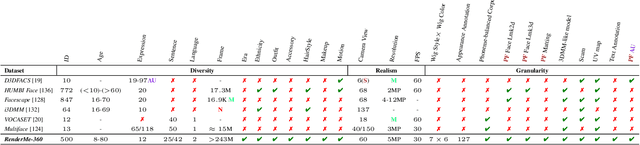
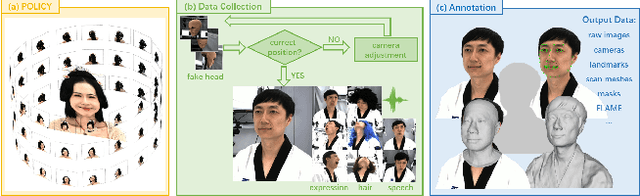
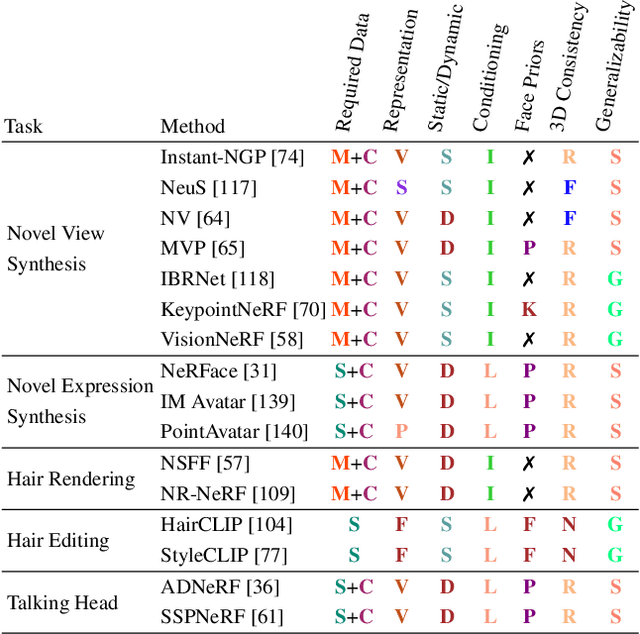
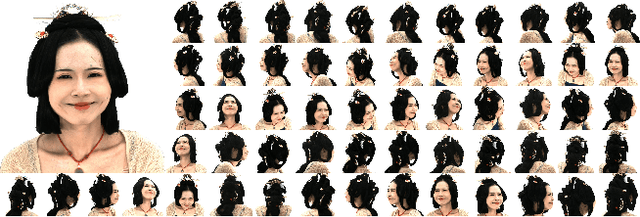
Synthesizing high-fidelity head avatars is a central problem for computer vision and graphics. While head avatar synthesis algorithms have advanced rapidly, the best ones still face great obstacles in real-world scenarios. One of the vital causes is inadequate datasets -- 1) current public datasets can only support researchers to explore high-fidelity head avatars in one or two task directions; 2) these datasets usually contain digital head assets with limited data volume, and narrow distribution over different attributes. In this paper, we present RenderMe-360, a comprehensive 4D human head dataset to drive advance in head avatar research. It contains massive data assets, with 243+ million complete head frames, and over 800k video sequences from 500 different identities captured by synchronized multi-view cameras at 30 FPS. It is a large-scale digital library for head avatars with three key attributes: 1) High Fidelity: all subjects are captured by 60 synchronized, high-resolution 2K cameras in 360 degrees. 2) High Diversity: The collected subjects vary from different ages, eras, ethnicities, and cultures, providing abundant materials with distinctive styles in appearance and geometry. Moreover, each subject is asked to perform various motions, such as expressions and head rotations, which further extend the richness of assets. 3) Rich Annotations: we provide annotations with different granularities: cameras' parameters, matting, scan, 2D/3D facial landmarks, FLAME fitting, and text description. Based on the dataset, we build a comprehensive benchmark for head avatar research, with 16 state-of-the-art methods performed on five main tasks: novel view synthesis, novel expression synthesis, hair rendering, hair editing, and talking head generation. Our experiments uncover the strengths and weaknesses of current methods. RenderMe-360 opens the door for future exploration in head avatars.
Fast-Vid2Vid: Spatial-Temporal Compression for Video-to-Video Synthesis
Jul 11, 2022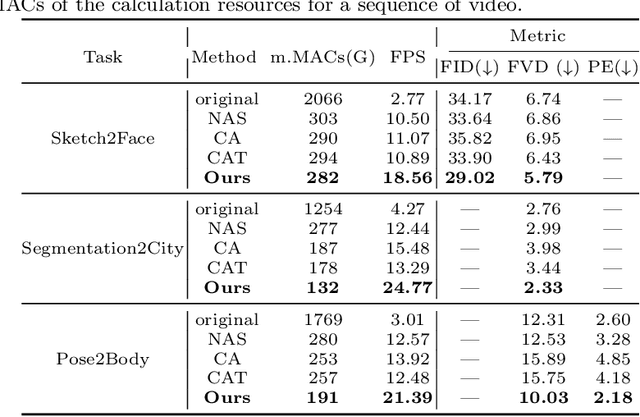
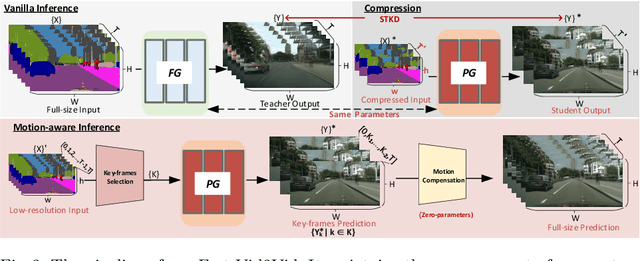
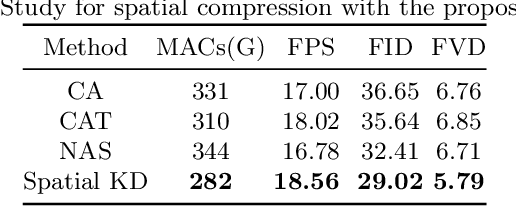
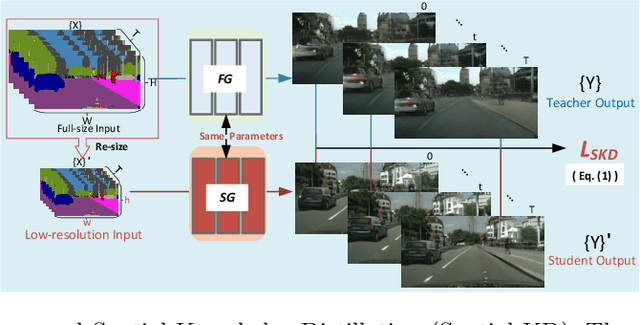
Video-to-Video synthesis (Vid2Vid) has achieved remarkable results in generating a photo-realistic video from a sequence of semantic maps. However, this pipeline suffers from high computational cost and long inference latency, which largely depends on two essential factors: 1) network architecture parameters, 2) sequential data stream. Recently, the parameters of image-based generative models have been significantly compressed via more efficient network architectures. Nevertheless, existing methods mainly focus on slimming network architectures and ignore the size of the sequential data stream. Moreover, due to the lack of temporal coherence, image-based compression is not sufficient for the compression of the video task. In this paper, we present a spatial-temporal compression framework, \textbf{Fast-Vid2Vid}, which focuses on data aspects of generative models. It makes the first attempt at time dimension to reduce computational resources and accelerate inference. Specifically, we compress the input data stream spatially and reduce the temporal redundancy. After the proposed spatial-temporal knowledge distillation, our model can synthesize key-frames using the low-resolution data stream. Finally, Fast-Vid2Vid interpolates intermediate frames by motion compensation with slight latency. On standard benchmarks, Fast-Vid2Vid achieves around real-time performance as 20 FPS and saves around 8x computational cost on a single V100 GPU.