 Add to Chrome
 Add to Firefox
 Add to Edge
CoT-Edit: Let CoT Guide Instruction Video Editing
Aug 02, 2026
Text-driven instruction-based video editing in complex scenes remains challenging: purely textual prompts often fail to capture precise spatial relationships and physical constraints, resulting in target ambiguity and physically implausible outcomes. To address this, we propose a plan--guide--edit framework that explicitly bridges semantic intent and spatial execution. In our framework, a Chain-of-Thought (CoT)-enhanced multimodal large language model (MLLM) serves as a planner, performing structured reasoning over the video and instructions to derive a precise sequence of bounding boxes and attribute-enriched editing directives. These spatial priors then guide a box-conditioned mask generator, transforming ambiguous global retrieval into localized, context-aware refinement and producing masks that more accurately capture object scale, contact relationships, and placement. Building on these spatial and semantic signals, a diffusion-based editor integrates the masks, enriched instructions, and frame features to render high-fidelity edits that remain temporally coherent and spatially well aligned. Trained first in a modular manner and then jointly, our framework achieves superior performance with reduced data requirements, delivering precise localization in scenes with multiple similar objects and physically consistent object additions, and extensive experiments demonstrate state-of-the-art performance over multiple strong baseline methods. More details are available at: https://github.com/flying-sky999/CoT-Edit

AgentHOI: Multi-Agent Reasoning for Human-Object-Interaction Video Generation via Implicit Representation Alignment
Jul 24, 2026Recent advances in video diffusion models have spurred interest in human-object interaction (HOI) video generation, which demands fine-grained control over interaction logic beyond single-subject animation. However, existing HOI methods rely heavily on explicit motion control, limiting scalability and generalization across diverse objects and interactions. In this study, we propose AgentHOI, a text-driven HOI video generation following a thinking-before-generation framework that bridges the gap between high-level textual intent and physical execution through multi-agent reasoning over perception, interaction, and motion planning. Building upon the generated interaction plans, we further strengthen text-driven motion understanding. We introduce an implicit text-motion alignment strategy that distills text-to-motion priors into the video diffusion model, enabling robust HOI synthesis without explicit motion inputs at inference. Experiments show that AgentHOI significantly improves interaction naturalness, object appearance preservation, and adherence to complex textual instructions across challenging object-centric scenarios such as wearing and riding. The code is available at https://github.com/bone-11/agenthoi.
Goku: A Million-Scale Universal Dataset and Benchmark for Instruction-Based Video Editing
Jun 30, 2026Existing instruction-based video editing datasets commonly focus on single-task appearance editing, failing to meet the complex creative demands of real-world scenarios. To bridge this gap, we present Goku, a large-scale dataset featuring 2 million high-quality, instruction-aligned video editing pairs, which is the first to extend task boundaries from basic appearance editing to multi-task and structural manipulations(e.g., precise control of subject movement). To tackle the data synthesis challenges inherent in these complex tasks, we design an efficient data synthesis pipeline that decomposes complex edits into controllable sub-problems and introduce a progressive filtering system for data reliability throughout the whole process. Furthermore, we explore the optimal network structures on Goku, and propose Goku-Edit. To deeply comprehend complex editing instructions, Goku-Edit leverages an MLLM as its text encoder and adopts a decoupled dual-branch design: a dedicated mask branch handles structural control, freeing the main branch for appearance rendering. A comprehensive video editing benchmark, Goku-Bench, is also proposed with 1,000 human-verified test cases and 7 novel editing-specific metrics. Evaluated on Goku-Bench, Goku-Edit obtains up to +8% improvement on other open-source models in terms of instruction following.
Representation Forcing for Bottleneck-Free Unified Multimodal Models
May 29, 2026Unified multimodal models (UMMs) aim to handle perception and generation in a single model. Yet existing UMMs still rely on a frozen, separately pretrained VAE for image generation, imposing a structural bottleneck. Naively removing it introduces a quality gap, as the model must learn both high-level structure and low-level details from raw pixels. In this paper, we propose Representation Forcing (RF), a technique that closes this gap by making representation prediction a native capability of the model. Concretely, RF forces the decoder to autoregressively predict visual representations as intermediate tokens before pixels; these tokens then stay in context to guide pixel diffusion within the same backbone. By turning representations from perception outputs into generation targets, RF eliminates the need for any external generative latent space. We find that RF benefits both understanding and generation. On image generation, our pixel-space model with RF matches state-of-the-art VAE-based unified models. On image understanding, pixel-space RF generally outperforms its VAE-based variant. Together, these results offer an effective step toward end-to-end, bottleneck-free UMMs.
OmniVerifier-M1: Multimodal Meta-Verifier with Explicit Structured Recalibration
May 27, 2026Visual outcomes are increasingly central to multimodal large language models, making reliable and fine-grained verification essential for scaling generalist foundation models. In this work, we investigate multimodal meta-verification, which leverages verifier-generated rationales rather than decision-only signals, and explore how to effectively incorporate meta-verification feedback into multimodal verifier training. We identify two key findings. First, symbolic verifier outputs (e.g., bounding boxes) outperform textual explanations as meta-verification rationales, enabling efficient rule-based reinforcement learning rewards while avoiding reliance on model-based rewards from auxiliary judge models. Second, decoupling reinforcement learning objectives for binary judgment and meta-verification substantially outperforms joint reward optimization, due to intrinsic differences in output structure and learning dynamics. Based on these insights, we train OmniVerifier-M1, a generalist visual verifier leveraging symbolic meta-verification and decoupled reinforcement learning. OmniVerifier-M1 provides robust verification and fine-grained error localization, and further enables M1-TTS, a verifier-driven agentic generation system achieving dynamic region-level self-correction. This approach paves the way for more reliable, interpretable, and fine-grained multimodal verification, supporting safer and more controllable foundation model deployment.
InfiniteDance: Scalable 3D Dance Generation Towards in-the-wild Generalization
Mar 10, 2026Although existing 3D dance generation methods perform well in controlled scenarios, they often struggle to generalize in the wild. When conditioned on unseen music, existing methods often produce unstructured or physically implausible dance, largely due to limited music-to-dance data and restricted model capacity. This work aims to push the frontier of generalizable 3D dance generation by scaling up both data and model design. (1) On the data side, we develop a fully automated pipeline that reconstructs high-fidelity 3D dance motions from monocular videos. To eliminate the physical artifacts prevalent in existing reconstruction methods, we introduce a Foot Restoration Diffusion Model (FRDM) guided by foot-contact and geometric constraints that enforce physical plausibility while preserving kinematic smoothness and expressiveness, resulting in a diverse, high-quality multimodal 3D dance dataset totaling 100.69 hours. (2) On model design, we propose Choreographic LLaMA (ChoreoLLaMA), a scalable LLaMA-based architecture. To enhance robustness under unfamiliar music conditions, we integrate a retrieval-augmented generation (RAG) module that injects reference dance as a prompt. Additionally, we design a slow/fast-cadence Mixture-of-Experts (MoE) module that enables ChoreoLLaMA to smoothly adapt motion rhythms across varying music tempos. Extensive experiments across diverse dance genres show that our approach surpasses existing methods in both qualitative and quantitative evaluations, marking a step toward scalable, real-world 3D dance generation. Code, models, and data will be released.
Making Avatars Interact: Towards Text-Driven Human-Object Interaction for Controllable Talking Avatars
Feb 02, 2026Generating talking avatars is a fundamental task in video generation. Although existing methods can generate full-body talking avatars with simple human motion, extending this task to grounded human-object interaction (GHOI) remains an open challenge, requiring the avatar to perform text-aligned interactions with surrounding objects. This challenge stems from the need for environmental perception and the control-quality dilemma in GHOI generation. To address this, we propose a novel dual-stream framework, InteractAvatar, which decouples perception and planning from video synthesis for grounded human-object interaction. Leveraging detection to enhance environmental perception, we introduce a Perception and Interaction Module (PIM) to generate text-aligned interaction motions. Additionally, an Audio-Interaction Aware Generation Module (AIM) is proposed to synthesize vivid talking avatars performing object interactions. With a specially designed motion-to-video aligner, PIM and AIM share a similar network structure and enable parallel co-generation of motions and plausible videos, effectively mitigating the control-quality dilemma. Finally, we establish a benchmark, GroundedInter, for evaluating GHOI video generation. Extensive experiments and comparisons demonstrate the effectiveness of our method in generating grounded human-object interactions for talking avatars. Project page: https://interactavatar.github.io
StreamAvatar: Streaming Diffusion Models for Real-Time Interactive Human Avatars
Dec 26, 2025Real-time, streaming interactive avatars represent a critical yet challenging goal in digital human research. Although diffusion-based human avatar generation methods achieve remarkable success, their non-causal architecture and high computational costs make them unsuitable for streaming. Moreover, existing interactive approaches are typically limited to head-and-shoulder region, limiting their ability to produce gestures and body motions. To address these challenges, we propose a two-stage autoregressive adaptation and acceleration framework that applies autoregressive distillation and adversarial refinement to adapt a high-fidelity human video diffusion model for real-time, interactive streaming. To ensure long-term stability and consistency, we introduce three key components: a Reference Sink, a Reference-Anchored Positional Re-encoding (RAPR) strategy, and a Consistency-Aware Discriminator. Building on this framework, we develop a one-shot, interactive, human avatar model capable of generating both natural talking and listening behaviors with coherent gestures. Extensive experiments demonstrate that our method achieves state-of-the-art performance, surpassing existing approaches in generation quality, real-time efficiency, and interaction naturalness. Project page: https://streamavatar.github.io .
ActAvatar: Temporally-Aware Precise Action Control for Talking Avatars
Dec 22, 2025Despite significant advances in talking avatar generation, existing methods face critical challenges: insufficient text-following capability for diverse actions, lack of temporal alignment between actions and audio content, and dependency on additional control signals such as pose skeletons. We present ActAvatar, a framework that achieves phase-level precision in action control through textual guidance by capturing both action semantics and temporal context. Our approach introduces three core innovations: (1) Phase-Aware Cross-Attention (PACA), which decomposes prompts into a global base block and temporally-anchored phase blocks, enabling the model to concentrate on phase-relevant tokens for precise temporal-semantic alignment; (2) Progressive Audio-Visual Alignment, which aligns modality influence with the hierarchical feature learning process-early layers prioritize text for establishing action structure while deeper layers emphasize audio for refining lip movements, preventing modality interference; (3) A two-stage training strategy that first establishes robust audio-visual correspondence on diverse data, then injects action control through fine-tuning on structured annotations, maintaining both audio-visual alignment and the model's text-following capabilities. Extensive experiments demonstrate that ActAvatar significantly outperforms state-of-the-art methods in both action control and visual quality.
A Plug-and-Play Physical Motion Restoration Approach for In-the-Wild High-Difficulty Motions
Dec 23, 2024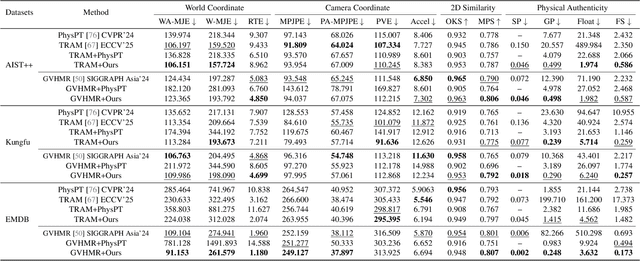
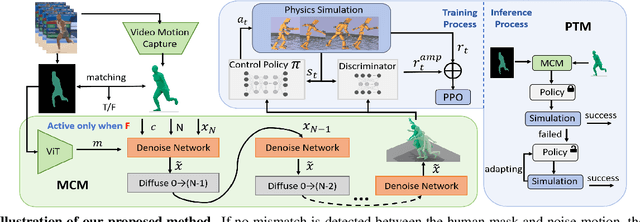
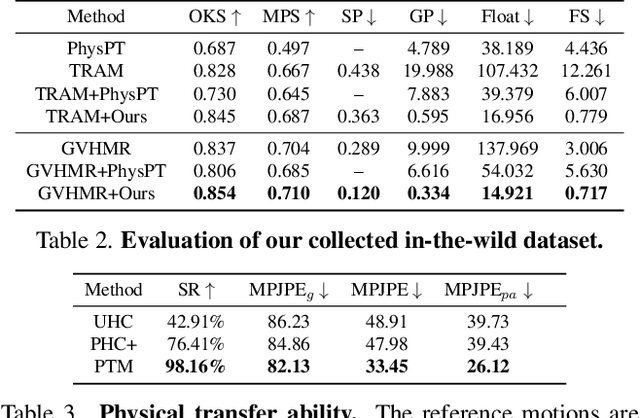
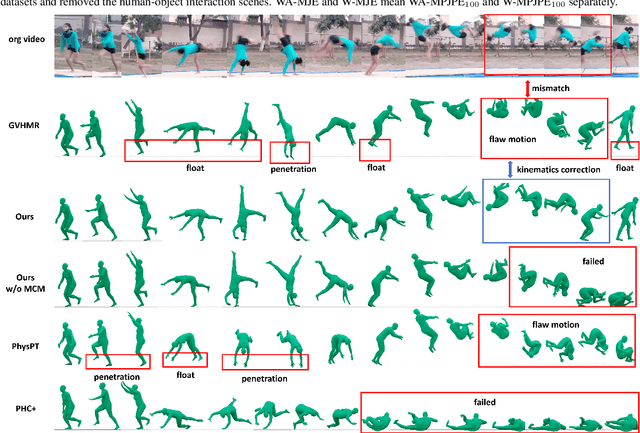
Extracting physically plausible 3D human motion from videos is a critical task. Although existing simulation-based motion imitation methods can enhance the physical quality of daily motions estimated from monocular video capture, extending this capability to high-difficulty motions remains an open challenge. This can be attributed to some flawed motion clips in video-based motion capture results and the inherent complexity in modeling high-difficulty motions. Therefore, sensing the advantage of segmentation in localizing human body, we introduce a mask-based motion correction module (MCM) that leverages motion context and video mask to repair flawed motions, producing imitation-friendly motions; and propose a physics-based motion transfer module (PTM), which employs a pretrain and adapt approach for motion imitation, improving physical plausibility with the ability to handle in-the-wild and challenging motions. Our approach is designed as a plug-and-play module to physically refine the video motion capture results, including high-difficulty in-the-wild motions. Finally, to validate our approach, we collected a challenging in-the-wild test set to establish a benchmark, and our method has demonstrated effectiveness on both the new benchmark and existing public datasets.https://physicalmotionrestoration.github.io