 Add to Chrome
 Add to Firefox
 Add to Edge
On the Road with GPT-4V: Early Explorations of Visual-Language Model on Autonomous Driving
Nov 28, 2023
The pursuit of autonomous driving technology hinges on the sophisticated integration of perception, decision-making, and control systems. Traditional approaches, both data-driven and rule-based, have been hindered by their inability to grasp the nuance of complex driving environments and the intentions of other road users. This has been a significant bottleneck, particularly in the development of common sense reasoning and nuanced scene understanding necessary for safe and reliable autonomous driving. The advent of Visual Language Models (VLM) represents a novel frontier in realizing fully autonomous vehicle driving. This report provides an exhaustive evaluation of the latest state-of-the-art VLM, GPT-4V(ision), and its application in autonomous driving scenarios. We explore the model's abilities to understand and reason about driving scenes, make decisions, and ultimately act in the capacity of a driver. Our comprehensive tests span from basic scene recognition to complex causal reasoning and real-time decision-making under varying conditions. Our findings reveal that GPT-4V demonstrates superior performance in scene understanding and causal reasoning compared to existing autonomous systems. It showcases the potential to handle out-of-distribution scenarios, recognize intentions, and make informed decisions in real driving contexts. However, challenges remain, particularly in direction discernment, traffic light recognition, vision grounding, and spatial reasoning tasks. These limitations underscore the need for further research and development. Project is now available on GitHub for interested parties to access and utilize: \url{https://github.com/PJLab-ADG/GPT4V-AD-Exploration}

DREAM+: Efficient Dataset Distillation by Bidirectional Representative Matching
Oct 23, 2023Dataset distillation plays a crucial role in creating compact datasets with similar training performance compared with original large-scale ones. This is essential for addressing the challenges of data storage and training costs. Prevalent methods facilitate knowledge transfer by matching the gradients, embedding distributions, or training trajectories of synthetic images with those of the sampled original images. Although there are various matching objectives, currently the strategy for selecting original images is limited to naive random sampling. We argue that random sampling overlooks the evenness of the selected sample distribution, which may result in noisy or biased matching targets. Besides, the sample diversity is also not constrained by random sampling. Additionally, current methods predominantly focus on single-dimensional matching, where information is not fully utilized. To address these challenges, we propose a novel matching strategy called Dataset Distillation by Bidirectional REpresentAtive Matching (DREAM+), which selects representative original images for bidirectional matching. DREAM+ is applicable to a variety of mainstream dataset distillation frameworks and significantly reduces the number of distillation iterations by more than 15 times without affecting performance. Given sufficient training time, DREAM+ can further improve the performance and achieve state-of-the-art results. We have released the code at github.com/NUS-HPC-AI-Lab/DREAM+.
DriveDreamer: Towards Real-world-driven World Models for Autonomous Driving
Sep 18, 2023World models, especially in autonomous driving, are trending and drawing extensive attention due to their capacity for comprehending driving environments. The established world model holds immense potential for the generation of high-quality driving videos, and driving policies for safe maneuvering. However, a critical limitation in relevant research lies in its predominant focus on gaming environments or simulated settings, thereby lacking the representation of real-world driving scenarios. Therefore, we introduce DriveDreamer, a pioneering world model entirely derived from real-world driving scenarios. Regarding that modeling the world in intricate driving scenes entails an overwhelming search space, we propose harnessing the powerful diffusion model to construct a comprehensive representation of the complex environment. Furthermore, we introduce a two-stage training pipeline. In the initial phase, DriveDreamer acquires a deep understanding of structured traffic constraints, while the subsequent stage equips it with the ability to anticipate future states. The proposed DriveDreamer is the first world model established from real-world driving scenarios. We instantiate DriveDreamer on the challenging nuScenes benchmark, and extensive experiments verify that DriveDreamer empowers precise, controllable video generation that faithfully captures the structural constraints of real-world traffic scenarios. Additionally, DriveDreamer enables the generation of realistic and reasonable driving policies, opening avenues for interaction and practical applications.
Introspective Deep Metric Learning
Sep 11, 2023This paper proposes an introspective deep metric learning (IDML) framework for uncertainty-aware comparisons of images. Conventional deep metric learning methods focus on learning a discriminative embedding to describe the semantic features of images, which ignore the existence of uncertainty in each image resulting from noise or semantic ambiguity. Training without awareness of these uncertainties causes the model to overfit the annotated labels during training and produce unsatisfactory judgments during inference. Motivated by this, we argue that a good similarity model should consider the semantic discrepancies with awareness of the uncertainty to better deal with ambiguous images for more robust training. To achieve this, we propose to represent an image using not only a semantic embedding but also an accompanying uncertainty embedding, which describes the semantic characteristics and ambiguity of an image, respectively. We further propose an introspective similarity metric to make similarity judgments between images considering both their semantic differences and ambiguities. The gradient analysis of the proposed metric shows that it enables the model to learn at an adaptive and slower pace to deal with the uncertainty during training. The proposed IDML framework improves the performance of deep metric learning through uncertainty modeling and attains state-of-the-art results on the widely used CUB-200-2011, Cars196, and Stanford Online Products datasets for image retrieval and clustering. We further provide an in-depth analysis of our framework to demonstrate the effectiveness and reliability of IDML. Code: https://github.com/wzzheng/IDML.
Unified Single-Stage Transformer Network for Efficient RGB-T Tracking
Aug 26, 2023


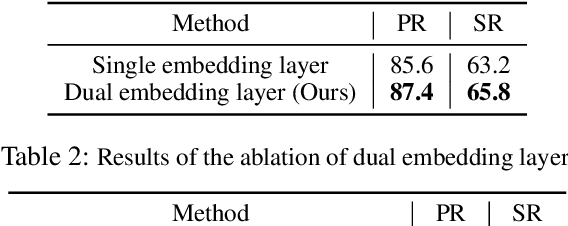
Most existing RGB-T tracking networks extract modality features in a separate manner, which lacks interaction and mutual guidance between modalities. This limits the network's ability to adapt to the diverse dual-modality appearances of targets and the dynamic relationships between the modalities. Additionally, the three-stage fusion tracking paradigm followed by these networks significantly restricts the tracking speed. To overcome these problems, we propose a unified single-stage Transformer RGB-T tracking network, namely USTrack, which unifies the above three stages into a single ViT (Vision Transformer) backbone with a dual embedding layer through self-attention mechanism. With this structure, the network can extract fusion features of the template and search region under the mutual interaction of modalities. Simultaneously, relation modeling is performed between these features, efficiently obtaining the search region fusion features with better target-background discriminability for prediction. Furthermore, we introduce a novel feature selection mechanism based on modality reliability to mitigate the influence of invalid modalities for prediction, further improving the tracking performance. Extensive experiments on three popular RGB-T tracking benchmarks demonstrate that our method achieves new state-of-the-art performance while maintaining the fastest inference speed 84.2FPS. In particular, MPR/MSR on the short-term and long-term subsets of VTUAV dataset increased by 11.1$\%$/11.7$\%$ and 11.3$\%$/9.7$\%$.
One at A Time: Multi-step Volumetric Probability Distribution Diffusion for Depth Estimation
Jul 07, 2023Recent works have explored the fundamental role of depth estimation in multi-view stereo (MVS) and semantic scene completion (SSC). They generally construct 3D cost volumes to explore geometric correspondence in depth, and estimate such volumes in a single step relying directly on the ground truth approximation. However, such problem cannot be thoroughly handled in one step due to complex empirical distributions, especially in challenging regions like occlusions, reflections, etc. In this paper, we formulate the depth estimation task as a multi-step distribution approximation process, and introduce a new paradigm of modeling the Volumetric Probability Distribution progressively (step-by-step) following a Markov chain with Diffusion models (VPDD). Specifically, to constrain the multi-step generation of volume in VPDD, we construct a meta volume guidance and a confidence-aware contextual guidance as conditional geometry priors to facilitate the distribution approximation. For the sampling process, we further investigate an online filtering strategy to maintain consistency in volume representations for stable training. Experiments demonstrate that our plug-and-play VPDD outperforms the state-of-the-arts for tasks of MVS and SSC, and can also be easily extended to different baselines to get improvement. It is worth mentioning that we are the first camera-based work that surpasses LiDAR-based methods on the SemanticKITTI dataset.
Evidential Detection and Tracking Collaboration: New Problem, Benchmark and Algorithm for Robust Anti-UAV System
Jul 04, 2023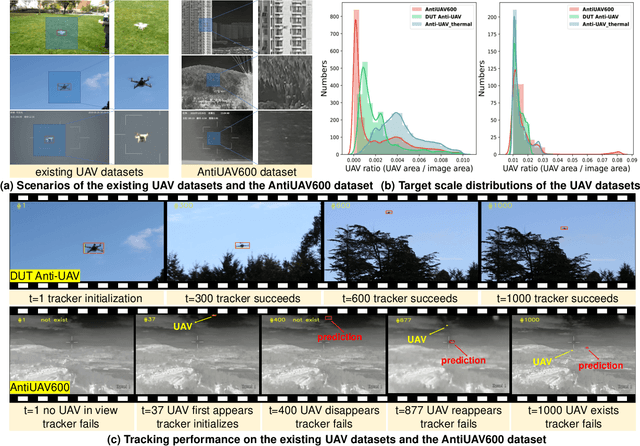
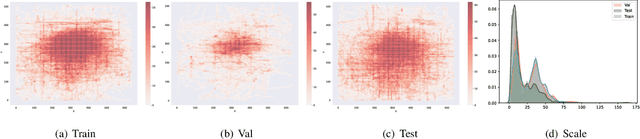

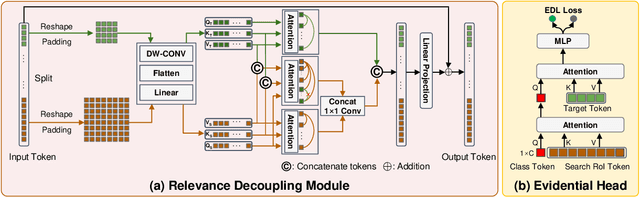
Unmanned Aerial Vehicles (UAVs) have been widely used in many areas, including transportation, surveillance, and military. However, their potential for safety and privacy violations is an increasing issue and highly limits their broader applications, underscoring the critical importance of UAV perception and defense (anti-UAV). Still, previous works have simplified such an anti-UAV task as a tracking problem, where the prior information of UAVs is always provided; such a scheme fails in real-world anti-UAV tasks (i.e. complex scenes, indeterminate-appear and -reappear UAVs, and real-time UAV surveillance). In this paper, we first formulate a new and practical anti-UAV problem featuring the UAVs perception in complex scenes without prior UAVs information. To benchmark such a challenging task, we propose the largest UAV dataset dubbed AntiUAV600 and a new evaluation metric. The AntiUAV600 comprises 600 video sequences of challenging scenes with random, fast, and small-scale UAVs, with over 723K thermal infrared frames densely annotated with bounding boxes. Finally, we develop a novel anti-UAV approach via an evidential collaboration of global UAVs detection and local UAVs tracking, which effectively tackles the proposed problem and can serve as a strong baseline for future research. Extensive experiments show our method outperforms SOTA approaches and validate the ability of AntiUAV600 to enhance UAV perception performance due to its large scale and complexity. Our dataset, pretrained models, and source codes will be released publically.
Multi-Prompt with Depth Partitioned Cross-Modal Learning
May 25, 2023In recent years, soft prompt learning methods have been proposed to fine-tune large-scale vision-language pre-trained models for various downstream tasks. These methods typically combine learnable textual tokens with class tokens as input for models with frozen parameters. However, they often employ a single prompt to describe class contexts, failing to capture categories' diverse attributes adequately. This study introduces the Partitioned Multi-modal Prompt (PMPO), a multi-modal prompting technique that extends the soft prompt from a single learnable prompt to multiple prompts. Our method divides the visual encoder depths and connects learnable prompts to the separated visual depths, enabling different prompts to capture the hierarchical contextual depths of visual representations. Furthermore, to maximize the advantages of multi-prompt learning, we incorporate prior information from manually designed templates and learnable multi-prompts, thus improving the generalization capabilities of our approach. We evaluate the effectiveness of our approach on three challenging tasks: new class generalization, cross-dataset evaluation, and domain generalization. For instance, our method achieves a $79.28$ harmonic mean, averaged over 11 diverse image recognition datasets ($+7.62$ compared to CoOp), demonstrating significant competitiveness compared to state-of-the-art prompting methods.
The 3rd Anti-UAV Workshop & Challenge: Methods and Results
May 12, 2023


The 3rd Anti-UAV Workshop & Challenge aims to encourage research in developing novel and accurate methods for multi-scale object tracking. The Anti-UAV dataset used for the Anti-UAV Challenge has been publicly released. There are two main differences between this year's competition and the previous two. First, we have expanded the existing dataset, and for the first time, released a training set so that participants can focus on improving their models. Second, we set up two tracks for the first time, i.e., Anti-UAV Tracking and Anti-UAV Detection & Tracking. Around 76 participating teams from the globe competed in the 3rd Anti-UAV Challenge. In this paper, we provide a brief summary of the 3rd Anti-UAV Workshop & Challenge including brief introductions to the top three methods in each track. The submission leaderboard will be reopened for researchers that are interested in the Anti-UAV challenge. The benchmark dataset and other information can be found at: https://anti-uav.github.io/.
OccFormer: Dual-path Transformer for Vision-based 3D Semantic Occupancy Prediction
Apr 11, 2023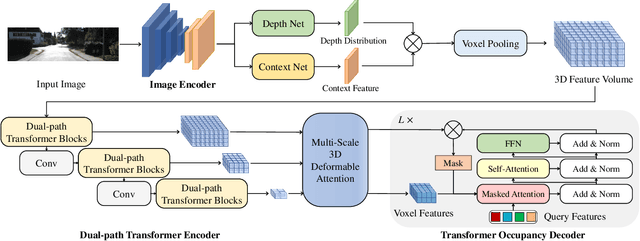
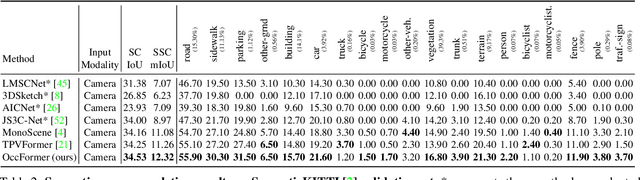
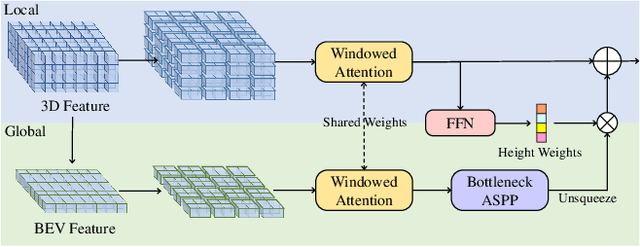
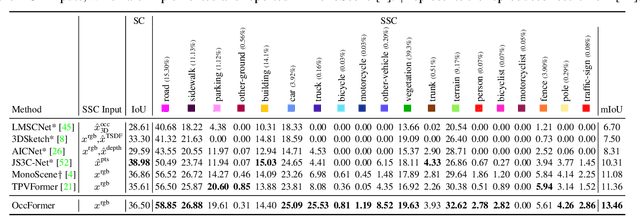
The vision-based perception for autonomous driving has undergone a transformation from the bird-eye-view (BEV) representations to the 3D semantic occupancy. Compared with the BEV planes, the 3D semantic occupancy further provides structural information along the vertical direction. This paper presents OccFormer, a dual-path transformer network to effectively process the 3D volume for semantic occupancy prediction. OccFormer achieves a long-range, dynamic, and efficient encoding of the camera-generated 3D voxel features. It is obtained by decomposing the heavy 3D processing into the local and global transformer pathways along the horizontal plane. For the occupancy decoder, we adapt the vanilla Mask2Former for 3D semantic occupancy by proposing preserve-pooling and class-guided sampling, which notably mitigate the sparsity and class imbalance. Experimental results demonstrate that OccFormer significantly outperforms existing methods for semantic scene completion on SemanticKITTI dataset and for LiDAR semantic segmentation on nuScenes dataset. Code is available at \url{https://github.com/zhangyp15/OccFormer}.