 Add to Chrome
 Add to Firefox
 Add to Edge
Let RGB Be the Language of Vision
Jul 14, 2026
This work introduces a unified formulation for vision models, where diverse forms of visual information beyond natural images, such as masks, depth maps, and other structured visual signals, are all represented as RGB images, while general visual tasks can be converted into a common RGB-to-RGB image editing problem. In this paradigm, different types of visual information internally share the same encoding and decoding architecture and parameters as natural images, enabling a single model to transfer across tasks through a unified visual interface, in a way analogous to how language models operate over text. We refer to this formulation as RGB In and RGB Out (RINO). Built upon a generic image editing backbone without task-specific fine-tuning, RINO demonstrates robust and competitive zero-shot performance on both dense understanding tasks such as segmentation and depth estimation (where we unify outputs as RGB), and dense-conditioned generation tasks such as pose-to-image generation (where we unify inputs as RGB). We hope this study provides useful insights toward general unified vision-language systems, where diverse visual tasks can be expressed, interpreted, and solved through a shared visual language. Code is available at https://github.com/yangtiming/RINO.

Omni-SimpleMem: Autoresearch-Guided Discovery of Lifelong Multimodal Agent Memory
Apr 02, 2026AI agents increasingly operate over extended time horizons, yet their ability to retain, organize, and recall multimodal experiences remains a critical bottleneck. Building effective lifelong memory requires navigating a vast design space spanning architecture, retrieval strategies, prompt engineering, and data pipelines; this space is too large and interconnected for manual exploration or traditional AutoML to explore effectively. We deploy an autonomous research pipeline to discover Omni-SimpleMem, a unified multimodal memory framework for lifelong AI agents. Starting from a naïve baseline (F1=0.117 on LoCoMo), the pipeline autonomously executes ${\sim}50$ experiments across two benchmarks, diagnosing failure modes, proposing architectural modifications, and repairing data pipeline bugs, all without human intervention in the inner loop. The resulting system achieves state-of-the-art on both benchmarks, improving F1 by +411% on LoCoMo (0.117$\to$0.598) and +214% on Mem-Gallery (0.254$\to$0.797) relative to the initial configurations. Critically, the most impactful discoveries are not hyperparameter adjustments: bug fixes (+175%), architectural changes (+44%), and prompt engineering (+188% on specific categories) each individually exceed the cumulative contribution of all hyperparameter tuning, demonstrating capabilities fundamentally beyond the reach of traditional AutoML. We provide a taxonomy of six discovery types and identify four properties that make multimodal memory particularly suited for autoresearch, offering guidance for applying autonomous research pipelines to other AI system domains. Code is available at this https://github.com/aiming-lab/SimpleMem.
CAST: Modeling Visual State Transitions for Consistent Video Retrieval
Mar 09, 2026As video content creation shifts toward long-form narratives, composing short clips into coherent storylines becomes increasingly important. However, prevailing retrieval formulations remain context-agnostic at inference time, prioritizing local semantic alignment while neglecting state and identity consistency. To address this structural limitation, we formalize the task of Consistent Video Retrieval (CVR) and introduce a diagnostic benchmark spanning YouCook2, COIN, and CrossTask. We propose CAST (Context-Aware State Transition), a lightweight, plug-and-play adapter compatible with diverse frozen vision-language embedding spaces. By predicting a state-conditioned residual update ($Δ$) from visual history, CAST introduces an explicit inductive bias for latent state evolution. Extensive experiments show that CAST improves performance on YouCook2 and CrossTask, remains competitive on COIN, and consistently outperforms zero-shot baselines across diverse foundation backbones. Furthermore, CAST provides a useful reranking signal for black-box video generation candidates (e.g., from Veo), promoting more temporally coherent continuations.
Investigating Group Relative Policy Optimization for Diffusion Transformer based Text-to-Audio Generation
Mar 02, 2026Text-to-audio (T2A) generation has advanced considerably in recent years, yet existing methods continue to face challenges in accurately rendering complex text prompts, particularly those involving intricate audio effects, and achieving precise text-audio alignment. While prior approaches have explored data augmentation, explicit timing conditioning, and reinforcement learning, overall synthesis quality remains constrained. In this work, we experiment with reinforcement learning to further enhance T2A generation quality, building on diffusion transformer (DiT)-based architectures. Our method first employs a large language model (LLM) to generate high-fidelity, richly detailed audio captions, substantially improving text-audio semantic alignment, especially for ambiguous or underspecified prompts. We then apply Group Relative Policy Optimization (GRPO), a recently introduced reinforcement learning algorithm, to fine-tune the T2A model. Through systematic experimentation with diverse reward functions (including CLAP, KL, FAD, and their combinations), we identify the key drivers of effective RL in audio synthesis and analyze how reward design impacts final audio quality. Experimental results demonstrate that GRPO-based fine-tuning yield substantial gains in synthesis fidelity and prompt adherence.
OpenVision 3: A Family of Unified Visual Encoder for Both Understanding and Generation
Jan 21, 2026This paper presents a family of advanced vision encoder, named OpenVision 3, that learns a single, unified visual representation that can serve both image understanding and image generation. Our core architecture is simple: we feed VAE-compressed image latents to a ViT encoder and train its output to support two complementary roles. First, the encoder output is passed to the ViT-VAE decoder to reconstruct the original image, encouraging the representation to capture generative structure. Second, the same representation is optimized with contrastive learning and image-captioning objectives, strengthening semantic features. By jointly optimizing reconstruction- and semantics-driven signals in a shared latent space, the encoder learns representations that synergize and generalize well across both regimes. We validate this unified design through extensive downstream evaluations with the encoder frozen. For multimodal understanding, we plug the encoder into the LLaVA-1.5 framework: it performs comparably with a standard CLIP vision encoder (e.g., 62.4 vs 62.2 on SeedBench, and 83.7 vs 82.9 on POPE). For generation, we test it under the RAE framework: ours substantially surpasses the standard CLIP-based encoder (e.g., gFID: 1.89 vs 2.54 on ImageNet). We hope this work can spur future research on unified modeling.
A Unified Neural Codec Language Model for Selective Editable Text to Speech Generation
Jan 18, 2026Neural codec language models achieve impressive zero-shot Text-to-Speech (TTS) by fully imitating the acoustic characteristics of a short speech prompt, including timbre, prosody, and paralinguistic information. However, such holistic imitation limits their ability to isolate and control individual attributes. In this paper, we present a unified codec language model SpeechEdit that extends zero-shot TTS with a selective control mechanism. By default, SpeechEdit reproduces the complete acoustic profile inferred from the speech prompt, but it selectively overrides only the attributes specified by explicit control instructions. To enable controllable modeling, SpeechEdit is trained on our newly constructed LibriEdit dataset, which provides delta (difference-aware) training pairs derived from LibriHeavy. Experimental results show that our approach maintains naturalness and robustness while offering flexible and localized control over desired attributes. Audio samples are available at https://speech-editing.github.io/speech-editing/.
Next Tokens Denoising for Speech Synthesis
Jul 30, 2025While diffusion and autoregressive (AR) models have significantly advanced generative modeling, they each present distinct limitations. AR models, which rely on causal attention, cannot exploit future context and suffer from slow generation speeds. Conversely, diffusion models struggle with key-value (KV) caching. To overcome these challenges, we introduce Dragon-FM, a novel text-to-speech (TTS) design that unifies AR and flow-matching. This model processes 48 kHz audio codec tokens in chunks at a compact 12.5 tokens per second rate. This design enables AR modeling across chunks, ensuring global coherence, while parallel flow-matching within chunks facilitates fast iterative denoising. Consequently, the proposed model can utilize KV-cache across chunks and incorporate future context within each chunk. Furthermore, it bridges continuous and discrete feature modeling, demonstrating that continuous AR flow-matching can predict discrete tokens with finite scalar quantizers. This efficient codec and fast chunk-autoregressive architecture also makes the proposed model particularly effective for generating extended content. Experiment for demos of our work} on podcast datasets demonstrate its capability to efficiently generate high-quality zero-shot podcasts.
StreamMel: Real-Time Zero-shot Text-to-Speech via Interleaved Continuous Autoregressive Modeling
Jun 14, 2025Recent advances in zero-shot text-to-speech (TTS) synthesis have achieved high-quality speech generation for unseen speakers, but most systems remain unsuitable for real-time applications because of their offline design. Current streaming TTS paradigms often rely on multi-stage pipelines and discrete representations, leading to increased computational cost and suboptimal system performance. In this work, we propose StreamMel, a pioneering single-stage streaming TTS framework that models continuous mel-spectrograms. By interleaving text tokens with acoustic frames, StreamMel enables low-latency, autoregressive synthesis while preserving high speaker similarity and naturalness. Experiments on LibriSpeech demonstrate that StreamMel outperforms existing streaming TTS baselines in both quality and latency. It even achieves performance comparable to offline systems while supporting efficient real-time generation, showcasing broad prospects for integration with real-time speech large language models. Audio samples are available at: https://aka.ms/StreamMel.
Zero-Shot Streaming Text to Speech Synthesis with Transducer and Auto-Regressive Modeling
May 26, 2025Zero-shot streaming text-to-speech is an important research topic in human-computer interaction. Existing methods primarily use a lookahead mechanism, relying on future text to achieve natural streaming speech synthesis, which introduces high processing latency. To address this issue, we propose SMLLE, a streaming framework for generating high-quality speech frame-by-frame. SMLLE employs a Transducer to convert text into semantic tokens in real time while simultaneously obtaining duration alignment information. The combined outputs are then fed into a fully autoregressive (AR) streaming model to reconstruct mel-spectrograms. To further stabilize the generation process, we design a Delete < Bos > Mechanism that allows the AR model to access future text introducing as minimal delay as possible. Experimental results suggest that the SMLLE outperforms current streaming TTS methods and achieves comparable performance over sentence-level TTS systems. Samples are available on https://anonymous.4open.science/w/demo_page-48B7/.
OpenVision: A Fully-Open, Cost-Effective Family of Advanced Vision Encoders for Multimodal Learning
May 07, 2025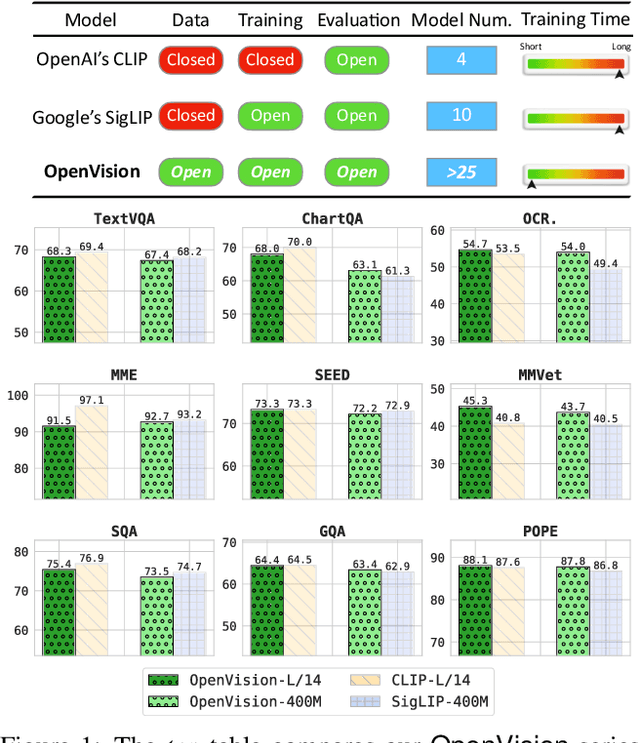
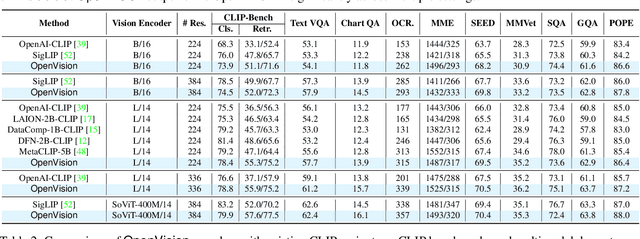
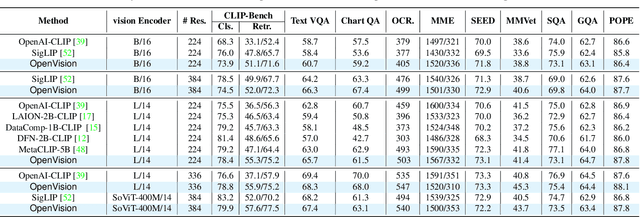
OpenAI's CLIP, released in early 2021, have long been the go-to choice of vision encoder for building multimodal foundation models. Although recent alternatives such as SigLIP have begun to challenge this status quo, to our knowledge none are fully open: their training data remains proprietary and/or their training recipes are not released. This paper fills this gap with OpenVision, a fully-open, cost-effective family of vision encoders that match or surpass the performance of OpenAI's CLIP when integrated into multimodal frameworks like LLaVA. OpenVision builds on existing works -- e.g., CLIPS for training framework and Recap-DataComp-1B for training data -- while revealing multiple key insights in enhancing encoder quality and showcasing practical benefits in advancing multimodal models. By releasing vision encoders spanning from 5.9M to 632.1M parameters, OpenVision offers practitioners a flexible trade-off between capacity and efficiency in building multimodal models: larger models deliver enhanced multimodal performance, while smaller versions enable lightweight, edge-ready multimodal deployments.