 Add to Chrome
 Add to Firefox
 Add to Edge
Unlock Predictable Scaling from Emergent Abilities
Oct 05, 2023




The scientific scale-up of large language models (LLMs) necessitates a comprehensive understanding of their scaling properties. However, the existing literature on the scaling properties only yields an incomplete answer: optimization loss decreases predictably as the model size increases, in line with established scaling law; yet no scaling law for task has been established and the task performances are far from predictable during scaling. Task performances typically show minor gains on small models until they improve dramatically once models exceed a size threshold, exemplifying the ``emergent abilities''. In this study, we discover that small models, although they exhibit minor performance, demonstrate critical and consistent task performance improvements that are not captured by conventional evaluation strategies due to insufficient measurement resolution. To measure such improvements, we introduce PassUntil, an evaluation strategy through massive sampling in the decoding phase. We conduct quantitative investigations into the scaling law of task performance. Firstly, a strict task scaling law is identified, enhancing the predictability of task performances. Remarkably, we are able to predict the performance of the 2.4B model on code generation with merely 0.05\% deviation before training starts. Secondly, underpinned by PassUntil, we observe concrete evidence of emergent abilities and ascertain that they are not in conflict with the continuity of performance improvement. Their semblance to break-through is that their scaling curve cannot be fitted by standard scaling law function. We then introduce a mathematical definition for the emergent abilities. Through the definition, we refute a prevalent ``multi-step reasoning hypothesis'' regarding the genesis of emergent abilities and propose a new hypothesis with a satisfying fit to the observed scaling curve.

A Survey on Large Language Model based Autonomous Agents
Sep 07, 2023Autonomous agents have long been a prominent research focus in both academic and industry communities. Previous research in this field often focuses on training agents with limited knowledge within isolated environments, which diverges significantly from human learning processes, and thus makes the agents hard to achieve human-like decisions. Recently, through the acquisition of vast amounts of web knowledge, large language models (LLMs) have demonstrated remarkable potential in achieving human-level intelligence. This has sparked an upsurge in studies investigating LLM-based autonomous agents. In this paper, we present a comprehensive survey of these studies, delivering a systematic review of the field of LLM-based autonomous agents from a holistic perspective. More specifically, we first discuss the construction of LLM-based autonomous agents, for which we propose a unified framework that encompasses a majority of the previous work. Then, we present a comprehensive overview of the diverse applications of LLM-based autonomous agents in the fields of social science, natural science, and engineering. Finally, we delve into the evaluation strategies commonly used for LLM-based autonomous agents. Based on the previous studies, we also present several challenges and future directions in this field. To keep track of this field and continuously update our survey, we maintain a repository of relevant references at https://github.com/Paitesanshi/LLM-Agent-Survey.
Large Language Model as Autonomous Decision Maker
Aug 24, 2023While large language models (LLMs) exhibit impressive language understanding and in-context learning abilities, their decision-making ability still heavily relies on the guidance of task-specific expert knowledge when solving real-world tasks. To unleash the potential of LLMs as autonomous decision makers, this paper presents an approach JuDec to endow LLMs with the self-judgment ability, enabling LLMs to achieve autonomous judgment and exploration for decision making. Specifically, in JuDec, Elo-based Self-Judgment Mechanism is designed to assign Elo scores to decision steps to judge their values and utilities via pairwise comparisons between two solutions and then guide the decision-searching process toward the optimal solution accordingly. Experimental results on the ToolBench dataset demonstrate JuDec's superiority over baselines, achieving over 10% improvement in Pass Rate on diverse tasks. It offers higher-quality solutions and reduces costs (ChatGPT API calls), highlighting its effectiveness and efficiency.
Large Multilingual Models Pivot Zero-Shot Multimodal Learning across Languages
Aug 23, 2023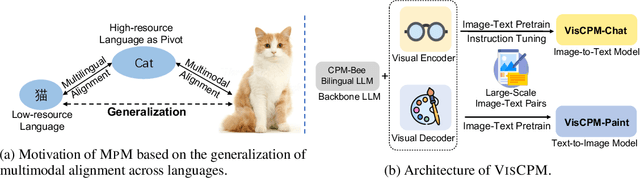
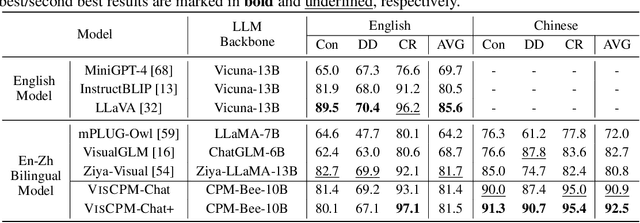
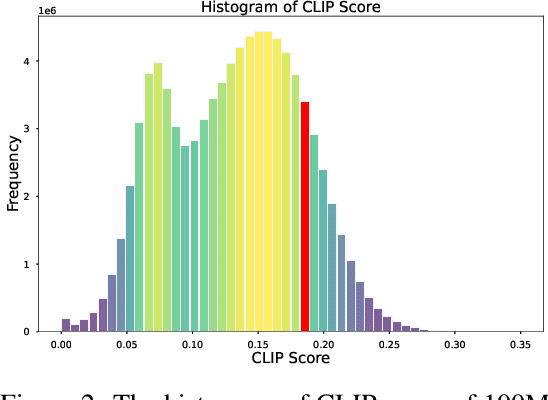
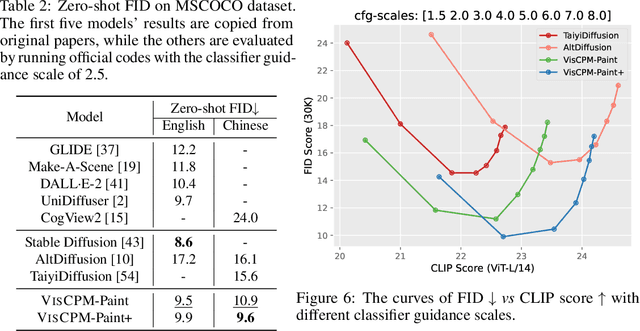
Recently there has been a significant surge in multimodal learning in terms of both image-to-text and text-to-image generation. However, the success is typically limited to English, leaving other languages largely behind. Building a competitive counterpart in other languages is highly challenging due to the low-resource nature of non-English multimodal data (i.e., lack of large-scale, high-quality image-text data). In this work, we propose MPM, an effective training paradigm for training large multimodal models in low-resource languages. MPM demonstrates that Multilingual language models can Pivot zero-shot Multimodal learning across languages. Specifically, based on a strong multilingual large language model, multimodal models pretrained on English-only image-text data can well generalize to other languages in a zero-shot manner for both image-to-text and text-to-image generation, even surpassing models trained on image-text data in native languages. Taking Chinese as a practice of MPM, we build large multimodal models VisCPM in image-to-text and text-to-image generation, which achieve state-of-the-art (open-source) performance in Chinese. To facilitate future research, we open-source codes and model weights at https://github.com/OpenBMB/VisCPM.git.
ToolLLM: Facilitating Large Language Models to Master 16000+ Real-world APIs
Jul 31, 2023Despite the advancements of open-source large language models (LLMs) and their variants, e.g., LLaMA and Vicuna, they remain significantly limited in performing higher-level tasks, such as following human instructions to use external tools (APIs). This is because current instruction tuning largely focuses on basic language tasks instead of the tool-use domain. This is in contrast to state-of-the-art (SOTA) LLMs, e.g., ChatGPT, which have demonstrated excellent tool-use capabilities but are unfortunately closed source. To facilitate tool-use capabilities within open-source LLMs, we introduce ToolLLM, a general tool-use framework of data construction, model training and evaluation. We first present ToolBench, an instruction-tuning dataset for tool use, which is created automatically using ChatGPT. Specifically, we collect 16,464 real-world RESTful APIs spanning 49 categories from RapidAPI Hub, then prompt ChatGPT to generate diverse human instructions involving these APIs, covering both single-tool and multi-tool scenarios. Finally, we use ChatGPT to search for a valid solution path (chain of API calls) for each instruction. To make the searching process more efficient, we develop a novel depth-first search-based decision tree (DFSDT), enabling LLMs to evaluate multiple reasoning traces and expand the search space. We show that DFSDT significantly enhances the planning and reasoning capabilities of LLMs. For efficient tool-use assessment, we develop an automatic evaluator: ToolEval. We fine-tune LLaMA on ToolBench and obtain ToolLLaMA. Our ToolEval reveals that ToolLLaMA demonstrates a remarkable ability to execute complex instructions and generalize to unseen APIs, and exhibits comparable performance to ChatGPT. To make the pipeline more practical, we devise a neural API retriever to recommend appropriate APIs for each instruction, negating the need for manual API selection.
Towards Codable Text Watermarking for Large Language Models
Jul 29, 2023As large language models (LLMs) generate texts with increasing fluency and realism, there is a growing need to identify the source of texts to prevent the abuse of LLMs. Text watermarking techniques have proven reliable in distinguishing whether a text is generated by LLMs by injecting hidden patterns into the generated texts. However, we argue that existing watermarking methods for LLMs are encoding-inefficient (only contain one bit of information - whether it is generated from an LLM or not) and cannot flexibly meet the diverse information encoding needs (such as encoding model version, generation time, user id, etc.) in different LLMs application scenarios. In this work, we conduct the first systematic study on the topic of Codable Text Watermarking for LLMs (CTWL) that allows text watermarks to carry more customizable information. First of all, we study the taxonomy of LLM watermarking technology and give a mathematical formulation for CTWL. Additionally, we provide a comprehensive evaluation system for CTWL: (1) watermarking success rate, (2) robustness against various corruptions, (3) coding rate of payload information, (4) encoding and decoding efficiency, (5) impacts on the quality of the generated text. To meet the requirements of these non-Pareto-improving metrics, we devise a CTWL method named Balance-Marking, based on the motivation of ensuring that available and unavailable vocabularies for encoding information have approximately equivalent probabilities. Compared to the random vocabulary partitioning extended from the existing work, a probability-balanced vocabulary partition can significantly improve the quality of the generated text. Extensive experimental results have shown that our method outperforms a direct baseline under comprehensive evaluation.
RecAgent: A Novel Simulation Paradigm for Recommender Systems
Jun 05, 2023Recommender system has deeply revolutionized people's daily life and production, bringing a large amount of business value. In the recommendation domain, simulation and real data-based studies are two typical research paradigms, with each having different advantages. Previously, real data-based studies occupy more important positions, since accurately simulating the user preference is quite difficult. Recently, large language models (LLM) have shown great potential to achieve human-like intelligence, which provides new opportunities to overcome the shortcomings of simulation-based studies and thus highlight their advantages, such as much more application scenarios and cheaper data acquisition strategies. To shed lights on this direction, in this paper, we introduce an LLM-based recommender simulator called RecAgent. Our simulator is composed of two modules: (1) the user module and (2) the recommender module. The user module can browse the recommendation website, communicate with other users and broadcast messages on the social media. The recommender module is designed to provide search or recommendation lists to the users, and one can design different models to implement the recommender. All the users take actions based on LLMs, and can freely evolve like in the real world. We present several case studies to demonstrate that the users in our simulator can indeed behave in a reasonable manner as expected. Our project has been released at https://github.com/RUC-GSAI/YuLan-Rec.
Arbitrary Few Parameters are Good Enough for Adapting Large-scale Pre-trained Language Models
Jun 04, 2023Parameter-efficient tuning (PET) methods can effectively drive extremely large pre-trained language models (PLMs) by only training minimal parameters. Different PET methods utilize different manually designed modules. In a small PLM, there are usually noticeable performance differences among PET methods. Nevertheless, when a PLM's scale grows up to tens of billions of parameters, all PET methods achieve almost the same performance and even perform on par with the full-parameter fine-tuning method. Hence, we hypothesize that model scaling can mitigate the design differences (the module structures and the number of trainable parameters) among PET methods. To study this hypothesis, we introduce a more flexible PET method - arbitrary PET (APET) method - to be compatible with arbitrary module structures and any number of trainable parameters. Then, we experiment on $11$ NLP tasks of $5$ types and $2$ representative PLMs. From our investigations, we find that the model scaling (1) mitigates the effects of the arbitrary module structure on the performance of tuning methods, and (2) enables the tuning methods to optimize fewer parameters to achieve the full-parameter fine-tuning performance. Intriguingly, we also observe that all tuning methods require almost the same number of trainable parameters to drive PLMs. We discuss this phenomenon and the above two findings collectively from optimization perspectives to fathom the mechanisms behind them. These conclusions not only demonstrate the positive impact of model scaling on tuning methods but disclose its mechanisms, which help us design more effective and efficient tuning methods on larger-scale PLMs.
Plug-and-Play Knowledge Injection for Pre-trained Language Models
May 28, 2023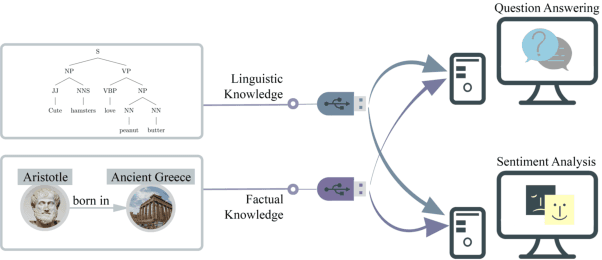
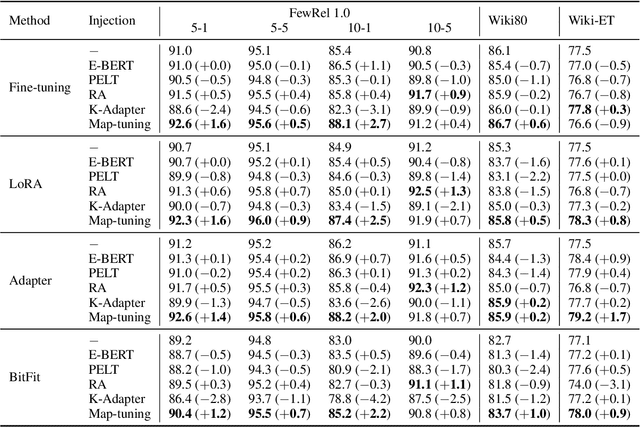

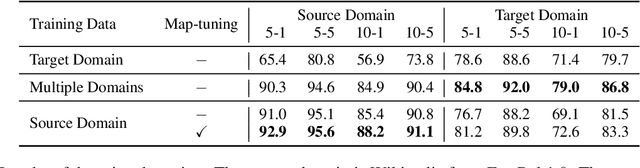
Injecting external knowledge can improve the performance of pre-trained language models (PLMs) on various downstream NLP tasks. However, massive retraining is required to deploy new knowledge injection methods or knowledge bases for downstream tasks. In this work, we are the first to study how to improve the flexibility and efficiency of knowledge injection by reusing existing downstream models. To this end, we explore a new paradigm plug-and-play knowledge injection, where knowledge bases are injected into frozen existing downstream models by a knowledge plugin. Correspondingly, we propose a plug-and-play injection method map-tuning, which trains a mapping of knowledge embeddings to enrich model inputs with mapped embeddings while keeping model parameters frozen. Experimental results on three knowledge-driven NLP tasks show that existing injection methods are not suitable for the new paradigm, while map-tuning effectively improves the performance of downstream models. Moreover, we show that a frozen downstream model can be well adapted to different domains with different mapping networks of domain knowledge. Our code and models are available at https://github.com/THUNLP/Knowledge-Plugin.
Stochastic Bridges as Effective Regularizers for Parameter-Efficient Tuning
May 28, 2023Parameter-efficient tuning methods (PETs) have achieved promising results in tuning large pre-trained language models (PLMs). By formalizing frozen PLMs and additional tunable parameters as systems and controls respectively, PETs can be theoretically grounded to optimal control and further viewed as optimizing the terminal cost and running cost in the optimal control literature. Despite the elegance of this theoretical grounding, in practice, existing PETs often ignore the running cost and only optimize the terminal cost, i.e., focus on optimizing the loss function of the output state, regardless of the running cost that depends on the intermediate states. Since it is non-trivial to directly model the intermediate states and design a running cost function, we propose to use latent stochastic bridges to regularize the intermediate states and use the regularization as the running cost of PETs. As the first work to propose regularized PETs that use stochastic bridges as the regularizers (running costs) for the intermediate states, we show the effectiveness and generality of this regularization across different tasks, PLMs and PETs. In view of the great potential and capacity, we believe more sophisticated regularizers can be designed for PETs and better performance can be achieved in the future. The code is released at \url{https://github.com/thunlp/stochastic-bridge-pet/tree/main}.