 Add to Chrome
 Add to Firefox
 Add to Edge
Toward Effective Reinforcement Learning Fine-Tuning for Medical VQA in Vision-Language Models
May 20, 2025
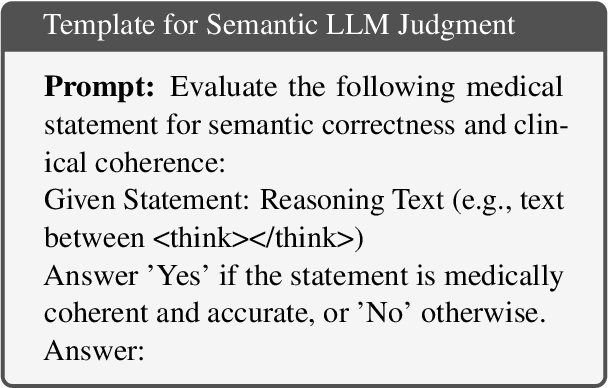
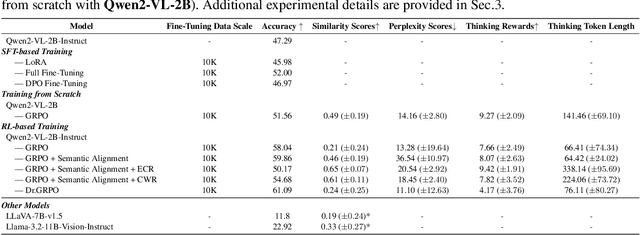
Recently, reinforcement learning (RL)-based tuning has shifted the trajectory of Multimodal Large Language Models (MLLMs), particularly following the introduction of Group Relative Policy Optimization (GRPO). However, directly applying it to medical tasks remains challenging for achieving clinically grounded model behavior. Motivated by the need to align model response with clinical expectations, we investigate four critical dimensions that affect the effectiveness of RL-based tuning in medical visual question answering (VQA): base model initialization strategy, the role of medical semantic alignment, the impact of length-based rewards on long-chain reasoning, and the influence of bias. We conduct extensive experiments to analyze these factors for medical MLLMs, providing new insights into how models are domain-specifically fine-tuned. Additionally, our results also demonstrate that GRPO-based RL tuning consistently outperforms standard supervised fine-tuning (SFT) in both accuracy and reasoning quality.

TCC-Bench: Benchmarking the Traditional Chinese Culture Understanding Capabilities of MLLMs
May 19, 2025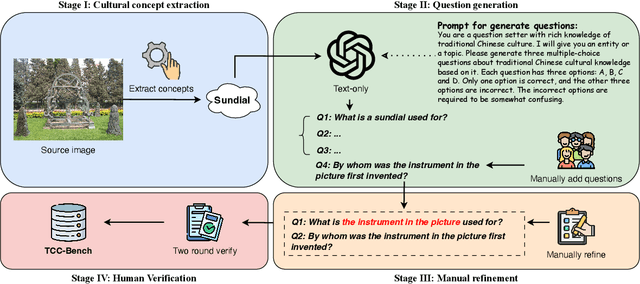
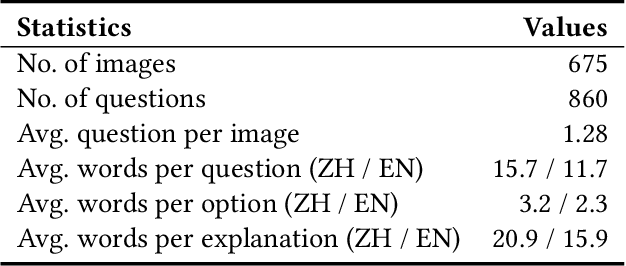
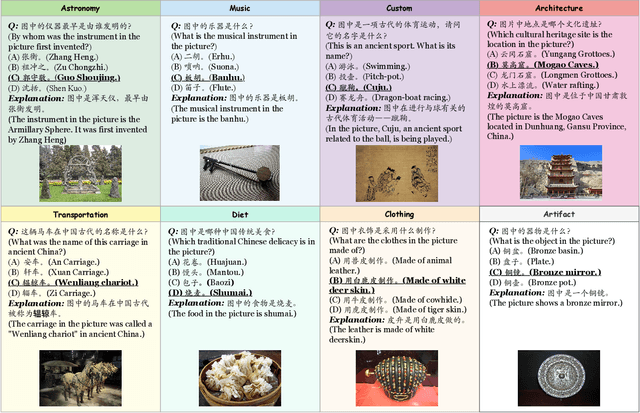
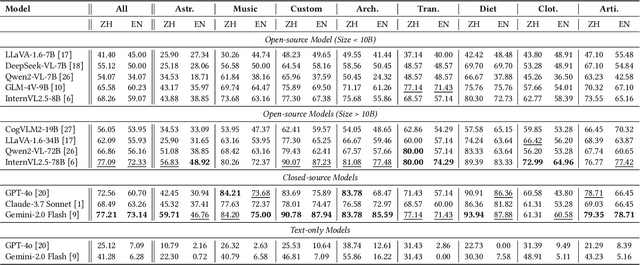
Recent progress in Multimodal Large Language Models (MLLMs) have significantly enhanced the ability of artificial intelligence systems to understand and generate multimodal content. However, these models often exhibit limited effectiveness when applied to non-Western cultural contexts, which raises concerns about their wider applicability. To address this limitation, we propose the Traditional Chinese Culture understanding Benchmark (TCC-Bench), a bilingual (i.e., Chinese and English) Visual Question Answering (VQA) benchmark specifically designed for assessing the understanding of traditional Chinese culture by MLLMs. TCC-Bench comprises culturally rich and visually diverse data, incorporating images from museum artifacts, everyday life scenes, comics, and other culturally significant contexts. We adopt a semi-automated pipeline that utilizes GPT-4o in text-only mode to generate candidate questions, followed by human curation to ensure data quality and avoid potential data leakage. The benchmark also avoids language bias by preventing direct disclosure of cultural concepts within question texts. Experimental evaluations across a wide range of MLLMs demonstrate that current models still face significant challenges when reasoning about culturally grounded visual content. The results highlight the need for further research in developing culturally inclusive and context-aware multimodal systems. The code and data can be found at: https://tcc-bench.github.io/.
The Evolving Landscape of Generative Large Language Models and Traditional Natural Language Processing in Medicine
May 15, 2025Natural language processing (NLP) has been traditionally applied to medicine, and generative large language models (LLMs) have become prominent recently. However, the differences between them across different medical tasks remain underexplored. We analyzed 19,123 studies, finding that generative LLMs demonstrate advantages in open-ended tasks, while traditional NLP dominates in information extraction and analysis tasks. As these technologies advance, ethical use of them is essential to ensure their potential in medical applications.
RLMiniStyler: Light-weight RL Style Agent for Arbitrary Sequential Neural Style Generation
May 07, 2025Arbitrary style transfer aims to apply the style of any given artistic image to another content image. Still, existing deep learning-based methods often require significant computational costs to generate diverse stylized results. Motivated by this, we propose a novel reinforcement learning-based framework for arbitrary style transfer RLMiniStyler. This framework leverages a unified reinforcement learning policy to iteratively guide the style transfer process by exploring and exploiting stylization feedback, generating smooth sequences of stylized results while achieving model lightweight. Furthermore, we introduce an uncertainty-aware multi-task learning strategy that automatically adjusts loss weights to adapt to the content and style balance requirements at different training stages, thereby accelerating model convergence. Through a series of experiments across image various resolutions, we have validated the advantages of RLMiniStyler over other state-of-the-art methods in generating high-quality, diverse artistic image sequences at a lower cost. Codes are available at https://github.com/fengxiaoming520/RLMiniStyler.
Why Compress What You Can Generate? When GPT-4o Generation Ushers in Image Compression Fields
Apr 30, 2025The rapid development of AIGC foundation models has revolutionized the paradigm of image compression, which paves the way for the abandonment of most pixel-level transform and coding, compelling us to ask: why compress what you can generate if the AIGC foundation model is powerful enough to faithfully generate intricate structure and fine-grained details from nothing more than some compact descriptors, i.e., texts, or cues. Fortunately, recent GPT-4o image generation of OpenAI has achieved impressive cross-modality generation, editing, and design capabilities, which motivates us to answer the above question by exploring its potential in image compression fields. In this work, we investigate two typical compression paradigms: textual coding and multimodal coding (i.e., text + extremely low-resolution image), where all/most pixel-level information is generated instead of compressing via the advanced GPT-4o image generation function. The essential challenge lies in how to maintain semantic and structure consistency during the decoding process. To overcome this, we propose a structure raster-scan prompt engineering mechanism to transform the image into textual space, which is compressed as the condition of GPT-4o image generation. Extensive experiments have shown that the combination of our designed structural raster-scan prompts and GPT-4o's image generation function achieved the impressive performance compared with recent multimodal/generative image compression at ultra-low bitrate, further indicating the potential of AIGC generation in image compression fields.
Benchmarking Multimodal Mathematical Reasoning with Explicit Visual Dependency
Apr 29, 2025Recent advancements in Large Vision-Language Models (LVLMs) have significantly enhanced their ability to integrate visual and linguistic information, achieving near-human proficiency in tasks like object recognition, captioning, and visual question answering. However, current benchmarks typically focus on knowledge-centric evaluations that assess domain-specific expertise, often neglecting the core ability to reason about fundamental mathematical elements and visual concepts. We identify a gap in evaluating elementary-level math problems, which rely on explicit visual dependencies-requiring models to discern, integrate, and reason across multiple images while incorporating commonsense knowledge, all of which are crucial for advancing toward broader AGI capabilities. To address this gap, we introduce VCBENCH, a comprehensive benchmark for multimodal mathematical reasoning with explicit visual dependencies. VCBENCH includes 1,720 problems across six cognitive domains, featuring 6,697 images (averaging 3.9 per question) to ensure multi-image reasoning. We evaluate 26 state-of-the-art LVLMs on VCBENCH, revealing substantial performance disparities, with even the top models unable to exceed 50% accuracy. Our findings highlight the ongoing challenges in visual-mathematical integration and suggest avenues for future LVLM advancements.
Muyan-TTS: A Trainable Text-to-Speech Model Optimized for Podcast Scenarios with a $50K Budget
Apr 27, 2025Recent advancements in text-to-speech (TTS) models have been driven by the integration of large language models (LLMs), enhancing semantic comprehension and improving speech naturalness. However, existing LLM-based TTS models often lack open-source training code and efficient inference acceleration frameworks, limiting their accessibility and adaptability. Additionally, there is no publicly available TTS model specifically optimized for podcast scenarios, which are in high demand for voice interaction applications. To address these limitations, we introduce Muyan-TTS, an open-source trainable TTS model designed for podcast applications within a $50,000 budget. Our model is pre-trained on over 100,000 hours of podcast audio data, enabling zero-shot TTS synthesis with high-quality voice generation. Furthermore, Muyan-TTS supports speaker adaptation with dozens of minutes of target speech, making it highly customizable for individual voices. In addition to open-sourcing the model, we provide a comprehensive data collection and processing pipeline, a full training procedure, and an optimized inference framework that accelerates LLM-based TTS synthesis. Our code and models are available at https://github.com/MYZY-AI/Muyan-TTS.
A BERT-Style Self-Supervised Learning CNN for Disease Identification from Retinal Images
Apr 25, 2025In the field of medical imaging, the advent of deep learning, especially the application of convolutional neural networks (CNNs) has revolutionized the analysis and interpretation of medical images. Nevertheless, deep learning methods usually rely on large amounts of labeled data. In medical imaging research, the acquisition of high-quality labels is both expensive and difficult. The introduction of Vision Transformers (ViT) and self-supervised learning provides a pre-training strategy that utilizes abundant unlabeled data, effectively alleviating the label acquisition challenge while broadening the breadth of data utilization. However, ViT's high computational density and substantial demand for computing power, coupled with the lack of localization characteristics of its operations on image patches, limit its efficiency and applicability in many application scenarios. In this study, we employ nn-MobileNet, a lightweight CNN framework, to implement a BERT-style self-supervised learning approach. We pre-train the network on the unlabeled retinal fundus images from the UK Biobank to improve downstream application performance. We validate the results of the pre-trained model on Alzheimer's disease (AD), Parkinson's disease (PD), and various retinal diseases identification. The results show that our approach can significantly improve performance in the downstream tasks. In summary, this study combines the benefits of CNNs with the capabilities of advanced self-supervised learning in handling large-scale unlabeled data, demonstrating the potential of CNNs in the presence of label scarcity.
NTIRE 2025 Challenge on Short-form UGC Video Quality Assessment and Enhancement: KwaiSR Dataset and Study
Apr 21, 2025In this work, we build the first benchmark dataset for short-form UGC Image Super-resolution in the wild, termed KwaiSR, intending to advance the research on developing image super-resolution algorithms for short-form UGC platforms. This dataset is collected from the Kwai Platform, which is composed of two parts, i.e., synthetic and wild parts. Among them, the synthetic dataset, including 1,900 image pairs, is produced by simulating the degradation following the distribution of real-world low-quality short-form UGC images, aiming to provide the ground truth for training and objective comparison in the validation/testing. The wild dataset contains low-quality images collected directly from the Kwai Platform, which are filtered using the quality assessment method KVQ from the Kwai Platform. As a result, the KwaiSR dataset contains 1800 synthetic image pairs and 1900 wild images, which are divided into training, validation, and testing parts with a ratio of 8:1:1. Based on the KwaiSR dataset, we organize the NTIRE 2025 challenge on a second short-form UGC Video quality assessment and enhancement, which attracts lots of researchers to develop the algorithm for it. The results of this competition have revealed that our KwaiSR dataset is pretty challenging for existing Image SR methods, which is expected to lead to a new direction in the image super-resolution field. The dataset can be found from https://lixinustc.github.io/NTIRE2025-KVQE-KwaSR-KVQ.github.io/.
Grounding-MD: Grounded Video-language Pre-training for Open-World Moment Detection
Apr 20, 2025Temporal Action Detection and Moment Retrieval constitute two pivotal tasks in video understanding, focusing on precisely localizing temporal segments corresponding to specific actions or events. Recent advancements introduced Moment Detection to unify these two tasks, yet existing approaches remain confined to closed-set scenarios, limiting their applicability in open-world contexts. To bridge this gap, we present Grounding-MD, an innovative, grounded video-language pre-training framework tailored for open-world moment detection. Our framework incorporates an arbitrary number of open-ended natural language queries through a structured prompt mechanism, enabling flexible and scalable moment detection. Grounding-MD leverages a Cross-Modality Fusion Encoder and a Text-Guided Fusion Decoder to facilitate comprehensive video-text alignment and enable effective cross-task collaboration. Through large-scale pre-training on temporal action detection and moment retrieval datasets, Grounding-MD demonstrates exceptional semantic representation learning capabilities, effectively handling diverse and complex query conditions. Comprehensive evaluations across four benchmark datasets including ActivityNet, THUMOS14, ActivityNet-Captions, and Charades-STA demonstrate that Grounding-MD establishes new state-of-the-art performance in zero-shot and supervised settings in open-world moment detection scenarios. All source code and trained models will be released.