 Add to Chrome
 Add to Firefox
 Add to Edge
Drift-Resilient Temporal Priors for Visual Tracking
Apr 03, 2026
Temporal information is crucial for visual tracking, but existing multi-frame trackers are vulnerable to model drift caused by naively aggregating noisy historical predictions. In this paper, we introduce DTPTrack, a lightweight and generalizable module designed to be seamlessly integrated into existing trackers to suppress drift. Our framework consists of two core components: (1) a Temporal Reliability Calibrator (TRC) mechanism that learns to assign a per-frame reliability score to historical states, filtering out noise while anchoring on the ground-truth template; and (2) a Temporal Guidance Synthesizer (TGS) module that synthesizes this calibrated history into a compact set of dynamic temporal priors to provide predictive guidance. To demonstrate its versatility, we integrate DTPTrack into three diverse tracking architectures--OSTrack, ODTrack, and LoRAT-and show consistent, significant performance gains across all baselines. Our best-performing model, built upon an extended LoRATv2 backbone, sets a new state-of-the-art on several benchmarks, achieving a 77.5% Success rate on LaSOT and an 80.3% AO on GOT-10k.

Cluster-Wise Spatio-Temporal Masking for Efficient Video-Language Pretraining
Mar 24, 2026Large-scale video-language pretraining enables strong generalization across multimodal tasks but often incurs prohibitive computational costs. Although recent advances in masked visual modeling help mitigate this issue, they still suffer from two fundamental limitations: severe visual information loss under high masking ratios and temporal information leakage caused by inter-frame correlations. To address these challenges, we propose ClusterSTM, a Cluster-Wise Spatio-Temporal Masking strategy for efficient video-language pretraining. ClusterSTM first performs intra-frame clustering to partition visual tokens into multiple semantically independent clusters, then conducts cluster-wise masking by retaining the token with the highest temporal density within each cluster. Our masking strategy ensure that the retained tokens capture holistic video content while exhibit strong temporal correlation. Additionally, we introduce a video-text relevance reconstruction objective that aligns high-level multimodal semantics beyond conventional visual reconstruction. Extensive experiments across multiple benchmarks demonstrate that ClusterSTM achieves superior performance on video-text retrieval, video question answering, and video captioning tasks, establishing a new state-of-the-art among efficient video-language models.
Grounding-MD: Grounded Video-language Pre-training for Open-World Moment Detection
Apr 20, 2025Temporal Action Detection and Moment Retrieval constitute two pivotal tasks in video understanding, focusing on precisely localizing temporal segments corresponding to specific actions or events. Recent advancements introduced Moment Detection to unify these two tasks, yet existing approaches remain confined to closed-set scenarios, limiting their applicability in open-world contexts. To bridge this gap, we present Grounding-MD, an innovative, grounded video-language pre-training framework tailored for open-world moment detection. Our framework incorporates an arbitrary number of open-ended natural language queries through a structured prompt mechanism, enabling flexible and scalable moment detection. Grounding-MD leverages a Cross-Modality Fusion Encoder and a Text-Guided Fusion Decoder to facilitate comprehensive video-text alignment and enable effective cross-task collaboration. Through large-scale pre-training on temporal action detection and moment retrieval datasets, Grounding-MD demonstrates exceptional semantic representation learning capabilities, effectively handling diverse and complex query conditions. Comprehensive evaluations across four benchmark datasets including ActivityNet, THUMOS14, ActivityNet-Captions, and Charades-STA demonstrate that Grounding-MD establishes new state-of-the-art performance in zero-shot and supervised settings in open-world moment detection scenarios. All source code and trained models will be released.
Reshaping the Online Data Buffering and Organizing Mechanism for Continual Test-Time Adaptation
Jul 12, 2024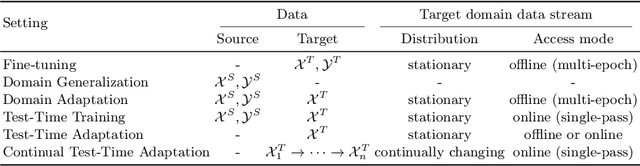
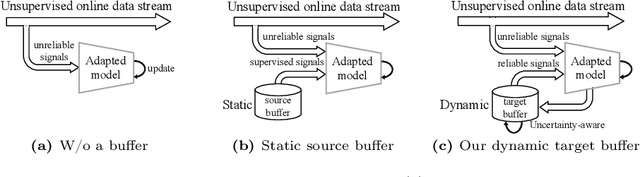
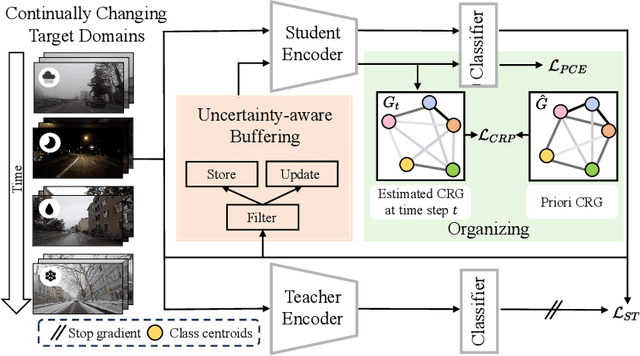
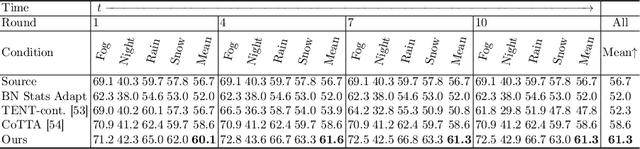
Continual Test-Time Adaptation (CTTA) involves adapting a pre-trained source model to continually changing unsupervised target domains. In this paper, we systematically analyze the challenges of this task: online environment, unsupervised nature, and the risks of error accumulation and catastrophic forgetting under continual domain shifts. To address these challenges, we reshape the online data buffering and organizing mechanism for CTTA. We propose an {uncertainty-aware buffering approach} to identify {and aggregate} significant samples with high certainty from the unsupervised, single-pass data stream. {Based on this}, we propose a graph-based class relation preservation constraint to overcome catastrophic forgetting. Furthermore, a pseudo-target replay objective is used to mitigate error accumulation. Extensive experiments demonstrate the superiority of our method in both segmentation and classification CTTA tasks. Code is available at \href{https://github.com/z1358/OBAO}{this https URL}.