 Add to Chrome
 Add to Firefox
 Add to Edge
Generative Learning for Quantum Measurement Design
Aug 11, 2026
Extracting quantum information from a quantum state is a fundamental task of quantum computation, often requiring the estimation of many non-commuting observables under a finite measurement budget. For both near-term and early fault-tolerant settings, the measurement protocol must balance statistical efficiency against implementation resources such as circuit depth, connectivity, and entangling-gate count. Many existing strategies focus on two extremes: hardware-friendly product measurements with high sampling cost, and fully commuting measurements with deep circuits. Here we recast resource-constrained measurement design as a generative learning problem. We introduce FlowMeas, which uses a generative flow network to directly sample finite ensembles of shallow Clifford measurement circuits subject to a prescribed shot budget and hardware constraints. At zero entangling depth, FlowMeas learns qubit-wise commuting measurement schedules and already matches or improves leading product-measurement methods on nearly all molecular benchmarks. Allowing one or two entangling gate layers yields further reductions in energy estimation error of up to $27\%$ relative to the strongest state-independent product-measurement baseline. The learned policy can also be reused across related Hamiltonians, substantially accelerating retraining along a molecular potential-energy surface. We further obtain results for molecular Hamiltonians with up to 20 qubits and apply the framework to a compactly encoded 54-qubit interacting fermionic model, extending the demonstrated scale beyond prior molecular benchmarks. These results establish generative learning as a flexible and unified framework for quantum measurement design under practical resource constraints.

Measuring the Wrong Thing: Internal Harmfulness Scores Anti-Rank Successful Jailbreaks
Aug 10, 2026Internal safety scores judge a prompt before any text is generated, and they are validated by how well they separate harmful prompts from benign ones. That separation is then read as evidence that the score will also catch the attacks that succeed. Harmful intent is a property of the prompt. Jailbreak success is an outcome produced later by a particular target model, decoding policy, and judge. A filter tuned on a score that measures the wrong quantity spends its false positive budget on attacks that would have failed anyway. In this paper we audit that inference. Attention based measurements are usually read from prompt dependent locations, so a wrapper changes both the content being judged and the place the signal is taken from. We therefore introduce Active Attention Probing, which supplies a fixed content independent measurement coordinate. We pair every base goal with a plain and a wrapped version and generate real completions from the target models. On Llama, wrapping raises harmful generation from 0.05 to 0.27 while harmful intent AUROC falls from 0.936 to 0.803, so the attacks grow more dangerous while the prompts look safer to the score. Among wrapped harmful prompts the outcome AUROC is 0.220, which places the attacks that succeeded below the attacks that failed. Rare token, passive, and detector derived channels reproduce the reversal on the same matched design, and the reversal itself persists across three target models, seven attack families, and two independent judges. Distribution shift then degrades calibration and threshold transfer before it degrades ranking.
OmniDelta: Skill-Driven Budget Allocation for Token Compression in OmniLLMs
Jul 28, 2026Emerging Omni-modal Large Language Models (OmniLLMs) enable unified understanding of text, audio, and video, but their long audio-video token sequences introduce substantial memory and inference costs. Existing compression methods mainly focus on selecting important tokens under fixed budgets, leaving the preceding budget-allocation problem underexplored. We show that direct query-to-audio/video similarity is unreliable for inter-modal budget allocation, and that uniform intra-modal budgets can miss key evidence while retaining redundant content. To address these limitations, we propose OmniDelta, a training-free, skill-driven framework that couples intent-aware inter-modal allocation with content-aware intra-modal allocation. OmniDelta first constructs audio and video skill pools to shift the fixed retained-token budget according to query demand, then reallocates modality budgets over audio segments and video frames using local complexity and temporal redundancy. The resulting local budgets can be combined with existing pruning strategies, preserving the total retained-token ratio while changing where the budget is spent. Experiments on four audio-video benchmarks with two Qwen2.5-Omni models show that OmniDelta establishes a new accuracy-efficiency Pareto frontier across pruning ratios. At 25% token retention on Qwen2.5-Omni-7B, OmniDelta reduces GPU memory by 22.0% and achieves a 1.64x end-to-end speedup over full-token inference.
When Agents Go Rogue: Activation-Based Detection of Malicious Behaviors in Multi-Agent Systems
Jul 07, 2026While enabling effective collaboration on complex tasks, LLM-based Multi-Agent Systems (MAS) face critical security challenges due to vulnerabilities at the agent and interaction levels. Most existing MAS security defenses are built upon two core assumptions: semantically-explicit malicious attacks and explicit graph-based modeling of the MAS topology and agent-level interactions. In practice, real-world attacks are becoming more semantically stealthy, while MAS execution is typically asynchronous without the temporal alignment assumed by graph-based propagation models. To address these limitations, we propose AcMAS, an activation-based framework for malicious-behavior detection in MAS. By analyzing internal reasoning states in the activation space of local agents, AcMAS detects even stealthy attacks in a synchronization-robust fashion, without relying on explicit interaction graphs. Moreover, our activation analysis provides critical signals to guide AcMAS in restoring the functionality of compromised agents, rather than the disruptive agent isolation commonly used by the state-of-the-art methods. Comprehensive evaluation demonstrates that AcMAS significantly outperforms graph-based baselines against stealthy attacks, by +0.22 F1 in synchronous settings (0.94 vs. 0.72) and by +0.55 F1 in asynchronous settings (0.93 vs. 0.38), with generalization across diverse open-source LLM backbones, attack intensity, and MAS scale.
Draft Less, Retrieve More: Hybrid Tree Construction for Speculative Decoding
May 19, 2026Speculative decoding (SD) accelerates large language model inference by leveraging a draft-then-verify paradigm. To maximize the acceptance rate, recent methods construct expansive draft trees, which unfortunately incur severe VRAM bandwidth and computational overheads that bottleneck end-to-end speedups. While dynamic-depth pruning can reduce this latency by removing marginal branches, it also discards potentially valid candidates, preventing the acceptance rate from reaching the upper bound of dense trees. In this paper, we identify a critical opportunity in resource allocation: the transition from dense to pruned drafting frees up significant computational budget. To break this Pareto tradeoff, we introduce Graft, a compensation framework that couples pruning and retrieval as mutually reinforcing operations. Pruning supplies sufficient budget for retrieval, while retrieval compensates for pruning-induced coverage loss and recovers accepted length. By employing a sequential `prune-then-graft' mechanism, Graft attaches highly predictive retrieved tokens into positions opened by pruning, filling the topological gaps with near-zero overhead. Graft is entirely training-free and lossless. Comprehensive evaluations show that Graft establishes a new Pareto frontier across practical deployment settings, including short-context generation, long-context generation, and large-scale models. On short-context benchmarks, it achieves up to 5.41$\times$ speedup and improves average speedup over EAGLE-3 by up to 21.8% on the large-scale Qwen3-235B. We also provide a preliminary exploration of applying Graft to the DFlash-style block drafting paradigm, offering initial evidence and insights for extending grafting beyond autoregressive draft trees.
Generalizable and Interpretable RF Fingerprinting with Shapelet-Enhanced Large Language Models
Feb 03, 2026Deep neural networks (DNNs) have achieved remarkable success in radio frequency (RF) fingerprinting for wireless device authentication. However, their practical deployment faces two major limitations: domain shift, where models trained in one environment struggle to generalize to others, and the black-box nature of DNNs, which limits interpretability. To address these issues, we propose a novel framework that integrates a group of variable-length two-dimensional (2D) shapelets with a pre-trained large language model (LLM) to achieve efficient, interpretable, and generalizable RF fingerprinting. The 2D shapelets explicitly capture diverse local temporal patterns across the in-phase and quadrature (I/Q) components, providing compact and interpretable representations. Complementarily, the pre-trained LLM captures more long-range dependencies and global contextual information, enabling strong generalization with minimal training overhead. Moreover, our framework also supports prototype generation for few-shot inference, enhancing cross-domain performance without additional retraining. To evaluate the effectiveness of our proposed method, we conduct extensive experiments on six datasets across various protocols and domains. The results show that our method achieves superior standard and few-shot performance across both source and unseen domains.
FlowQ-Net: A Generative Framework for Automated Quantum Circuit Design
Oct 30, 2025Designing efficient quantum circuits is a central bottleneck to exploring the potential of quantum computing, particularly for noisy intermediate-scale quantum (NISQ) devices, where circuit efficiency and resilience to errors are paramount. The search space of gate sequences grows combinatorially, and handcrafted templates often waste scarce qubit and depth budgets. We introduce \textsc{FlowQ-Net} (Flow-based Quantum design Network), a generative framework for automated quantum circuit synthesis based on Generative Flow Networks (GFlowNets). This framework learns a stochastic policy to construct circuits sequentially, sampling them in proportion to a flexible, user-defined reward function that can encode multiple design objectives such as performance, depth, and gate count. This approach uniquely enables the generation of a diverse ensemble of high-quality circuits, moving beyond single-solution optimization. We demonstrate the efficacy of \textsc{FlowQ-Net} through an extensive set of simulations. We apply our method to Variational Quantum Algorithm (VQA) ansatz design for molecular ground state estimation, Max-Cut, and image classification, key challenges in near-term quantum computing. Circuits designed by \textsc{FlowQ-Net} achieve significant improvements, yielding circuits that are 10$\times$-30$\times$ more compact in terms of parameters, gates, and depth compared to commonly used unitary baselines, without compromising accuracy. This trend holds even when subjected to error profiles from real-world quantum devices. Our results underline the potential of generative models as a general-purpose methodology for automated quantum circuit design, offering a promising path towards more efficient quantum algorithms and accelerating scientific discovery in the quantum domain.
Muyan-TTS: A Trainable Text-to-Speech Model Optimized for Podcast Scenarios with a $50K Budget
Apr 27, 2025Recent advancements in text-to-speech (TTS) models have been driven by the integration of large language models (LLMs), enhancing semantic comprehension and improving speech naturalness. However, existing LLM-based TTS models often lack open-source training code and efficient inference acceleration frameworks, limiting their accessibility and adaptability. Additionally, there is no publicly available TTS model specifically optimized for podcast scenarios, which are in high demand for voice interaction applications. To address these limitations, we introduce Muyan-TTS, an open-source trainable TTS model designed for podcast applications within a $50,000 budget. Our model is pre-trained on over 100,000 hours of podcast audio data, enabling zero-shot TTS synthesis with high-quality voice generation. Furthermore, Muyan-TTS supports speaker adaptation with dozens of minutes of target speech, making it highly customizable for individual voices. In addition to open-sourcing the model, we provide a comprehensive data collection and processing pipeline, a full training procedure, and an optimized inference framework that accelerates LLM-based TTS synthesis. Our code and models are available at https://github.com/MYZY-AI/Muyan-TTS.
A Physics-Informed Blur Learning Framework for Imaging Systems
Feb 17, 2025Accurate blur estimation is essential for high-performance imaging across various applications. Blur is typically represented by the point spread function (PSF). In this paper, we propose a physics-informed PSF learning framework for imaging systems, consisting of a simple calibration followed by a learning process. Our framework could achieve both high accuracy and universal applicability. Inspired by the Seidel PSF model for representing spatially varying PSF, we identify its limitations in optimization and introduce a novel wavefront-based PSF model accompanied by an optimization strategy, both reducing optimization complexity and improving estimation accuracy. Moreover, our wavefront-based PSF model is independent of lens parameters, eliminate the need for prior knowledge of the lens. To validate our approach, we compare it with recent PSF estimation methods (Degradation Transfer and Fast Two-step) through a deblurring task, where all the estimated PSFs are used to train state-of-the-art deblurring algorithms. Our approach demonstrates improvements in image quality in simulation and also showcases noticeable visual quality improvements on real captured images.
Tolerance-Aware Deep Optics
Feb 07, 2025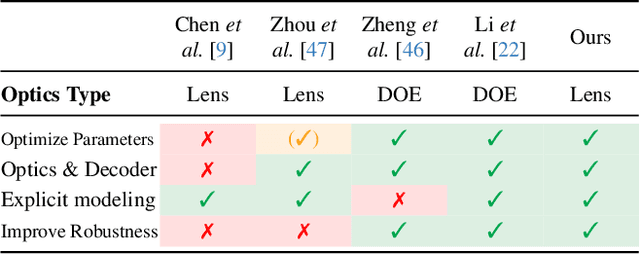
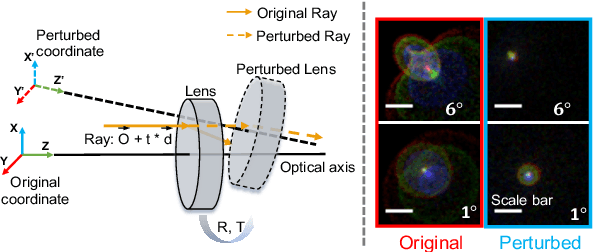
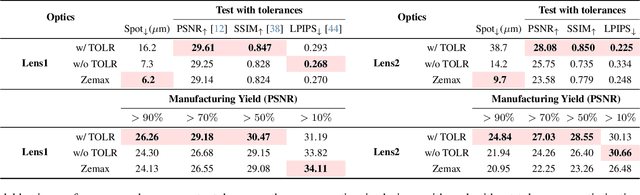
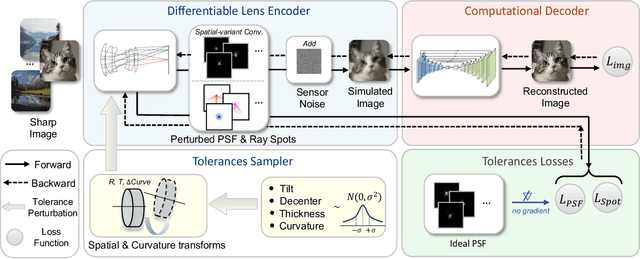
Deep optics has emerged as a promising approach by co-designing optical elements with deep learning algorithms. However, current research typically overlooks the analysis and optimization of manufacturing and assembly tolerances. This oversight creates a significant performance gap between designed and fabricated optical systems. To address this challenge, we present the first end-to-end tolerance-aware optimization framework that incorporates multiple tolerance types into the deep optics design pipeline. Our method combines physics-informed modelling with data-driven training to enhance optical design by accounting for and compensating for structural deviations in manufacturing and assembly. We validate our approach through computational imaging applications, demonstrating results in both simulations and real-world experiments. We further examine how our proposed solution improves the robustness of optical systems and vision algorithms against tolerances through qualitative and quantitative analyses. Code and additional visual results are available at openimaginglab.github.io/LensTolerance.