 Add to Chrome
 Add to Firefox
 Add to Edge
BRIDGES: Bridging Graph Modality and Large Language Models within EDA Tasks
Apr 07, 2025
While many EDA tasks already involve graph-based data, existing LLMs in EDA primarily either represent graphs as sequential text, or simply ignore graph-structured data that might be beneficial like dataflow graphs of RTL code. Recent studies have found that LLM performance suffers when graphs are represented as sequential text, and using additional graph information significantly boosts performance. To address these challenges, we introduce BRIDGES, a framework designed to incorporate graph modality into LLMs for EDA tasks. BRIDGES integrates an automated data generation workflow, a solution that combines graph modality with LLM, and a comprehensive evaluation suite. First, we establish an LLM-driven workflow to generate RTL and netlist-level data, converting them into dataflow and netlist graphs with function descriptions. This workflow yields a large-scale dataset comprising over 500,000 graph instances and more than 1.5 billion tokens. Second, we propose a lightweight cross-modal projector that encodes graph representations into text-compatible prompts, enabling LLMs to effectively utilize graph data without architectural modifications. Experimental results demonstrate 2x to 10x improvements across multiple tasks compared to text-only baselines, including accuracy in design retrieval, type prediction and perplexity in function description, with negligible computational overhead (<1% model weights increase and <30% additional runtime overhead). Even without additional LLM finetuning, our results outperform text-only by a large margin. We plan to release BRIDGES, including the dataset, models, and training flow.

JavisDiT: Joint Audio-Video Diffusion Transformer with Hierarchical Spatio-Temporal Prior Synchronization
Mar 30, 2025This paper introduces JavisDiT, a novel Joint Audio-Video Diffusion Transformer designed for synchronized audio-video generation (JAVG). Built upon the powerful Diffusion Transformer (DiT) architecture, JavisDiT is able to generate high-quality audio and video content simultaneously from open-ended user prompts. To ensure optimal synchronization, we introduce a fine-grained spatio-temporal alignment mechanism through a Hierarchical Spatial-Temporal Synchronized Prior (HiST-Sypo) Estimator. This module extracts both global and fine-grained spatio-temporal priors, guiding the synchronization between the visual and auditory components. Furthermore, we propose a new benchmark, JavisBench, consisting of 10,140 high-quality text-captioned sounding videos spanning diverse scenes and complex real-world scenarios. Further, we specifically devise a robust metric for evaluating the synchronization between generated audio-video pairs in real-world complex content. Experimental results demonstrate that JavisDiT significantly outperforms existing methods by ensuring both high-quality generation and precise synchronization, setting a new standard for JAVG tasks. Our code, model, and dataset will be made publicly available at https://javisdit.github.io/.
Harmonizing Visual Representations for Unified Multimodal Understanding and Generation
Mar 27, 2025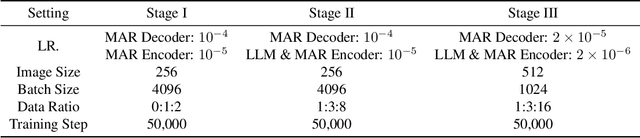
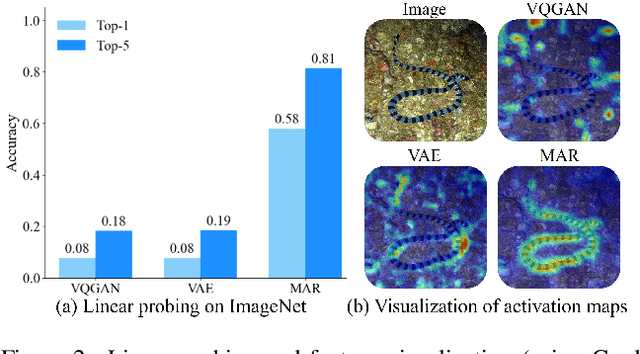

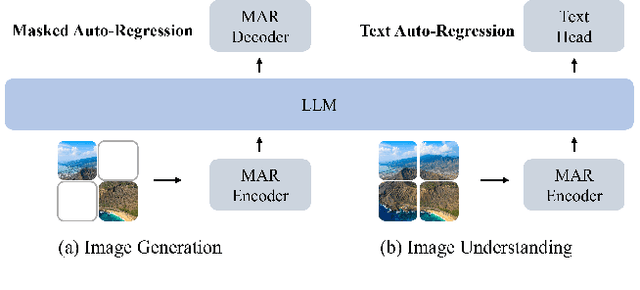
Unifying visual understanding and generation within a single multimodal framework remains a significant challenge, as the two inherently heterogeneous tasks require representations at different levels of granularity. Current approaches that utilize vector quantization (VQ) or variational autoencoders (VAE) for unified visual representation prioritize intrinsic imagery features over semantics, compromising understanding performance. In this work, we take inspiration from masked image modelling (MIM) that learns rich semantics via a mask-and-reconstruct pre-training and its successful extension to masked autoregressive (MAR) image generation. A preliminary study on the MAR encoder's representation reveals exceptional linear probing accuracy and precise feature response to visual concepts, which indicates MAR's potential for visual understanding tasks beyond its original generation role. Based on these insights, we present \emph{Harmon}, a unified autoregressive framework that harmonizes understanding and generation tasks with a shared MAR encoder. Through a three-stage training procedure that progressively optimizes understanding and generation capabilities, Harmon achieves state-of-the-art image generation results on the GenEval, MJHQ30K and WISE benchmarks while matching the performance of methods with dedicated semantic encoders (e.g., Janus) on image understanding benchmarks. Our code and models will be available at https://github.com/wusize/Harmon.
OpenHuEval: Evaluating Large Language Model on Hungarian Specifics
Mar 27, 2025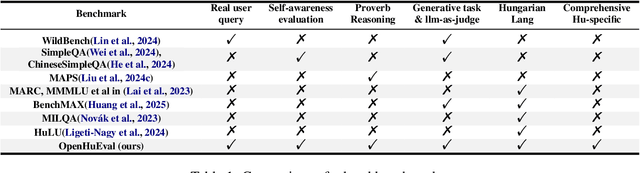
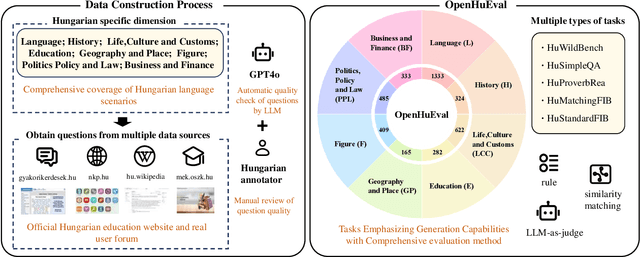
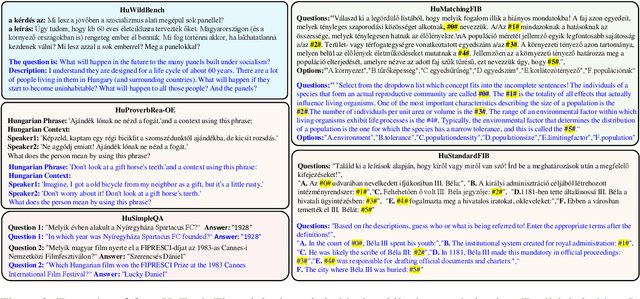
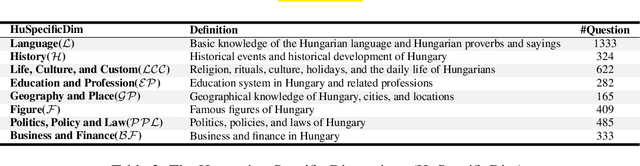
We introduce OpenHuEval, the first benchmark for LLMs focusing on the Hungarian language and specifics. OpenHuEval is constructed from a vast collection of Hungarian-specific materials sourced from multiple origins. In the construction, we incorporated the latest design principles for evaluating LLMs, such as using real user queries from the internet, emphasizing the assessment of LLMs' generative capabilities, and employing LLM-as-judge to enhance the multidimensionality and accuracy of evaluations. Ultimately, OpenHuEval encompasses eight Hungarian-specific dimensions, featuring five tasks and 3953 questions. Consequently, OpenHuEval provides the comprehensive, in-depth, and scientifically accurate assessment of LLM performance in the context of the Hungarian language and its specifics. We evaluated current mainstream LLMs, including both traditional LLMs and recently developed Large Reasoning Models. The results demonstrate the significant necessity for evaluation and model optimization tailored to the Hungarian language and specifics. We also established the framework for analyzing the thinking processes of LRMs with OpenHuEval, revealing intrinsic patterns and mechanisms of these models in non-English languages, with Hungarian serving as a representative example. We will release OpenHuEval at https://github.com/opendatalab/OpenHuEval .
Free4D: Tuning-free 4D Scene Generation with Spatial-Temporal Consistency
Mar 26, 2025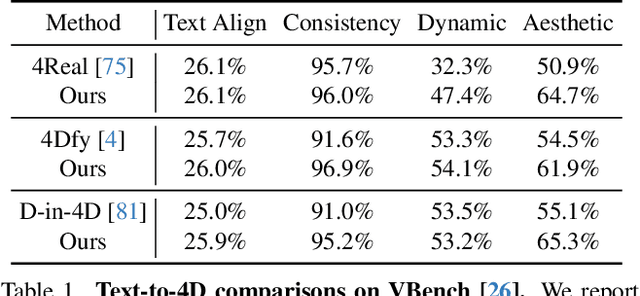
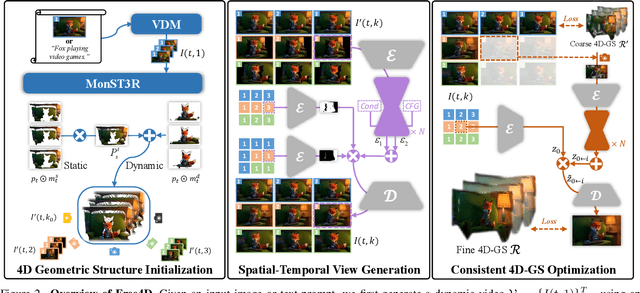
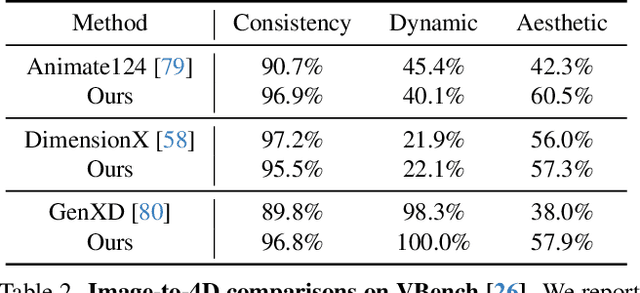
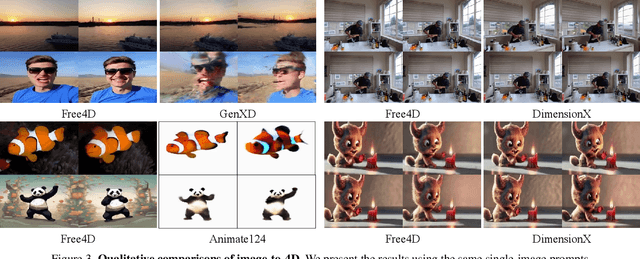
We present Free4D, a novel tuning-free framework for 4D scene generation from a single image. Existing methods either focus on object-level generation, making scene-level generation infeasible, or rely on large-scale multi-view video datasets for expensive training, with limited generalization ability due to the scarcity of 4D scene data. In contrast, our key insight is to distill pre-trained foundation models for consistent 4D scene representation, which offers promising advantages such as efficiency and generalizability. 1) To achieve this, we first animate the input image using image-to-video diffusion models followed by 4D geometric structure initialization. 2) To turn this coarse structure into spatial-temporal consistent multiview videos, we design an adaptive guidance mechanism with a point-guided denoising strategy for spatial consistency and a novel latent replacement strategy for temporal coherence. 3) To lift these generated observations into consistent 4D representation, we propose a modulation-based refinement to mitigate inconsistencies while fully leveraging the generated information. The resulting 4D representation enables real-time, controllable rendering, marking a significant advancement in single-image-based 4D scene generation.
ACVUBench: Audio-Centric Video Understanding Benchmark
Mar 25, 2025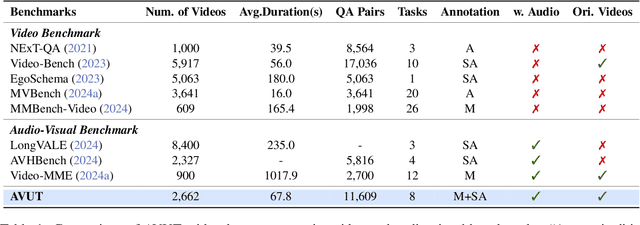
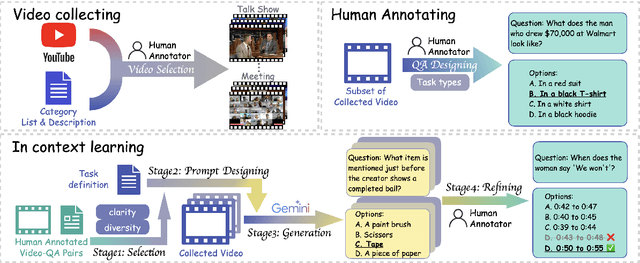
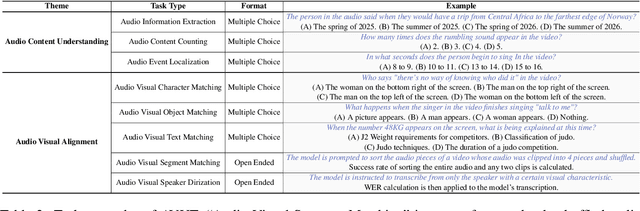
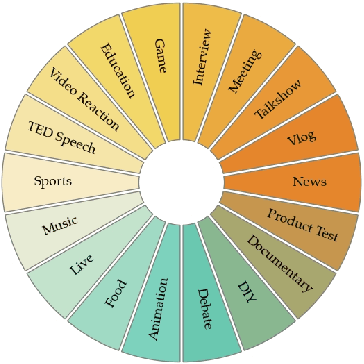
Audio often serves as an auxiliary modality in video understanding tasks of audio-visual large language models (LLMs), merely assisting in the comprehension of visual information. However, a thorough understanding of videos significantly depends on auditory information, as audio offers critical context, emotional cues, and semantic meaning that visual data alone often lacks. This paper proposes an audio-centric video understanding benchmark (ACVUBench) to evaluate the video comprehension capabilities of multimodal LLMs with a particular focus on auditory information. Specifically, ACVUBench incorporates 2,662 videos spanning 18 different domains with rich auditory information, together with over 13k high-quality human annotated or validated question-answer pairs. Moreover, ACVUBench introduces a suite of carefully designed audio-centric tasks, holistically testing the understanding of both audio content and audio-visual interactions in videos. A thorough evaluation across a diverse range of open-source and proprietary multimodal LLMs is performed, followed by the analyses of deficiencies in audio-visual LLMs. Demos are available at https://github.com/lark-png/ACVUBench.
ISPDiffuser: Learning RAW-to-sRGB Mappings with Texture-Aware Diffusion Models and Histogram-Guided Color Consistency
Mar 25, 2025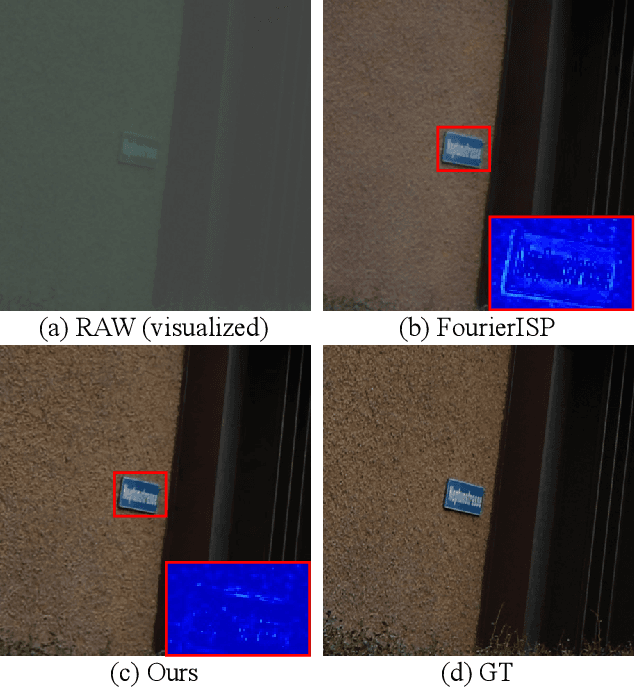
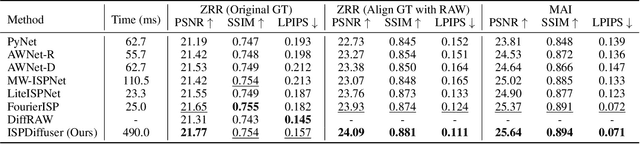
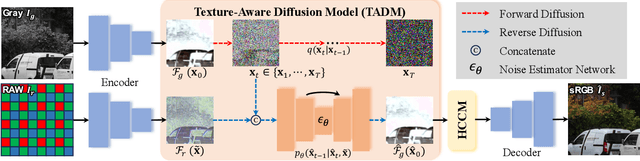
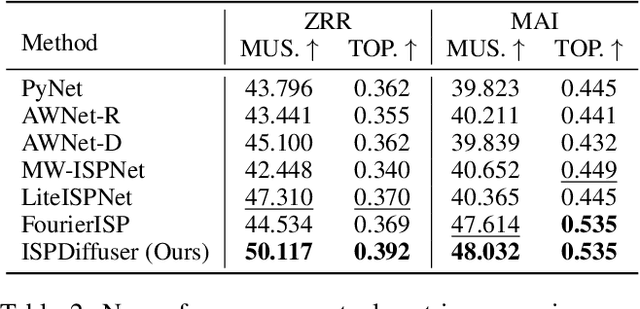
RAW-to-sRGB mapping, or the simulation of the traditional camera image signal processor (ISP), aims to generate DSLR-quality sRGB images from raw data captured by smartphone sensors. Despite achieving comparable results to sophisticated handcrafted camera ISP solutions, existing learning-based methods still struggle with detail disparity and color distortion. In this paper, we present ISPDiffuser, a diffusion-based decoupled framework that separates the RAW-to-sRGB mapping into detail reconstruction in grayscale space and color consistency mapping from grayscale to sRGB. Specifically, we propose a texture-aware diffusion model that leverages the generative ability of diffusion models to focus on local detail recovery, in which a texture enrichment loss is further proposed to prompt the diffusion model to generate more intricate texture details. Subsequently, we introduce a histogram-guided color consistency module that utilizes color histogram as guidance to learn precise color information for grayscale to sRGB color consistency mapping, with a color consistency loss designed to constrain the learned color information. Extensive experimental results show that the proposed ISPDiffuser outperforms state-of-the-art competitors both quantitatively and visually. The code is available at https://github.com/RenYangSCU/ISPDiffuser.
CCMusic: An Open and Diverse Database for Chinese Music Information Retrieval Research
Mar 24, 2025Data are crucial in various computer-related fields, including music information retrieval (MIR), an interdisciplinary area bridging computer science and music. This paper introduces CCMusic, an open and diverse database comprising multiple datasets specifically designed for tasks related to Chinese music, highlighting our focus on this culturally rich domain. The database integrates both published and unpublished datasets, with steps taken such as data cleaning, label refinement, and data structure unification to ensure data consistency and create ready-to-use versions. We conduct benchmark evaluations for all datasets using a unified evaluation framework developed specifically for this purpose. This publicly available framework supports both classification and detection tasks, ensuring standardized and reproducible results across all datasets. The database is hosted on HuggingFace and ModelScope, two open and multifunctional data and model hosting platforms, ensuring ease of accessibility and usability.
* 17 pages, 18 figures
Improving LLM Video Understanding with 16 Frames Per Second
Mar 18, 2025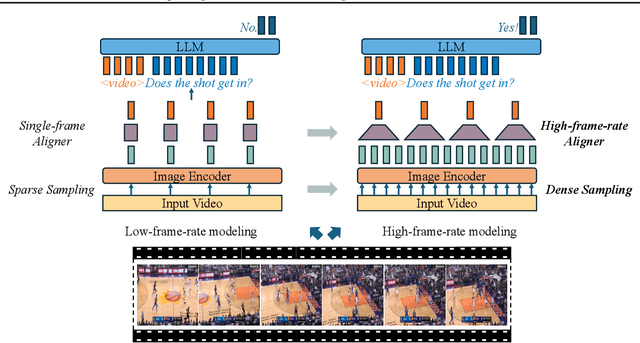
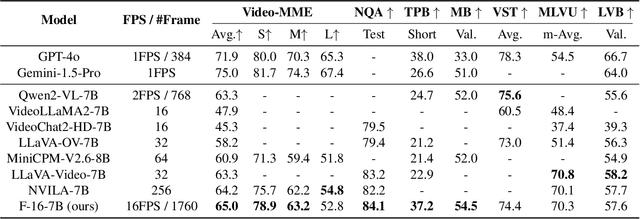
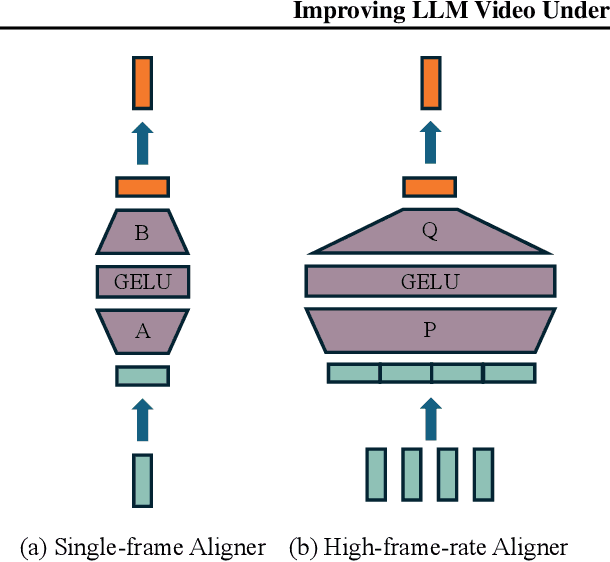
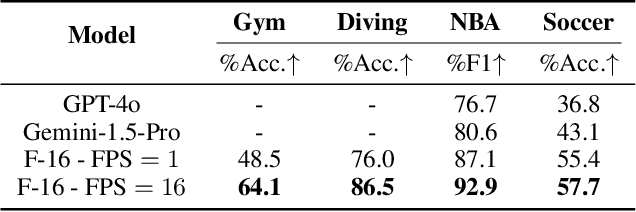
Human vision is dynamic and continuous. However, in video understanding with multimodal large language models (LLMs), existing methods primarily rely on static features extracted from images sampled at a fixed low frame rate of frame-per-second (FPS) $\leqslant$2, leading to critical visual information loss. In this paper, we introduce F-16, the first multimodal LLM designed for high-frame-rate video understanding. By increasing the frame rate to 16 FPS and compressing visual tokens within each 1-second clip, F-16 efficiently captures dynamic visual features while preserving key semantic information. Experimental results demonstrate that higher frame rates considerably enhance video understanding across multiple benchmarks, providing a new approach to improving video LLMs beyond scaling model size or training data. F-16 achieves state-of-the-art performance among 7-billion-parameter video LLMs on both general and fine-grained video understanding benchmarks, such as Video-MME and TemporalBench. Furthermore, F-16 excels in complex spatiotemporal tasks, including high-speed sports analysis (\textit{e.g.}, basketball, football, gymnastics, and diving), outperforming SOTA proprietary visual models like GPT-4o and Gemini-1.5-pro. Additionally, we introduce a novel decoding method for F-16 that enables highly efficient low-frame-rate inference without requiring model retraining. Upon acceptance, we will release the source code, model checkpoints, and data.
Boosting Semi-Supervised Medical Image Segmentation via Masked Image Consistency and Discrepancy Learning
Mar 18, 2025Semi-supervised learning is of great significance in medical image segmentation by exploiting unlabeled data. Among its strategies, the co-training framework is prominent. However, previous co-training studies predominantly concentrate on network initialization variances and pseudo-label generation, while overlooking the equilibrium between information interchange and model diversity preservation. In this paper, we propose the Masked Image Consistency and Discrepancy Learning (MICD) framework with three key modules. The Masked Cross Pseudo Consistency (MCPC) module enriches context perception and small sample learning via pseudo-labeling across masked-input branches. The Cross Feature Consistency (CFC) module fortifies information exchange and model robustness by ensuring decoder feature consistency. The Cross Model Discrepancy (CMD) module utilizes EMA teacher networks to oversee outputs and preserve branch diversity. Together, these modules address existing limitations by focusing on fine-grained local information and maintaining diversity in a heterogeneous framework. Experiments on two public medical image datasets, AMOS and Synapse, demonstrate that our approach outperforms state-of-the-art methods.