 Add to Chrome
 Add to Firefox
 Add to Edge
AgRefactor: Self-Evolving Agentic Workflow for HLS Compatibility and Performance
Jun 29, 2026
High-Level Synthesis (HLS) provides a fast path from concepts to silicon, but converting real-world software into synthesizable HLS code remains challenging due to restrictive language support and the gap between software and hardware programming practices. Existing automated and LLM-based refactoring approaches partially address this problem, yet they often lack flexibility, struggle to scale, and incur high computational costs. We introduce AgRefactor, an LLM-based multi-agent workflow for refactoring software into HLS-compatible programs. AgRefactor incorporates a self-evolving memory system that accumulates and retrieves factual and strategic knowledge across tasks, improving robustness and efficiency on unseen programs. To reduce cost and enhance scalability, it integrates automated refactoring tools, enabling agents to balance LLM-driven rewrites with efficient tool-based transformations. On 9 out of 11 challenging real-world benchmarks, which are 5-10x longer than the most complex cases studied in prior work, AgRefactor outperforms or matches the state-of-the-art automated refactoring tool and a strong LLM-based baseline built on the same framework backbone. Further agentic performance optimization yields a 6.51x geometric mean speedup over the SoTA pragma tuning tool and a 1.20x speedup over optimized open-source designs with less than 20% extra resources. AgRefactor is fully-automated and open-sourced.

Uncertainty-aware Spatial-Frequency Registration and Fusion for Infrared and Visible Images
May 13, 2026Infrared and Visible Image Fusion (IVIF) has shown promise in visual tasks under challenging environments, but fusion under unregistered conditions faces inherent misalignments. Current studies to solve them either predict the deformation parameters coarse-to-fine (i.e., coarse registration and fine registration) or estimate the deformation fields in multi-scales for registration. Though straightforward, they overlook the cumulative errors in registration, which contaminate the fusion stage and severely deteriorate the resulting images. We introduce the Spatial-Frequency Registration and Fusion (SFRF) framework, which incorporates uncertainty estimation and infrared thermal radiation distribution consistency into a unified pipeline to handle the error accumulation for robust registration and fusion across both spatial and frequency domains. Specifically, SFRF constructs a Multi-scale Iterative Registration (MIR) framework that iteratively refines the deformation field across scales, leveraging uncertainty estimation at each stage to mitigate error accumulation and enhance alignment accuracy dynamically. To ensure the accurate alignment of infrared thermal distributions during registration, thermal radiation distribution consistency is employed as a frequency-domain supervisory signal, promoting global consistency in the frequency domain. Based on the spatial-frequency alignment, SFRF further adopts a Dual-branch Spatial-Frequency Fusion (DSFF) module, which incorporates spatial geometric features and frequency distribution information to reconstruct visually appealing images. SFRF achieves impressive performance across diverse datasets.
MM-ReCoder: Advancing Chart-to-Code Generation with Reinforcement Learning and Self-Correction
Apr 02, 2026Multimodal Large Language Models (MLLMs) have recently demonstrated promising capabilities in multimodal coding tasks such as chart-to-code generation. However, existing methods primarily rely on supervised fine-tuning (SFT), which requires the model to learn code patterns through chart-code pairs but does not expose the model to a code execution environment. Moreover, while self-correction through execution feedback offers a potential route to improve coding quality, even state-of-the-art MLLMs have been shown to struggle with effective self-correction. In this work, we introduce MM-ReCoder, a chart-to-code generation model trained with reinforcement learning (RL) and equipped with self-correction ability. We propose a two-stage multi-turn self-correction RL strategy based on Group Relative Policy Optimization (GRPO). The first stage enhances the model's self-correction ability via rolling out a shared first turn, while the second stage improves the coding capability with full-trajectory optimization. MM-ReCoder learns to produce more accurate and executable code through the interaction with the environment and by iteratively correcting its own outputs. Our results on three chart-to-code benchmarks demonstrate the state-of-the-art performance of MM-ReCoder.
Pansharpening for Thin-Cloud Contaminated Remote Sensing Images: A Unified Framework and Benchmark Dataset
Mar 16, 2026Pansharpening under thin cloudy conditions is a practically significant yet rarely addressed task, challenged by simultaneous spatial resolution degradation and cloud-induced spectral distortions. Existing methods often address cloud removal and pansharpening sequentially, leading to cumulative errors and suboptimal performance due to the lack of joint degradation modeling. To address these challenges, we propose a Unified Pansharpening Model with Thin Cloud Removal (Pan-TCR), an end-to-end framework that integrates physical priors. Motivated by theoretical analysis in the frequency domain, we design a frequency-decoupled restoration (FDR) block that disentangles the restoration of multispectral image (MSI) features into amplitude and phase components, each guided by complementary degradation-robust prompts: the near-infrared (NIR) band amplitude for cloud-resilient restoration, and the panchromatic (PAN) phase for high-resolution structural enhancement. To ensure coherence between the two components, we further introduce an interactive inter-frequency consistency (IFC) module, enabling cross-modal refinement that enforces consistency and robustness across frequency cues. Furthermore, we introduce the first real-world thin-cloud contaminated pansharpening dataset (PanTCR-GF2), comprising paired clean and cloudy PAN-MSI images, to enable robust benchmarking under realistic conditions. Extensive experiments on real-world and synthetic datasets demonstrate the superiority and robustness of Pan-TCR, establishing a new benchmark for pansharpening under realistic atmospheric degradations.
UniFusion: A Unified Image Fusion Framework with Robust Representation and Source-Aware Preservation
Mar 15, 2026Image fusion aims to integrate complementary information from multiple source images to produce a more informative and visually consistent representation, benefiting both human perception and downstream vision tasks. Despite recent progress, most existing fusion methods are designed for specific tasks (i.e., multi-modal, multi-exposure, or multi-focus fusion) and struggle to effectively preserve source information during the fusion process. This limitation primarily arises from task-specific architectures and the degradation of source information caused by deep-layer propagation. To overcome these issues, we propose UniFusion, a unified image fusion framework designed to achieve cross-task generalization. First, leveraging DINOv3 for modality-consistent feature extraction, UniFusion establishes a shared semantic space for diverse inputs. Second, to preserve the understanding of each source image, we introduce a reconstruction-alignment loss to maintain consistency between fused outputs and inputs. Finally, we employ a bilevel optimization strategy to decouple and jointly optimize reconstruction and fusion objectives, effectively balancing their coupling relationship and ensuring smooth convergence. Extensive experiments across multiple fusion tasks demonstrate UniFusion's superior visual quality, generalization ability, and adaptability to real-world scenarios. Code is available at https://github.com/dusongcheng/UniFusion.
Toward Real-world Infrared Image Super-Resolution: A Unified Autoregressive Framework and Benchmark Dataset
Mar 05, 2026Infrared image super-resolution (IISR) under real-world conditions is a practically significant yet rarely addressed task. Pioneering works are often trained and evaluated on simulated datasets or neglect the intrinsic differences between infrared and visible imaging. In practice, however, real infrared images are affected by coupled optical and sensing degradations that jointly deteriorate both structural sharpness and thermal fidelity. To address these challenges, we propose Real-IISR, a unified autoregressive framework for real-world IISR that progressively reconstructs fine-grained thermal structures and clear backgrounds in a scale-by-scale manner via thermal-structural guided visual autoregression. Specifically, a Thermal-Structural Guidance module encodes thermal priors to mitigate the mismatch between thermal radiation and structural edges. Since non-uniform degradations typically induce quantization bias, Real-IISR adopts a Condition-Adaptive Codebook that dynamically modulates discrete representations based on degradation-aware thermal priors. Also, a Thermal Order Consistency Loss enforces a monotonic relation between temperature and pixel intensity, ensuring relative brightness order rather than absolute values to maintain physical consistency under spatial misalignment and thermal drift. We build FLIR-IISR, a real-world IISR dataset with paired LR-HR infrared images acquired via automated focus variation and motion-induced blur. Extensive experiments demonstrate the promising performance of Real-IISR, providing a unified foundation for real-world IISR and benchmarking. The dataset and code are available at: https://github.com/JZD151/Real-IISR.
RE-MCDF: Closed-Loop Multi-Expert LLM Reasoning for Knowledge-Grounded Clinical Diagnosis
Feb 01, 2026Electronic medical records (EMRs), particularly in neurology, are inherently heterogeneous, sparse, and noisy, which poses significant challenges for large language models (LLMs) in clinical diagnosis. In such settings, single-agent systems are vulnerable to self-reinforcing errors, as their predictions lack independent validation and can drift toward spurious conclusions. Although recent multi-agent frameworks attempt to mitigate this issue through collaborative reasoning, their interactions are often shallow and loosely structured, failing to reflect the rigorous, evidence-driven processes used by clinical experts. More fundamentally, existing approaches largely ignore the rich logical dependencies among diseases, such as mutual exclusivity, pathological compatibility, and diagnostic confusion. This limitation prevents them from ruling out clinically implausible hypotheses, even when sufficient evidence is available. To overcome these, we propose RE-MCDF, a relation-enhanced multi-expert clinical diagnosis framework. RE-MCDF introduces a generation--verification--revision closed-loop architecture that integrates three complementary components: (i) a primary expert that generates candidate diagnoses and supporting evidence, (ii) a laboratory expert that dynamically prioritizes heterogeneous clinical indicators, and (iii) a multi-relation awareness and evaluation expert group that explicitly enforces inter-disease logical constraints. Guided by a medical knowledge graph (MKG), the first two experts adaptively reweight EMR evidence, while the expert group validates and corrects candidate diagnoses to ensure logical consistency. Extensive experiments on the neurology subset of CMEMR (NEEMRs) and on our curated dataset (XMEMRs) demonstrate that RE-MCDF consistently outperforms state-of-the-art baselines in complex diagnostic scenarios.
HATIR: Heat-Aware Diffusion for Turbulent Infrared Video Super-Resolution
Jan 08, 2026Infrared video has been of great interest in visual tasks under challenging environments, but often suffers from severe atmospheric turbulence and compression degradation. Existing video super-resolution (VSR) methods either neglect the inherent modality gap between infrared and visible images or fail to restore turbulence-induced distortions. Directly cascading turbulence mitigation (TM) algorithms with VSR methods leads to error propagation and accumulation due to the decoupled modeling of degradation between turbulence and resolution. We introduce HATIR, a Heat-Aware Diffusion for Turbulent InfraRed Video Super-Resolution, which injects heat-aware deformation priors into the diffusion sampling path to jointly model the inverse process of turbulent degradation and structural detail loss. Specifically, HATIR constructs a Phasor-Guided Flow Estimator, rooted in the physical principle that thermally active regions exhibit consistent phasor responses over time, enabling reliable turbulence-aware flow to guide the reverse diffusion process. To ensure the fidelity of structural recovery under nonuniform distortions, a Turbulence-Aware Decoder is proposed to selectively suppress unstable temporal cues and enhance edge-aware feature aggregation via turbulence gating and structure-aware attention. We built FLIR-IVSR, the first dataset for turbulent infrared VSR, comprising paired LR-HR sequences from a FLIR T1050sc camera (1024 X 768) spanning 640 diverse scenes with varying camera and object motion conditions. This encourages future research in infrared VSR. Project page: https://github.com/JZ0606/HATIR
BRIDGES: Bridging Graph Modality and Large Language Models within EDA Tasks
Apr 07, 2025While many EDA tasks already involve graph-based data, existing LLMs in EDA primarily either represent graphs as sequential text, or simply ignore graph-structured data that might be beneficial like dataflow graphs of RTL code. Recent studies have found that LLM performance suffers when graphs are represented as sequential text, and using additional graph information significantly boosts performance. To address these challenges, we introduce BRIDGES, a framework designed to incorporate graph modality into LLMs for EDA tasks. BRIDGES integrates an automated data generation workflow, a solution that combines graph modality with LLM, and a comprehensive evaluation suite. First, we establish an LLM-driven workflow to generate RTL and netlist-level data, converting them into dataflow and netlist graphs with function descriptions. This workflow yields a large-scale dataset comprising over 500,000 graph instances and more than 1.5 billion tokens. Second, we propose a lightweight cross-modal projector that encodes graph representations into text-compatible prompts, enabling LLMs to effectively utilize graph data without architectural modifications. Experimental results demonstrate 2x to 10x improvements across multiple tasks compared to text-only baselines, including accuracy in design retrieval, type prediction and perplexity in function description, with negligible computational overhead (<1% model weights increase and <30% additional runtime overhead). Even without additional LLM finetuning, our results outperform text-only by a large margin. We plan to release BRIDGES, including the dataset, models, and training flow.
AxisPose: Model-Free Matching-Free Single-Shot 6D Object Pose Estimation via Axis Generation
Mar 09, 2025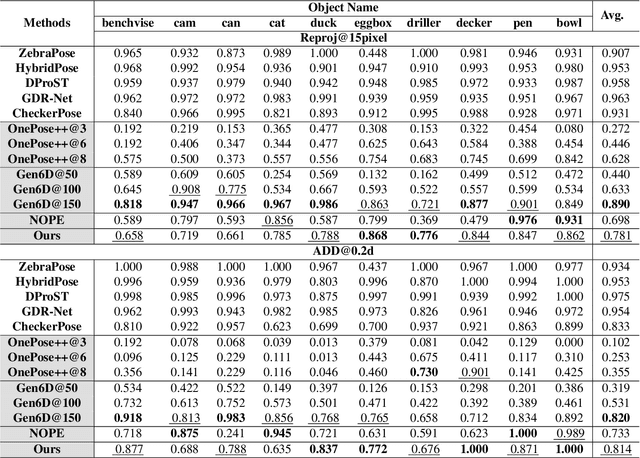
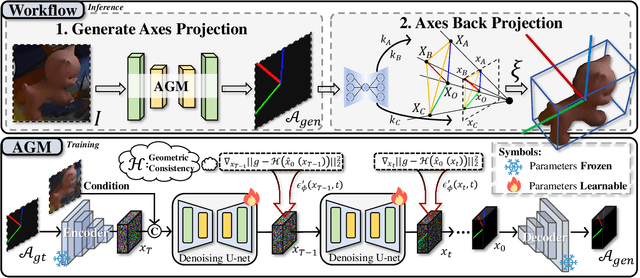
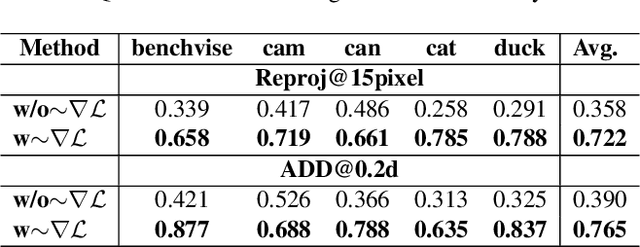

Object pose estimation, which plays a vital role in robotics, augmented reality, and autonomous driving, has been of great interest in computer vision. Existing studies either require multi-stage pose regression or rely on 2D-3D feature matching. Though these approaches have shown promising results, they rely heavily on appearance information, requiring complex input (i.e., multi-view reference input, depth, or CAD models) and intricate pipeline (i.e., feature extraction-SfM-2D to 3D matching-PnP). We propose AxisPose, a model-free, matching-free, single-shot solution for robust 6D pose estimation, which fundamentally diverges from the existing paradigm. Unlike existing methods that rely on 2D-3D or 2D-2D matching using 3D techniques, such as SfM and PnP, AxisPose directly infers a robust 6D pose from a single view by leveraging a diffusion model to learn the latent axis distribution of objects without reference views. Specifically, AxisPose constructs an Axis Generation Module (AGM) to capture the latent geometric distribution of object axes through a diffusion model. The diffusion process is guided by injecting the gradient of geometric consistency loss into the noise estimation to maintain the geometric consistency of the generated tri-axis. With the generated tri-axis projection, AxisPose further adopts a Triaxial Back-projection Module (TBM) to recover the 6D pose from the object tri-axis. The proposed AxisPose achieves robust performance at the cross-instance level (i.e., one model for N instances) using only a single view as input without reference images, with great potential for generalization to unseen-object level.