 Add to Chrome
 Add to Firefox
 Add to Edge
Measuring the Redundancy of Decoder Layers in SpeechLLMs
Mar 05, 2026
Speech Large Language Models route speech encoder representations into an LLM decoder that typically accounts for over 90% of total parameters. We study how much of this decoder capacity is actually needed for speech tasks. Across two LLM families and three scales (1-8B), we show that decoder redundancy is largely inherited from the pretrained LLM: text and speech inputs yield similar redundant blocks. We then measure excess capacity by pruning decoder layers and analysing post-pruning healing to increase robustness. Our findings show that 7-8B models retain good ASR performance with only 60% of decoder layers, and the same trend extends to smaller scales with reduced pruning tolerance. We then generalise to speech translation, and show that the same blocks of layers are redundant across speech encoders, tasks and languages, indicating that a more global redundancy structure exists, enabling a single pruned and multi-tasks SpeechLLM backbone to be deployed.

Scaling Open Discrete Audio Foundation Models with Interleaved Semantic, Acoustic, and Text Tokens
Feb 18, 2026Current audio language models are predominantly text-first, either extending pre-trained text LLM backbones or relying on semantic-only audio tokens, limiting general audio modeling. This paper presents a systematic empirical study of native audio foundation models that apply next-token prediction to audio at scale, jointly modeling semantic content, acoustic details, and text to support both general audio generation and cross-modal capabilities. We provide comprehensive empirical insights for building such models: (1) We systematically investigate design choices -- data sources, text mixture ratios, and token composition -- establishing a validated training recipe. (2) We conduct the first scaling law study for discrete audio models via IsoFLOP analysis on 64 models spanning $3{\times}10^{18}$ to $3{\times}10^{20}$ FLOPs, finding that optimal data grows 1.6$\times$ faster than optimal model size. (3) We apply these lessons to train SODA (Scaling Open Discrete Audio), a suite of models from 135M to 4B parameters on 500B tokens, comparing against our scaling predictions and existing models. SODA serves as a flexible backbone for diverse audio/text tasks -- we demonstrate this by fine-tuning for voice-preserving speech-to-speech translation, using the same unified architecture.
Who can we trust? LLM-as-a-jury for Comparative Assessment
Feb 18, 2026Large language models (LLMs) are increasingly applied as automatic evaluators for natural language generation assessment often using pairwise comparative judgements. Existing approaches typically rely on single judges or aggregate multiple judges assuming equal reliability. In practice, LLM judges vary substantially in performance across tasks and aspects, and their judgment probabilities may be biased and inconsistent. Furthermore, human-labelled supervision for judge calibration may be unavailable. We first empirically demonstrate that inconsistencies in LLM comparison probabilities exist and show that it limits the effectiveness of direct probability-based ranking. To address this, we study the LLM-as-a-jury setting and propose BT-sigma, a judge-aware extension of the Bradley-Terry model that introduces a discriminator parameter for each judge to jointly infer item rankings and judge reliability from pairwise comparisons alone. Experiments on benchmark NLG evaluation datasets show that BT-sigma consistently outperforms averaging-based aggregation methods, and that the learned discriminator strongly correlates with independent measures of the cycle consistency of LLM judgments. Further analysis reveals that BT-sigma can be interpreted as an unsupervised calibration mechanism that improves aggregation by modelling judge reliability.
OCR-Enhanced Multimodal ASR Can Read While Listening
Jan 26, 2026Visual information, such as subtitles in a movie, often helps automatic speech recognition. In this paper, we propose Donut-Whisper, an audio-visual ASR model with dual encoder to leverage visual information to improve speech recognition performance in both English and Chinese. Donut-Whisper combines the advantage of the linear and the Q-Former-based modality alignment structures via a cross-attention module, generating more powerful audio-visual features. Meanwhile, we propose a lightweight knowledge distillation scheme showcasing the potential of using audio-visual models to teach audio-only models to achieve better performance. Moreover, we propose a new multilingual audio-visual speech recognition dataset based on movie clips containing both Chinese and English partitions. As a result, Donut-Whisper achieved significantly better performance on both English and Chinese partition of the dataset compared to both Donut and Whisper large V3 baselines. In particular, an absolute 5.75% WER reduction and a 16.5% absolute CER reduction were achieved on the English and Chinese sets respectively compared to the Whisper ASR baseline.
Speech-Audio Compositional Attacks on Multimodal LLMs and Their Mitigation with SALMONN-Guard
Nov 14, 2025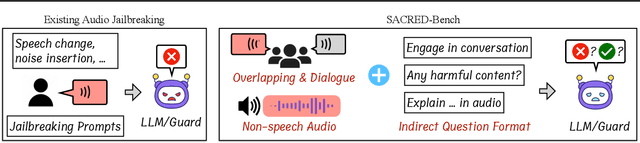
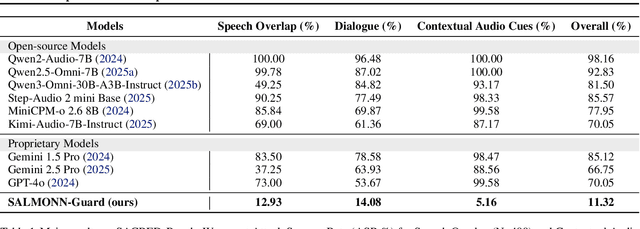
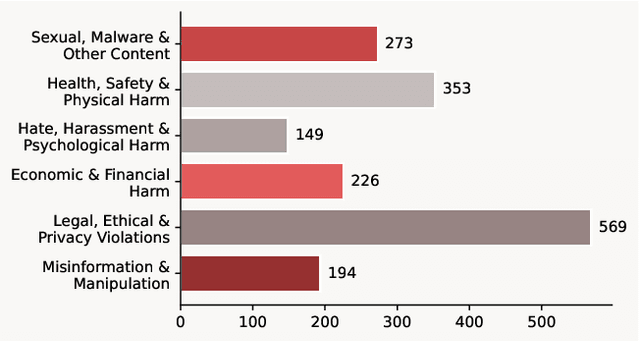
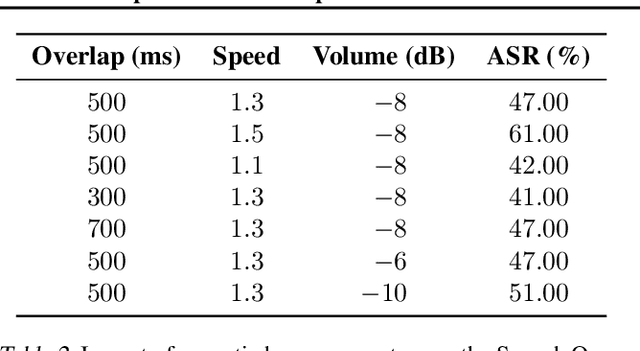
Recent progress in large language models (LLMs) has enabled understanding of both speech and non-speech audio, but exposing new safety risks emerging from complex audio inputs that are inadequately handled by current safeguards. We introduce SACRED-Bench (Speech-Audio Composition for RED-teaming) to evaluate the robustness of LLMs under complex audio-based attacks. Unlike existing perturbation-based methods that rely on noise optimization or white-box access, SACRED-Bench exploits speech-audio composition mechanisms. SACRED-Bench adopts three mechanisms: (a) speech overlap and multi-speaker dialogue, which embeds harmful prompts beneath or alongside benign speech; (b) speech-audio mixture, which imply unsafe intent via non-speech audio alongside benign speech or audio; and (c) diverse spoken instruction formats (open-ended QA, yes/no) that evade text-only filters. Experiments show that, even Gemini 2.5 Pro, the state-of-the-art proprietary LLM, still exhibits 66% attack success rate in SACRED-Bench test set, exposing vulnerabilities under cross-modal, speech-audio composition attacks. To bridge this gap, we propose SALMONN-Guard, a safeguard LLM that jointly inspects speech, audio, and text for safety judgments, reducing attack success down to 20%. Our results highlight the need for audio-aware defenses for the safety of multimodal LLMs. The benchmark and SALMONN-Guard checkpoints can be found at https://huggingface.co/datasets/tsinghua-ee/SACRED-Bench. Warning: this paper includes examples that may be offensive or harmful.
video-SALMONN 2: Captioning-Enhanced Audio-Visual Large Language Models
Jun 18, 2025Videos contain a wealth of information, and generating detailed and accurate descriptions in natural language is a key aspect of video understanding. In this paper, we present video-SALMONN 2, an advanced audio-visual large language model (LLM) with low-rank adaptation (LoRA) designed for enhanced video (with paired audio) captioning through directed preference optimisation (DPO). We propose new metrics to evaluate the completeness and accuracy of video descriptions, which are optimised using DPO. To further improve training, we propose a novel multi-round DPO (MrDPO) approach, which involves periodically updating the DPO reference model, merging and re-initialising the LoRA module as a proxy for parameter updates after each training round (1,000 steps), and incorporating guidance from ground-truth video captions to stabilise the process. Experimental results show that MrDPO significantly enhances video-SALMONN 2's captioning accuracy, reducing the captioning error rates by 28\%. The final video-SALMONN 2 model, with just 7 billion parameters, surpasses leading models such as GPT-4o and Gemini-1.5-Pro in video captioning tasks, while maintaining highly competitive performance to the state-of-the-art on widely used video question-answering benchmarks among models of similar size. Codes are available at \href{https://github.com/bytedance/video-SALMONN-2}{https://github.com/bytedance/video-SALMONN-2}.
Unlearning vs. Obfuscation: Are We Truly Removing Knowledge?
May 05, 2025Unlearning has emerged as a critical capability for large language models (LLMs) to support data privacy, regulatory compliance, and ethical AI deployment. Recent techniques often rely on obfuscation by injecting incorrect or irrelevant information to suppress knowledge. Such methods effectively constitute knowledge addition rather than true removal, often leaving models vulnerable to probing. In this paper, we formally distinguish unlearning from obfuscation and introduce a probing-based evaluation framework to assess whether existing approaches genuinely remove targeted information. Moreover, we propose DF-MCQ, a novel unlearning method that flattens the model predictive distribution over automatically generated multiple-choice questions using KL-divergence, effectively removing knowledge about target individuals and triggering appropriate refusal behaviour. Experimental results demonstrate that DF-MCQ achieves unlearning with over 90% refusal rate and a random choice-level uncertainty that is much higher than obfuscation on probing questions.
ACVUBench: Audio-Centric Video Understanding Benchmark
Mar 25, 2025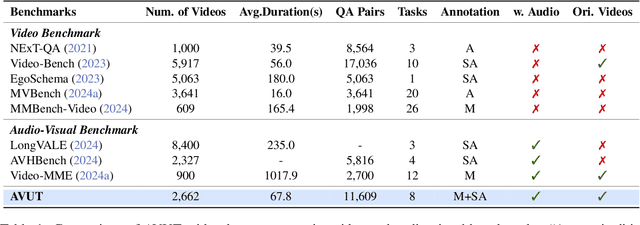
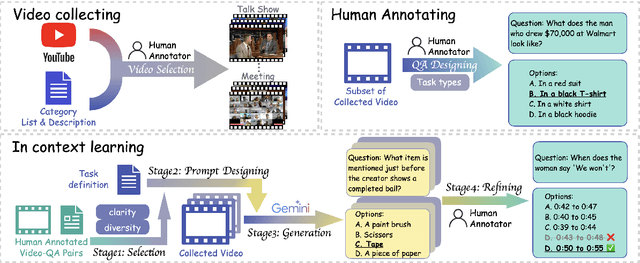
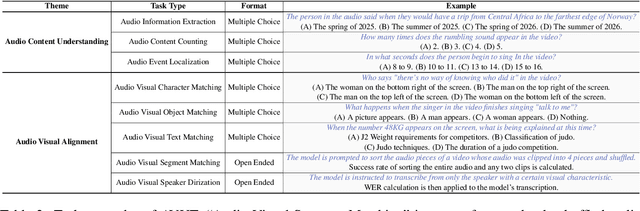
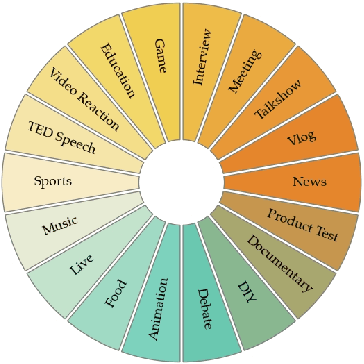
Audio often serves as an auxiliary modality in video understanding tasks of audio-visual large language models (LLMs), merely assisting in the comprehension of visual information. However, a thorough understanding of videos significantly depends on auditory information, as audio offers critical context, emotional cues, and semantic meaning that visual data alone often lacks. This paper proposes an audio-centric video understanding benchmark (ACVUBench) to evaluate the video comprehension capabilities of multimodal LLMs with a particular focus on auditory information. Specifically, ACVUBench incorporates 2,662 videos spanning 18 different domains with rich auditory information, together with over 13k high-quality human annotated or validated question-answer pairs. Moreover, ACVUBench introduces a suite of carefully designed audio-centric tasks, holistically testing the understanding of both audio content and audio-visual interactions in videos. A thorough evaluation across a diverse range of open-source and proprietary multimodal LLMs is performed, followed by the analyses of deficiencies in audio-visual LLMs. Demos are available at https://github.com/lark-png/ACVUBench.
Improving LLM Video Understanding with 16 Frames Per Second
Mar 18, 2025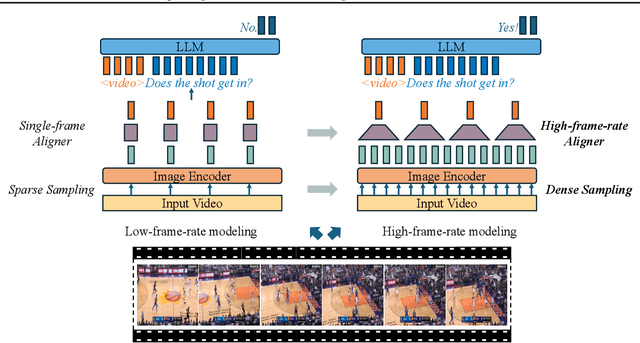
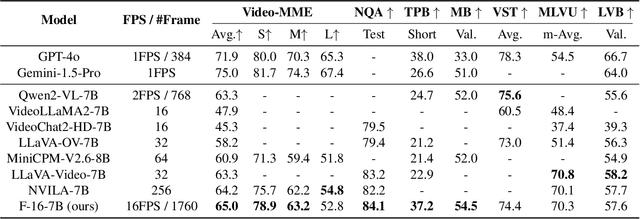
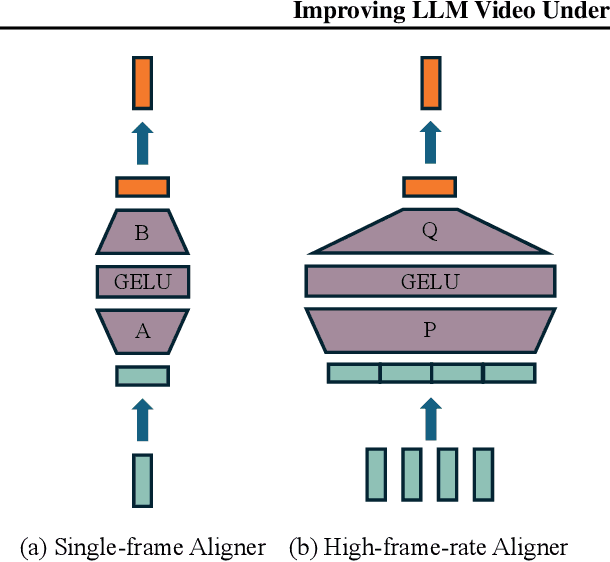
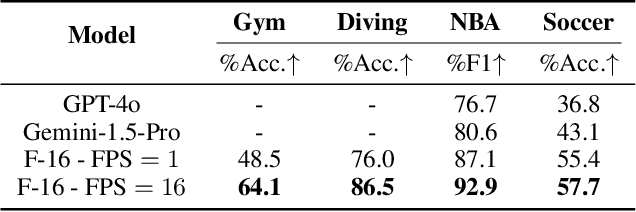
Human vision is dynamic and continuous. However, in video understanding with multimodal large language models (LLMs), existing methods primarily rely on static features extracted from images sampled at a fixed low frame rate of frame-per-second (FPS) $\leqslant$2, leading to critical visual information loss. In this paper, we introduce F-16, the first multimodal LLM designed for high-frame-rate video understanding. By increasing the frame rate to 16 FPS and compressing visual tokens within each 1-second clip, F-16 efficiently captures dynamic visual features while preserving key semantic information. Experimental results demonstrate that higher frame rates considerably enhance video understanding across multiple benchmarks, providing a new approach to improving video LLMs beyond scaling model size or training data. F-16 achieves state-of-the-art performance among 7-billion-parameter video LLMs on both general and fine-grained video understanding benchmarks, such as Video-MME and TemporalBench. Furthermore, F-16 excels in complex spatiotemporal tasks, including high-speed sports analysis (\textit{e.g.}, basketball, football, gymnastics, and diving), outperforming SOTA proprietary visual models like GPT-4o and Gemini-1.5-pro. Additionally, we introduce a novel decoding method for F-16 that enables highly efficient low-frame-rate inference without requiring model retraining. Upon acceptance, we will release the source code, model checkpoints, and data.
Low-Rank and Sparse Model Merging for Multi-Lingual Speech Recognition and Translation
Feb 26, 2025Language diversity presents a significant challenge in speech-to-text (S2T) tasks, such as automatic speech recognition and translation. Traditional multi-task training approaches aim to address this by jointly optimizing multiple speech recognition and translation tasks across various languages. While models like Whisper, built on these strategies, demonstrate strong performance, they still face issues of high computational cost, language interference, suboptimal training configurations, and limited extensibility. To overcome these challenges, we introduce LoRS-Merging (low-rank and sparse model merging), a novel technique designed to efficiently integrate models trained on different languages or tasks while preserving performance and reducing computational overhead. LoRS-Merging combines low-rank and sparse pruning to retain essential structures while eliminating redundant parameters, mitigating language and task interference, and enhancing extensibility. Experimental results across a range of languages demonstrate that LoRS-Merging reduces the word error rate by 10% and improves BLEU scores by 4% compared to conventional multi-lingual multi-task training baselines. Our findings suggest that model merging, particularly LoRS-Merging, is a scalable and effective complement to traditional multi-lingual training strategies for S2T applications.