 Add to Chrome
 Add to Firefox
 Add to Edge
UniHEAR: Unified Heterogeneous-Source Attentive Retrieval for Knowledge-Based Visual Question Answering
Aug 02, 2026
Knowledge-Based Visual Question Answering (KB-VQA) requires retrieving relevant entity knowledge from external sources to answer visually grounded questions. Existing retrieval-augmented systems suffer from two critical limitations. First, relying on a single retrieval modality creates a Single-Source Retrieval Bottleneck, missing ground-truth entities that are only accessible through complementary sources. Second, dual-tower pointwise rerankers suffer from Retrieval-Source-Blind Reranking, as they overlook retrieval origins and candidate-level retrieval priors, leading to redundant modality reliance. To address these challenges, we propose UniHEAR, a unified lightweight framework for heterogeneous-source entity retrieval and reranking. UniHEAR constructs a Coarse Retrieval Descriptor for each candidate entity, and introduces Retrieval-Guided Attentive Modality Gating to condition modality attention weights on this descriptor, further complemented by Entropy-Weighted Source Fusion of coarse retrieval priors. A hybrid training strategy combining contrastive learning with an auxiliary modality-preserving loss unifies entity-level and section-level retrieval within a single model. Extensive experiments on E-VQA and InfoSeek demonstrate that UniHEAR achieves state-of-the-art retrieval and VQA performance, improving Recall@1 by 6.7 and 1.2 points over the strongest baselines while maintaining a lightweight reranking architecture. Code and model are available at https://github.com/iven-luo/UniHEAR.

ExO-PPO: an Extended Off-policy Proximal Policy Optimization Algorithm
Feb 10, 2026Deep reinforcement learning has been able to solve various tasks successfully, however, due to the construction of policy gradient and training dynamics, tuning deep reinforcement learning models remains challenging. As one of the most successful deep reinforcement-learning algorithm, the Proximal Policy Optimization algorithm (PPO) clips the policy gradient within a conservative on-policy updates, which ensures reliable and stable policy improvement. However, this training pattern may sacrifice sample efficiency. On the other hand, off-policy methods make more adequate use of data through sample reuse, though at the cost of increased the estimation variance and bias. To leverage the advantages of both, in this paper, we propose a new PPO variant based on the stability guarantee from conservative on-policy iteration with a more efficient off-policy data utilization. Specifically, we first derive an extended off-policy improvement from an expectation form of generalized policy improvement lower bound. Then, we extend the clipping mechanism with segmented exponential functions for a suitable surrogate objective function. Third, the trajectories generated by the past $M$ policies are organized in the replay buffer for off-policy training. We refer to this method as Extended Off-policy Proximal Policy Optimization (ExO-PPO). Compared with PPO and some other state-of-the-art variants, we demonstrate an improved performance of ExO-PPO with balanced sample efficiency and stability on varied tasks in the empirical experiments.
ISPDiffuser: Learning RAW-to-sRGB Mappings with Texture-Aware Diffusion Models and Histogram-Guided Color Consistency
Mar 25, 2025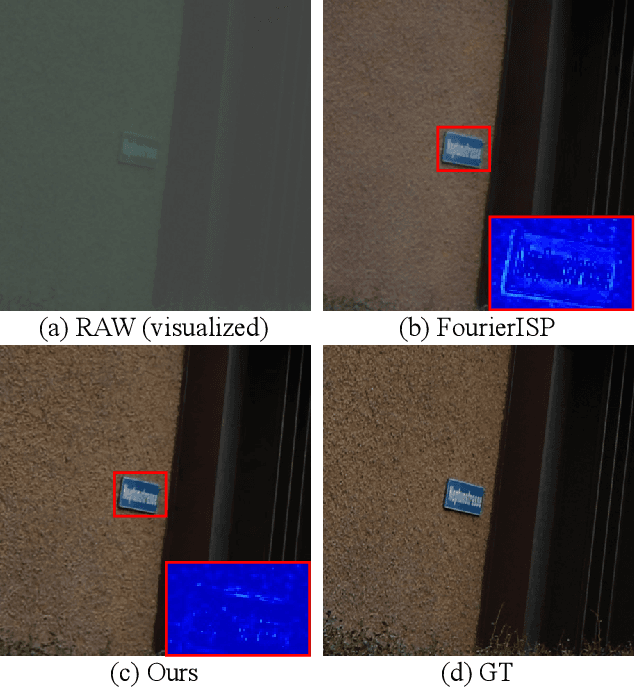
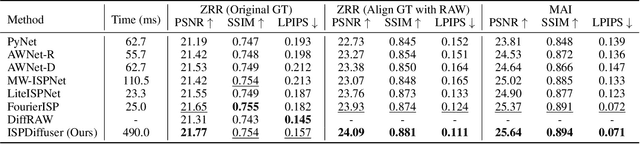
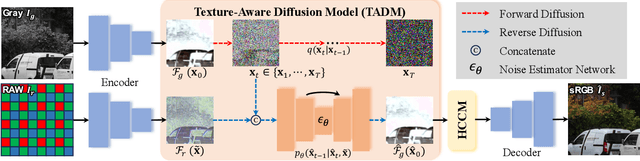
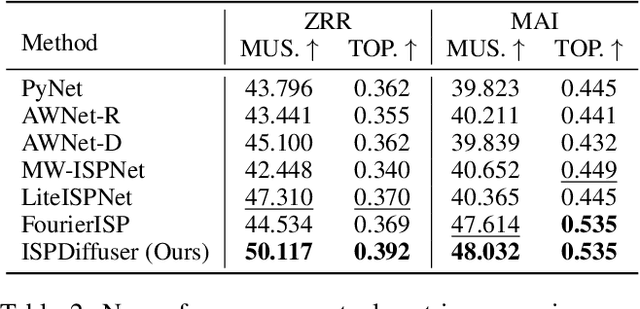
RAW-to-sRGB mapping, or the simulation of the traditional camera image signal processor (ISP), aims to generate DSLR-quality sRGB images from raw data captured by smartphone sensors. Despite achieving comparable results to sophisticated handcrafted camera ISP solutions, existing learning-based methods still struggle with detail disparity and color distortion. In this paper, we present ISPDiffuser, a diffusion-based decoupled framework that separates the RAW-to-sRGB mapping into detail reconstruction in grayscale space and color consistency mapping from grayscale to sRGB. Specifically, we propose a texture-aware diffusion model that leverages the generative ability of diffusion models to focus on local detail recovery, in which a texture enrichment loss is further proposed to prompt the diffusion model to generate more intricate texture details. Subsequently, we introduce a histogram-guided color consistency module that utilizes color histogram as guidance to learn precise color information for grayscale to sRGB color consistency mapping, with a color consistency loss designed to constrain the learned color information. Extensive experimental results show that the proposed ISPDiffuser outperforms state-of-the-art competitors both quantitatively and visually. The code is available at https://github.com/RenYangSCU/ISPDiffuser.