 Add to Chrome
 Add to Firefox
 Add to Edge
A Parallel Cross-Lingual Benchmark for Multimodal Idiomaticity Understanding
Jan 13, 2026
Potentially idiomatic expressions (PIEs) construe meanings inherently tied to the everyday experience of a given language community. As such, they constitute an interesting challenge for assessing the linguistic (and to some extent cultural) capabilities of NLP systems. In this paper, we present XMPIE, a parallel multilingual and multimodal dataset of potentially idiomatic expressions. The dataset, containing 34 languages and over ten thousand items, allows comparative analyses of idiomatic patterns among language-specific realisations and preferences in order to gather insights about shared cultural aspects. This parallel dataset allows to evaluate model performance for a given PIE in different languages and whether idiomatic understanding in one language can be transferred to another. Moreover, the dataset supports the study of PIEs across textual and visual modalities, to measure to what extent PIE understanding in one modality transfers or implies in understanding in another modality (text vs. image). The data was created by language experts, with both textual and visual components crafted under multilingual guidelines, and each PIE is accompanied by five images representing a spectrum from idiomatic to literal meanings, including semantically related and random distractors. The result is a high-quality benchmark for evaluating multilingual and multimodal idiomatic language understanding.

OpenHuEval: Evaluating Large Language Model on Hungarian Specifics
Mar 27, 2025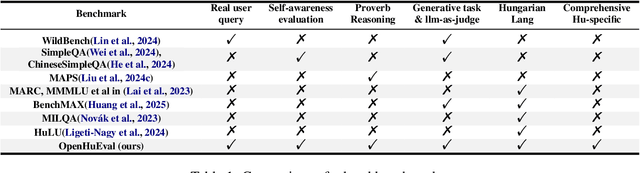
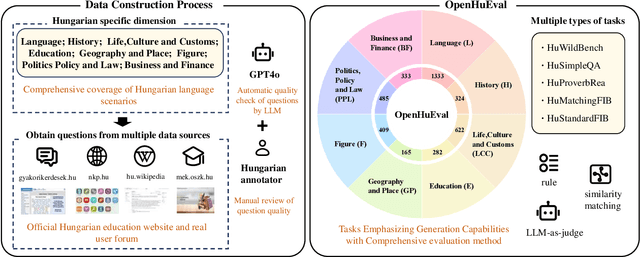
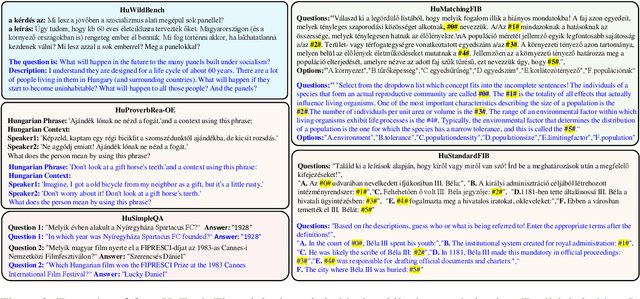
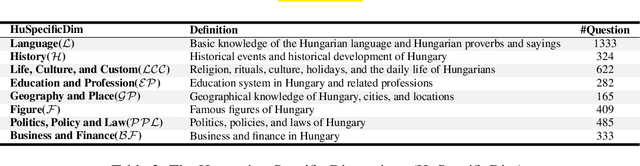
We introduce OpenHuEval, the first benchmark for LLMs focusing on the Hungarian language and specifics. OpenHuEval is constructed from a vast collection of Hungarian-specific materials sourced from multiple origins. In the construction, we incorporated the latest design principles for evaluating LLMs, such as using real user queries from the internet, emphasizing the assessment of LLMs' generative capabilities, and employing LLM-as-judge to enhance the multidimensionality and accuracy of evaluations. Ultimately, OpenHuEval encompasses eight Hungarian-specific dimensions, featuring five tasks and 3953 questions. Consequently, OpenHuEval provides the comprehensive, in-depth, and scientifically accurate assessment of LLM performance in the context of the Hungarian language and its specifics. We evaluated current mainstream LLMs, including both traditional LLMs and recently developed Large Reasoning Models. The results demonstrate the significant necessity for evaluation and model optimization tailored to the Hungarian language and specifics. We also established the framework for analyzing the thinking processes of LRMs with OpenHuEval, revealing intrinsic patterns and mechanisms of these models in non-English languages, with Hungarian serving as a representative example. We will release OpenHuEval at https://github.com/opendatalab/OpenHuEval .