 Add to Chrome
 Add to Firefox
 Add to Edge
TaxBreak: Unmasking the Hidden Costs of LLM Inference Through Overhead Decomposition
Mar 12, 2026
Large Language Model (LLM) inference is widely used in interactive assistants and agentic systems. In latency-sensitive deployments, inference time can become dominated by host-side overheads. Existing approaches typically expose this cost only as an aggregate residual or a launch/queue metric, which is often insufficient to identify which execution layer should be optimized. This work presents TaxBreak, a trace-driven methodology for decomposing host-visible orchestration overhead into three components: framework translation time, CUDA library translation time, and kernel launch-path time. We validate TaxBreak on NVIDIA H100 and H200 systems and use it to derive our proposed Host-Device Balance Index (HDBI), a boundedness summary index that relates device-active execution to host-visible orchestration. Across representative dense and mixture-of-experts workloads in both prefill and decode, we show that aggregate latency, GPU inactivity, or boundedness ratios alone can obscure the dominant optimization target. TaxBreak instead distinguishes cases where optimization should reduce software-stack overhead from cases where the primary win comes from reducing device-side work. We further show that MoE models dispatch 8-11x more kernels per output token than dense models, and that for such host-bound workloads, CPU single-thread performance is a first-order parameter: a faster host CPU reduces orchestration overhead by 10-29% and improves end-to-end latency by up to 14%, even when paired with a slower-clocked GPU. These results position TaxBreak as a diagnostic tool for assessing whether optimization effort should target the software stack or the device-side workload execution.

Exploration of Unary Arithmetic-Based Matrix Multiply Units for Low Precision DL Accelerators
Jan 31, 2026General matrix multiplication (GEMM) is a fundamental operation in deep learning (DL). With DL moving increasingly toward low precision, recent works have proposed novel unary GEMM designs as an alternative to conventional binary GEMM hardware. A rigorous evaluation of recent unary and binary GEMM designs is needed to assess the potential of unary hardware for future DL compute. This paper focuses on unary GEMM designs for integer-based DL inference and performs a detailed evaluation of three latest unary design proposals, namely, uGEMM, tuGEMM and tubGEMM, by comparing them to a conventional binary GEMM. Rigorous post-synthesis evaluations beyond prior works are performed across varying bit-widths and matrix sizes to assess the designs' tradeoffs and determine optimal sweetspots. Further, we perform weight sparsity analysis across eight pretrained convolutional neural networks (CNNs) and the LLaMA2 large language model (LLM). In this work, we demonstrate how unary GEMM can be effectively used for energy-efficient compute in future edge AI accelerators.
BRIDGES: Bridging Graph Modality and Large Language Models within EDA Tasks
Apr 07, 2025While many EDA tasks already involve graph-based data, existing LLMs in EDA primarily either represent graphs as sequential text, or simply ignore graph-structured data that might be beneficial like dataflow graphs of RTL code. Recent studies have found that LLM performance suffers when graphs are represented as sequential text, and using additional graph information significantly boosts performance. To address these challenges, we introduce BRIDGES, a framework designed to incorporate graph modality into LLMs for EDA tasks. BRIDGES integrates an automated data generation workflow, a solution that combines graph modality with LLM, and a comprehensive evaluation suite. First, we establish an LLM-driven workflow to generate RTL and netlist-level data, converting them into dataflow and netlist graphs with function descriptions. This workflow yields a large-scale dataset comprising over 500,000 graph instances and more than 1.5 billion tokens. Second, we propose a lightweight cross-modal projector that encodes graph representations into text-compatible prompts, enabling LLMs to effectively utilize graph data without architectural modifications. Experimental results demonstrate 2x to 10x improvements across multiple tasks compared to text-only baselines, including accuracy in design retrieval, type prediction and perplexity in function description, with negligible computational overhead (<1% model weights increase and <30% additional runtime overhead). Even without additional LLM finetuning, our results outperform text-only by a large margin. We plan to release BRIDGES, including the dataset, models, and training flow.
Tempus Core: Area-Power Efficient Temporal-Unary Convolution Core for Low-Precision Edge DLAs
Dec 25, 2024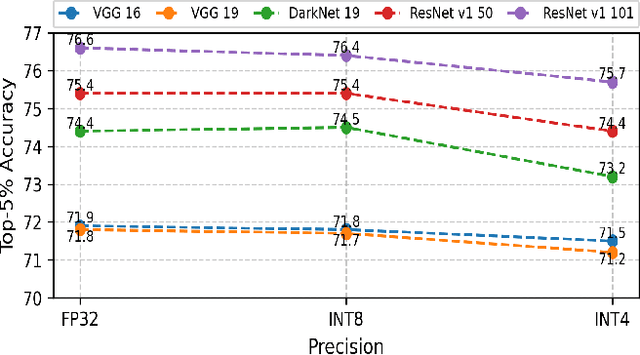
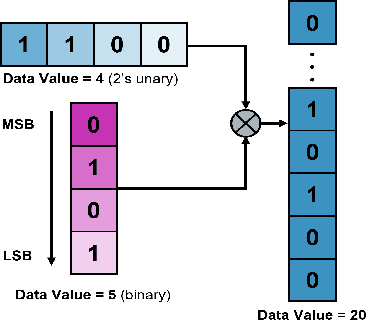
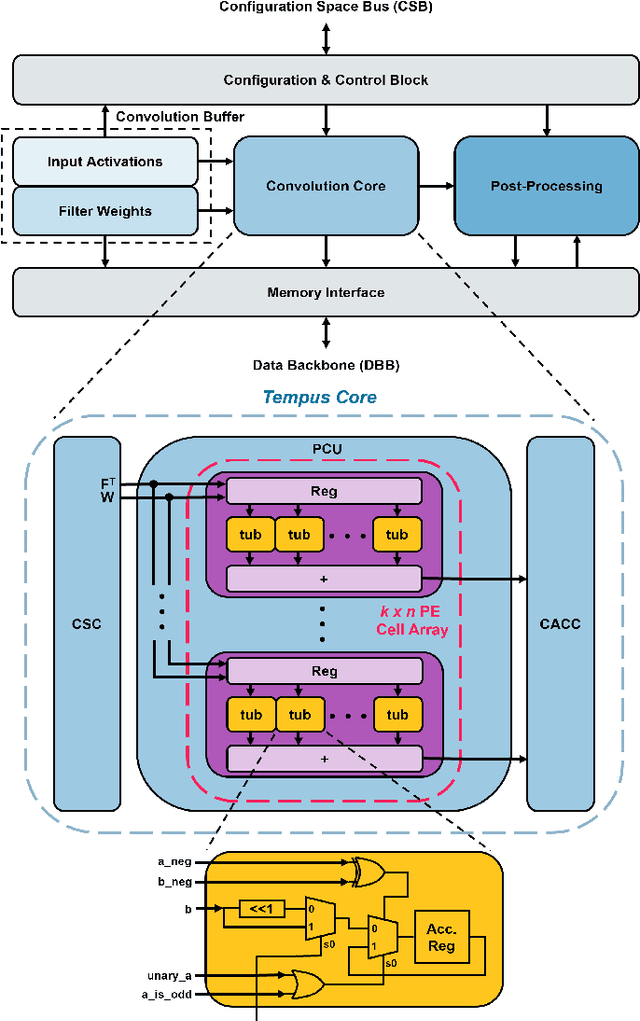
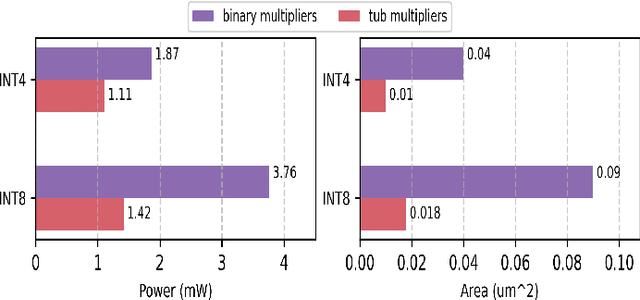
The increasing complexity of deep neural networks (DNNs) poses significant challenges for edge inference deployment due to resource and power constraints of edge devices. Recent works on unary-based matrix multiplication hardware aim to leverage data sparsity and low-precision values to enhance hardware efficiency. However, the adoption and integration of such unary hardware into commercial deep learning accelerators (DLA) remain limited due to processing element (PE) array dataflow differences. This work presents Tempus Core, a convolution core with highly scalable unary-based PE array comprising of tub (temporal-unary-binary) multipliers that seamlessly integrates with the NVDLA (NVIDIA's open-source DLA for accelerating CNNs) while maintaining dataflow compliance and boosting hardware efficiency. Analysis across various datapath granularities shows that for INT8 precision in 45nm CMOS, Tempus Core's PE cell unit (PCU) yields 59.3% and 15.3% reductions in area and power consumption, respectively, over NVDLA's CMAC unit. Considering a 16x16 PE array in Tempus Core, area and power improves by 75% and 62%, respectively, while delivering 5x and 4x iso-area throughput improvements for INT8 and INT4 precisions. Post-place and route analysis of Tempus Core's PCU shows that the 16x4 PE array for INT4 precision in 45nm CMOS requires only 0.017 mm^2 die area and consumes only 6.2mW of total power. We demonstrate that area-power efficient unary-based hardware can be seamlessly integrated into conventional DLAs, paving the path for efficient unary hardware for edge AI inference.