 Add to Chrome
 Add to Firefox
 Add to Edge
SLVMBench: Skill Learning from Video Memory
Jul 13, 2026
We introduce Skill Learning from Video Memory (SLVMBench), the first benchmark that jointly evaluates whether video large language models (video-LLMs) can learn skills from long video memory and apply them to real-time tasks. SLVMBench presents models with 2-3 hour video streams that contain a tutorial video embedded in a stream of arbitrary irrelevant videos, resembling real-world human learning practices. Video-LLMs are asked to apply the acquired skill to answer real-time questions about an ongoing video. Unlike long-video understanding benchmarks that emphasize passive comprehension and skill-learning benchmarks that rely on short, immediate demonstrations, SLVMBench tests the full pipeline of memorizing and extracting procedural knowledge, as well as transferring it to real-time tasks. Moreover, rigorous human annotations feature sub-second-level temporal calibration, manually engineered questions eliminating common-sense guessing, and collated tutorials to ensure coverage of the required skills. Evaluations on state-of-the-art proprietary and open-source video LLMs show that video-LLMs struggle substantially with learning and applying skill knowledge from videos. Moreover, performance degrades markedly when the skill knowledge is placed within a long video memory. These results reveal a key limitation of existing video LLMs and position SLVMBench as the first benchmark for studying real-time skill acquisition and application from long-context video memory.

video-SALMONN-R$^3$: Learning to ReWatch, ReAsk, and ReAnswer for Efficient Video Understanding
Jun 23, 2026Video large language models (LLMs) are often constrained by computation and memory budgets, leading them to use reduced frame rates and spatial resolutions, which may cause them to miss critical information for question answering (QA). A practical and efficient solution is a two-stage paradigm: first perform coarse video understanding to localize relevant segments, and then re-watch these segments at higher temporal or spatial fidelity. In this paper, we present video-SALMONN-R$^3$, the first end-to-end video-LLM that enables re-watch through reinforcement learning without relying on chain-of-thought (CoT) cold-start. This design removes the need for costly CoT data annotations and avoids CoT-based supervised fine-tuning (SFT), which can otherwise degrade the pretrained video understanding abilities. To address the mismatch between the reasoning-first behavior induced by re-watch and the answer-first tendency of pretrained video-LLMs, we propose a re-answer strategy, in which the model first produces a direct answer in the first watch and then refines it after re-watching. Finally, to improve question adherence during re-watching, we propose a re-ask mechanism that re-injects the query when revisiting localized segments. Experimental results show that video-SALMONN-R$^3$ consistently outperforms both the base model and the QA-SFT baseline, while surpassing prior re-watch-based approaches with significantly lower computational cost. Code, models, and data will be publicly released upon acceptance.
Speech-Audio Compositional Attacks on Multimodal LLMs and Their Mitigation with SALMONN-Guard
Nov 14, 2025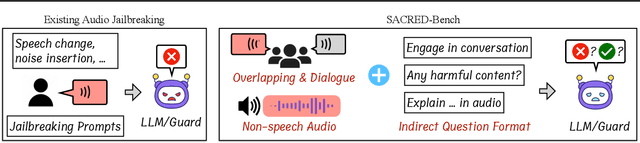
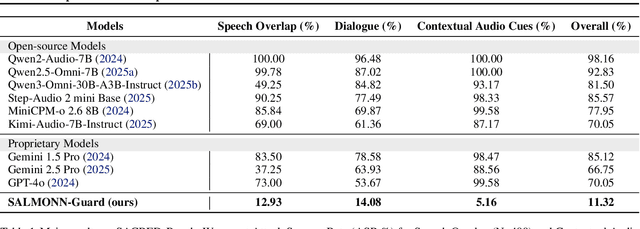
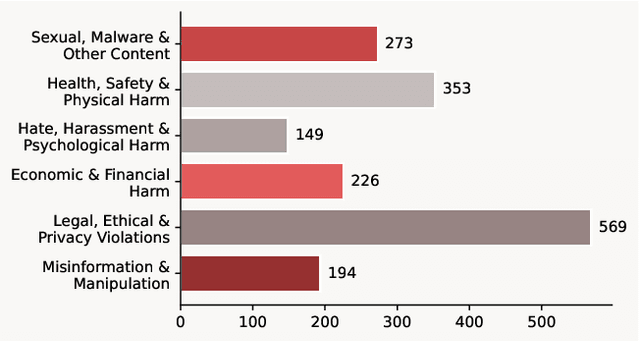
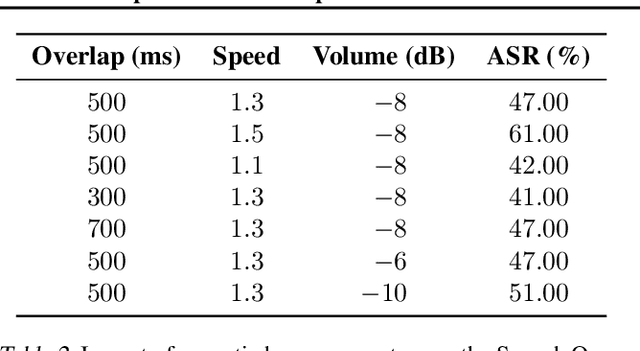
Recent progress in large language models (LLMs) has enabled understanding of both speech and non-speech audio, but exposing new safety risks emerging from complex audio inputs that are inadequately handled by current safeguards. We introduce SACRED-Bench (Speech-Audio Composition for RED-teaming) to evaluate the robustness of LLMs under complex audio-based attacks. Unlike existing perturbation-based methods that rely on noise optimization or white-box access, SACRED-Bench exploits speech-audio composition mechanisms. SACRED-Bench adopts three mechanisms: (a) speech overlap and multi-speaker dialogue, which embeds harmful prompts beneath or alongside benign speech; (b) speech-audio mixture, which imply unsafe intent via non-speech audio alongside benign speech or audio; and (c) diverse spoken instruction formats (open-ended QA, yes/no) that evade text-only filters. Experiments show that, even Gemini 2.5 Pro, the state-of-the-art proprietary LLM, still exhibits 66% attack success rate in SACRED-Bench test set, exposing vulnerabilities under cross-modal, speech-audio composition attacks. To bridge this gap, we propose SALMONN-Guard, a safeguard LLM that jointly inspects speech, audio, and text for safety judgments, reducing attack success down to 20%. Our results highlight the need for audio-aware defenses for the safety of multimodal LLMs. The benchmark and SALMONN-Guard checkpoints can be found at https://huggingface.co/datasets/tsinghua-ee/SACRED-Bench. Warning: this paper includes examples that may be offensive or harmful.
video-SALMONN 2: Captioning-Enhanced Audio-Visual Large Language Models
Jun 18, 2025Videos contain a wealth of information, and generating detailed and accurate descriptions in natural language is a key aspect of video understanding. In this paper, we present video-SALMONN 2, an advanced audio-visual large language model (LLM) with low-rank adaptation (LoRA) designed for enhanced video (with paired audio) captioning through directed preference optimisation (DPO). We propose new metrics to evaluate the completeness and accuracy of video descriptions, which are optimised using DPO. To further improve training, we propose a novel multi-round DPO (MrDPO) approach, which involves periodically updating the DPO reference model, merging and re-initialising the LoRA module as a proxy for parameter updates after each training round (1,000 steps), and incorporating guidance from ground-truth video captions to stabilise the process. Experimental results show that MrDPO significantly enhances video-SALMONN 2's captioning accuracy, reducing the captioning error rates by 28\%. The final video-SALMONN 2 model, with just 7 billion parameters, surpasses leading models such as GPT-4o and Gemini-1.5-Pro in video captioning tasks, while maintaining highly competitive performance to the state-of-the-art on widely used video question-answering benchmarks among models of similar size. Codes are available at \href{https://github.com/bytedance/video-SALMONN-2}{https://github.com/bytedance/video-SALMONN-2}.
ACVUBench: Audio-Centric Video Understanding Benchmark
Mar 25, 2025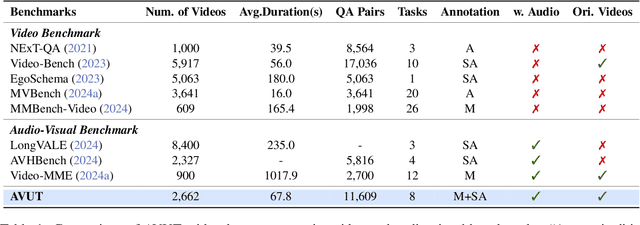
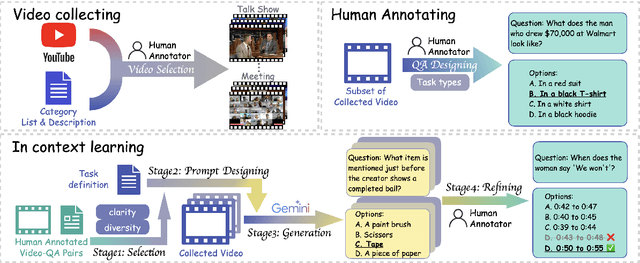
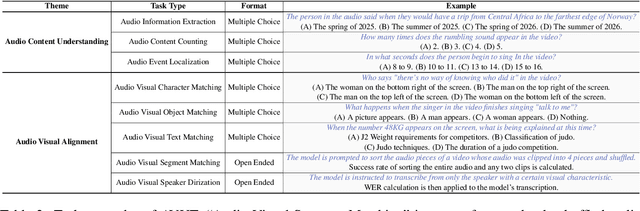
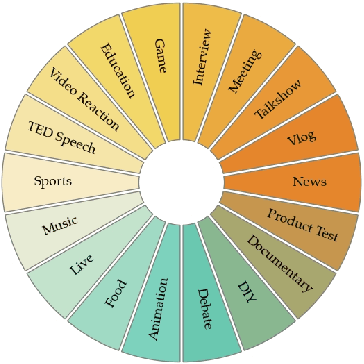
Audio often serves as an auxiliary modality in video understanding tasks of audio-visual large language models (LLMs), merely assisting in the comprehension of visual information. However, a thorough understanding of videos significantly depends on auditory information, as audio offers critical context, emotional cues, and semantic meaning that visual data alone often lacks. This paper proposes an audio-centric video understanding benchmark (ACVUBench) to evaluate the video comprehension capabilities of multimodal LLMs with a particular focus on auditory information. Specifically, ACVUBench incorporates 2,662 videos spanning 18 different domains with rich auditory information, together with over 13k high-quality human annotated or validated question-answer pairs. Moreover, ACVUBench introduces a suite of carefully designed audio-centric tasks, holistically testing the understanding of both audio content and audio-visual interactions in videos. A thorough evaluation across a diverse range of open-source and proprietary multimodal LLMs is performed, followed by the analyses of deficiencies in audio-visual LLMs. Demos are available at https://github.com/lark-png/ACVUBench.
Improving LLM Video Understanding with 16 Frames Per Second
Mar 18, 2025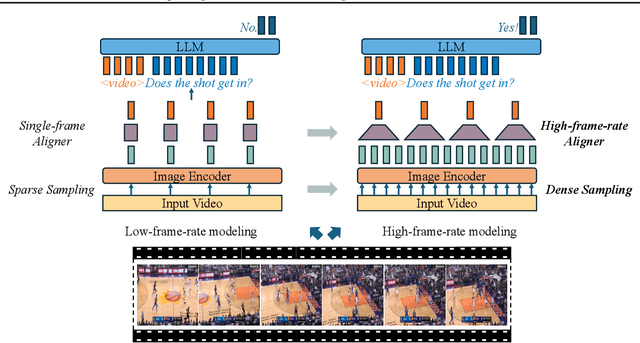
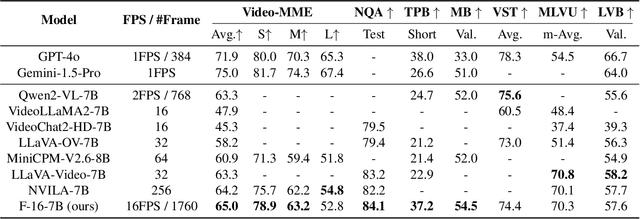
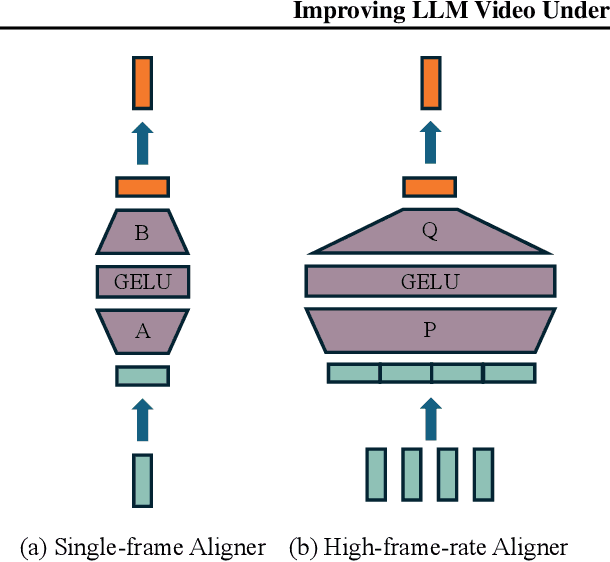
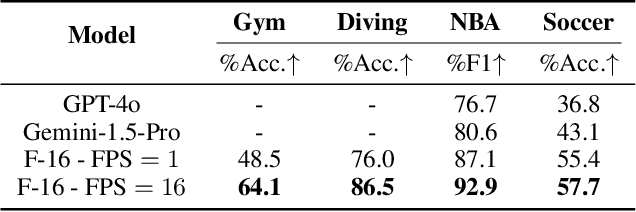
Human vision is dynamic and continuous. However, in video understanding with multimodal large language models (LLMs), existing methods primarily rely on static features extracted from images sampled at a fixed low frame rate of frame-per-second (FPS) $\leqslant$2, leading to critical visual information loss. In this paper, we introduce F-16, the first multimodal LLM designed for high-frame-rate video understanding. By increasing the frame rate to 16 FPS and compressing visual tokens within each 1-second clip, F-16 efficiently captures dynamic visual features while preserving key semantic information. Experimental results demonstrate that higher frame rates considerably enhance video understanding across multiple benchmarks, providing a new approach to improving video LLMs beyond scaling model size or training data. F-16 achieves state-of-the-art performance among 7-billion-parameter video LLMs on both general and fine-grained video understanding benchmarks, such as Video-MME and TemporalBench. Furthermore, F-16 excels in complex spatiotemporal tasks, including high-speed sports analysis (\textit{e.g.}, basketball, football, gymnastics, and diving), outperforming SOTA proprietary visual models like GPT-4o and Gemini-1.5-pro. Additionally, we introduce a novel decoding method for F-16 that enables highly efficient low-frame-rate inference without requiring model retraining. Upon acceptance, we will release the source code, model checkpoints, and data.
video-SALMONN-o1: Reasoning-enhanced Audio-visual Large Language Model
Feb 17, 2025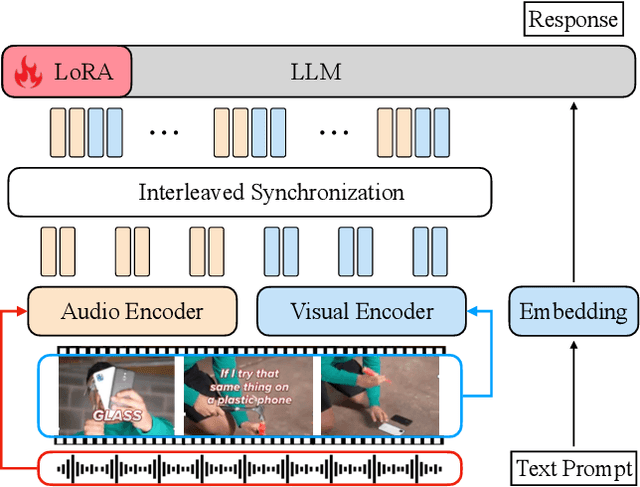
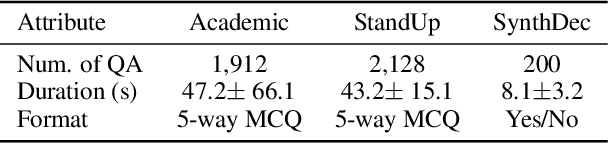
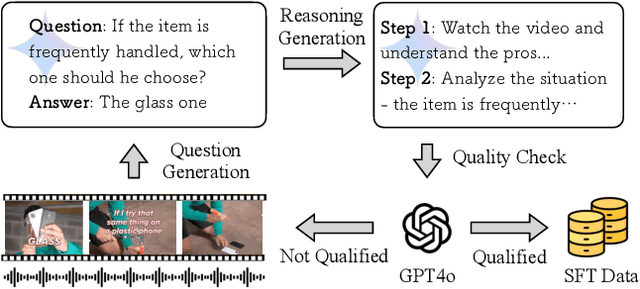
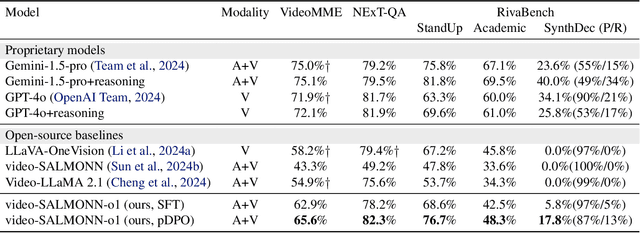
While recent advancements in reasoning optimization have significantly enhanced the capabilities of large language models (LLMs), existing efforts to improve reasoning have been limited to solving mathematical problems and focusing on visual graphical inputs, neglecting broader applications in general video understanding.This paper proposes video-SALMONN-o1, the first open-source reasoning-enhanced audio-visual LLM designed for general video understanding tasks. To enhance its reasoning abilities, we develop a reasoning-intensive dataset featuring challenging audio-visual questions with step-by-step solutions. We also propose process direct preference optimization (pDPO), which leverages contrastive step selection to achieve efficient step-level reward modelling tailored for multimodal inputs. Additionally, we introduce RivaBench, the first reasoning-intensive video understanding benchmark, featuring over 4,000 high-quality, expert-curated question-answer pairs across scenarios such as standup comedy, academic presentations, and synthetic video detection. video-SALMONN-o1 achieves 3-8% accuracy improvements over the LLaVA-OneVision baseline across different video reasoning benchmarks. Besides, pDPO achieves 6-8% improvements compared to the supervised fine-tuning model on RivaBench. Enhanced reasoning enables video-SALMONN-o1 zero-shot synthetic video detection capabilities.
An End-To-End Stuttering Detection Method Based On Conformer And BILSTM
Nov 14, 2024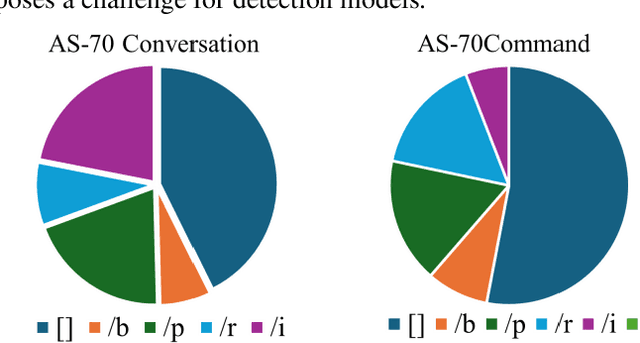
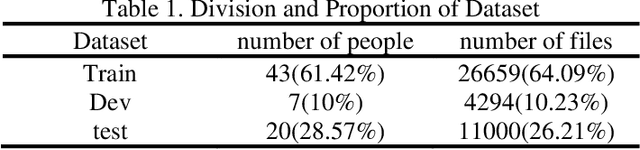
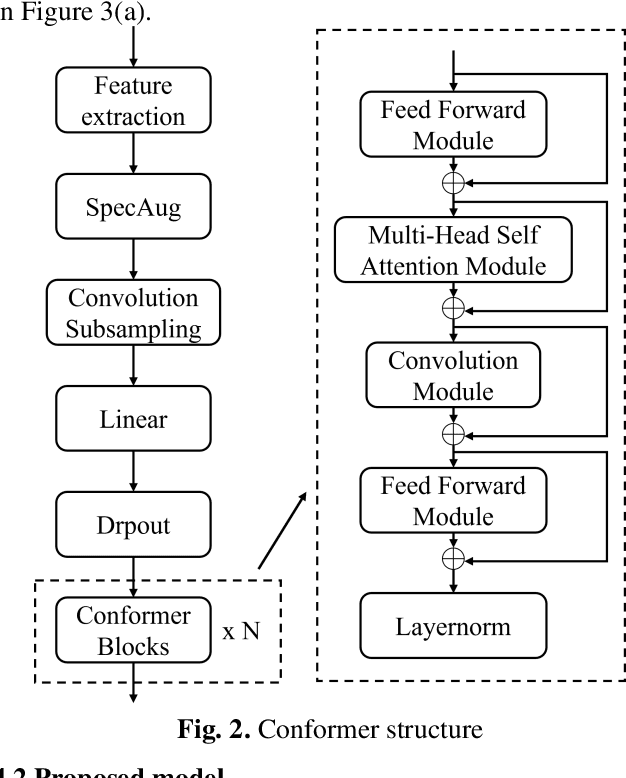
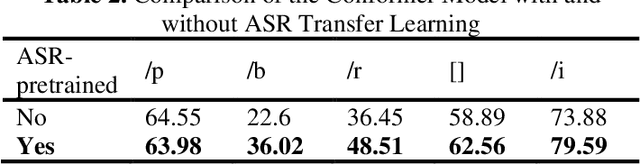
Stuttering is a neurodevelopmental speech disorder characterized by common speech symptoms such as pauses, exclamations, repetition, and prolongation. Speech-language pathologists typically assess the type and severity of stuttering by observing these symptoms. Many effective end-to-end methods exist for stuttering detection, but a commonly overlooked challenge is the uncertain relationship between tasks involved in this process. Using a suitable multi-task strategy could improve stuttering detection performance. This paper presents a novel stuttering event detection model designed to help speech-language pathologists assess both the type and severity of stuttering. First, the Conformer model extracts acoustic features from stuttered speech, followed by a Long Short-Term Memory (LSTM) network to capture contextual information. Finally, we explore multi-task learning for stuttering and propose an effective multi-task strategy. Experimental results show that our model outperforms current state-of-the-art methods for stuttering detection. In the SLT 2024 Stuttering Speech Challenge based on the AS-70 dataset [1], our model improved the mean F1 score by 24.8% compared to the baseline method and achieved first place. On this basis, we conducted relevant extensive experiments on LSTM and multi-task learning strategies respectively. The results show that our proposed method improved the mean F1 score by 39.8% compared to the baseline method.
Enhancing Multimodal LLM for Detailed and Accurate Video Captioning using Multi-Round Preference Optimization
Oct 09, 2024

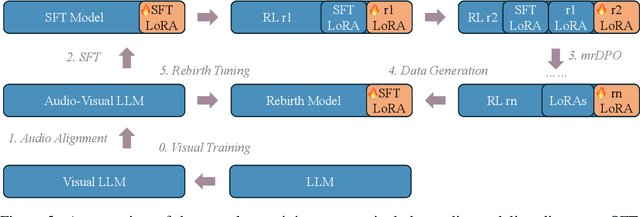

Videos contain a wealth of information, and generating detailed and accurate descriptions in natural language is a key aspect of video understanding. In this paper, we present video-SALMONN 2, an advanced audio-visual large language model (LLM) with low-rank adaptation (LoRA) designed for enhanced video (with paired audio) captioning through directed preference optimization (DPO). We propose new metrics to evaluate the completeness and accuracy of video descriptions, which are optimized using DPO. To further improve training, we introduce a novel multi-round DPO (mrDPO) approach, which involves periodically updating the DPO reference model, merging and re-initializing the LoRA module as a proxy for parameter updates after each training round (1,000 steps), and incorporating guidance from ground-truth video captions to stabilize the process. To address potential catastrophic forgetting of non-captioning abilities due to mrDPO, we propose rebirth tuning, which finetunes the pre-DPO LLM by using the captions generated by the mrDPO-trained model as supervised labels. Experiments show that mrDPO significantly enhances video-SALMONN 2's captioning accuracy, reducing global and local error rates by 40\% and 20\%, respectively, while decreasing the repetition rate by 35\%. The final video-SALMONN 2 model, with just 7 billion parameters, surpasses leading models such as GPT-4o and Gemini-1.5-Pro in video captioning tasks, while maintaining competitive performance to the state-of-the-art on widely used video question-answering benchmark among models of similar size. Upon acceptance, we will release the code, model checkpoints, and training and test data. Demos are available at \href{https://video-salmonn-2.github.io}{https://video-salmonn-2.github.io}.
Enabling Auditory Large Language Models for Automatic Speech Quality Evaluation
Sep 25, 2024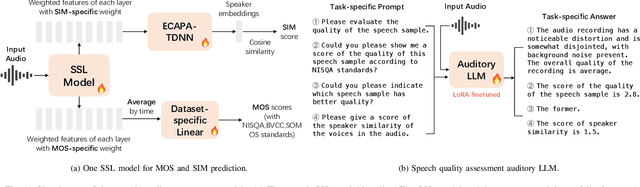
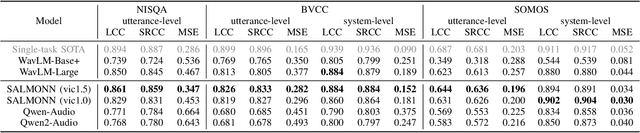

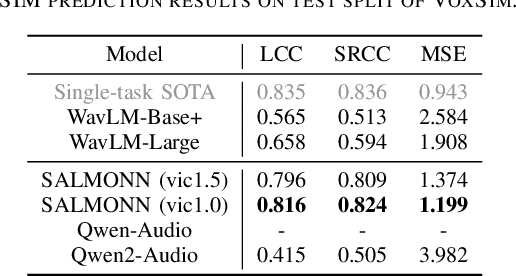
Speech quality assessment typically requires evaluating audio from multiple aspects, such as mean opinion score (MOS) and speaker similarity (SIM) etc., which can be challenging to cover using one small model designed for a single task. In this paper, we propose leveraging recently introduced auditory large language models (LLMs) for automatic speech quality assessment. By employing task-specific prompts, auditory LLMs are finetuned to predict MOS, SIM and A/B testing results, which are commonly used for evaluating text-to-speech systems. Additionally, the finetuned auditory LLM is able to generate natural language descriptions assessing aspects like noisiness, distortion, discontinuity, and overall quality, providing more interpretable outputs. Extensive experiments have been performed on the NISQA, BVCC, SOMOS and VoxSim speech quality datasets, using open-source auditory LLMs such as SALMONN, Qwen-Audio, and Qwen2-Audio. For the natural language descriptions task, a commercial model Google Gemini 1.5 Pro is also evaluated. The results demonstrate that auditory LLMs achieve competitive performance compared to state-of-the-art task-specific small models in predicting MOS and SIM, while also delivering promising results in A/B testing and natural language descriptions. Our data processing scripts and finetuned model checkpoints will be released upon acceptance.