 Add to Chrome
 Add to Firefox
 Add to Edge
SCOPE: Subspace Clustering with Online Per-Head Top-K Estimation for Sparse Video Attention
Aug 13, 2026
Diffusion Transformers (DiTs) incur quadratic self-attention cost over spatiotemporal tokens. Existing training-free sparse attention methods often construct sparse masks from block-level or cluster-level proxy scores, which can obscure fine-grained differences among keys and miss high contribution keys under aggressive sparsity. Moreover, such proxy scores may yield overly concentrated softmax distributions, causing Top-$p$ to retain too few keys for some query clusters. Although a fixed Top-$k$ minimum alleviates this failure mode, a shared value cannot adapt to variations across heads and inputs. To address both limitations, we propose SCOPE, a training-free sparse attention framework that combines 3D-RoPE-aligned key subspace clustering with online per-head Top-$k$ estimation for efficient video-DiT inference. SCOPE partitions post-RoPE keys into temporal, height, and width subspaces, clusters them independently, and aggregates the corresponding centroid scores through lookup tables to obtain per key proxy scores for each query cluster. Building on existing hybrid Top-$p$/fixed Top-$k$ selection, SCOPE derives a head-specific Top-$k$ value online by averaging the initial retained key counts within each head, weighted by query cluster size, and selects additional keys only for query clusters whose initial retained key counts fall below this value. Sparse attention is then computed over the selected original keys and values. Across six model--task configurations, SCOPE consistently outperforms existing training-free baselines in both fidelity and latency, achieving up to a $1.99\times$ end-to-end speedup on 720p HunyuanVideo with $28.46$ dB PSNR relative to dense attention.

Text Template Tokens Are Implicit Semantic Registers in Diffusion Transformers
Jul 21, 2026Text-to-image diffusion transformers (DiTs) jointly process text and image tokens, yet their internal computation during denoising remains poorly understood. We introduce a causal interpretability framework for modern large-scale DiTs that combines attention decomposition with targeted interventions across token spans, heads, and layers. Using it to separate prompt-content tokens from structural template tokens, we find that the structural tokens carry little prompt-specific information at the encoder output. Yet surprisingly, they emerge as dominant image-to-text attention sinks and causally maintain object identity inside the DiT, acting as implicit semantic registers. We show that they acquire this identity indirectly, with prompt semantics first injected into the image latents and then read back into the template tokens rather than transferred directly from the prompt tokens. Inspired by the above findings, we design a training-free pruning rule for DiTs. Heads that attend most strongly to prompt tokens are dispensable, and pruning them removes $20\%$ of attention FLOPs with only a $1.4$-point drop on GenEval. We further reveal how generative computation in DiTs is organized across heads and depth, separating semantic routing from visual synthesis and progressing from identity formation to propagation and refinement. Our work not only reveals that the tokens encoding semantics at input need not be those that maintain it during generation, but also provides a causal view of internal mechanisms in DiTs.
C$^2$KV: Compressed and Composable KV Cache Reuse for Efficient LLM Inference
Jul 20, 2026Long-context inference is central to modern large language model (LLM) applications such as retrieval-augmented generation and multi-document reasoning. To mitigate the growing inference cost, recent work has explored key-value (KV) cache reuse to reduce redundant prefill computation. However, existing reuse methods primarily focus on computation savings and overlook a critical bottleneck in long-context LLM serving: the cost of storing and accessing large KV caches. While KV compression appears to be a natural complement, naively combining compression with non-prefix KV reuse often leads to severe accuracy degradation. In this work, we propose C$^2$KV, a unified framework for non-prefix KV reuse that jointly optimizes KV extraction and inference-time concatenation. C$^2$KV learns a composable and compressed KV cache manifold that is explicitly designed to be position-agnostic. Our approach introduces a lightweight sidecar Extractor with learnable compression tokens and a structured attention flow, enabling modular KV representations that can be flexibly reused and concatenated without modifying the frozen base model. We further employ a compression-concatenation co-training strategy to align extraction-time representations with their downstream reuse behavior. Extensive experiments across multiple long-context benchmarks and model families demonstrate that C$^2$KV significantly reduces KV cache storage and transfer costs, achieving up to 17$\times$ inference speedup under long contexts, while preserving generation quality.
Prompt Generation Technical Report
Jul 13, 2026Generative retrieval has become an increasingly adopted paradigm for industrial search, recommendation, and advertising systems, delivering significant online gains. Most existing work combines user behavior sequences with large language models (LLMs) to model user preferences. In practice, feature engineering remains critical to model effectiveness, yet its complexity slows offline iteration and makes online deployment heavy and hard to reuse, all under tight online latency budgets. The root cause is a tight coupling between feature-processing logic and model architecture, where every feature change touches the training and serving code and resists reuse across scenarios. To break this coupling, we present Prompt Generation (PG), a high-level tokenizer and configuration-driven framework that decouples feature-processing logic from model architecture through two declarative JSON files, which serve as the single source of truth for both offline training and online serving, ensuring feature consistency across the two stages. Organizing features under four types with three composable processing components to assemble and compress heterogeneous features, PG delivers acceleration at three levels: (1)fast training iteration: feature experiments require only configuration changes, with built-in token compression for ultra-long sequences; (2)fast deployment: a new scenario only needs to conform to the PG schema and plug into a universal pipeline, with no scenario-specific engineering; (3)fast online inference: engine applies unified optimizations over the standardized configuration, reducing PG's overhead to a negligible level. PG has been deployed on Taobao Search with statistically significant online A/B uplifts of +0.47% in transaction count and +0.51% in GMV, and has been applied across multiple Taobao search and recommendation teams as the iteration framework for generative retrieval.
Linear-DPO: Linear Direct Preference Optimization for Diffusion and Flow-Matching Generative Models
May 20, 2026Direct Preference Optimization (DPO) is successful for alignment in LLMs but still faces challenges in text-to-image generation. Existing studies are confined to denoising diffusion models while overlooking flow-matching, and suffer from an objective mismatch when applying discrete NLP-based DPO to regression-based generative tasks.\ In this paper, we derive a generalized DPO objective that covers both diffusion and flow-matching via a unified reverse-time SDE framework, and point out from a gradient perspective that the standard DPO objective is suboptimal for text-to-image generation. Consequently, we propose Linear-DPO, which replaces the aggressive sigmoid-based utility function with a sustained linear utility and incorporates an EMA-updated reference model. Qualitative and quantitative experiments on diffusion models (SD1.5, SDXL) and flow-matching model (SD3-Medium) demonstrate the superiority of our approach over existing baselines.
Rethinking Cross-Layer Information Routing in Diffusion Transformers
May 20, 2026Diffusion Transformers (DiTs) have become a de facto backbone of modern visual generation, and nearly every major axis of their design -- tokenization, attention, conditioning, objectives, and latent autoencoders -- has been extensively revisited. The residual stream that governs how information accumulates across layers, however, has been directly inherited from the original Transformer. In this paper, we present a systematic empirical analysis of cross-layer information flow in DiTs, jointly along depth and denoising timestep, and identify three concrete symptoms of traditional residual addition, namely monotonic forward magnitude inflation, sharp backward gradient decay, and pronounced block-wise redundancy. Motivated by this diagnosis, we propose Diffusion-Adaptive Routing (\textsc{DAR}), a drop-in residual replacement that performs \emph{learnable, timestep-adaptive, and non-incremental} aggregation over the history of sublayer outputs. Moreover, the proposed \textsc{DAR} is compatible with many modern Transformer enhancement methods, such as REPA. On ImageNet $256\times256$, \textsc{DAR} improves SiT-XL/2 by $2.11$ FID ($7.56$ vs.\ $9.67$) and matches the baseline's converged quality with $8.75\times$ fewer training iterations. Stacked on top of REPA, it yields a $2\times$ training acceleration in the early stage, suggesting cross-layer information routing as an underexplored design axis in diffusion modeling, one that operates orthogonally to existing representation-alignment objectives. Beyond pretraining, \textsc{DAR} can also be applied during the fine-tuning stage of large-scale T2I models and preserves high-frequency details during Distribution Matching Distillation.
Qwen-Image-2.0 Technical Report
May 11, 2026We present Qwen-Image-2.0, an omni-capable image generation foundation model that unifies high-fidelity generation and precise image editing within a single framework. Despite recent progress, existing models still struggle with ultra-long text rendering, multilingual typography, high-resolution photorealism, robust instruction following, and efficient deployment, especially in text-rich and compositionally complex scenarios. Qwen-Image-2.0 addresses these challenges by coupling Qwen3-VL as the condition encoder with a Multimodal Diffusion Transformer for joint condition-target modeling, supported by large-scale data curation and a customized multi-stage training pipeline. This enables strong multimodal understanding while preserving flexible generation and editing capabilities. The model supports instructions of up to 1K tokens for generating text-rich content such as slides, posters, infographics, and comics, while significantly improving multilingual text fidelity and typography. It also enhances photorealistic generation with richer details, more realistic textures, and coherent lighting, and follows complex prompts more reliably across diverse styles. Extensive human evaluations show that Qwen-Image-2.0 substantially outperforms previous Qwen-Image models in both generation and editing, marking a step toward more general, reliable, and practical image generation foundation models.
LegoDiffusion: Micro-Serving Text-to-Image Diffusion Workflows
Apr 09, 2026Text-to-image generation executes a diffusion workflow comprising multiple models centered on a base diffusion model. Existing serving systems treat each workflow as an opaque monolith, provisioning, placing, and scaling all constituent models together, which obscures internal dataflow, prevents model sharing, and enforces coarse-grained resource management. In this paper, we make a case for micro-serving diffusion workflows with LegoDiffusion, a system that decomposes a workflow into loosely coupled model-execution nodes that can be independently managed and scheduled. By explicitly managing individual model inference, LegoDiffusion unlocks cluster-scale optimizations, including per-model scaling, model sharing, and adaptive model parallelism. Collectively, LegoDiffusion outperforms existing diffusion workflow serving systems, sustaining up to 3x higher request rates and tolerating up to 8x higher burst traffic.
Shiva-DiT: Residual-Based Differentiable Top-$k$ Selection for Efficient Diffusion Transformers
Feb 05, 2026Diffusion Transformers (DiTs) incur prohibitive computational costs due to the quadratic scaling of self-attention. Existing pruning methods fail to simultaneously satisfy differentiability, efficiency, and the strict static budgets required for hardware overhead. To address this, we propose Shiva-DiT, which effectively reconciles these conflicting requirements via Residual-Based Differentiable Top-$k$ Selection. By leveraging a residual-aware straight-through estimator, our method enforces deterministic token counts for static compilation while preserving end-to-end learnability through residual gradient estimation. Furthermore, we introduce a Context-Aware Router and Adaptive Ratio Policy to autonomously learn an adaptive pruning schedule. Experiments on mainstream models, including SD3.5, demonstrate that Shiva-DiT establishes a new Pareto frontier, achieving a 1.54$\times$ wall-clock speedup with superior fidelity compared to existing baselines, effectively eliminating ragged tensor overheads.
InstGenIE: Generative Image Editing Made Efficient with Mask-aware Caching and Scheduling
May 27, 2025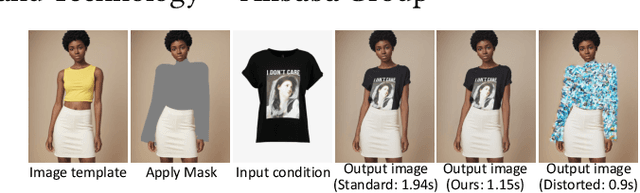


Generative image editing using diffusion models has become a prevalent application in today's AI cloud services. In production environments, image editing typically involves a mask that specifies the regions of an image template to be edited. The use of masks provides direct control over the editing process and introduces sparsity in the model inference. In this paper, we present InstGenIE, a system that efficiently serves image editing requests. The key insight behind InstGenIE is that image editing only modifies the masked regions of image templates while preserving the original content in the unmasked areas. Driven by this insight, InstGenIE judiciously skips redundant computations associated with the unmasked areas by reusing cached intermediate activations from previous inferences. To mitigate the high cache loading overhead, InstGenIE employs a bubble-free pipeline scheme that overlaps computation with cache loading. Additionally, to reduce queuing latency in online serving while improving the GPU utilization, InstGenIE proposes a novel continuous batching strategy for diffusion model serving, allowing newly arrived requests to join the running batch in just one step of denoising computation, without waiting for the entire batch to complete. As heterogeneous masks induce imbalanced loads, InstGenIE also develops a load balancing strategy that takes into account the loads of both computation and cache loading. Collectively, InstGenIE outperforms state-of-the-art diffusion serving systems for image editing, achieving up to 3x higher throughput and reducing average request latency by up to 14.7x while ensuring image quality.