 Add to Chrome
 Add to Firefox
 Add to Edge
Prompt Generation Technical Report
Jul 13, 2026
Generative retrieval has become an increasingly adopted paradigm for industrial search, recommendation, and advertising systems, delivering significant online gains. Most existing work combines user behavior sequences with large language models (LLMs) to model user preferences. In practice, feature engineering remains critical to model effectiveness, yet its complexity slows offline iteration and makes online deployment heavy and hard to reuse, all under tight online latency budgets. The root cause is a tight coupling between feature-processing logic and model architecture, where every feature change touches the training and serving code and resists reuse across scenarios. To break this coupling, we present Prompt Generation (PG), a high-level tokenizer and configuration-driven framework that decouples feature-processing logic from model architecture through two declarative JSON files, which serve as the single source of truth for both offline training and online serving, ensuring feature consistency across the two stages. Organizing features under four types with three composable processing components to assemble and compress heterogeneous features, PG delivers acceleration at three levels: (1)fast training iteration: feature experiments require only configuration changes, with built-in token compression for ultra-long sequences; (2)fast deployment: a new scenario only needs to conform to the PG schema and plug into a universal pipeline, with no scenario-specific engineering; (3)fast online inference: engine applies unified optimizations over the standardized configuration, reducing PG's overhead to a negligible level. PG has been deployed on Taobao Search with statistically significant online A/B uplifts of +0.47% in transaction count and +0.51% in GMV, and has been applied across multiple Taobao search and recommendation teams as the iteration framework for generative retrieval.

KARMA: Knowledge-Action Regularized Multimodal Alignment for Personalized Search at Taobao
Mar 24, 2026Large Language Models (LLMs) are equipped with profound semantic knowledge, making them a natural choice for injecting semantic generalization into personalized search systems. However, in practice we find that directly fine-tuning LLMs on industrial personalized tasks (e.g. next item prediction) often yields suboptimal results. We attribute this bottleneck to a critical Knowledge--Action Gap: the inherent conflict between preserving pre-trained semantic knowledge and aligning with specific personalized actions by discriminative objectives. Empirically, action-only training objectives induce Semantic Collapse, such as attention ``sinks''. This degradation severely cripples the LLM's generalization, failing to bring improvements to personalized search systems. We propose KARMA (Knowledge--Action Regularized Multimodal Alignment), a unified framework that treats semantic reconstruction as a train-only regularizer. KARMA optimizes a next-interest embedding for retrieval (Action) while enforcing semantic decodability (Knowledge) through two complementary objectives: (i) history-conditioned semantic generation, which anchors optimization to the LLM's native next-token distribution, and (ii) embedding-conditioned semantic reconstruction, which constrains the interest embedding to remain semantically recoverable. On Taobao search system, KARMA mitigates semantic collapse (attention-sink analysis) and improves both action metrics and semantic fidelity. In ablations, semantic decodability yields up to +22.5 HR@200. With KARMA, we achieve +0.25 CTR AUC in ranking, +1.86 HR in pre-ranking and +2.51 HR in recalling. Deployed online with low inference overhead at ranking stage, KARMA drives +0.5% increase in Item Click.
Dual Side Deep Context-aware Modulation for Social Recommendation
Mar 16, 2021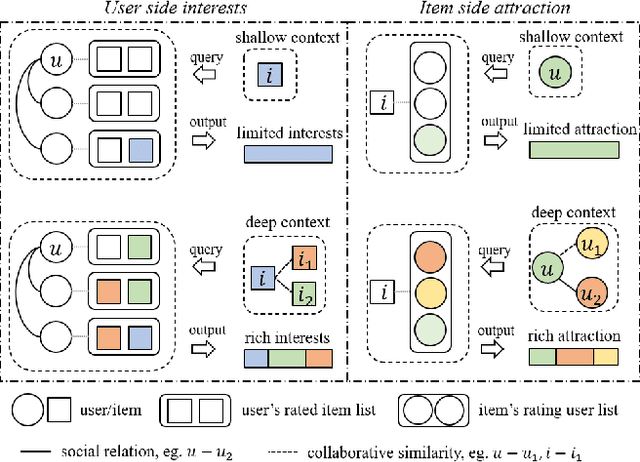
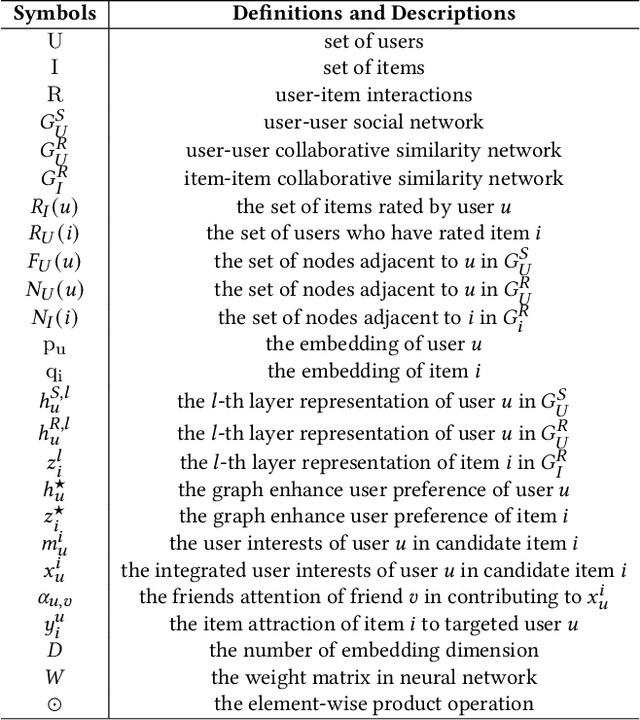
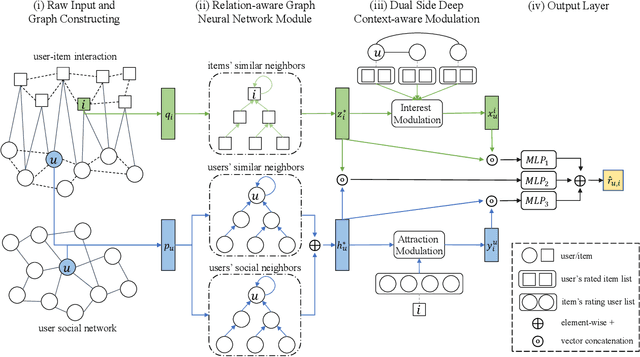
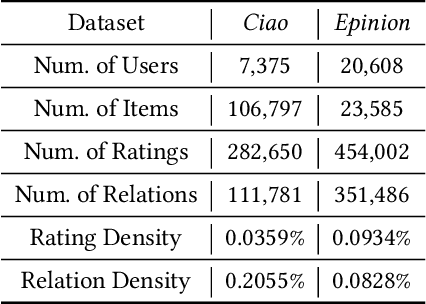
Social recommendation is effective in improving the recommendation performance by leveraging social relations from online social networking platforms. Social relations among users provide friends' information for modeling users' interest in candidate items and help items expose to potential consumers (i.e., item attraction). However, there are two issues haven't been well-studied: Firstly, for the user interests, existing methods typically aggregate friends' information contextualized on the candidate item only, and this shallow context-aware aggregation makes them suffer from the limited friends' information. Secondly, for the item attraction, if the item's past consumers are the friends of or have a similar consumption habit to the targeted user, the item may be more attractive to the targeted user, but most existing methods neglect the relation enhanced context-aware item attraction. To address the above issues, we proposed DICER (Dual Side Deep Context-aware Modulation for SocialRecommendation). Specifically, we first proposed a novel graph neural network to model the social relation and collaborative relation, and on top of high-order relations, a dual side deep context-aware modulation is introduced to capture the friends' information and item attraction. Empirical results on two real-world datasets show the effectiveness of the proposed model and further experiments are conducted to help understand how the dual context-aware modulation works.