 Add to Chrome
 Add to Firefox
 Add to Edge
TSGR: Taobao Search Generative Retrieval
Jul 21, 2026
Generative retrieval (GR) has demonstrated strong promise for industrial e-commerce search by training a single autoregressive model to directly generate the Semantic IDs (SIDs) of target items. However, existing GR systems are primarily optimized for semantic matching and remain insensitive to item business value: SID construction is value-unaware, and candidates are ranked without access to item side-info. Consequently, high-value items are often missed or deprioritized at the retrieval stage, limiting downstream business impact. This limitation is particularly critical in industrial settings such as Taobao Search, where business objectives are central to system design. To address this, we propose $\textbf{T}$aobao $\textbf{S}$earch $\textbf{G}$enerative $\textbf{R}$etrieval ($\textbf{TSGR}$), a unified generative retrieval framework that incorporates value awareness into both item representation and candidate ranking. 1) For item representation, TSGR introduces $\textbf{Query-aware Parallel SID (QP-SID)}$, which encodes query-conditioned value orderings into the SID construction by building parallel codebooks derived from query-item statistics, so that higher-value and query-relevant items are assigned better token indices. 2) For candidate ranking, we introduce a $\textbf{Value-aware Ranking Module (VRM)}$ that is built upon and jointly optimized with the GR, enabling a single model to seamlessly serve as both retriever and pre-ranker without a dedicated pre-ranking stage. A progressive training pipeline further aligns the model with semantic relevance, user preferences, and business objectives. Offline experiments show that TSGR achieves an 9.16% improvement in HR@1000, and online A/B tests further validate its effectiveness, yielding gains of +0.43% in IPV, +1.12% in Transaction Count, and +1.64% in GMV.

Beyond Semantic IDs: Encoding Business-Value Ranking into Document Identifiers for Generative Retrieval
Jul 13, 2026Generative Retrieval (GR) formulates retrieval as a sequence-to-sequence generation task, assigning each document a document identifier (DocID) and retrieving it through autoregressive decoding, making DocID design a critical factor in retrieval quality. However, existing schemes based on discrete representation learning suffer from inherent collision issues and create a mismatch between the DocID's encoding objective and the system's business optimization target. To address these limitations, we propose Cluster-Ranked Identifier (CRID), which decouples DocID into semantic clustering and business-value ranking, yielding collision-free identifiers that support incremental updates via intra-cluster reranking. We further introduce an analytical framework that decomposes retrieval gains into personalized preference and statistical prior generalization, revealing how semantic cluster size governs the balance between the two components. Experiments on a 300M-item Taobao e-commerce corpus show that CRID surpasses the strongest embedding-based retrieval baseline on top-K Hitrate, and delivers +1.06% GMV in full-traffic deployment.
Prompt Generation Technical Report
Jul 13, 2026Generative retrieval has become an increasingly adopted paradigm for industrial search, recommendation, and advertising systems, delivering significant online gains. Most existing work combines user behavior sequences with large language models (LLMs) to model user preferences. In practice, feature engineering remains critical to model effectiveness, yet its complexity slows offline iteration and makes online deployment heavy and hard to reuse, all under tight online latency budgets. The root cause is a tight coupling between feature-processing logic and model architecture, where every feature change touches the training and serving code and resists reuse across scenarios. To break this coupling, we present Prompt Generation (PG), a high-level tokenizer and configuration-driven framework that decouples feature-processing logic from model architecture through two declarative JSON files, which serve as the single source of truth for both offline training and online serving, ensuring feature consistency across the two stages. Organizing features under four types with three composable processing components to assemble and compress heterogeneous features, PG delivers acceleration at three levels: (1)fast training iteration: feature experiments require only configuration changes, with built-in token compression for ultra-long sequences; (2)fast deployment: a new scenario only needs to conform to the PG schema and plug into a universal pipeline, with no scenario-specific engineering; (3)fast online inference: engine applies unified optimizations over the standardized configuration, reducing PG's overhead to a negligible level. PG has been deployed on Taobao Search with statistically significant online A/B uplifts of +0.47% in transaction count and +0.51% in GMV, and has been applied across multiple Taobao search and recommendation teams as the iteration framework for generative retrieval.
Synthetic Data Powers Product Retrieval for Long-tail Knowledge-Intensive Queries in E-commerce Search
Feb 27, 2026Product retrieval is the backbone of e-commerce search: for each user query, it identifies a high-recall candidate set from billions of items, laying the foundation for high-quality ranking and user experience. Despite extensive optimization for mainstream queries, existing systems still struggle with long-tail queries, especially knowledge-intensive ones. These queries exhibit diverse linguistic patterns, often lack explicit purchase intent, and require domain-specific knowledge reasoning for accurate interpretation. They also suffer from a shortage of reliable behavioral logs, which makes such queries a persistent challenge for retrieval optimization. To address these issues, we propose an efficient data synthesis framework tailored to retrieval involving long-tail, knowledge-intensive queries. The key idea is to implicitly distill the capabilities of a powerful offline query-rewriting model into an efficient online retrieval system. Leveraging the strong language understanding of LLMs, we train a multi-candidate query rewriting model with multiple reward signals and capture its rewriting capability in well-curated query-product pairs through a powerful offline retrieval pipeline. This design mitigates distributional shift in rewritten queries, which might otherwise limit incremental recall or introduce irrelevant products. Experiments demonstrate that without any additional tricks, simply incorporating this synthetic data into retrieval model training leads to significant improvements. Online Side-By-Side (SBS) human evaluation results indicate a notable enhancement in user search experience.
TaoSearchEmb: A Multi-Objective Reinforcement Learning Framework for Dense Retrieval in Taobao Search
Nov 17, 2025Dense retrieval, as the core component of e-commerce search engines, maps user queries and items into a unified semantic space through pre-trained embedding models to enable large-scale real-time semantic retrieval. Despite the rapid advancement of LLMs gradually replacing traditional BERT architectures for embedding, their training paradigms still adhere to BERT-like supervised fine-tuning and hard negative mining strategies. This approach relies on complex offline hard negative sample construction pipelines, which constrain model iteration efficiency and hinder the evolutionary potential of semantic representation capabilities. Besides, existing multi-task learning frameworks face the seesaw effect when simultaneously optimizing semantic relevance and non-relevance objectives. In this paper, we propose Retrieval-GRPO, a multi-objective reinforcement learning-based dense retrieval framework designed to address these challenges. The method eliminates offline hard negative sample construction by dynamically retrieving Top-K candidate products for each query during training, while introducing a relevance LLM as a reward model to generate real-time feedback. Specifically, the retrieval model dynamically optimizes embedding representations through reinforcement learning, with reward signals combining LLM-generated relevance scores, product quality scores, and multi-way exclusivity metrics to achieve multi-objective user preference alignment and real-time error correction. This mechanism not only removes dependency on hard negatives but also mitigates the seesaw effect through collaborative multi-objective optimization, significantly enhancing the model's semantic generalization capability for complex long-tail queries. Extensive offline and online experiments validate the effectiveness of Retrieval-GRPO, which has been deployed on China's largest e-commerce platform.
SlimGPT: Layer-wise Structured Pruning for Large Language Models
Dec 24, 2024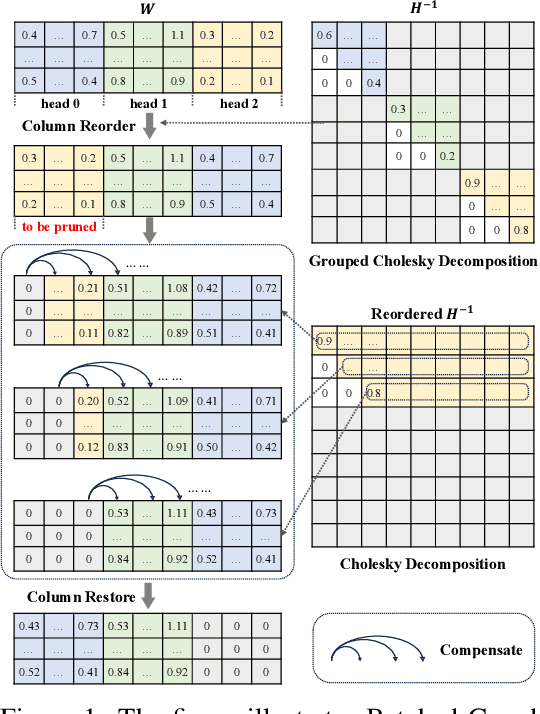
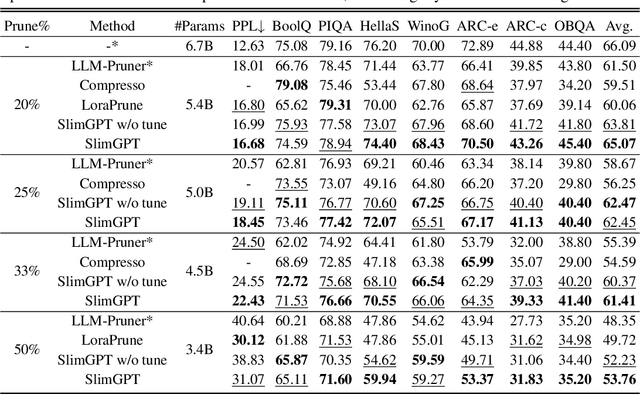
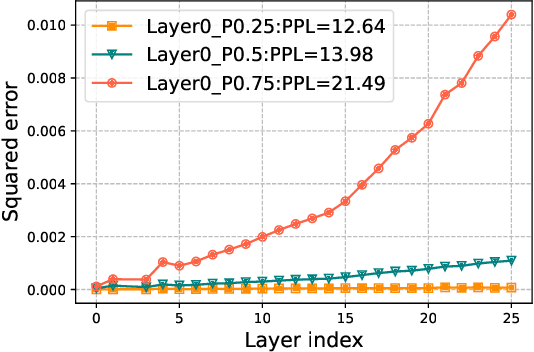
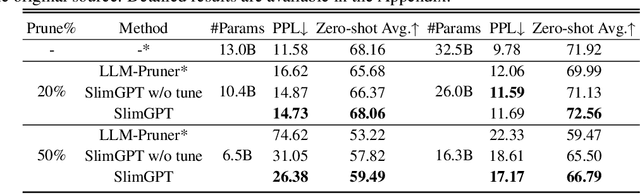
Large language models (LLMs) have garnered significant attention for their remarkable capabilities across various domains, whose vast parameter scales present challenges for practical deployment. Structured pruning is an effective method to balance model performance with efficiency, but performance restoration under computational resource constraints is a principal challenge in pruning LLMs. Therefore, we present a low-cost and fast structured pruning method for LLMs named SlimGPT based on the Optimal Brain Surgeon framework. We propose Batched Greedy Pruning for rapid and near-optimal pruning, which enhances the accuracy of head-wise pruning error estimation through grouped Cholesky decomposition and improves the pruning efficiency of FFN via Dynamic Group Size, thereby achieving approximate local optimal pruning results within one hour. Besides, we explore the limitations of layer-wise pruning from the perspective of error accumulation and propose Incremental Pruning Ratio, a non-uniform pruning strategy to reduce performance degradation. Experimental results on the LLaMA benchmark show that SlimGPT outperforms other methods and achieves state-of-the-art results.