 Add to Chrome
 Add to Firefox
 Add to Edge
From LLM Inference to Agentic Workloads: Characterization and Implications for Serving Systems
Aug 15, 2026
Agentic applications are shifting AI serving from isolated model inference to long-running workloads in which LLMs coordinate tools, environments, and persistent state. However, the system behavior of these workloads---where latency, cost, and bottlenecks arise---remains poorly characterized, leaving serving systems to rely on assumptions built for conventional inference. We present AgentSysBench, a benchmark suite and measurement toolkit with ten representative agentic applications and unified systems-level instrumentation. Across controlled deployments and production traces, we identify six properties that distinguish agentic workloads from conventional LLM serving: (1) execution is heavyweight and stateful, with non-LLM components dominating latency in 5 of 10 applications and sandbox working-set memory peaking at 28 GB per session; (2) applications compose components with heterogeneous resource affinity---GPU-bound inference, memory-bound retrieval, CPU-bound sandboxes---whose task latencies diverge by up to 32x; (3) bottlenecks shift across requests, models, and deployments; (4) production sessions hold state idle for minutes to hours between active steps; (5) a control-plane tax---auxiliary LLM calls and context overhead from tool schemas and observations---crowds out productive compute and context; and (6) production traces from three applications reveal heavy cross-request redundancy in search queries and web fetches, exposing a large caching opportunity. Four design explorations demonstrate that these findings are actionable: task-aware serving reduces latency by 29--40%, communication-aware placement by up to 4.5x, state offloading reduces memory usage by 4.6x, and tool-result caching removes 35.2% of redundant search calls and saves 19.3% of aggregate search latency.

Rollplex: Cross-Phase GPU Spatial Sharing for Vision Language Model Post-Training
Aug 14, 2026Vision-language models (VLMs) enable embodied agents to reason and act from visual observations and language instructions. Reinforcement learning (RL) post-training enhances these capabilities using task feedback, but current on-policy RL runtimes execute rollout, reference scoring, and actor training in strict serial phases. While effective for text-only RL, this phase-granular execution is wasteful for VLMs, where processing dense video inputs and prompt prefixes occupies a large fraction of each phase. Because prefix processing is independent of the generated response, it can be run alongside rollout decoding, which leaves GPU compute capacity underutilized, without breaking synchronous on-policy semantics. We present Rollplex, a runtime that decomposes the reference and training phase and moves the prefix computation into the rollout decode window. Realizing this schedule requires more than concurrent kernel launches: naive colocation of Qwen2.5-VL-32\,B requires roughly 165\,GiB per GPU, while rollout and training prefer different tensor-parallel (TP) degrees and weight layouts. Rollplex addresses these constraints with two mechanisms. Phase-aware memory management controls HBM residency according to producer--consumer lifetimes. Parallelism-aware weight sharing uses the same physical storage for layout-compatible tensors across distinct TP degrees and reconstructs only incompatible tensors, avoiding a complete second actor copy. On 32 H800 GPUs, Rollplex achieves $1.23\times$--$1.30\times$ speedup over serial colocation and $1.57\times$--$2.24\times$ over disaggregation under the same GPU budget, while preserving the synchronous RL update.
ServerlessT2I: Efficient Text-to-Image Workflow Serving on a Serverless Platform
Jul 29, 2026Text-to-image (T2I) workflows are increasingly deployed on serverless platforms because users often compose customized workflows and invoke them intermittently. Existing platforms typically deploy each workflow as an opaque GPU function, provisioning, placing, and scaling all constituent models in the workflow together. This monolithic design obscures workflow structure, inflates scaling overhead, forces users to manage low-level GPU coordination, and limits fine-grained fairness in multi-tenant clusters. In this paper, we present ServerlessT2I, a serverless-native system that decomposes a T2I workflow into loosely coupled model functions that can be independently managed and scheduled. By explicitly managing individual model execution, ServerlessT2I enables per-model scaling, declarative workflow composition, transparent GPU-resident communication, and fairness-aware scheduling. To make this decomposition efficient, ServerlessT2I harvests slack GPU memory left idle by compute-bound T2I inference to build a data plane that reduces model loading and data communication overheads. \sys{} further introduces a fair scheduler for multi-tenant serving. Using production traces, ServerlessT2I sustains up to 2$\times$ higher request rates than existing T2I workflow serving systems with the same GPU budget; for a fixed request rate, it saves up to 3$\times$ GPU resources while satisfying service level objectives (SLOs).
LegoDiffusion: Micro-Serving Text-to-Image Diffusion Workflows
Apr 09, 2026Text-to-image generation executes a diffusion workflow comprising multiple models centered on a base diffusion model. Existing serving systems treat each workflow as an opaque monolith, provisioning, placing, and scaling all constituent models together, which obscures internal dataflow, prevents model sharing, and enforces coarse-grained resource management. In this paper, we make a case for micro-serving diffusion workflows with LegoDiffusion, a system that decomposes a workflow into loosely coupled model-execution nodes that can be independently managed and scheduled. By explicitly managing individual model inference, LegoDiffusion unlocks cluster-scale optimizations, including per-model scaling, model sharing, and adaptive model parallelism. Collectively, LegoDiffusion outperforms existing diffusion workflow serving systems, sustaining up to 3x higher request rates and tolerating up to 8x higher burst traffic.
InstGenIE: Generative Image Editing Made Efficient with Mask-aware Caching and Scheduling
May 27, 2025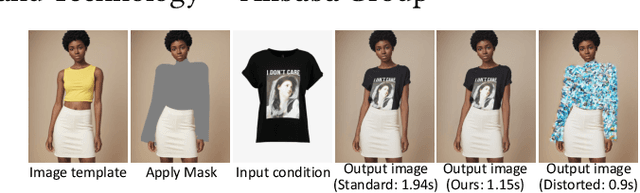


Generative image editing using diffusion models has become a prevalent application in today's AI cloud services. In production environments, image editing typically involves a mask that specifies the regions of an image template to be edited. The use of masks provides direct control over the editing process and introduces sparsity in the model inference. In this paper, we present InstGenIE, a system that efficiently serves image editing requests. The key insight behind InstGenIE is that image editing only modifies the masked regions of image templates while preserving the original content in the unmasked areas. Driven by this insight, InstGenIE judiciously skips redundant computations associated with the unmasked areas by reusing cached intermediate activations from previous inferences. To mitigate the high cache loading overhead, InstGenIE employs a bubble-free pipeline scheme that overlaps computation with cache loading. Additionally, to reduce queuing latency in online serving while improving the GPU utilization, InstGenIE proposes a novel continuous batching strategy for diffusion model serving, allowing newly arrived requests to join the running batch in just one step of denoising computation, without waiting for the entire batch to complete. As heterogeneous masks induce imbalanced loads, InstGenIE also develops a load balancing strategy that takes into account the loads of both computation and cache loading. Collectively, InstGenIE outperforms state-of-the-art diffusion serving systems for image editing, achieving up to 3x higher throughput and reducing average request latency by up to 14.7x while ensuring image quality.