 Add to Chrome
 Add to Firefox
 Add to Edge
SCOPE: Subspace Clustering with Online Per-Head Top-K Estimation for Sparse Video Attention
Aug 13, 2026
Diffusion Transformers (DiTs) incur quadratic self-attention cost over spatiotemporal tokens. Existing training-free sparse attention methods often construct sparse masks from block-level or cluster-level proxy scores, which can obscure fine-grained differences among keys and miss high contribution keys under aggressive sparsity. Moreover, such proxy scores may yield overly concentrated softmax distributions, causing Top-$p$ to retain too few keys for some query clusters. Although a fixed Top-$k$ minimum alleviates this failure mode, a shared value cannot adapt to variations across heads and inputs. To address both limitations, we propose SCOPE, a training-free sparse attention framework that combines 3D-RoPE-aligned key subspace clustering with online per-head Top-$k$ estimation for efficient video-DiT inference. SCOPE partitions post-RoPE keys into temporal, height, and width subspaces, clusters them independently, and aggregates the corresponding centroid scores through lookup tables to obtain per key proxy scores for each query cluster. Building on existing hybrid Top-$p$/fixed Top-$k$ selection, SCOPE derives a head-specific Top-$k$ value online by averaging the initial retained key counts within each head, weighted by query cluster size, and selects additional keys only for query clusters whose initial retained key counts fall below this value. Sparse attention is then computed over the selected original keys and values. Across six model--task configurations, SCOPE consistently outperforms existing training-free baselines in both fidelity and latency, achieving up to a $1.99\times$ end-to-end speedup on 720p HunyuanVideo with $28.46$ dB PSNR relative to dense attention.

Text Template Tokens Are Implicit Semantic Registers in Diffusion Transformers
Jul 21, 2026Text-to-image diffusion transformers (DiTs) jointly process text and image tokens, yet their internal computation during denoising remains poorly understood. We introduce a causal interpretability framework for modern large-scale DiTs that combines attention decomposition with targeted interventions across token spans, heads, and layers. Using it to separate prompt-content tokens from structural template tokens, we find that the structural tokens carry little prompt-specific information at the encoder output. Yet surprisingly, they emerge as dominant image-to-text attention sinks and causally maintain object identity inside the DiT, acting as implicit semantic registers. We show that they acquire this identity indirectly, with prompt semantics first injected into the image latents and then read back into the template tokens rather than transferred directly from the prompt tokens. Inspired by the above findings, we design a training-free pruning rule for DiTs. Heads that attend most strongly to prompt tokens are dispensable, and pruning them removes $20\%$ of attention FLOPs with only a $1.4$-point drop on GenEval. We further reveal how generative computation in DiTs is organized across heads and depth, separating semantic routing from visual synthesis and progressing from identity formation to propagation and refinement. Our work not only reveals that the tokens encoding semantics at input need not be those that maintain it during generation, but also provides a causal view of internal mechanisms in DiTs.
Rethinking Cross-Layer Information Routing in Diffusion Transformers
May 20, 2026Diffusion Transformers (DiTs) have become a de facto backbone of modern visual generation, and nearly every major axis of their design -- tokenization, attention, conditioning, objectives, and latent autoencoders -- has been extensively revisited. The residual stream that governs how information accumulates across layers, however, has been directly inherited from the original Transformer. In this paper, we present a systematic empirical analysis of cross-layer information flow in DiTs, jointly along depth and denoising timestep, and identify three concrete symptoms of traditional residual addition, namely monotonic forward magnitude inflation, sharp backward gradient decay, and pronounced block-wise redundancy. Motivated by this diagnosis, we propose Diffusion-Adaptive Routing (\textsc{DAR}), a drop-in residual replacement that performs \emph{learnable, timestep-adaptive, and non-incremental} aggregation over the history of sublayer outputs. Moreover, the proposed \textsc{DAR} is compatible with many modern Transformer enhancement methods, such as REPA. On ImageNet $256\times256$, \textsc{DAR} improves SiT-XL/2 by $2.11$ FID ($7.56$ vs.\ $9.67$) and matches the baseline's converged quality with $8.75\times$ fewer training iterations. Stacked on top of REPA, it yields a $2\times$ training acceleration in the early stage, suggesting cross-layer information routing as an underexplored design axis in diffusion modeling, one that operates orthogonally to existing representation-alignment objectives. Beyond pretraining, \textsc{DAR} can also be applied during the fine-tuning stage of large-scale T2I models and preserves high-frequency details during Distribution Matching Distillation.
Autoregressive Video Autoencoder with Decoupled Temporal and Spatial Context
Dec 12, 2025Video autoencoders compress videos into compact latent representations for efficient reconstruction, playing a vital role in enhancing the quality and efficiency of video generation. However, existing video autoencoders often entangle spatial and temporal information, limiting their ability to capture temporal consistency and leading to suboptimal performance. To address this, we propose Autoregressive Video Autoencoder (ARVAE), which compresses and reconstructs each frame conditioned on its predecessor in an autoregressive manner, allowing flexible processing of videos with arbitrary lengths. ARVAE introduces a temporal-spatial decoupled representation that combines downsampled flow field for temporal coherence with spatial relative compensation for newly emerged content, achieving high compression efficiency without information loss. Specifically, the encoder compresses the current and previous frames into the temporal motion and spatial supplement, while the decoder reconstructs the original frame from the latent representations given the preceding frame. A multi-stage training strategy is employed to progressively optimize the model. Extensive experiments demonstrate that ARVAE achieves superior reconstruction quality with extremely lightweight models and small-scale training data. Moreover, evaluations on video generation tasks highlight its strong potential for downstream applications.
Decouple Content and Motion for Conditional Image-to-Video Generation
Nov 24, 2023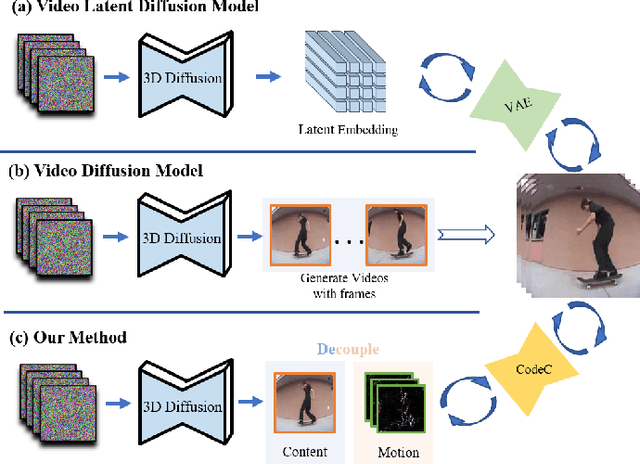
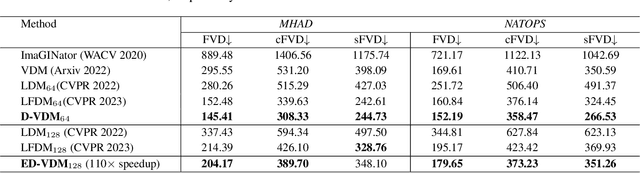
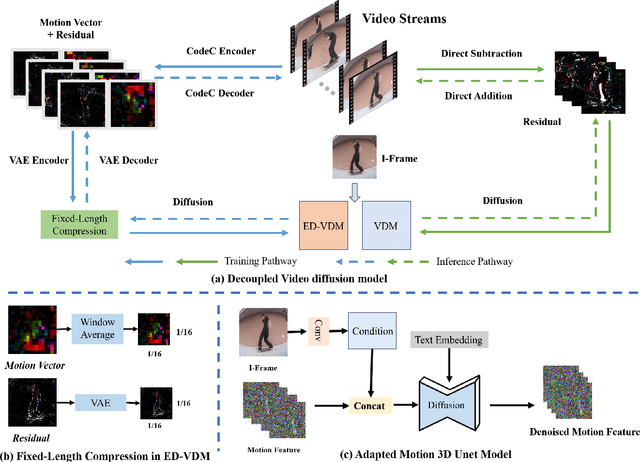

The goal of conditional image-to-video (cI2V) generation is to create a believable new video by beginning with the condition, i.e., one image and text.The previous cI2V generation methods conventionally perform in RGB pixel space, with limitations in modeling motion consistency and visual continuity. Additionally, the efficiency of generating videos in pixel space is quite low.In this paper, we propose a novel approach to address these challenges by disentangling the target RGB pixels into two distinct components: spatial content and temporal motions. Specifically, we predict temporal motions which include motion vector and residual based on a 3D-UNet diffusion model. By explicitly modeling temporal motions and warping them to the starting image, we improve the temporal consistency of generated videos. This results in a reduction of spatial redundancy, emphasizing temporal details. Our proposed method achieves performance improvements by disentangling content and motion, all without introducing new structural complexities to the model. Extensive experiments on various datasets confirm our approach's superior performance over the majority of state-of-the-art methods in both effectiveness and efficiency.
Injecting Image Details into CLIP's Feature Space
Aug 31, 2022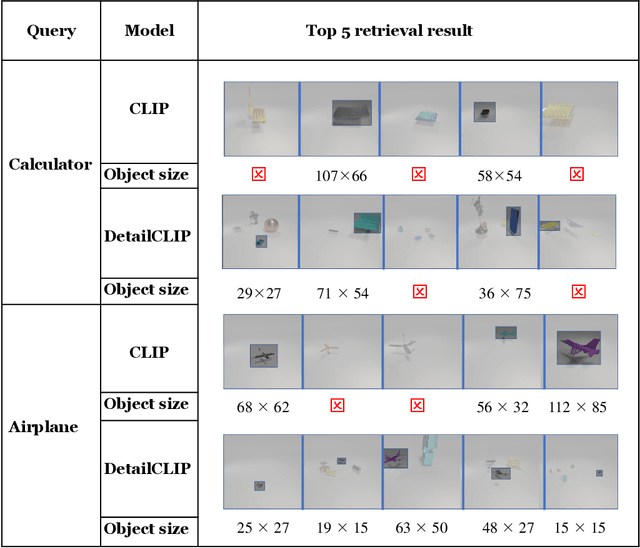
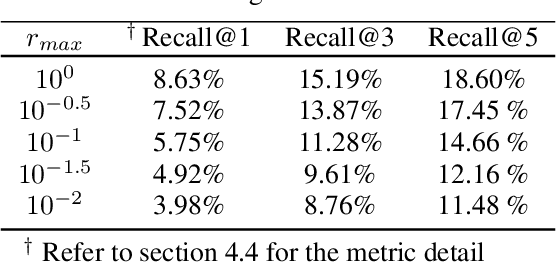
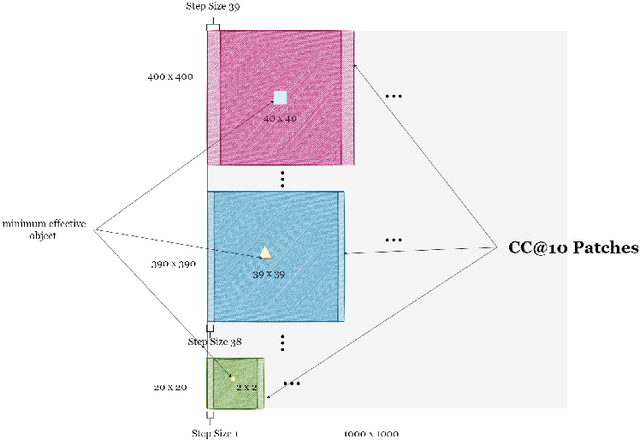
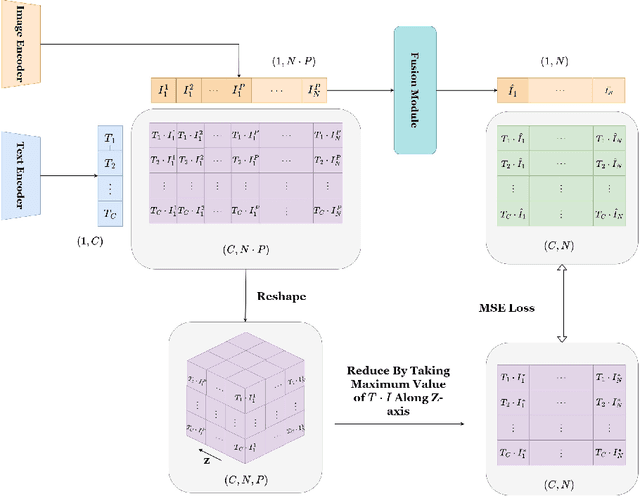
Although CLIP-like Visual Language Models provide a functional joint feature space for image and text, due to the limitation of the CILP-like model's image input size (e.g., 224), subtle details are lost in the feature representation if we input high-resolution images (e.g., 2240). In this work, we introduce an efficient framework that can produce a single feature representation for a high-resolution image that injects image details and shares the same semantic space as the original CLIP. In the framework, we train a feature fusing model based on CLIP features extracted from a carefully designed image patch method that can cover objects of any scale, weakly supervised by image-agnostic class prompted queries. We validate our framework by retrieving images from class prompted queries on the real world and synthetic datasets, showing significant performance improvement on these tasks. Furthermore, to fully demonstrate our framework's detail retrieval ability, we construct a CLEVR-like synthetic dataset called CLVER-DS, which is fully annotated and has a controllable object scale.