 Add to Chrome
 Add to Firefox
 Add to Edge
LipCache: A Local Inference Proxy with Certified Caching for Edge Image Classification Service
Aug 13, 2026
As edge-side vision services continue to expand toward low-latency, high-throughput scenarios, reducing the inference cost of vision models without sacrificing reliability has become a central concern. Existing semantic caching methods largely rely on empirical similarity thresholds; while such thresholds improve hit rates, they tend to introduce silent misclassifications near decision boundaries. To address this, we propose \texttt{LipCache}, a certified semantic caching framework for image classification. Without modifying the existing deployed main model, \texttt{MainNet}, the framework introduces a lightweight network, \texttt{GuardNet}, that maps inputs into a low-dimensional feature space subject to a Lipschitz constraint. It then computes a per-sample certified reuse radius from the local classification margin and the spectral norm of the classification head. At runtime, a cached result is reused only when the query feature falls inside the certified reuse ball; otherwise, the query falls back to \texttt{MainNet}. Thus, cache hits are transformed from empirical threshold tests into geometric certification decisions with explicit theoretical boundaries. Across standard image classification tasks like CIFAR, Tiny-ImageNet, and SVHN, \texttt{LipCache} achieves a measured speedup of up to $1.65\times$ with limited end-to-end accuracy degradation, while all accepted cache hits satisfy the \texttt{GuardNet}-side certified-consistency condition. Furthermore, an enhanced \texttt{GuardNet} training recipe substantially improves cache hit rates in the Tiny-ImageNet multi-class extension while maintaining a certified-consistency rate of $100\%$. These results demonstrate that per-sample certified reuse can reduce main-model fallback while preserving theoretical consistency, providing a feasible approach to reliable cache-assisted inference at the edge.

Towards Optimal Robustness in Learning-Augmented Paging
May 31, 2026Learning-augmented paging has been extensively studied in recent years. A key advantage over naive ML-based approaches is \emph{bounded robustness}, which guarantees worst-case performance even when predictions are inaccurate, making these algorithms valuable for real-world systems. Prior work achieves robustness bounds of $2H_k + O(1)$ in the randomized setting, leaving a gap to the optimal competitive ratio $H_k$. In this paper, we study how to close this gap. We begin by reviewing online optimality and proving a new property of the latest $H_k$-competitive algorithm, which facilitates our analysis in the learning-augmented setting. Then, we review existing learning-augmented paging algorithms and introduce a unifying primitive, the \emph{relative prediction budget}, which captures the essence of establishing robustness and reveals that prior algorithms either overuse or underutilize predictions. Guided by the above analysis, we develop a new framework that achieves the best-possible robustness up to an additive constant for learning-augmented paging: $H_k + O(1)$. Experiments further demonstrate strong practical performance.
When Does Hierarchy Help? Benchmarking Agent Coordination in Event-Driven Industrial Scheduling
May 13, 2026Recent advances in agent and multi-agent systems have shown strong performance on tool use, reasoning, and collaborative tasks. However, existing benchmarks mostly evaluate task completion in weakly coupled environments, and provide limited support for studying coordination in shared, dynamically evolving systems with hierarchy and coupled constraints. This leaves an important question underexplored: when do different coordination paradigms succeed or fail? We introduce Distributed Event-driven Scheduling Benchmark (DESBench), a benchmark for evaluating agent coordination in hierarchical event-driven scheduling. Built on a shared discrete-event driven environment in industrial scheduling, our benchmark captures multi-timescale decision making, partial observability, and dynamically coupled constraints. We define tasks and metrics that evaluate effectiveness, constraint alignment, coordination efficiency, and robustness, and focus on four representative coordination paradigms: centralized, hierarchical, heterarchical, and holonic. These paradigms correspond to distinct mechanisms of information flow, decision authority, and conflict resolution. Our controlled evaluations reveal clear coordination trade-offs: centralized coordination is robust and communication-efficient but scales poorly with difficulty; hierarchical coordination improves efficiency through decomposition but suffers from cross-level misalignment; heterarchical coordination is flexible but communication-heavy; and holonic coordination satisfies constraints well but loses global robustness. These findings demonstrate that coordination design fundamentally shapes agent system behavior in complex environments, revealing structural trade-offs that cannot be captured by outcome metrics alone and underscoring the imperative for more adaptive, principled, and dynamic coordination mechanisms in future MAS research.
Frequency Matching in Spiking Neural Networks for mmWave Sensing
May 11, 2026Millimeter-wave (mmWave) sensing enables privacy-preserving, always-on edge perception, but its measurements are often sparse, temporally irregular, and corrupted by high-frequency noise. Existing mmWave pipelines predominantly rely on artificial neural networks (ANNs), which achieve robustness through extensive preprocessing or deep architectures, thereby limiting their efficiency on edge devices. In this work, we study spiking neural networks (SNNs) for mmWave sensing from a mechanism-data alignment perspective. By leveraging the low-pass filtering behavior of leaky integrate-and-fire (LIF) dynamics, we analyze how their implicit temporal filtering interacts with the frequency structure of mmWave signals. Our analysis shows that when discriminative information resides in low-to-mid frequencies, LIF dynamics can inherently suppress high-frequency noise, clarifying when and why SNNs outperform ANNs. Based on this insight, we derive a principled criterion for configuring the membrane decay factor by matching the effective bandwidth of LIF dynamics to the data's discriminative spectral content. Experimental results across four widely used mmWave datasets validate the proposed frequency-matching hypothesis, yielding an average test-accuracy improvement of 6.22% and a 3.64$\times$ reduction in theoretical energy consumption relative to ANN baselines, under a unified evaluation protocol.
Missing-Aware Multimodal Fusion for Unified Microservice Incident Management
Mar 27, 2026Automated incident management is critical for microservice reliability. While recent unified frameworks leverage multimodal data for joint optimization, they unrealistically assume perfect data completeness. In practice, network fluctuations and agent failures frequently cause missing modalities. Existing approaches relying on static placeholders introduce imputation noise that masks anomalies and degrades performance. To address this, we propose ARMOR, a robust self-supervised framework designed for missing modality scenarios. ARMOR features: (i) a modality-specific asymmetric encoder that isolates distribution disparities among metrics, logs, and traces; and (ii) a missing-aware gated fusion mechanism utilizing learnable placeholders and dynamic bias compensation to prevent cross-modal interference from incomplete inputs. By employing self-supervised auto-regression with mask-guided reconstruction, ARMOR jointly optimizes anomaly detection (AD), failure triage (FT), and root cause localization (RCL). AD and RCL require no fault labels, while FT relies solely on failure-type annotations for the downstream classifier. Extensive experiments demonstrate that ARMOR achieves state-of-the-art performance under complete data conditions and maintains robust diagnostic accuracy even with severe modality loss.
Shiva-DiT: Residual-Based Differentiable Top-$k$ Selection for Efficient Diffusion Transformers
Feb 05, 2026Diffusion Transformers (DiTs) incur prohibitive computational costs due to the quadratic scaling of self-attention. Existing pruning methods fail to simultaneously satisfy differentiability, efficiency, and the strict static budgets required for hardware overhead. To address this, we propose Shiva-DiT, which effectively reconciles these conflicting requirements via Residual-Based Differentiable Top-$k$ Selection. By leveraging a residual-aware straight-through estimator, our method enforces deterministic token counts for static compilation while preserving end-to-end learnability through residual gradient estimation. Furthermore, we introduce a Context-Aware Router and Adaptive Ratio Policy to autonomously learn an adaptive pruning schedule. Experiments on mainstream models, including SD3.5, demonstrate that Shiva-DiT establishes a new Pareto frontier, achieving a 1.54$\times$ wall-clock speedup with superior fidelity compared to existing baselines, effectively eliminating ragged tensor overheads.
Adaptive Dual-Weighting Framework for Federated Learning via Out-of-Distribution Detection
Feb 01, 2026Federated Learning (FL) enables collaborative model training across large-scale distributed service nodes while preserving data privacy, making it a cornerstone of intelligent service systems in edge-cloud environments. However, in real-world service-oriented deployments, data generated by heterogeneous users, devices, and application scenarios are inherently non-IID. This severe data heterogeneity critically undermines the convergence stability, generalization ability, and ultimately the quality of service delivered by the global model. To address this challenge, we propose FLood, a novel FL framework inspired by out-of-distribution (OOD) detection. FLood dynamically counteracts the adverse effects of heterogeneity through a dual-weighting mechanism that jointly governs local training and global aggregation. At the client level, it adaptively reweights the supervised loss by upweighting pseudo-OOD samples, thereby encouraging more robust learning from distributionally misaligned or challenging data. At the server level, it refines model aggregation by weighting client contributions according to their OOD confidence scores, prioritizing updates from clients with higher in-distribution consistency and enhancing the global model's robustness and convergence stability. Extensive experiments across multiple benchmarks under diverse non-IID settings demonstrate that FLood consistently outperforms state-of-the-art FL methods in both accuracy and generalization. Furthermore, FLood functions as an orthogonal plug-in module: it seamlessly integrates with existing FL algorithms to boost their performance under heterogeneity without modifying their core optimization logic. These properties make FLood a practical and scalable solution for deploying reliable intelligent services in real-world federated environments.
TrackTeller: Temporal Multimodal 3D Grounding for Behavior-Dependent Object References
Dec 25, 2025Understanding natural-language references to objects in dynamic 3D driving scenes is essential for interactive autonomous systems. In practice, many referring expressions describe targets through recent motion or short-term interactions, which cannot be resolved from static appearance or geometry alone. We study temporal language-based 3D grounding, where the objective is to identify the referred object in the current frame by leveraging multi-frame observations. We propose TrackTeller, a temporal multimodal grounding framework that integrates LiDAR-image fusion, language-conditioned decoding, and temporal reasoning in a unified architecture. TrackTeller constructs a shared UniScene representation aligned with textual semantics, generates language-aware 3D proposals, and refines grounding decisions using motion history and short-term dynamics. Experiments on the NuPrompt benchmark demonstrate that TrackTeller consistently improves language-grounded tracking performance, outperforming strong baselines with a 70% relative improvement in Average Multi-Object Tracking Accuracy and a 3.15-3.4 times reduction in False Alarm Frequency.
SeMi: When Imbalanced Semi-Supervised Learning Meets Mining Hard Examples
Jan 10, 2025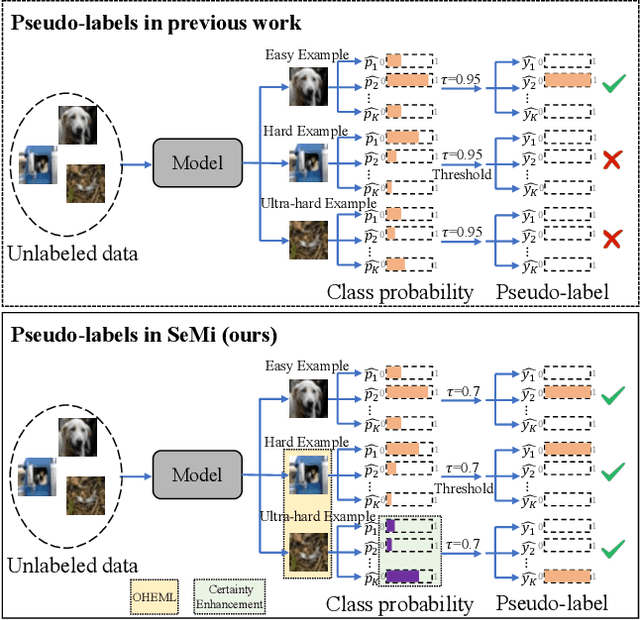
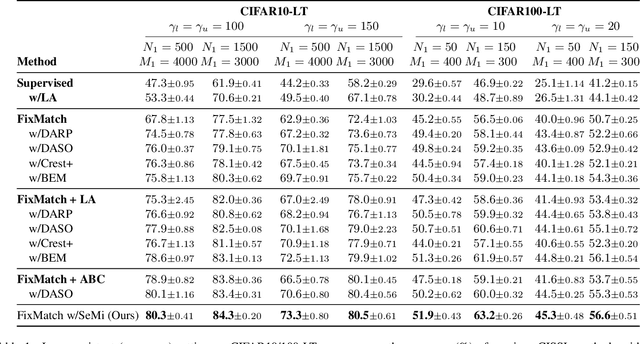
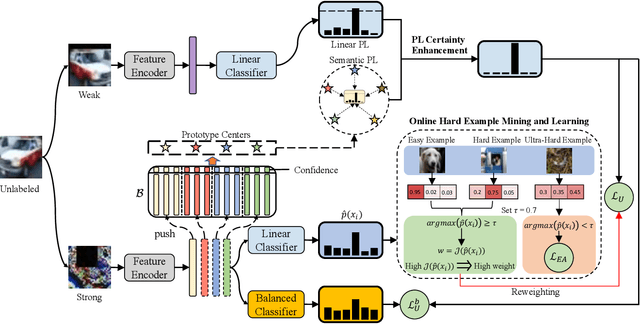
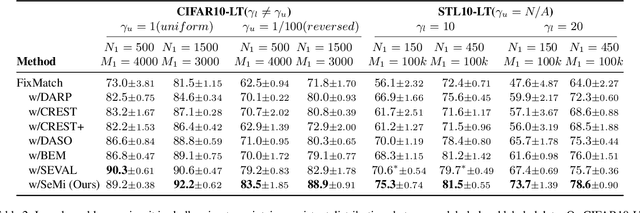
Semi-Supervised Learning (SSL) can leverage abundant unlabeled data to boost model performance. However, the class-imbalanced data distribution in real-world scenarios poses great challenges to SSL, resulting in performance degradation. Existing class-imbalanced semi-supervised learning (CISSL) methods mainly focus on rebalancing datasets but ignore the potential of using hard examples to enhance performance, making it difficult to fully harness the power of unlabeled data even with sophisticated algorithms. To address this issue, we propose a method that enhances the performance of Imbalanced Semi-Supervised Learning by Mining Hard Examples (SeMi). This method distinguishes the entropy differences among logits of hard and easy examples, thereby identifying hard examples and increasing the utility of unlabeled data, better addressing the imbalance problem in CISSL. In addition, we maintain a class-balanced memory bank with confidence decay for storing high-confidence embeddings to enhance the pseudo-labels' reliability. Although our method is simple, it is effective and seamlessly integrates with existing approaches. We perform comprehensive experiments on standard CISSL benchmarks and experimentally demonstrate that our proposed SeMi outperforms existing state-of-the-art methods on multiple benchmarks, especially in reversed scenarios, where our best result shows approximately a 54.8\% improvement over the baseline methods.
Learning-Augmented Algorithms for the Bahncard Problem
Oct 20, 2024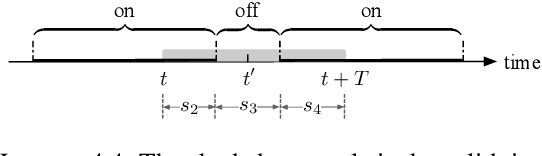


In this paper, we study learning-augmented algorithms for the Bahncard problem. The Bahncard problem is a generalization of the ski-rental problem, where a traveler needs to irrevocably and repeatedly decide between a cheap short-term solution and an expensive long-term one with an unknown future. Even though the problem is canonical, only a primal-dual-based learning-augmented algorithm was explicitly designed for it. We develop a new learning-augmented algorithm, named PFSUM, that incorporates both history and short-term future to improve online decision making. We derive the competitive ratio of PFSUM as a function of the prediction error and conduct extensive experiments to show that PFSUM outperforms the primal-dual-based algorithm.