 Add to Chrome
 Add to Firefox
 Add to Edge
Rethinking Cross-Layer Information Routing in Diffusion Transformers
May 20, 2026
Diffusion Transformers (DiTs) have become a de facto backbone of modern visual generation, and nearly every major axis of their design -- tokenization, attention, conditioning, objectives, and latent autoencoders -- has been extensively revisited. The residual stream that governs how information accumulates across layers, however, has been directly inherited from the original Transformer. In this paper, we present a systematic empirical analysis of cross-layer information flow in DiTs, jointly along depth and denoising timestep, and identify three concrete symptoms of traditional residual addition, namely monotonic forward magnitude inflation, sharp backward gradient decay, and pronounced block-wise redundancy. Motivated by this diagnosis, we propose Diffusion-Adaptive Routing (\textsc{DAR}), a drop-in residual replacement that performs \emph{learnable, timestep-adaptive, and non-incremental} aggregation over the history of sublayer outputs. Moreover, the proposed \textsc{DAR} is compatible with many modern Transformer enhancement methods, such as REPA. On ImageNet $256\times256$, \textsc{DAR} improves SiT-XL/2 by $2.11$ FID ($7.56$ vs.\ $9.67$) and matches the baseline's converged quality with $8.75\times$ fewer training iterations. Stacked on top of REPA, it yields a $2\times$ training acceleration in the early stage, suggesting cross-layer information routing as an underexplored design axis in diffusion modeling, one that operates orthogonally to existing representation-alignment objectives. Beyond pretraining, \textsc{DAR} can also be applied during the fine-tuning stage of large-scale T2I models and preserves high-frequency details during Distribution Matching Distillation.

Training-free Conversion of Pretrained ANNs to SNNs for Low-Power and High-Performance Applications
Sep 05, 2024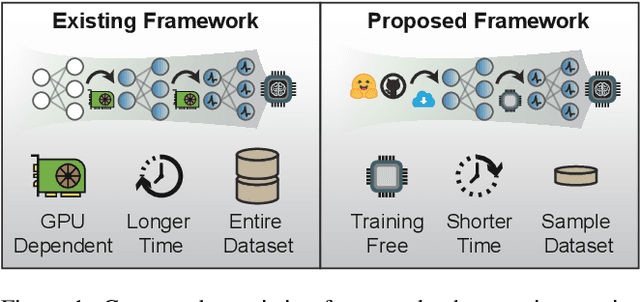
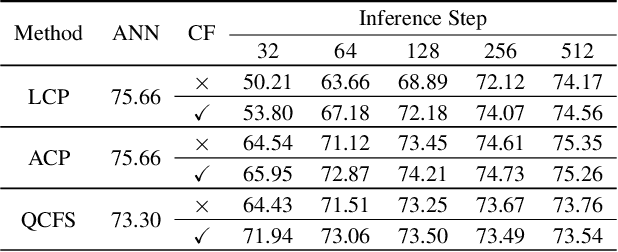
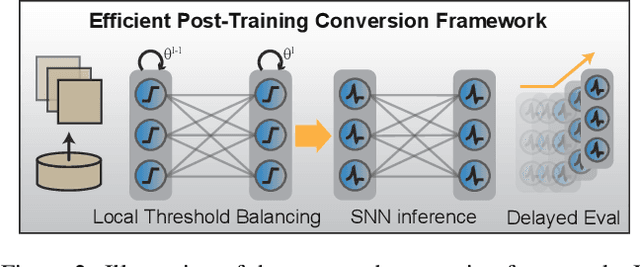
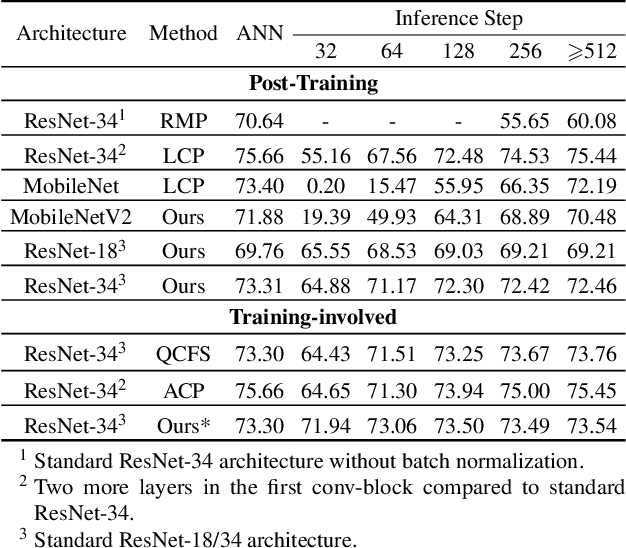
Spiking Neural Networks (SNNs) have emerged as a promising substitute for Artificial Neural Networks (ANNs) due to their advantages of fast inference and low power consumption. However, the lack of efficient training algorithms has hindered their widespread adoption. Existing supervised learning algorithms for SNNs require significantly more memory and time than their ANN counterparts. Even commonly used ANN-SNN conversion methods necessitate re-training of ANNs to enhance conversion efficiency, incurring additional computational costs. To address these challenges, we propose a novel training-free ANN-SNN conversion pipeline. Our approach directly converts pre-trained ANN models into high-performance SNNs without additional training. The conversion pipeline includes a local-learning-based threshold balancing algorithm, which enables efficient calculation of the optimal thresholds and fine-grained adjustment of threshold value by channel-wise scaling. We demonstrate the scalability of our framework across three typical computer vision tasks: image classification, semantic segmentation, and object detection. This showcases its applicability to both classification and regression tasks. Moreover, we have evaluated the energy consumption of the converted SNNs, demonstrating their superior low-power advantage compared to conventional ANNs. Our training-free algorithm outperforms existing methods, highlighting its practical applicability and efficiency. This approach simplifies the deployment of SNNs by leveraging open-source pre-trained ANN models and neuromorphic hardware, enabling fast, low-power inference with negligible performance reduction.