 Add to Chrome
 Add to Firefox
 Add to Edge
RT-Lynx: Putting the GEMM Sparsity In a Right Way for Diffusion Models
May 26, 2026
Diffusion Transformers (DiT) achieve strong performance in image generation but incur substantial inference costs. While prior work has reduced this cost via quantization and distillation, semi-structured sparsity, which can nearly halve FLOPs, remains underexplored. A key reason is that most existing approaches focus on weight sparsification, and pruning 50% of the weights can remove critical model capacity and degrade generation quality. Our study, however, shows that DiT activations are intrinsically sparse and significantly more robust to N:M semi-structured sparsification than weights. Motivated by this observation, we advocate a paradigm shift from weight sparsification to activation sparsification. We propose RT-Lynx, which applies N:M sparsification to activations and incorporates error-compensation techniques to mitigate accuracy loss. We further implement highly optimized CUDA kernels tailored to this setting, achieving up to a 1.55x speedup on average in linear layers. Extensive experiments across multiple diffusion models demonstrate that our method preserves the generation quality of the original models while substantially accelerating inference.

Rethinking Cross-Layer Information Routing in Diffusion Transformers
May 20, 2026Diffusion Transformers (DiTs) have become a de facto backbone of modern visual generation, and nearly every major axis of their design -- tokenization, attention, conditioning, objectives, and latent autoencoders -- has been extensively revisited. The residual stream that governs how information accumulates across layers, however, has been directly inherited from the original Transformer. In this paper, we present a systematic empirical analysis of cross-layer information flow in DiTs, jointly along depth and denoising timestep, and identify three concrete symptoms of traditional residual addition, namely monotonic forward magnitude inflation, sharp backward gradient decay, and pronounced block-wise redundancy. Motivated by this diagnosis, we propose Diffusion-Adaptive Routing (\textsc{DAR}), a drop-in residual replacement that performs \emph{learnable, timestep-adaptive, and non-incremental} aggregation over the history of sublayer outputs. Moreover, the proposed \textsc{DAR} is compatible with many modern Transformer enhancement methods, such as REPA. On ImageNet $256\times256$, \textsc{DAR} improves SiT-XL/2 by $2.11$ FID ($7.56$ vs.\ $9.67$) and matches the baseline's converged quality with $8.75\times$ fewer training iterations. Stacked on top of REPA, it yields a $2\times$ training acceleration in the early stage, suggesting cross-layer information routing as an underexplored design axis in diffusion modeling, one that operates orthogonally to existing representation-alignment objectives. Beyond pretraining, \textsc{DAR} can also be applied during the fine-tuning stage of large-scale T2I models and preserves high-frequency details during Distribution Matching Distillation.
Linear-DPO: Linear Direct Preference Optimization for Diffusion and Flow-Matching Generative Models
May 20, 2026Direct Preference Optimization (DPO) is successful for alignment in LLMs but still faces challenges in text-to-image generation. Existing studies are confined to denoising diffusion models while overlooking flow-matching, and suffer from an objective mismatch when applying discrete NLP-based DPO to regression-based generative tasks.\ In this paper, we derive a generalized DPO objective that covers both diffusion and flow-matching via a unified reverse-time SDE framework, and point out from a gradient perspective that the standard DPO objective is suboptimal for text-to-image generation. Consequently, we propose Linear-DPO, which replaces the aggressive sigmoid-based utility function with a sustained linear utility and incorporates an EMA-updated reference model. Qualitative and quantitative experiments on diffusion models (SD1.5, SDXL) and flow-matching model (SD3-Medium) demonstrate the superiority of our approach over existing baselines.
LegoDiffusion: Micro-Serving Text-to-Image Diffusion Workflows
Apr 09, 2026Text-to-image generation executes a diffusion workflow comprising multiple models centered on a base diffusion model. Existing serving systems treat each workflow as an opaque monolith, provisioning, placing, and scaling all constituent models together, which obscures internal dataflow, prevents model sharing, and enforces coarse-grained resource management. In this paper, we make a case for micro-serving diffusion workflows with LegoDiffusion, a system that decomposes a workflow into loosely coupled model-execution nodes that can be independently managed and scheduled. By explicitly managing individual model inference, LegoDiffusion unlocks cluster-scale optimizations, including per-model scaling, model sharing, and adaptive model parallelism. Collectively, LegoDiffusion outperforms existing diffusion workflow serving systems, sustaining up to 3x higher request rates and tolerating up to 8x higher burst traffic.
Shiva-DiT: Residual-Based Differentiable Top-$k$ Selection for Efficient Diffusion Transformers
Feb 05, 2026Diffusion Transformers (DiTs) incur prohibitive computational costs due to the quadratic scaling of self-attention. Existing pruning methods fail to simultaneously satisfy differentiability, efficiency, and the strict static budgets required for hardware overhead. To address this, we propose Shiva-DiT, which effectively reconciles these conflicting requirements via Residual-Based Differentiable Top-$k$ Selection. By leveraging a residual-aware straight-through estimator, our method enforces deterministic token counts for static compilation while preserving end-to-end learnability through residual gradient estimation. Furthermore, we introduce a Context-Aware Router and Adaptive Ratio Policy to autonomously learn an adaptive pruning schedule. Experiments on mainstream models, including SD3.5, demonstrate that Shiva-DiT establishes a new Pareto frontier, achieving a 1.54$\times$ wall-clock speedup with superior fidelity compared to existing baselines, effectively eliminating ragged tensor overheads.
RecGPT Technical Report
Jul 30, 2025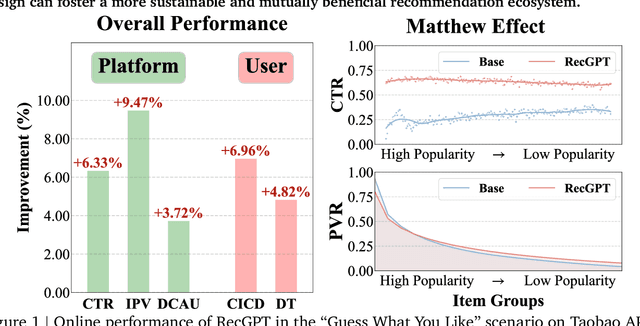
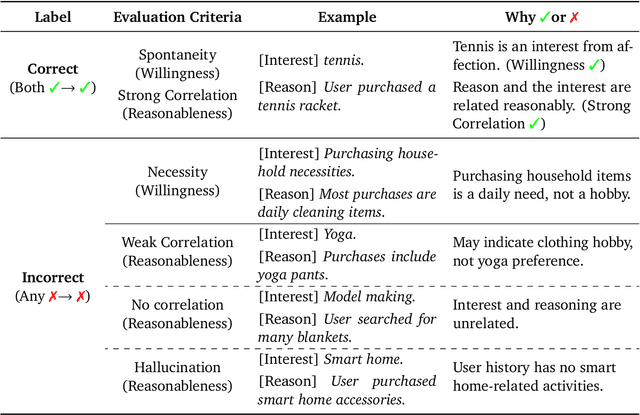
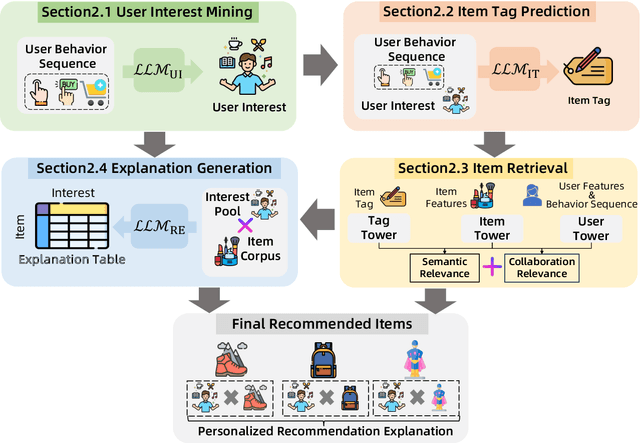

Recommender systems are among the most impactful applications of artificial intelligence, serving as critical infrastructure connecting users, merchants, and platforms. However, most current industrial systems remain heavily reliant on historical co-occurrence patterns and log-fitting objectives, i.e., optimizing for past user interactions without explicitly modeling user intent. This log-fitting approach often leads to overfitting to narrow historical preferences, failing to capture users' evolving and latent interests. As a result, it reinforces filter bubbles and long-tail phenomena, ultimately harming user experience and threatening the sustainability of the whole recommendation ecosystem. To address these challenges, we rethink the overall design paradigm of recommender systems and propose RecGPT, a next-generation framework that places user intent at the center of the recommendation pipeline. By integrating large language models (LLMs) into key stages of user interest mining, item retrieval, and explanation generation, RecGPT transforms log-fitting recommendation into an intent-centric process. To effectively align general-purpose LLMs to the above domain-specific recommendation tasks at scale, RecGPT incorporates a multi-stage training paradigm, which integrates reasoning-enhanced pre-alignment and self-training evolution, guided by a Human-LLM cooperative judge system. Currently, RecGPT has been fully deployed on the Taobao App. Online experiments demonstrate that RecGPT achieves consistent performance gains across stakeholders: users benefit from increased content diversity and satisfaction, merchants and the platform gain greater exposure and conversions. These comprehensive improvement results across all stakeholders validates that LLM-driven, intent-centric design can foster a more sustainable and mutually beneficial recommendation ecosystem.
InstGenIE: Generative Image Editing Made Efficient with Mask-aware Caching and Scheduling
May 27, 2025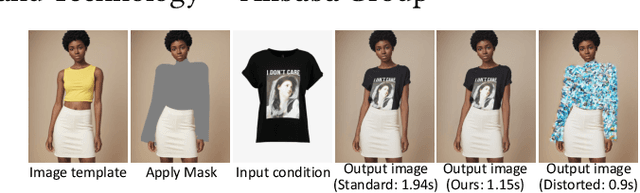


Generative image editing using diffusion models has become a prevalent application in today's AI cloud services. In production environments, image editing typically involves a mask that specifies the regions of an image template to be edited. The use of masks provides direct control over the editing process and introduces sparsity in the model inference. In this paper, we present InstGenIE, a system that efficiently serves image editing requests. The key insight behind InstGenIE is that image editing only modifies the masked regions of image templates while preserving the original content in the unmasked areas. Driven by this insight, InstGenIE judiciously skips redundant computations associated with the unmasked areas by reusing cached intermediate activations from previous inferences. To mitigate the high cache loading overhead, InstGenIE employs a bubble-free pipeline scheme that overlaps computation with cache loading. Additionally, to reduce queuing latency in online serving while improving the GPU utilization, InstGenIE proposes a novel continuous batching strategy for diffusion model serving, allowing newly arrived requests to join the running batch in just one step of denoising computation, without waiting for the entire batch to complete. As heterogeneous masks induce imbalanced loads, InstGenIE also develops a load balancing strategy that takes into account the loads of both computation and cache loading. Collectively, InstGenIE outperforms state-of-the-art diffusion serving systems for image editing, achieving up to 3x higher throughput and reducing average request latency by up to 14.7x while ensuring image quality.
DASH: Input-Aware Dynamic Layer Skipping for Efficient LLM Inference with Markov Decision Policies
May 23, 2025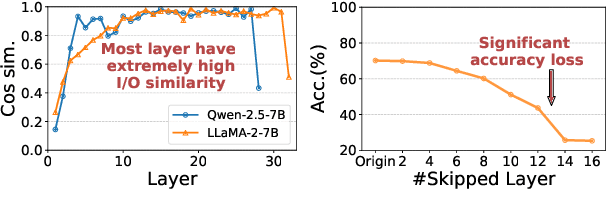
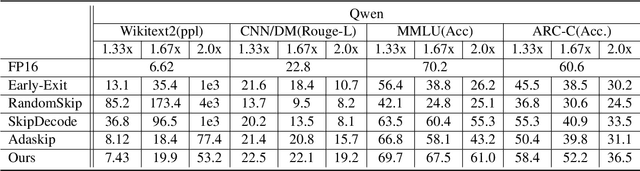
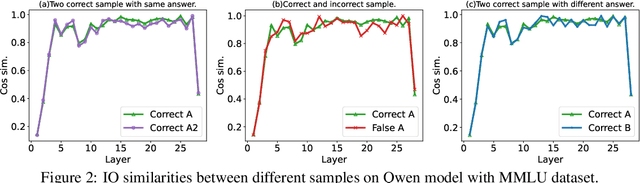
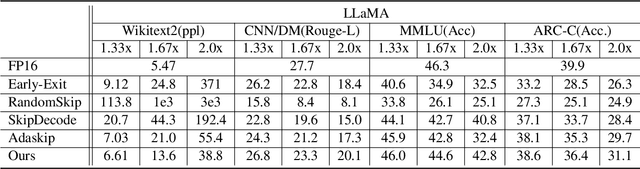
Large language models (LLMs) have achieved remarkable performance across a wide range of NLP tasks. However, their substantial inference cost poses a major barrier to real-world deployment, especially in latency-sensitive scenarios. To address this challenge, we propose \textbf{DASH}, an adaptive layer-skipping framework that dynamically selects computation paths conditioned on input characteristics. We model the skipping process as a Markov Decision Process (MDP), enabling fine-grained token-level decisions based on intermediate representations. To mitigate potential performance degradation caused by skipping, we introduce a lightweight compensation mechanism that injects differential rewards into the decision process. Furthermore, we design an asynchronous execution strategy that overlaps layer computation with policy evaluation to minimize runtime overhead. Experiments on multiple LLM architectures and NLP benchmarks show that our method achieves significant inference acceleration while maintaining competitive task performance, outperforming existing methods.
Denoising Diffusions in Latent Space for Medical Image Segmentation
Jul 17, 2024Diffusion models (DPMs) have demonstrated remarkable performance in image generation, often times outperforming other generative models. Since their introduction, the powerful noise-to-image denoising pipeline has been extended to various discriminative tasks, including image segmentation. In case of medical imaging, often times the images are large 3D scans, where segmenting one image using DPMs become extremely inefficient due to large memory consumption and time consuming iterative sampling process. In this work, we propose a novel conditional generative modeling framework (LDSeg) that performs diffusion in latent space for medical image segmentation. Our proposed framework leverages the learned inherent low-dimensional latent distribution of the target object shapes and source image embeddings. The conditional diffusion in latent space not only ensures accurate n-D image segmentation for multi-label objects, but also mitigates the major underlying problems of the traditional DPM based segmentation: (1) large memory consumption, (2) time consuming sampling process and (3) unnatural noise injection in forward/reverse process. LDSeg achieved state-of-the-art segmentation accuracy on three medical image datasets with different imaging modalities. Furthermore, we show that our proposed model is significantly more robust to noises, compared to the traditional deterministic segmentation models, which can be potential in solving the domain shift problems in the medical imaging domain. Codes are available at: https://github.com/LDSeg/LDSeg.
SwiftDiffusion: Efficient Diffusion Model Serving with Add-on Modules
Jul 02, 2024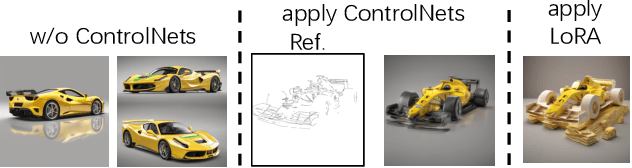
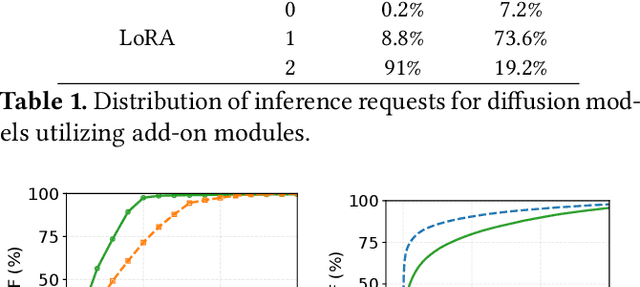
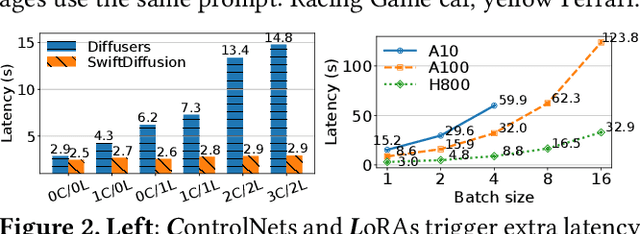

This paper documents our characterization study and practices for serving text-to-image requests with stable diffusion models in production. We first comprehensively analyze inference request traces for commercial text-to-image applications. It commences with our observation that add-on modules, i.e., ControlNets and LoRAs, that augment the base stable diffusion models, are ubiquitous in generating images for commercial applications. Despite their efficacy, these add-on modules incur high loading overhead, prolong the serving latency, and swallow up expensive GPU resources. Driven by our characterization study, we present SwiftDiffusion, a system that efficiently generates high-quality images using stable diffusion models and add-on modules. To achieve this, SwiftDiffusion reconstructs the existing text-to-image serving workflow by identifying the opportunities for parallel computation and distributing ControlNet computations across multiple GPUs. Further, SwiftDiffusion thoroughly analyzes the dynamics of image generation and develops techniques to eliminate the overhead associated with LoRA loading and patching while preserving the image quality. Last, SwiftDiffusion proposes specialized optimizations in the backbone architecture of the stable diffusion models, which are also compatible with the efficient serving of add-on modules. Compared to state-of-the-art text-to-image serving systems, SwiftDiffusion reduces serving latency by up to 5x and improves serving throughput by up to 2x without compromising image quality.