 Add to Chrome
 Add to Firefox
 Add to Edge
ServerlessT2I: Efficient Text-to-Image Workflow Serving on a Serverless Platform
Jul 29, 2026
Text-to-image (T2I) workflows are increasingly deployed on serverless platforms because users often compose customized workflows and invoke them intermittently. Existing platforms typically deploy each workflow as an opaque GPU function, provisioning, placing, and scaling all constituent models in the workflow together. This monolithic design obscures workflow structure, inflates scaling overhead, forces users to manage low-level GPU coordination, and limits fine-grained fairness in multi-tenant clusters. In this paper, we present ServerlessT2I, a serverless-native system that decomposes a T2I workflow into loosely coupled model functions that can be independently managed and scheduled. By explicitly managing individual model execution, ServerlessT2I enables per-model scaling, declarative workflow composition, transparent GPU-resident communication, and fairness-aware scheduling. To make this decomposition efficient, ServerlessT2I harvests slack GPU memory left idle by compute-bound T2I inference to build a data plane that reduces model loading and data communication overheads. \sys{} further introduces a fair scheduler for multi-tenant serving. Using production traces, ServerlessT2I sustains up to 2$\times$ higher request rates than existing T2I workflow serving systems with the same GPU budget; for a fixed request rate, it saves up to 3$\times$ GPU resources while satisfying service level objectives (SLOs).

Are LLM-Generated GPU Kernels Production-Ready? A Trace-Driven Benchmark and Optimization Agent
Jul 16, 2026Existing GPU kernel generation benchmarks draw problems from synthetic or curated sources that diverge from deployed workloads. We present Atrex-Bench, a benchmark whose 30 operators and 440 shapes are sampled directly from full-cluster production inference traces of compute-limited, memory-rich GPUs. Each problem carries an importance weight derived from its share of observed GPU time, weighted by application card-hours and computed separately for the serving phases in which it runs, together with a per-problem roofline ceiling, so the aggregate score emphasizes the kernels that consume the most serving time. Evaluating six frontier coding agents on Atrex-Bench shows that even the best vanilla model reaches only ${\sim}10\%$ of the hardware roofline on production operators; and correctness alone overstates capability, since much of the apparent pass rate comes from PyTorch fallbacks rather than kernels the model wrote. To close this gap, we co-release Atrex-Kernel-Agent (AKA), a profile-driven kernel-optimization agent that combines iterative measure-revise search, optimization dropout for escaping stalled search contexts, and a layered GPU-optimization knowledge base (298 reference-kernel files and 244 optimization-knowledge documents, plus external upstream reference projects for API/ISA lookup). In a controlled case study, the agent converts zero-FlyDSL fallbacks into real kernels that match or exceed hand-tuned production baselines.
LegoDiffusion: Micro-Serving Text-to-Image Diffusion Workflows
Apr 09, 2026Text-to-image generation executes a diffusion workflow comprising multiple models centered on a base diffusion model. Existing serving systems treat each workflow as an opaque monolith, provisioning, placing, and scaling all constituent models together, which obscures internal dataflow, prevents model sharing, and enforces coarse-grained resource management. In this paper, we make a case for micro-serving diffusion workflows with LegoDiffusion, a system that decomposes a workflow into loosely coupled model-execution nodes that can be independently managed and scheduled. By explicitly managing individual model inference, LegoDiffusion unlocks cluster-scale optimizations, including per-model scaling, model sharing, and adaptive model parallelism. Collectively, LegoDiffusion outperforms existing diffusion workflow serving systems, sustaining up to 3x higher request rates and tolerating up to 8x higher burst traffic.
BuddyMoE: Exploiting Expert Redundancy to Accelerate Memory-Constrained Mixture-of-Experts Inference
Nov 13, 2025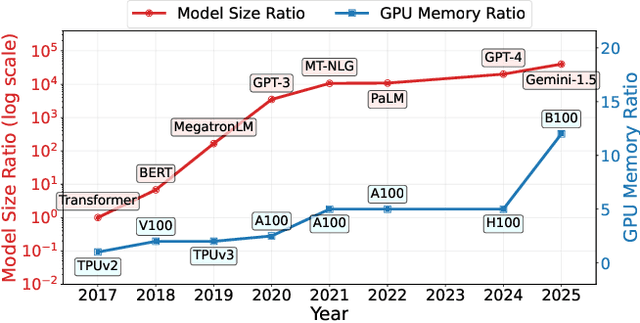
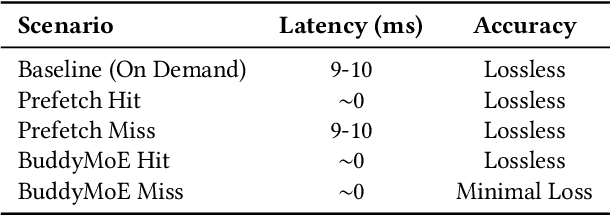
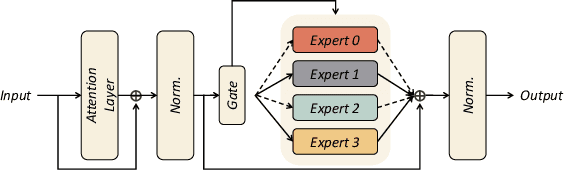
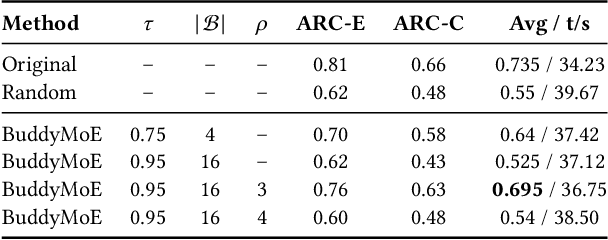
Mixture-of-Experts (MoE) architectures scale language models by activating only a subset of specialized expert networks for each input token, thereby reducing the number of floating-point operations. However, the growing size of modern MoE models causes their full parameter sets to exceed GPU memory capacity; for example, Mixtral-8x7B has 45 billion parameters and requires 87 GB of memory even though only 14 billion parameters are used per token. Existing systems alleviate this limitation by offloading inactive experts to CPU memory, but transferring experts across the PCIe interconnect incurs significant latency (about 10 ms). Prefetching heuristics aim to hide this latency by predicting which experts are needed, but prefetch failures introduce significant stalls and amplify inference latency. In the event of a prefetch failure, prior work offers two primary solutions: either fetch the expert on demand, which incurs a long stall due to the PCIe bottleneck, or drop the expert from the computation, which significantly degrades model accuracy. The critical challenge, therefore, is to maintain both high inference speed and model accuracy when prefetching fails.
InstGenIE: Generative Image Editing Made Efficient with Mask-aware Caching and Scheduling
May 27, 2025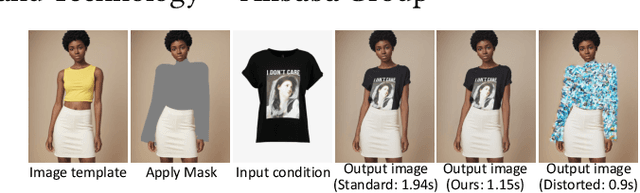


Generative image editing using diffusion models has become a prevalent application in today's AI cloud services. In production environments, image editing typically involves a mask that specifies the regions of an image template to be edited. The use of masks provides direct control over the editing process and introduces sparsity in the model inference. In this paper, we present InstGenIE, a system that efficiently serves image editing requests. The key insight behind InstGenIE is that image editing only modifies the masked regions of image templates while preserving the original content in the unmasked areas. Driven by this insight, InstGenIE judiciously skips redundant computations associated with the unmasked areas by reusing cached intermediate activations from previous inferences. To mitigate the high cache loading overhead, InstGenIE employs a bubble-free pipeline scheme that overlaps computation with cache loading. Additionally, to reduce queuing latency in online serving while improving the GPU utilization, InstGenIE proposes a novel continuous batching strategy for diffusion model serving, allowing newly arrived requests to join the running batch in just one step of denoising computation, without waiting for the entire batch to complete. As heterogeneous masks induce imbalanced loads, InstGenIE also develops a load balancing strategy that takes into account the loads of both computation and cache loading. Collectively, InstGenIE outperforms state-of-the-art diffusion serving systems for image editing, achieving up to 3x higher throughput and reducing average request latency by up to 14.7x while ensuring image quality.
SwiftDiffusion: Efficient Diffusion Model Serving with Add-on Modules
Jul 02, 2024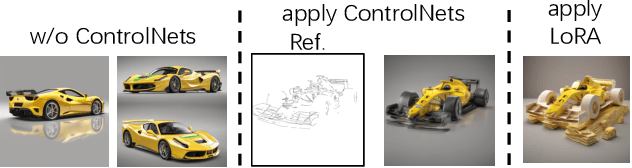
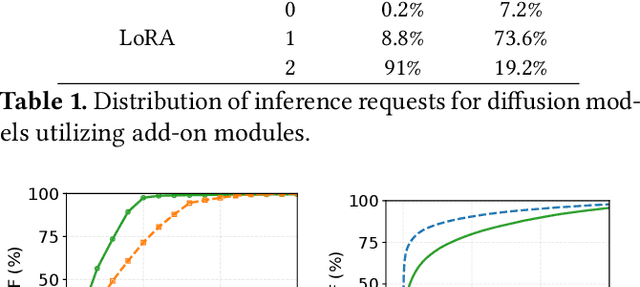
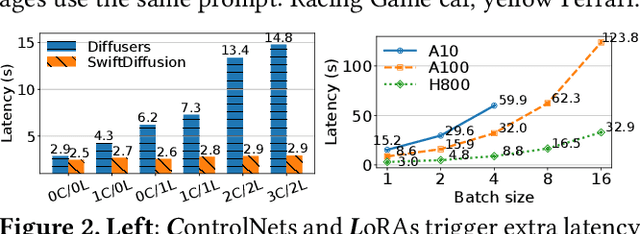

This paper documents our characterization study and practices for serving text-to-image requests with stable diffusion models in production. We first comprehensively analyze inference request traces for commercial text-to-image applications. It commences with our observation that add-on modules, i.e., ControlNets and LoRAs, that augment the base stable diffusion models, are ubiquitous in generating images for commercial applications. Despite their efficacy, these add-on modules incur high loading overhead, prolong the serving latency, and swallow up expensive GPU resources. Driven by our characterization study, we present SwiftDiffusion, a system that efficiently generates high-quality images using stable diffusion models and add-on modules. To achieve this, SwiftDiffusion reconstructs the existing text-to-image serving workflow by identifying the opportunities for parallel computation and distributing ControlNet computations across multiple GPUs. Further, SwiftDiffusion thoroughly analyzes the dynamics of image generation and develops techniques to eliminate the overhead associated with LoRA loading and patching while preserving the image quality. Last, SwiftDiffusion proposes specialized optimizations in the backbone architecture of the stable diffusion models, which are also compatible with the efficient serving of add-on modules. Compared to state-of-the-art text-to-image serving systems, SwiftDiffusion reduces serving latency by up to 5x and improves serving throughput by up to 2x without compromising image quality.